Sasya-Niyojana: Crop Planning and Rotation

Scientific Agriculture in Ancient India

The Arthashastra's crop planning system matched seeds to soil, balanced food security with revenue, and pioneered rotation principles that modern sustainable agriculture is rediscovering. Learn how Kautilya's sasya-niyojana prevented famine and preserved soil fertility.

The Dying Fields
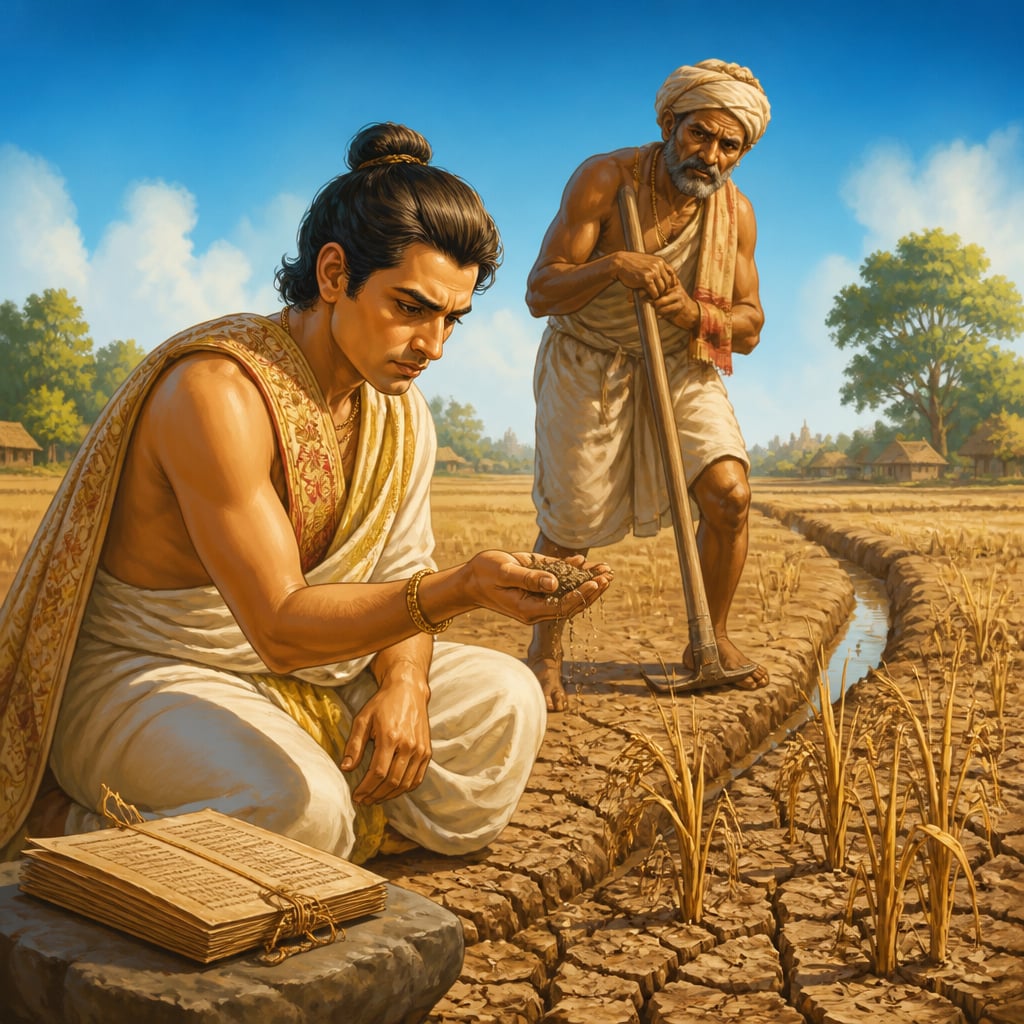
Pushyamitra diagnosing exhausted Vaishali rice fields

In the seventh year of Chandragupta's reign, the sita lands near Vaishali stopped yielding. Pushyamitra, the regional Sitadhyaksha, stood in a field that should have grown chest-high rice but instead produced stunted stalks barely reaching his knee. The soil, once dark and fragrant, had turned pale and compacted.

The farmers knew the problem: eka-sasya-pida, the exhaustion of single-crop cultivation. For six years, the treasury had demanded rice from these fields because rice fetched the highest revenue. Each harvest had taken more from the soil than monsoon floods could restore. The land was dying.

Pushyamitra consulted his copy of the Arthashastra. Kautilya had anticipated this crisis. The master's solution would transform not just Vaishali, but agricultural thinking for millennia.

The Science of Crop Planning

The Arthashastra's approach to crop selection was systematic, not arbitrary. Kautilya prescribed matching crops to land and rotating them to preserve fertility, principles that modern sustainable agriculture is only now recovering.

Matching Crops to Classification

The bhumi-vargana (land classification) from our previous lesson wasn't just for taxation, it guided crop selection:

"शालिव्रीहियवतिलमाषमुद्गकोद्रवप्रियङ्गुवरकादीनां क्षेत्रविशेषे वपनकालः"

"The times for sowing rice, barley, sesame, black gram, green gram, millet, and similar crops depend on the specific nature of the field." , Arthashastra 2.24.3

The Sitadhyaksha maintained detailed registers correlating:

The Rotation Principle

Kautilya understood what would take Europe two millennia to discover: continuous cultivation of the same crop depletes specific nutrients and invites pests. His solution was systematic rotation:

"एकक्षेत्रे वारंवारं एकमेव सस्यं न वपेत्"

"One should not sow the same crop repeatedly in the same field." , Arthashastra 2.24.8

Pushyamitra implemented the prescription: the exhausted rice fields would now grow legumes. Legumes (shimbi, including various pulses) fixed nitrogen in the soil, a biochemical fact the Mauryans observed empirically even without understanding the chemistry. After two seasons of pulses, the land would again support rice.

Seasonal Integration

The Arthashastra recognized India's agricultural calendar:

Varsha-Sasya (Monsoon/Kharif crops):

Hemanta-Vasanta-Sasya (Winter/Rabi crops):

Grishma-Sasya (Summer crops):

The Sitadhyaksha planned across all three seasons, ensuring continuous productivity without continuous exhaustion.

The Three Pillars of Sasya-Niyojana

Kautilya's crop planning balanced three objectives that remain relevant today:

1. Anna-Suraksha (Food Security)

Certain crops were non-negotiable. The state required sufficient grain production to:

Food crops took priority over cash crops in state planning.

2. Kosha-Vriddhi (Treasury Growth)

But the state also needed revenue. High-value crops like:

The art was balancing, never sacrificing food security for revenue, but maximizing revenue within food security constraints.

3. Bhumi-Poshana (Soil Nourishment)

Neither food security nor revenue mattered if the soil died. The Arthashastra prescribed:

Pushyamitra's crisis arose because revenue pressure had overridden soil nourishment. The Arthashastra's framework prevented this by making bhumi-poshana a non-negotiable constraint.

Global Perspectives on Crop Rotation

Charles Townshend at his Norfolk four-course rotation

The West celebrates the Norfolk Four-Course Rotation as a landmark agricultural innovation. Developed in 18th-century England by Charles "Turnip" Townshend and others, it transformed European agriculture:

This system ended the medieval three-field system where one-third of land lay fallow each year, dramatically increasing productivity.

But the Norfolk rotation came in the 1730s CE, more than 2,000 years after Kautilya prescribed rotation principles in the Arthashastra.

Jethro Tull (1674-1741), the British agriculturalist famous for inventing the seed drill, systematized planting but didn't emphasize rotation. George Washington Carver (1864-1943) promoted crop rotation in the American South, particularly alternating cotton with peanuts and sweet potatoes, but again, millennia after Kautilya.

Agricultural Innovation Western Pioneer Date Kautilyan Parallel Arthashastra Era
Crop rotation Townshend (Norfolk) 1730s CE Sasya-niyojana 300 BCE
Matching crops to soil Liebig 1840s CE Kshetra-vishesha 300 BCE
Legume nitrogen fixation Boussingault 1838 CE Shimbi-vapa (pulse planting) 300 BCE

The difference: India's farmers knew these principles for millennia. Colonial disruption and post-independence policy distortions obscured this heritage.

From Pushyamitra to Punjab: Modern Resonance

Punjab today faces exactly Pushyamitra's crisis, but on a vastly larger scale.

The MSP Monoculture Trap: Since the 1970s, assured procurement prices for rice and wheat created a rotation-killing incentive. Farmers rational responded: plant only what the government guarantees to buy. Result:

This is eka-sasya-pida at industrial scale, the same disease Pushyamitra diagnosed in 300 BCE.

S.K. Vasal (1938-2023), the Indian maize scientist associated with the World Food Prize, offered part of the solution. His Quality Protein Maize (QPM) provides higher nutrition than ordinary maize, enabling diversification away from rice-wheat monoculture. By 2024, QPM covers 2 million hectares in India, a Kautilyan rotation for the modern age.

Punjab farmer in a diversified millet and pulse plot

The National Mission on Oilseeds and Oil Palm (NMOOP) represents strategic sasya-niyojana at national level. India imports Rs. 1.5 lakh crore worth of edible oils annually, a vulnerability. The mission incentivizes mustard, groundnut, sunflower, and palm cultivation, diversifying away from rice-wheat dependence while addressing import dependence.

Per Drop More Crop (PMKSY) enables rotation by making water available beyond monsoon dependence. When farmers can irrigate through micro-irrigation, they can grow rabi and summer crops that rotation requires, escaping the monsoon-or-nothing constraint that pushes toward monoculture.

The 2025 Crop Plan

What would a Kautilyan Sitadhyaksha advise India today?

  1. Restructure MSP to reward diversification, not monoculture
  2. Zone-based crop planning matching cultivation to groundwater availability
  3. Mandatory rotation on lands receiving government benefits
  4. Oilseed mission scaling to reduce import vulnerability
  5. Millet revival for nutrition security and soil health

Prime Minister Modi's declaration of 2023 as the International Year of Millets aligns with Kautilyan thinking, millets (kodrava, shyamaka) were staples in the Arthashastra's crop plan, suited to India's diverse agro-climatic zones.

Your Turn: Rotating Your Resources

Sasya-niyojana offers wisdom beyond agriculture. Consider:

Are you monocropping your time? Continuous focus on one activity, work, study, exercise, without rotation leads to exhaustion. Just as soil needs varied crops, your mind and body need varied activities.

What's your "pulse crop"? Legumes restored soil fertility. What activities restore you? Identify your restorative practices and schedule them as deliberately as a farmer plans pulse seasons.

Are incentives creating monoculture? Punjab's crisis came from MSP structure, not farmer ignorance. Where in your life are incentive structures pushing you toward unsustainable single-focus that will eventually exhaust you?

In our next lesson, we'll explore Setu-Nirmana, the irrigation infrastructure that made the Arthashastra's agricultural vision possible.

Sustainable resource extraction, the idea that long-term productivity requires periodic restoration rather than continuous exploitation.

The Norfolk rotation (1730s) is celebrated as revolutionary, but Kautilya prescribed rotation 2,000 years earlier. Herman Daly's 'steady-state economics' (1970s) argues the same point for modern resource use.

The Arthashastra integrated rotation with land classification and state planning. It wasn't just advice, it was policy, enforced through the Sitadhyaksha's administration.

Punjab's rice-wheat monoculture has depleted groundwater by 0.5m/year. Diversification could reduce water use by 35% while improving soil health.

Synergistic production, outputs that generate positive externalities, improving conditions for future production.

Jean-Baptiste Boussingault (1838) first demonstrated nitrogen fixation scientifically. But Indian farmers had been using legumes for soil restoration for over 2,000 years before scientific explanation.

Key terms

Sasya-Niyojana
Crop planning, the systematic selection and scheduling of crops based on land classification, season, market demand, and soil restoration needs.
Eka-Sasya-Pida
The exhaustion or distress caused by single-crop cultivation, monoculture's damage to soil, water, and long-term productivity.
Shimbi
Legumes or pulses, the family of crops whose roots fix atmospheric nitrogen into the soil, restoring fertility for subsequent cultivation.
Rituchakra
The seasonal cycle, the six-season calendar that governed agricultural activities, determining planting and harvesting times for each crop type.

Verses

शालिव्रीहियवतिलमाषमुद्गकोद्रवप्रियङ्गुवरकादीनां क्षेत्रविशेषे वपनकालः

śālivrīhiyavatilmāṣamudgakodravapriyanṅguvarakādīnāṁ kṣetraviśeṣe vapanakālaḥ

Rice, barley, sesame, and pulse, each finds its field and season just.

Optimal resource allocation requires matching inputs to conditions. A field suited for millet but forced to grow rice wastes water and yields poorly, an inefficiency Kautilya sought to eliminate.

Arthashastra, Book 2, Chapter 24, Verse 3 (R.P. Kangle critical edition)

एकक्षेत्रे वारंवारं एकमेव सस्यं न वपेत्

ekakṣetre vāraṁvāraṁ ekameva sasyaṁ na vapet

The same seed in the same soil, year after year, makes the earth recoil.

Monoculture creates short-term efficiency but long-term disaster. Kautilya understood that sustainable yield requires rotation, a principle modern industrial agriculture often ignores at great cost.

Arthashastra, Book 2, Chapter 24, Verse 8 (Patrick Olivelle (2013))

शिम्बीनां वापनेन भूमिः पुष्यति

śimbīnāṁ vāpanena bhūmiḥ puṣyati

Plant the pulse, feed the soil, from legume roots, fertility uncoils.

Legumes are dual-purpose crops: they provide food while restoring soil fertility. This is agricultural synergy, the insight behind crop rotation systems worldwide.

Arthashastra, Book 2, Chapter 24, Verse 12 (L.N. Rangarajan)

Key figures

The Mauryan Crop Planner

Agricultural planners within the Sitadhyaksha's office responsible for crop selection, rotation scheduling, and seasonal coordination

S.K. Vasal

Indian maize scientist, World Food Prize laureate (2000), developer of Quality Protein Maize (QPM)

Charles 'Turnip' Townshend

British politician and agricultural reformer who popularized the Norfolk four-course rotation in 18th-century England

Case studies

Punjab's Monoculture Crisis: Eka-Sasya-Pida at Industrial Scale

Punjab, India's breadbasket, faces an agricultural crisis that Kautilya diagnosed 2,300 years ago, eka-sasya-pida, the exhaustion of single-crop cultivation. The story began with good intentions. After the 1960s famines, the Green Revolution prioritized rice and wheat for food security. Punjab's farmers responded brilliantly, the state now produces 20% of India's wheat and 12% of its rice on just 1.5% of the country's land. The Minimum Support Price (MSP) system guaranteed procurement, making rice-wheat cultivation economically rational for individual farmers. But what made sense for each farmer destroyed the commons. The results by 2024: - **Groundwater**: 79% of wells overexploited, water tables dropping 0.5m annually - **Soil**: Organic carbon dropped from 0.8% (1970) to 0.3% (2024) - **Pollution**: 32 million tonnes of rice stubble burned annually, choking North India - **Health**: Cancer rates elevated due to pesticide accumulation - **Economics**: Input costs rising faster than MSP, squeezing margins

This is the precise crisis the Arthashastra was designed to prevent. Kautilya prescribed: 1. **Mandatory rotation**: 'One should not sow the same crop repeatedly' 2. **Matching crops to water**: Deva-matrka classification for rain-fed, not irrigated rice 3. **Legume restoration**: 'The land flourishes through the sowing of legumes' 4. **State planning**: Sitadhyaksha ensuring long-term sustainability, not just immediate revenue The MSP structure, paying only for rice and wheat, violated Kautilyan principles by incentivizing monoculture. This wasn't farmer failure; it was policy failure. The state created conditions that made eka-sasya-pida inevitable. The government's 2024 Natural Farming push and millet promotion represent a return to Kautilyan thinking, but implementation requires restructuring the incentives that caused the crisis.

Solutions are emerging, though slowly: **Diversification incentives**: Punjab announced Rs. 2,500/acre for farmers shifting from rice to maize, cotton, or pulses (2024) **Direct Seeded Rice**: Reduces water use by 20-25%, gaining adoption **Stubble management**: Happy Seeder machines allow wheat sowing without burning **Millet revival**: Area under millets up 30% from 2022-24 base But fundamental change requires restructuring MSP to reward rotation, essentially implementing the Sitadhyaksha's planning function at state level. Ashok Gulati's research shows that states without MSP-driven monoculture (like Maharashtra) have more sustainable cropping patterns.

Incentive structures shape behavior. Punjab's farmers aren't ignorant of rotation, they're responding rationally to MSP signals. The solution isn't education; it's restructuring incentives to align with Kautilyan sustainability principles. Policy must make sustainable farming the economically rational choice.

Punjab's groundwater crisis is now reaching emergency levels, with the Central Ground Water Authority reporting that 80% of blocks are over-exploited. The solution requires restructuring MSP incentives to make diversification economically rational. Without changing the price signals, no amount of awareness campaigns will shift farmer behavior.

If Punjab adopted diversified cropping, groundwater extraction would drop by 35%, potentially reversing decades of depletion within a generation.

National Mission on Oilseeds: Strategic Sasya-Niyojana for Self-Reliance

India imports Rs. 1.5 lakh crore worth of edible oils annually, more than any other commodity except crude oil and gold. This dependency represents both an economic vulnerability and a failure of national crop planning. The National Mission on Oilseeds and Oil Palm (NMOOP), restructured under the National Food Security Mission, aims to change this through strategic sasya-niyojana: **Mustard expansion**: Target 16 million tonnes by 2027 (from 10 MT in 2022) **Groundnut diversification**: Expanding in Gujarat, Andhra Pradesh, Tamil Nadu **Oil palm**: Ambitious 10 lakh hectare expansion in Northeast and Andaman **Sunflower revival**: Targeting Karnataka and Tamil Nadu **Soybean intensification**: Madhya Pradesh and Maharashtra focus Complementing this, the PM-KISAN scheme's Rs. 6,000 annual transfer enables farmers to take risks on new crops, while Per Drop More Crop (PMKSY) provides the micro-irrigation that oilseed cultivation often requires.

NMOOP represents national-level sasya-niyojana in the Kautilyan tradition: **Matching crops to land**: Oil palm in high-rainfall Northeast rather than water-stressed plains **Reducing single-commodity dependence**: Just as the Sitadhyaksha balanced rice with other crops, NMOOP balances wheat-rice with oilseeds **Strategic planning**: The Arthashastra coordinated cultivation across the empire for food security; NMOOP coordinates for energy/import security **Supporting cultivators first**: MSP for oilseeds, seed distribution, assured procurement, support before extraction The Mission on Edible Oils-Oil Palm (MEOOOP, 2021) added Rs. 11,000 crore investment for oil palm specifically, recognizing that strategic crops require strategic support.

By December 2024: **Mustard**: Record production of 12.3 MT in 2023-24, up from 8.5 MT in 2019-20 **Oil palm**: 1.5 lakh hectares planted under new mission (target 10 lakh by 2030) **Import dependency**: Edible oil imports reduced from 15 MT to 13.5 MT despite consumption increase **Self-sufficiency trajectory**: Target 70% self-sufficiency by 2030 (from 40% in 2020) Challenges remain, oil palm takes 4 years to fruit, groundnut faces weather volatility, farmer adoption varies. But the Kautilyan framework is in place: identify strategic need, plan crop allocation, support farmers, measure and adjust.

Strategic crop planning isn't just about individual farm productivity, it's about national economic security. Kautilya's Sitadhyaksha planned for the empire's needs; modern India must plan for import reduction and supply chain resilience. NMOOP shows that sasya-niyojana remains relevant at scale.

India's edible oil import bill remains one of its largest trade vulnerabilities, second only to crude oil. The NMOOP target of 50% self-sufficiency by 2030 would save Rs. 75,000 crore annually in import costs, directly strengthening the national treasury that Kautilya placed at the center of state power.

Every 1 MT increase in domestic oilseed production saves Rs. 10,000 crore in imports, making strategic crop planning directly wealth-creating for the nation.

Historical context

Mauryan Empire, 4th-3rd century BCE

The Mauryan period saw India's first empire-wide agricultural planning. The Sitadhyaksha coordinated cultivation across the Gangetic plain, the Deccan, and newly acquired territories. Megasthenes reported that Indian agriculture was remarkably productive, a result of the systematic planning the Arthashastra prescribed.

No contemporary civilization had comparable crop planning systems. Rome would later develop large estates (latifundia) but without systematic rotation. Chinese agriculture was advanced but lacked the integrated land-classification-to-crop-selection system of the Arthashastra. The Norfolk rotation wouldn't emerge for another 2,000 years.

The Mauryan Empire at its peak cultivated an estimated 8-10 million hectares, more than any contemporary polity and sufficient to support populations that wouldn't be matched until the medieval period.

India's current agricultural challenges, monoculture, soil degradation, water depletion, stem from abandoning Kautilyan principles. The solutions proposed today (crop diversification, rotation, legume integration) are essentially returns to sasya-niyojana. We're recovering what was lost.

Living traditions

India's agricultural planning apparatus, from central government's crop targets to state-level advisory systems to district agricultural officers, represents an institutionalized form of sasya-niyojana. The National Food Security Mission coordinates cultivation of rice, wheat, and pulses across states, echoing the Sitadhyaksha's empire-wide planning role.

Reflection

More in Sita: Agriculture and Land Revenue

All lessons in Sita: Agriculture and Land Revenue · Arthashastra: Economic Principles course