Relevance in 2026 and Beyond
Why 2,300-Year-Old Agricultural Policy Matters for Climate-Era Food Security
How Kautilya's integrated agricultural system, from land classification to grain reserves, offers a comprehensive framework for modern India's food security challenges.
The Food Security Paradox
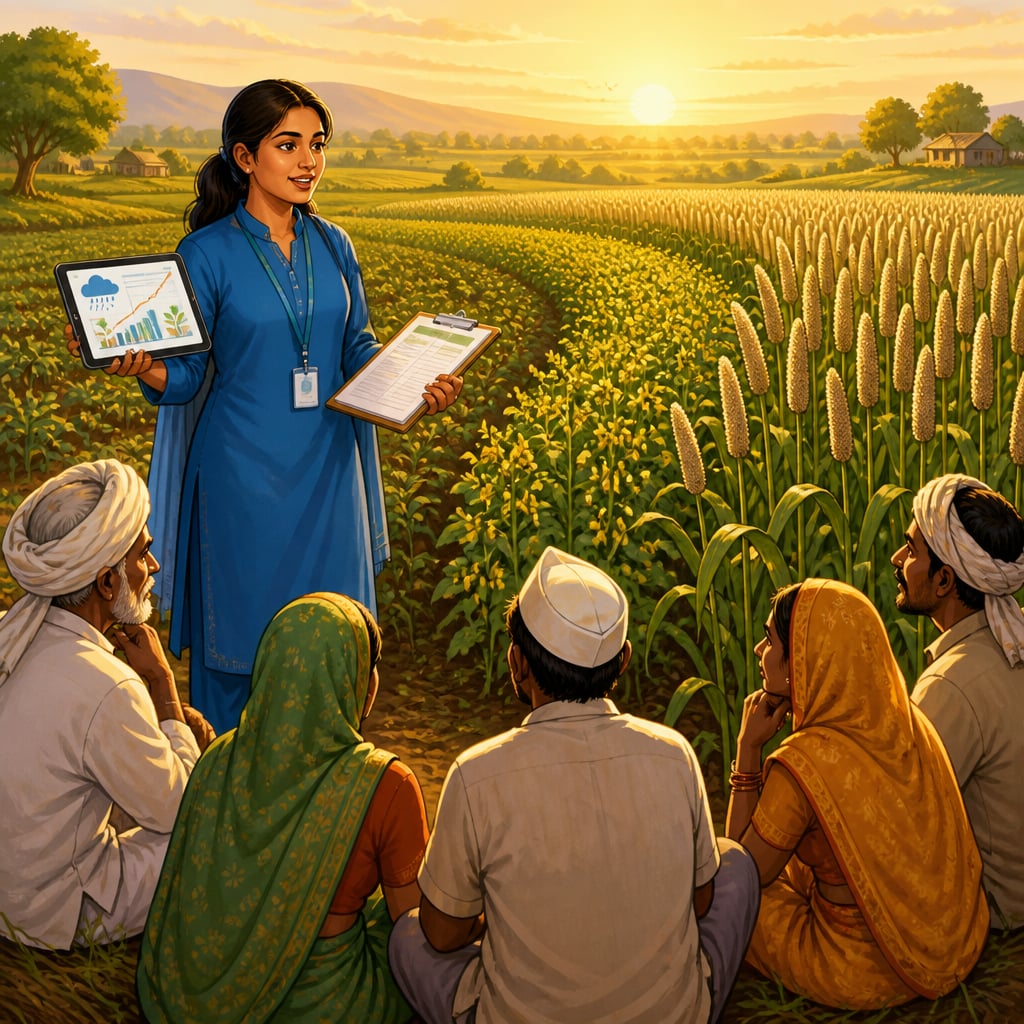
India produces more food grains than ever in its history, over 330 million tonnes annually. Yet in 2023, the Global Hunger Index ranked India 111th out of 125 countries. Warehouses overflow while malnutrition persists. Climate change threatens the very productivity gains that Green Revolution technologies delivered. And across the agricultural belt, farmer suicides continue at rates that shock the conscience.
This paradox, abundance coexisting with vulnerability, would not have surprised Kautilya. Twenty-three centuries ago, he understood that agricultural success is never simply about production volumes. It requires an integrated system: trained administrators, classified lands, planned crops, reliable water, quality seeds, and strategic reserves working in concert.
The question facing India in 2026 is not whether ancient wisdom has relevance. It's whether we can afford to ignore it.
The Modern Challenge: Fragmented Abundance
India's agricultural challenges in 2024-2026 reveal systemic fragmentation rather than capability gaps. Consider the evidence:
Production without protection: India exported record wheat in 2021-22, then imposed export bans in May 2022 when domestic prices spiked and heatwaves damaged crops. The absence of strategic planning left policymakers reactive rather than proactive.
Technology without integration: The PM-KISAN portal, e-NAM digital mandis, Soil Health Cards, and crop insurance schemes each function well independently. But farmers must navigate multiple portals, disconnected databases, and competing bureaucracies, exactly the administrative fragmentation Kautilya warned against.
Water without coordination: The Ken-Betwa river interlinking project, finally approved in 2021 after decades of dispute, illustrates how water governance remains fractured across states. Meanwhile, groundwater depletion in Punjab and Haryana threatens the very breadbasket of India.
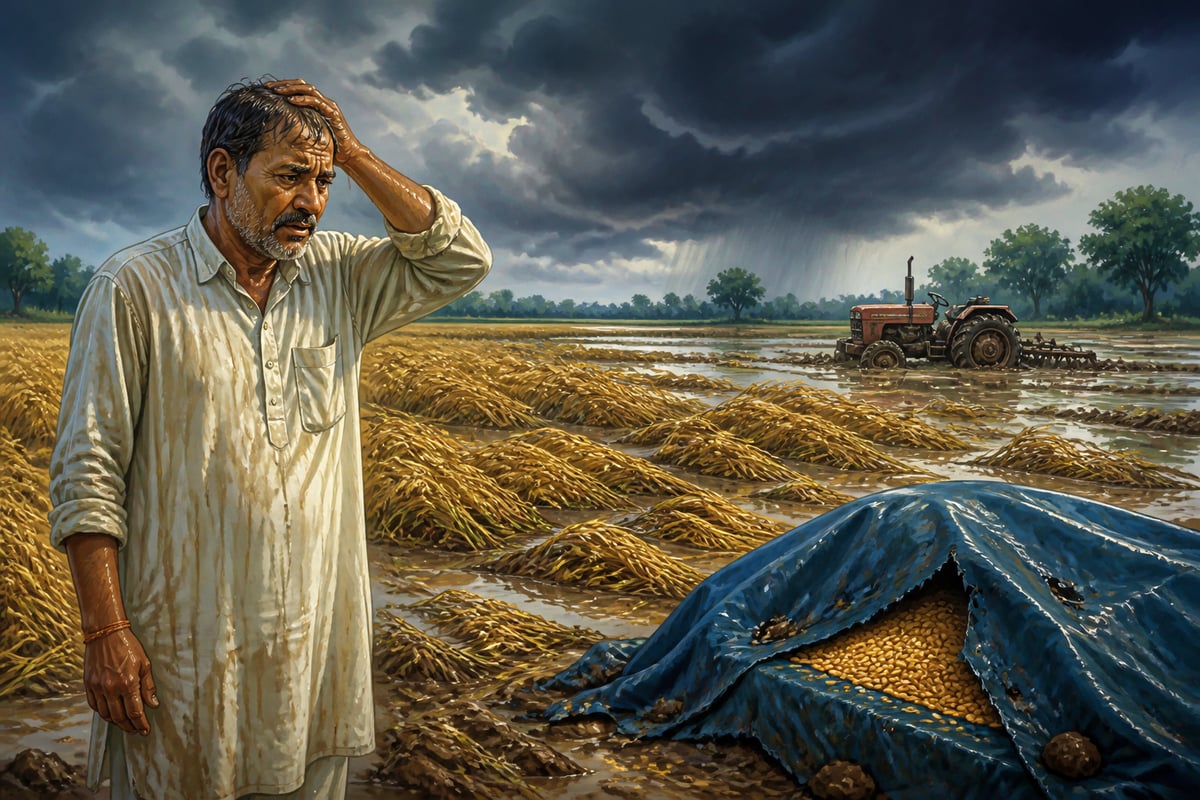
Climate without preparation: Unseasonal rains destroyed standing crops in 2023. Flash droughts affected rice production. Yet crop planning remains dominated by MSP incentives for wheat and rice rather than climate-resilient diversification.
The challenge isn't individual program failures, many work remarkably well. It's the absence of the integrated approach (samanvaya) that transforms separate initiatives into systemic resilience.
The Ancient Insight: Systematic Agriculture
Kautilya's Krishi-Niti chapters present not isolated recommendations but an interconnected system. The six lessons of this chapter reveal the architecture:
The Sitadhyaksha establishes unified administrative authority, one trained superintendent who understands agriculture scientifically and coordinates all functions. No competing fiefdoms, no gaps in accountability.
Bhumi-Vargana ensures decisions flow from data: land classified by soil type, water availability, and productive capacity. The modern equivalent, DILRMP, PM-SVAMITVA, Soil Health Cards, exists but remains fragmented across ministries.
Sasya-Niyojana demonstrates that crop selection is too important for market forces alone. Strategic planning balances productivity, soil health, and food security needs. The contrast with India's MSP-driven monoculture crisis is stark.
Setu-Nirmana treats water infrastructure as the foundation of agricultural prosperity. Kautilya's detailed irrigation classifications anticipated debates we're still having about groundwater, tank restoration, and river management.
Bija-Vitarana recognizes that farmers require state support, quality seeds, credit access, and protection from catastrophic loss. The welfare state isn't a modern invention; it's ancient dharmic governance.
Dhanya-Sangraha reveals the keystone: strategic grain reserves that stabilize prices, prevent famines, and provide the margin of safety every agricultural system requires.
The insight isn't any single policy. It's the integration, each element designed to reinforce the others under unified, expert oversight.
The Bridge: From Ancient Framework to Modern Application
Agricultural Policy and Systems Thinking
The Arthashastra's approach anticipates what management theorists now call 'systems thinking', understanding that optimizing individual components can degrade overall performance. India's Green Revolution achieved spectacular production gains but degraded soil health, depleted aquifers, and created stubble-burning crises that now choke Delhi's air.
Kautilya's integrated model suggests a different metric: resilient productivity over time, not maximum output in any single year. NITI Aayog's Agriculture 4.0 vision and the National Mission on Natural Farming implicitly embrace this systems approach. The question is implementation coordination.
Climate Adaptation and Ancient Wisdom
Kautilya's crop rotation principles (sasya-niyojana) weren't driven by climate change concerns but by identical logic: sustaining soil fertility across years, not depleting it for short-term gains. His emphasis on water storage (setu-nirmana) anticipated exactly the challenge facing water-stressed regions today.

Andhra Pradesh's Zero-Budget Natural Farming program, now scaled to over 700,000 farmers, operationalizes similar principles: diverse crops, minimal external inputs, water conservation. The parallels aren't coincidental, sustainable agriculture in any era shares common foundations.
Food Security and Strategic Reserves
The COVID-19 pandemic validated Kautilya's grain reserve doctrine dramatically. India's ability to distribute free foodgrains to 800 million people under PM Garib Kalyan Anna Yojana depended entirely on buffer stocks the Shanta Kumar Committee had once recommended reducing. The trivarsika (three-year reserve) principle proved its worth in unprecedented crisis.
For climate-era food security, this lesson extends beyond famine response. Strategic reserves enable policy flexibility, the capacity to weather bad harvests without panic, to moderate price volatility without distorting markets, to project food sovereignty internationally.
Administrative Reform and Expert Governance
The Sitadhyaksha model challenges contemporary assumptions about bureaucratic generalism. Kautilya insisted on superintendents with deep agricultural knowledge, not rotating administrators who learn on the job. India's agricultural universities produce exactly such expertise, but career civil servants, not agricultural scientists, typically lead policy.
This isn't an argument against IAS officers, who provide valuable coordination capabilities. It's recognition that complex technical domains require integrated expertise throughout the hierarchy, not just in advisory roles.
Addressing Skepticism
'Ancient texts can't address modern problems like climate change or global markets.'
This objection mistakes specificity for relevance. Kautilya didn't anticipate climate change, but his principles, diversified cropping, strategic reserves, water conservation, expert administration, address climate adaptation directly. The framework adapts; the underlying logic remains sound.
'Modern agriculture is too complex for ancient frameworks.'
Actually, modern agriculture suffers from insufficient integration, not excessive complexity. Digital tools make Kautilyan coordination more achievable than ever. The Agri-Stack initiative, if implemented as envisioned, would create exactly the unified data infrastructure the Sitadhyaksha would have envied.
'This is nostalgic nationalism, not practical policy.'
Practical policy should learn from whatever works. If Norman Borlaug's Green Revolution techniques were appropriate to adopt from the West, Kautilya's administrative principles are equally appropriate to recover from India's own tradition. The test is effectiveness, not origin.
The honest limitation: Kautilya wrote for a command economy under monarchical authority. Market integration, democratic governance, and federal structures require adaptation. The principles translate; the specific mechanisms often don't. This is a framework for thinking, not a policy manual.
Call to Practice
Kautilya's agricultural wisdom offers three actionable orientations for citizens engaging with India's food security future:
Think systemically: When evaluating agricultural policies, ask how they connect to related systems. Does a crop insurance scheme integrate with soil health data? Does MSP reform account for water availability? Fragmented solutions create fragmented results.
Demand expert governance: Support initiatives that put agricultural scientists and trained specialists in leadership roles, not just advisory positions. Technical domains require technical expertise.
Value reserves over efficiency: Whether in personal food storage or policy preferences, recognize that resilience requires surplus. The most efficient system, one with no slack, is also the most fragile.
The Arthashastra's agricultural chapters aren't museum pieces. They're design patterns for food sovereignty in an uncertain era. The choice isn't whether to build integrated agricultural systems, climate change will force that regardless. The choice is whether to learn from accumulated wisdom or rediscover these principles through costly trial and error.