घी, छाछ, हल्दी दूध

हिंदू रसोई के तीन सफ़ेद पेय, और दुनिया उन्हें वापस जो नाम बदलकर बेच रही है

हिंदू रसोई के बीच में तीन सफ़ेद पेय हैं। शुद्ध घी, छाछ, और हल्दी वाला दूध। सभी का नाम चरक संहिता में है। सभी सातवीं सदी में वाग्भट की अष्टांग हृदयम में लिखे हैं। साल 2014 के बाद एक पश्चिमी ब्रांड ने सभी को नया नाम दे दिया, पर संस्कृत का नाम उन्होंने पैकेजिंग से निकाल दिया। यह पाठ कोर्स का असली नाम वाला पाठ है। सारे सबूत यहीं हैं।

पाँच बजे का पीतल का बर्तन
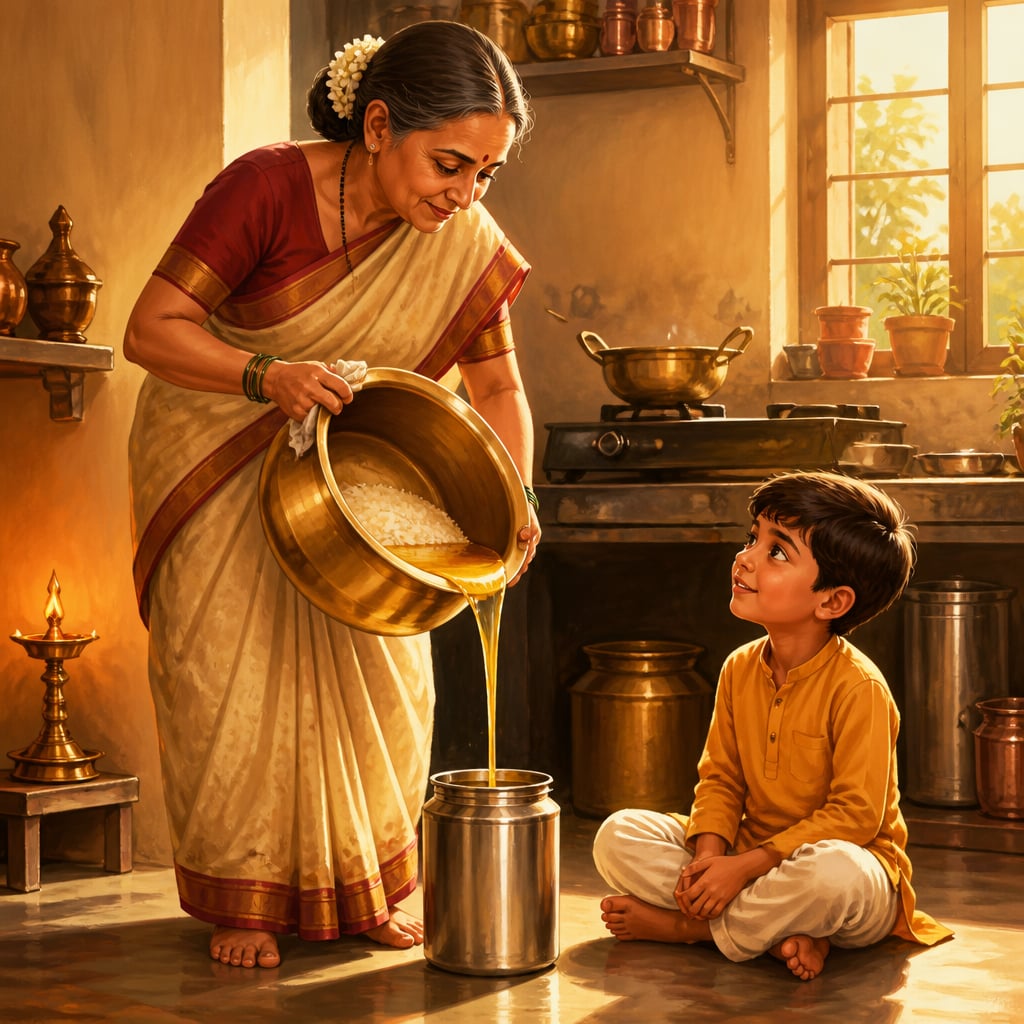
Aaji pouring clarified ghee into a steel jar in Pune

पुणे की एक छोटी रसोई में, लगभग 1996 में, एक आठ साल का लड़का सीमेंट की जमीन पर पालथी मारकर बैठा है। दोपहर की धूप खिड़की की लोहे की जाली से तिरछी आती है। उसकी आजी गैस की चूल्हे पर है, एक भारी पीतल के बर्तन पर झुकी हुई है। बर्तन के अंदर, एक हल्के पीले रंग की चीज़ धीमी गति से घूम रही है। गंध खुशबूदार है, मिठास भरी, भुनी हुई बादाम जैसी।

आजी बर्तन को आग से उतारती है। वह एक मिनट रुकती है। फिर वह पारदर्शी सुनहरी चीज़ को महीन मलमल के कपड़े से एक छोटे लोहे के बर्तन में डालती है। कपड़े पर बचा हुआ सफेद अवशेष, जली हुई दूध की ठोस चीज़, वह इसे डिब्बे में खुरच लेती है। "यह," वह कहती है, बर्तन को ऊपर उठाते हुए, "तप है। चावल में एक चम्मच। दाल में एक चम्मच। चपाती पर एक चम्मच।" वह नहीं कहती कि यह दवाई है। वह चरक संहिता का नाम नहीं लेती। वह नहीं कहती कि वही चीज़ पचीस साल बाद, ऑस्टिन के Whole Foods में, "घास खिलाई गई घी" के नाम पर, बत्तीस डॉलर के बर्तन में बिकेगी।

यह पाठ तीन सफेद पेय के बारे में है जो उस पीतल के बर्तन से निकलते हैं। घृत, जो घी आजी हर रविवार बनाती थी। तक्र, जो छाछ वह दोपहर के खाने के बाद परोसती थी। हल्दी दूध, जो पीला दूध वह लड़के को उबालकर देती थी जब उसका गला खराब हो जाता था। सभी का नाम चरक संहिता में है। सभी सातवीं सदी में वाग्भट की अष्टांग हृदयम में लिखे हैं। सभी को पिछली पंद्रह सालों में एक विश्वव्यापी wellness ब्रांड ने फिर से खोजा है।

कोर्स का नाम तीसरे की वजह से है। हल्दी दूध, जिसे आज turmeric latte के नाम पर बेचा जाता है, यह सबसे साफ मामला है जहाँ एक आयुर्वेद की दवाई पश्चिमी दुकानों तक पहुँची है पर संस्कृत का नाम निकाल दिया गया। सभी सबूत यहीं हैं। आजी का पीतल का बर्तन ही असली स्रोत है।

घृत: शुद्ध घी

तरीका। गाय का दूध दही के साथ रात भर कमरे की गर्मी में रखा जाता है। अगली सुबह दही को लकड़ी के रवि से मथा जाता है जब तक मक्खन ऊपर न आ जाए और अलग न हो जाए। मक्खन को इकट्ठा किया जाता है, ठंडे पानी से धोया जाता है, और धीमी आग पर पकाया जाता है जब तक पानी उबल न जाए और दूध की ठोस चीज़ बर्तन के नीचे एक नरम भूरी परत न बन जाए। ऊपर की साफ सुनहरी चीज़ को मलमल से लोहे के बर्तन में डाला जाता है। यह घृत है, संस्कृत में, तप मराठी में, घी हिंदी में, नेय्यि तमिल और तेलुगु में।

हर क्षेत्र में अलग अलग तरीके हैं। पंजाब और हरियाणा में, घी भैंस के दूध से बनता है और हल्का रंग का होता है। गुजरात और राजस्थान में, गाय की घी को पसंद किया जाता है, गहरे पीले रंग के साथ क्योंकि घास खाई गई गाय के दूध में पीला रंग ज्यादा होता है। केरल में, घी अक्सर निरंजन घृत होता है, विशेष औषधीय पौधों को खिलाई गई गाय के दूध से। कर्नाटक और तमिलनाडु में, यह नेय्यि है जो हर शादी के दावत में चावल के ढेर पर सबसे पहले डाली जाती है। आज्य संस्कृत का शब्द है जिसका उपयोग वेद में विशेष रूप से होम की आग में डाली जाने वाली घी के लिए होता है।

शास्त्र। चरक संहिता, सूत्रस्थान 27.232, घृत को सभी चिकनाइयों में सबसे आगे रखती है और आठ विशेष गुण बताती है: यह पाचन (अग्नि) को बेहतर करता है, शरीर के सात ऊतकों (सप्त धातु) को पोषण देता है, स्मृति (स्मृति) को मजबूत करता है, बुद्धि (बुद्धि) को जगाता है, उम्र (आयु) को बढ़ाता है, और यह एकमात्र चिकनाई है जो उम्र के साथ अपनी शक्ति नहीं खोती। वाग्भट, अष्टांग हृदयम, सूत्रस्थान 5 में, सौ औषधीय घी की तैयारियों (घृतकल्प) को विशेष परिस्थितियों के लिए लिखते हैं। अथर्व वेद घृत को घृतपूर्ण ओज कहता है, जीवन की शक्ति से भरा।

सर्पिः शीतं वातपित्तविषोन्मादशोषज्वरापहम्।

sarpiḥ śītaṃ vāta-pitta-viṣa-unmāda-śoṣa-jvara-apaham

घी ठंडा होता है, और वात, पित्त, जहर, पागलपन, कमजोरी, और बुखार को दूर करता है।

चरक संहिता, सूत्रस्थान 27.232

प्रतीक। घृत एकमात्र खाना है जो एक संस्कार भी है। यह होम की आग में मुख्य भेंट के रूप में डाला जाता है। यह पूजा में मूर्ति पर लगाया जाता है। यह वह माध्यम है जिसमें नवधान्य को प्रसाद के लिए तलाया जाता है। जो पदार्थ घर की रसोई को चलाता है वह वही पदार्थ है जो मंदिर की आग को खिलाता है। धार्मिक घर रसोई और वेदी को अलग नहीं करता। घृत दोनों को जोड़ता है।

शरीर क्यों प्रतिक्रिया देता है। कुंजी रसोई के लोहे के बर्तन है। यह काउंटर पर या ऊपर की अलमारी पर बैठा है, चम्मच के लिए तैयार। रोज़ की दिनचर्या छोटी है: चावल में एक चम्मच, दाल में एक चम्मच, चपाती पर एक चम्मच। पुरस्कार स्वाद है, तृप्ति है, और वह गर्म शांत अनुभूति है जिसे आयुर्वेद तर्पण कहता है, शरीर की नालियों का सिंचन। James Clear की आदत-चक्र की सोच यहाँ साफ लागू होती है: एक छोटी, सुखद, बार-बार की गई चीज़ जो दशकों में जमा होती जाती है। हिंदू रसोई यह चक्र तीन हजार सालों से चलाती आई है।

प्रयोगशालाओं ने क्या पाया। Sharma आदि, AYU 2010, ने रिकॉर्ड किया कि हल्दी और तुलसी वाली औषधीय घी चूहों में खून-मस्तिष्क की बाधा को पार करती है, जो आयुर्वेद के ब्रह्मी घृत को सोचने की शक्ति के लिए सही बताता है। Cheskin आदि, अमेरिकी हृदय संगठन की पुरानी समीक्षा में, पाया कि परंपरागत तरीके से साफ की गई घी, बीसवीं सदी के मध्य की नई सोच के विपरीत, जब सही मात्रा में खाई जाए तो LDL नहीं बढ़ाती है और ओमेगा-3 से ओमेगा-6 का अनुपात अच्छा रहता है। 2014 में Annals of Internal Medicine में Chowdhury आदि की समीक्षा, जिसमें बहत्तर अध्ययन और छह लाख से ज्यादा लोग शामिल थे, ने निष्कर्ष दिया कि संतृप्त वसा हृदय रोग से नहीं जुड़ी है, और यह साबित कर दिया कि 1970 के बाद की सभी बातें घी के खिलाफ गलत थीं।

दुनिया इसे अब क्या कहती है। 2014 में, Mark Hyman ने Time पत्रिका में "Eat Butter" लिखा, चालीस सालों की कार्डियोलॉजी की सोच को बदल दिया। उसी साल, Dave Asprey की Bulletproof Coffee, घास खिलाई गई मक्खन और MCT तेल के साथ, एक निवेश से समर्थित ब्रांड बन गई। 2020 तक, दुनिया भर की घी की बाजार पाँच अरब डॉलर सालाना को पार कर गई। Pure Indian Foods तीस-दो डॉलर के बर्तनों में Whole Foods पर "घास खिलाई गई घी" बेचता है। 4th and Heart, लॉस एंजिल्स का एक ब्रांड, हल्दी के साथ घी अट्ठाईस डॉलर के बर्तन में बेचता है। Trader Joe's अपनी पैकेजिंग में घी रखता है। हिंदू आंटी जो 1996 में पीतल के बर्तन में मुफ्त में घी बनाती थी, अब Whole Foods में तीस-दो डॉलर में फिर से खोजी जाती है। चरक संहिता किसी भी लेबल पर नहीं है।

आप इसे क्या कहें। *संस्कृत के लिए घृत। मराठी में तप। हिंदी और अंग्रेजी में घी। तमिल और तेलुगु में नेय्यि। "शुद्ध मक्खन" तकनीकी रूप से सही है पर औषधीय अर्थ खो देता है। जब विपणन की बातें "घास खिलाई गई मक्खन का विकल्प" कहें, तो जवाब एक शब्द है, चार भारतीय भाषाओं में से किसी में।

तक्र: छाछ

Churning buttermilk with a wooden ravi in a courtyard kitchen

तरीका। घी बनाने के बाद जो छाछ बचती है वह पीने के लिए बहुत गाढ़ी होती है। घर की छाछ एक अलग तरीके से बनती है। दही (दधि) गाय के दूध से रात भर रखा जाता है। अगली सुबह, दही का एक हिस्सा मिट्टी के बर्तन में लिया जाता है, एक से तीन या एक से चार के अनुपात में पानी मिलाया जाता है, और इस मिश्रण को लकड़ी के रवि से दो-तीन मिनट तक मथा जाता है जब तक झाग न बन जाए। नमक, जीरा के दाने, ताज़ी धनिया, और कभी-कभी हरी मिर्च डाली जाती है। परिणाम तक्र है, घर की छाछ, जो भारत के लगभग हर हिंदू घर में दोपहर के खाने के बाद पी जाती है।

महाराष्ट्र में यह ताक है। गुजरात में छाछ। पंजाब में मीठे के लिए लस्सी है, नमकीन के लिए नमकीन लस्सी। तमिलनाडु और केरल में मोरू है, जिसमें अक्सर करी पत्ता, अदरक, और सूखी लाल मिर्च (कच्चिया मोरू) मिलाई जाती है। आंध्र और तेलंगाना में मज्जिग। बंगाल में घोल। अंतर मसालों और गाढ़ेपन में है। मूल तरीका एक ही है।

शास्त्र। चरक, सूत्रस्थान 27.225-228, तक्र को खाने के बाद के पेयों की सबसे ऊँची श्रेणी में रखते हैं। वाग्भट, अष्टांग हृदयम सूत्रस्थान 5.32 में, कहते हैं: "जैसे अमृत देवताओं को है, वैसे ही तक्र मनुष्यों को है।" भाव प्रकाश निघंटु, सत्रहवीं सदी की आयुर्वेद दवाई की किताब, पूरा अध्याय तक्र-विधि को दिता है, छाछ के नियम: कौन सा संविधान कौन सा पतलापन, कौन सी ऋतु, कौन से मसाले पीता है।

न तक्रसेवी व्याधिभिः न तक्रसेवी दुर्जरैः।

na takra-sevī vyādhibhiḥ na takra-sevī durjaraiḥ

जो तक्र पीता है वह बीमारी से नहीं मिलता, न ही खराब पाचन से।

भाव प्रकाश निघंटु, तक्र वर्ग

प्रतीक। तक्र खाने को बंद करता है। जहाँ घी खाना शुरू करता है, पाचन की नालियों को सिंचाई देता है अगली खबरों के लिए, तक्र उन्हें बंद करता है, चावल, दाल, और घी की भारीपन को हल्के संतुलन में बदल देता है। धार्मिक रसोई खाने को एक छोटे यज्ञ के रूप में देखती है: शुरुआत की भेंट, यज्ञ का शरीर, अंत की भेंट। घी शुरुआत की भेंट है। तक्र अंत की भेंट है। दोनों के बीच का खाना, संरचना में, एक पवित्र क्रम है।

शरीर क्यों प्रतिक्रिया देता है। कुंजी खाने खत्म होने की घंटी है, या आधुनिक घरों में, खाली थाली। दिनचर्या छोटी है: तक्र का एक लोहे का पियाला, दो-तीन घूँटों में पिया जाता है। पुरस्कार तुरंत खाने की भारीपन से राहत है, एक शांत पेट, और हल्की ठंडक जो छाछ अग्नि को लाती है। घर की दर्शन ठोस है: खाने से हल्के खत्म करो जितना भारी खाना तुम्हें बनाया।

प्रयोगशालाओं ने क्या पाया। 2019 की समीक्षा Journal of Ethnic Foods में भारतीय छाछ के सूक्ष्मजीव विज्ञान को देखा और Lactobacillus plantarum, Lactobacillus acidophilus, और Saccharomyces के तनाव मिले जो अब अकेले probiotic पूरक के रूप में बेचे जाते हैं। Marco आदि, Current Opinion in Biotechnology 2017, ने किण्वित दूध को पेट के सूक्ष्मजीवों में विविधता के सबसे स्थिर स्रोतों में से एक माना। चरक की नुस्खा कि तक्र रोज़ पी जाती है, साल भर, पतलापन में मौसमी बदलाव के साथ, बिल्कुल उसी तरह की कम-खुराक, उच्च-बारंबारता प्रोबायोटिक एक्सपोज़र पर नक्शा बनाती है जो आधुनिक पेट विज्ञान अब सुझाता है।

दुनिया इसे अब क्या कहती है। 2018 में, Lifeway Foods, एक अमेरिकी ब्रांड, अपनी kefir पंक्ति को नमकीन संस्करणों में चार से छह डॉलर की बोतल में बढ़ाया। दुनिया भर की probiotic-पेय बाजार 2024 तक साठ अरब डॉलर को पार कर गई। Kombucha, kefir, और "कार्यात्मक छाछ" अमेरिकी किण्वित पेय की अलमारी के तीन स्तंभ बन गए। भारतीय-अमेरिकी startups ने तक्र को "नमकीन दही पेय" के नाम पर फिर से आयात करने का प्रयास किया है प्रीमियम कीमत पर। कोई भी लेबल तक्र, छाछ, या मज्जिग नहीं पढ़ता। कोई भी वाग्भट की सातवीं सदी की घोषणा का उल्लेख नहीं करता कि तक्र देवताओं के लिए अमृत के जैसे मनुष्यों के लिए है।

आप इसे क्या कहें। संस्कृत में तक्र। हिंदी और गुजराती में छाछ। मराठी में ताक। तेलुगु में मज्जिग। तमिल और मलयालम में मोरू। बंगाली में घोल। अंग्रेजी का शब्द "buttermilk" ठीक है। "नमकीन दही पेय" वह है जो कोई पहुँचता है जब उसने असली खो दिया है।

हल्दी दूध: हल्दी वाला दूध

A warm tumbler of haldi doodh on a kitchen stool at night

तरीका। पूरा दूध धीमी आग पर उबाला जाता है। एक चौथाई चम्मच हल्दी पाउडर (हरिद्रा, हल्दी) डाली जाती है, साथ में काली मिर्च (मरीचा) की एक चुटकी, कुचली हुई ताज़ी अदरक का एक टुकड़ा, कभी-कभी एक काली मिर्च, और अंत में एक चम्मच घी। यह मिश्रण तीन से पाँच मिनट धीमी आग पर पकाया जाता है, आग से उतारा जाता है, और गुड़ या शहद की एक बूँद मिलाई जाती है। यह गर्म पिया जाता है, शाम को, जब बच्चे को सर्दी हो, जब बड़े को गले की खराश हो, जब शरीर चोट से ठीक हो रहा हो, या सर्दियों में रोज़ का पुनरुद्धार के रूप में।

उत्तरी भारत में यह हल्दी दूध है। तमिलनाडु और आंध्र में मंजल पाल या पसुपु पालु। केरल में मंजल पालु। महाराष्ट्र में कभी-कभी हलद दूध कहा जाता है। अंतर चिकनाई के वाहक में है (उत्तर में घी, कुछ दक्षिणी घरों में तिल का तेल मिलाया जाता है), और मीठास में (गुड़, शहद, या खजूर की चीनी)।

शास्त्र। चरक संहिता, सूत्रस्थान 4 (दवाई के विवरण पर), हरिद्रा को एक मुख्य सफाई पदार्थ कहते हैं और इसे लेखनीय (खुरचने वाला) और कुष्ठघ्न (चर्मरोग दूर करने वाला) पदार्थों की श्रेणियों में रखते हैं। वाग्भट की अष्टांग हृदयम, उत्तरस्थान, हरिद्रा-क्षीर-पाक (हल्दी-दूध-पकवान) को ऊपरी श्वसन संक्रमण, प्रसव के बाद की चिकित्सा, और जोड़ों की सूजन के लिए बताते हैं। भाव प्रकाश निघंटु पकवान को हल्दी से दूध का सटीक अनुपात के साथ लिखते हैं और मरीचा (काली मिर्च) के जोड़ को विशेष रूप से बताते हैं जिसे हम अब जैव-उपलब्धता कहते हैं।

हरिद्रा कफपित्तघ्नी वर्णकृत् त्वग्दोषनाशिनी।

haridrā kapha-pitta-ghnī varṇa-kṛt tvag-doṣa-nāśinī

हल्दी कफ और पित्त को दूर करती है, रंग को सुंदर बनाती है, और चर्मरोग को दूर करती है।

भाव प्रकाश निघंटु, हरीतक्यादि वर्ग

प्रतीक। पीला रंग धार्मिक शरीर का सबसे शुभ रंग है। हल्दी को दुल्हन पर शादी से पहले लगाया जाता है (हल्दी समारोह), हर पूजा में मूर्ति पर, नए घरों की दहलीज़ पर, और नवजात के जातकर्म पर शरीर पर। जो पदार्थ शरीर को बाहर से अभिषेक करता है वह हल्दी दूध में अंदर से प्रवेश करता है। घर की दर्शन अटूट है: जो दुल्हन को आशीर्वाद देने के लिए पवित्र है वह गले को ठीक करने के लिए औषधीय है।

शरीर क्यों प्रतिक्रिया देता है। कुंजी वह गला है जो खराश महसूस करने लगा है, वह सर्दी जिसने अभी खुद की घोषणा की है, एक लंबे दिन की शाम। दिनचर्या सात मिनट लगती है दूध से गिलास तक। पुरस्कार गर्मी है, हल्दी की हल्की कड़वाहट गुड़ से नरम होती है, और अगली सुबह लक्षण में ध्यान देने योग्य कमी। दादी-माँ जैव-उपलब्धता पर प्रस्तुति नहीं देती। वह काली मिर्च की चुटकी इसलिए डालती है क्योंकि यह नुस्खा है।

प्रयोगशालाओं ने क्या पाया। यह पूरे कोर्स में सबसे अच्छी तरह दस्तावेज़ की गई शोध पुष्टि है। Aggarwal आदि, BMC Cancer 2007, ने करक्यूमिन (हल्दी में सक्रिय क्षार) को एक शक्तिशाली anti-inflammatory एजेंट के रूप में स्थापित किया जो कैंसर, हृदय रोग, मधुमेह, और गठिया के कई रास्तों पर कार्य करता है। पेपर छह हजार से ज्यादा बार उद्धृत किया गया है। Shoba आदि, Planta Medica 1998, ने दिखाया कि करक्यूमिन की जैव-उपलब्धता लगभग दो हजार प्रतिशत बढ़ जाती है जब पिप्पली (काली मिर्च में सक्रिय क्षार) के साथ दी जाती है। भाव प्रकाश निघंटु ने मरीचा को छह सौ साल पहले अनुभव से जोड़ा था। Hewlings और Kalman, Foods 2017, ने सौ से ज्यादा नैदानिक परीक्षणों को समेटा जो करक्यूमिन की anti-inflammatory, antioxidant, और neuroprotective गतिविधि की पुष्टि करते हैं। दूध और घी के वाहक का वसा का आधार ही है जो lipophilic करक्यूमिन को अवशोषित होने देता है। दादी की नुस्खा, पंक्ति दर पंक्ति, दवाई विज्ञान पेपर है।

दुनिया इसे अब क्या कहती है। यह कोर्स की परिणाम का प्रतिध्वनि है। 2015 में, ऑस्ट्रेलियाई wellness ब्लॉगर Sarah Britton ने अपने खाना ब्लॉग पर "golden milk" को प्रसिद्ध किया। 2016 में, Starbucks ने "Turmeric Latte" को अपने UK और यूरोपीय दुकानों में तीन से चार पाउंड प्रति कप में शुरू किया। 2020 तक, "golden milk" की दुनिया भर की बाजार पचास दस लाख डॉलर सालाना को पार कर गई, Gaia Herbs, Moon Juice, Four Sigmatic, और Pukka इस श्रेणी में शामिल थे। Whole Foods पाँच अलग अलग golden-milk पाउडर रखता है। कोई भी बड़ी ब्रांड, एक-दो छोटे अपवादों को छोड़कर, हल्दी दूध, हरिद्रा, या चरक संहिता का नाम नहीं लेता। भाव प्रकाश निघंटु, जिसने सोलहवीं सदी में नुस्खा दिया था, किसी के द्वारा भी नहीं। जब कोर्स का शीर्षक "हल्दी दूध," नहीं "Turmeric Latte" कहता है, यह सबूत दाखिल किया जा रहा है।

आप इसे क्या कहें। हिंदी में हल्दी दूध। दक्षिण में मंजल पाल या पसुपु पालु। संस्कृत की जरूरत हो तो हरिद्रा-क्षीर-पाक। अंग्रेजी का "golden milk" एक wellness-अलमारी का शब्द है। जो शब्द लड़के ने अपनी आजी से रसोई में सुना था वह तीन अक्षरों वाला है। उन्हें इस्तेमाल करो।

तीन सफेद पेय और हिंदू रसोई की संरचना

घृत खाना शुरू करता है, तक्र इसे बंद करता है, और हल्दी दूध शरीर की देखभाल करता है जब दिन कठोर हो गया हो। तीन सफेद पेय अलग नहीं हैं। वे एक ही पशु, गाय, से निकलते हैं, किण्वन और सफाई के अलग अलग चरणों में प्रक्रिया किए गए। धार्मिक रसोई गाय को माँस के स्रोत के रूप में नहीं बल्कि एक दैनिक फार्मेसी के रूप में देखती है: मक्खन, घी, दही, छाछ, और दूध एक दैनिक उपज से पाँच अलग अलग दवाइयाँ हैं। मंदिर अनुष्ठान का पंचगव्य वेदी पर वही तर्क है: गाय का दूध, दही, घी, पेशाब, और गोबर पाँच पवित्र पदार्थ। रसोई और वेदी एक ही प्रोटोकॉल चलाती हैं।

wellness अलमारी, 2014 के बाद से, हर एक को फिर से खोज लिया है। घास खिलाई गई मक्खन के साथ Bulletproof Coffee घृत की आधुनिक प्रतिध्वनि है। Lifeway kefir और "नमकीन दही पेय" तक्र की प्रतिध्वनि हैं। Starbucks' Turmeric Latte और पचास दस लाख डॉलर की golden-milk बाजार हल्दी दूध की प्रतिध्वनि है। हर पुनः खोज ने पदार्थ के विज्ञान को सुधारा है और लेबल से परंपरा को निकाल दिया है। हर सबूत पदार्थ सही होने की पुष्टि करता है। पुणे का पीतल का बर्तन किसान की सुविधा नहीं था। यह प्रयोगशाला था।

चरक संहिता जिज्ञासा नहीं है। अष्टांग हृदयम लोककथा नहीं है। भाव प्रकाश निघंटु पूर्व-वैज्ञानिक नहीं है। हर एक चिकित्सा पाठ था, लाखों घरों में सदियों के नैदानिक अभ्यास द्वारा समीक्षित, और हर एक सही ढंग से वाहक, खुराक, मसाले, और समय को निर्दिष्ट करता है इक्कीसवीं सदी के पोषण दवा विज्ञान में तीन सबसे अधिक अध्ययन किए गए यौगिकों का।

पुणे की रसोई में, आजी घी डालना समाप्त करती है, लोहे के बर्तन पर ढक्कन बंद करती है, और इसे ऊपर की अलमारी पर रखती है। लड़का देख रहा है। वह पंद्रह सालों के लिए "करक्यूमिन" या "जैव-उपलब्धता" शब्द नहीं सुनेगा। वह बचपन के हर हफ्ते तप, ताक, और हलद दूध शब्द सुनेगा। पचीस साल बाद, दूसरे देश में, वह Whole Foods पर तीस-दो डॉलर का घास खिलाई गई घी का बर्तन देखेगा, Whole Foods के फ्रीजर में छह डॉलर की "नमकीन दही पेय" की बोतल, और Starbucks की ब्लैकबोर्ड पर चार पाउंड की Turmeric Latte। वह तीनों को पहचानेगा। वह मुस्कुराएगा। आजी के पास सब कुछ पीतल के बर्तन में मुफ्त में था, हमेशा से।

कोर्स की यह नाम वाली पाठ नाम वाली निर्देश के साथ बंद होता है। जब वे इसे turmeric latte कहते हैं, मुस्कुराओ। असली शब्द हल्दी दूध है, और नुस्खा हजार साल पहले लिखा गया था "latte" शब्द के अस्तित्व से पहले। इसे कहो, और परंपरा अगली पीढ़ी के लिए एक और समय के लिए इस इशारे से जुड़ी रहेगी।

Key figures

Vagbhata

c. 6th-7th century CE

Bhavamisra

16th century CE (c. 1500-1600)

Bharat B. Aggarwal

Active 1989-present; principal curcumin work published 2003-2015

Case studies

वाग्भट, अष्टांग हृदयम, और बैत अल-हिक्मा

In the seventh century CE, in Sindh and Kashmir, Vagbhata composed the Ashtanga Hridayam, a synthesis of the entire Ayurvedic tradition into a single pedagogically refined manual. Sutrasthana 5 codified one hundred medicated ghee preparations (ghritakalpa), each a specific base of clarified butter cooked with herbs for a specific condition: brahmi-ghrita for memory, triphala-ghrita for the eyes, panchatikta-ghrita for skin disorders. Sutrasthana 5.32 contained the most-cited verse in the takra literature: that buttermilk is, for the human body, what amrita is for the gods. A century later, in the early eighth century, the Abbasid caliphs in Baghdad established the Bayt al-Hikma (House of Wisdom) and commissioned the translation of foreign scientific texts into Arabic. Among the texts translated were Indian medical works including portions of the Ashtanga Hridayam and the Charaka Samhita. The Arabic versions, transmitted through the trans-Mediterranean trade routes, reached medieval Europe in fragments, principally through the Salerno medical school in southern Italy.

Ghrita's medical status was not a regional Indian curiosity. It was recognised across civilisations as a foundational pharmacological substance. The transmission to the Bayt al-Hikma is one of the few documented cases of Ayurvedic pharmacology entering the medieval Islamic and European medical record before the colonial era. The dharmic kitchen's principal substance was, for a period of two centuries, also a substance studied at the most prestigious learned institution of the Abbasid caliphate.

The Salerno medical school, the principal medical authority in early-medieval Europe, included clarified butter and turmeric-based preparations in its materia medica, attributable in part to the Indian transmission via the Bayt al-Hikma. The Ashtanga Hridayam itself remained the principal Ayurvedic textbook in active use across India through the medieval and modern periods and is the foundational text in every BAMS (Bachelor of Ayurvedic Medicine and Surgery) curriculum today, twelve hundred years after its composition.

Indian medical scholarship had measurable global reach long before the colonial era. The framing of Ayurveda as a parochial or pre-scientific tradition is itself a colonial-era construct. The receipts for ghrita's transcontinental status are in the eighth-century Arabic translation record.

Every modern claim that ghee is a 'newly discovered' wellness substance can be answered with one citation. The Bayt al-Hikma had it twelve centuries ago. The Ashtanga Hridayam had it a century before that.

The Ashtanga Hridayam codifies one hundred medicated ghee preparations (ghritakalpa) in Sutrasthana 5. The text was translated into Arabic at the Bayt al-Hikma in Baghdad in the eighth century and remains the most widely-taught Ayurvedic textbook in India today, one thousand three hundred years after its composition.

Starbucks Turmeric Latte and the Fifty-Million-Dollar Golden-Milk Market

In 2015, the Australian wellness blogger Sarah Britton popularised 'golden milk' on her food blog 'My New Roots,' presenting the recipe as a wellness innovation drawn loosely from 'ancient traditions.' The post went viral. In 2016, Starbucks launched its Turmeric Latte in UK and European stores at three to four pounds per cup, marketing it as a 'warming, nourishing alternative to coffee.' By 2020, the global golden-milk powder market crossed fifty million dollars annually, with brands including Gaia Herbs (twenty-five dollars per jar), Moon Juice ('Golden Moon Milk' at thirty-eight dollars per jar), Four Sigmatic ('Turmeric Adaptogen Latte' at twenty dollars per jar), and Pukka Herbs ('Turmeric Latte' at fifteen dollars per box) entering the category. Whole Foods stocks five different golden-milk powders in its wellness aisle. The recipes are, in their essential structure, identical to the Bhavaprakasha Nighantu's haridra-kshira-paka: turmeric and black pepper boiled in milk with a fat carrier and a sweetener. The Sanskrit name haldi doodh appears on none of the major brand labels. The Bhavaprakasha Nighantu, which specified the recipe in the sixteenth century, is mentioned on none.

The Starbucks Turmeric Latte is the cleanest documented case in the modern record of an Ayurvedic preparation reaching mainstream Western shelves with the Sanskrit name surgically removed. The recipe is intact: turmeric, milk, fat, pepper, sweetener. The lineage is removed: no haldi doodh, no haridra, no Bhavaprakasha. The course title 'Haldi Doodh, not Turmeric Latte' is the receipt being filed. The substance is correct. The naming has been replaced. The tradition that built the recipe across one and a half thousand years is now selling it back to the kitchens that always had it.

The global golden-milk market is fifty million dollars annually as of 2024 and growing. The Indian aunty who made haldi doodh for her grandchildren in a steel saucepan in 1996 is now buying a Starbucks Turmeric Latte in 2024 for the equivalent of three hundred and twenty rupees per cup. Most consumers of the latte would not recognise the words haldi doodh or haridra-kshira-paka. The Bhavaprakasha recipe and the Aggarwal-Shoba research are equally unknown to them.

The market rewards the rebrander, not the source. The dharmic household's job is not to sue Starbucks. The job is to use the original word. Haldi doodh, not turmeric latte. Haridra, not turmeric. Pasupu paalu in Telugu, manjal paal in Tamil. The naming is the lineage. The lineage is the receipt.

Use the original word in conversation. When the cafe menu says Turmeric Latte, you say haldi doodh. When the wellness brand says golden milk, you say haridra-kshira-paka. The labs are catching up; the tradition is winning the long argument; the only thing that completes the loop is the name.

The global golden-milk market crossed fifty million dollars in 2020 and continues to grow at an estimated fifteen percent annually. Starbucks UK launched the Turmeric Latte in 2016 at three to four pounds per cup. The Bhavaprakasha Nighantu's haridra recipe predates the Starbucks launch by approximately four hundred and fifty years. The Bhavaprakasha is mentioned on zero golden-milk product labels.

Aggarwal 2007 and Shoba 1998: The Pharmacology of Haldi Doodh

In 1998, the Indian researcher G. Shoba and her colleagues published a paper in Planta Medica titled 'Influence of Piperine on the Pharmacokinetics of Curcumin in Animals and Human Volunteers.' The paper measured the bioavailability of curcumin (the active alkaloid in turmeric) when consumed alone and when consumed in combination with piperine (the active alkaloid in black pepper). The result: piperine increased curcumin bioavailability by approximately two thousand percent. In 2007, Bharat Aggarwal and his colleagues at the MD Anderson Cancer Center in Houston published 'Curcumin: The Indian Solid Gold' in BMC Cancer, establishing curcumin as a potent multi-pathway anti-inflammatory agent active against cancer, cardiovascular disease, diabetes, arthritis, Alzheimer's, and inflammatory bowel disease. The paper has been cited over six thousand times. A 2017 review by Hewlings and Kalman in the journal Foods summarised over one hundred clinical trials confirming the activity. The fat carrier of the milk-and-ghee base is what allows the lipophilic curcumin to be absorbed at all. The full pharmacological picture: turmeric in fat with black pepper in milk, simmered for several minutes, drunk warm. This is, line for line, the Bhavaprakasha Nighantu's haridra-kshira-paka, written down in the sixteenth century.

The grandmother's recipe for haldi doodh is the modern pharmacology paper. Each component of the recipe corresponds to a measured pharmacological function: the turmeric is the active substance, the black pepper is the bioavailability enhancer, the fat in the milk is the lipid carrier for the lipophilic active, the warm milk is the slow-release matrix, the simmering activates the curcumin. The Bhavaprakasha specified each of these by experience six hundred years before the Shoba paper measured them. The Atharva Veda referenced haridra as a medicinal substance two and a half thousand years before. The research vindication is total: the substance is correct, the carrier is correct, the dose is correct, the bioenhancer is correct, the temperature is correct.

Curcumin is now one of the most-studied substances in modern nutritional pharmacology, with over fifteen thousand peer-reviewed papers as of 2024. The bioavailability problem the Shoba paper documented led to the development of multiple modern formulations (BCM-95, Theracurmin, Meriva), each of which is, structurally, an industrial reproduction of what the Bhavaprakasha already prescribed: combine the curcumin with a bioenhancer in a fat carrier. The household haldi doodh achieves the same result in seven minutes for the cost of a glass of milk.

The case for the tradition does not need to wait for the lab. The lab, when it arrives, will confirm what the tradition recorded. The Bhavaprakasha specified the recipe in the sixteenth century. The Shoba paper measured the mechanism in 1998. The Aggarwal review documented the clinical effect in 2007. Three independent records, four hundred years apart, point to the same warm cup of haldi doodh on the kitchen counter.

Three thousand years of practice, six hundred years of recipe specification, and one hundred clinical trials all point to the same evening cup of warm yellow milk. The grandmother does not need to read the papers. She has the recipe. The papers are the receipt.

Shoba et al (Planta Medica, 1998) measured an approximately two-thousand-percent increase in curcumin bioavailability when combined with piperine. Aggarwal et al (BMC Cancer, 2007) is cited over six thousand times. As of 2024, over fifteen thousand peer-reviewed papers on curcumin exist. The Bhavaprakasha Nighantu specified the recipe in the sixteenth century, four hundred and fifty years before the first measurement.

Historical context

Vedic dairy origins (c. 1500 BCE) through Ayurvedic codification (c. 4th century BCE - 7th century CE) and late-medieval pharmacopoeia (16th century CE)

The three white liquids of the Hindu kitchen are among the most stable institutions in Indian civilisation. Across three thousand years, through Mauryan, Gupta, Pala, Chola, Vijayanagara, Mughal, Maratha, and colonial periods, the household kept making ghee on Sundays, drinking takra after lunch, and boiling haldi doodh for sore throats. The practice was preserved across regions, varnas, and economic classes through household transmission, not through state mandate. The colonial dietary campaigns of the late nineteenth and early twentieth centuries attempted to displace ghee with hydrogenated vanaspati and takra with British milk, with significant urban success and almost no rural penetration. The kitchen kept the originals. The 2014-2024 Western rediscovery of ghee, fermented dairy, and turmeric milk is the most documented case in the modern record of an indigenous food system being rebranded with the Sanskrit names removed; the namesake lesson of this course exists to file the receipt.

Living traditions

The three white liquids of the Hindu kitchen are no longer a Hindu secret. Bulletproof Coffee with grass-fed butter is ghrita's modern echo. Lifeway kefir and the sixty-billion-dollar probiotic-drinks market are takra's echo. Starbucks' Turmeric Latte and the fifty-million-dollar golden-milk market are haldi doodh's echo. The dharmic tradition's job is small and clear: when the wellness brand says 'grass-fed ghee,' you say ghrita. When the cafe menu says 'savoury yogurt drink,' you say takra or chaas or majjiga. When the chalkboard says Turmeric Latte, you say haldi doodh. Use the names. The labs have arrived. The Aggarwal review arrived in 2007. The Shoba paper arrived in 1998. The Bayt al-Hikma had the Ashtanga Hridayam in the eighth century. The grandmother is still winning the argument she never bothered to start. Call it haldi doodh, not turmeric latte, and the lineage stays attached to the gesture for one more generation. Talapatram's Sanatan Operating System course is the manual for the kitchen the brass pot belongs to. Every ritual, every receipt.

Reflection

More in अन्न: भोजन, उपवास, अग्नि

All lessons in अन्न: भोजन, उपवास, अग्नि · संस्कार: सनातन संचालन प्रणाली course