Varna-Sahayoga: Inter-Occupational Economic Cooperation
The Symphony of Village Specializations
Discover how different occupational groups, farmers, priests, artisans, and laborers, created an interdependent economic ecosystem where each specialty was essential and no occupation could survive without the others.
The Day the Potter Died
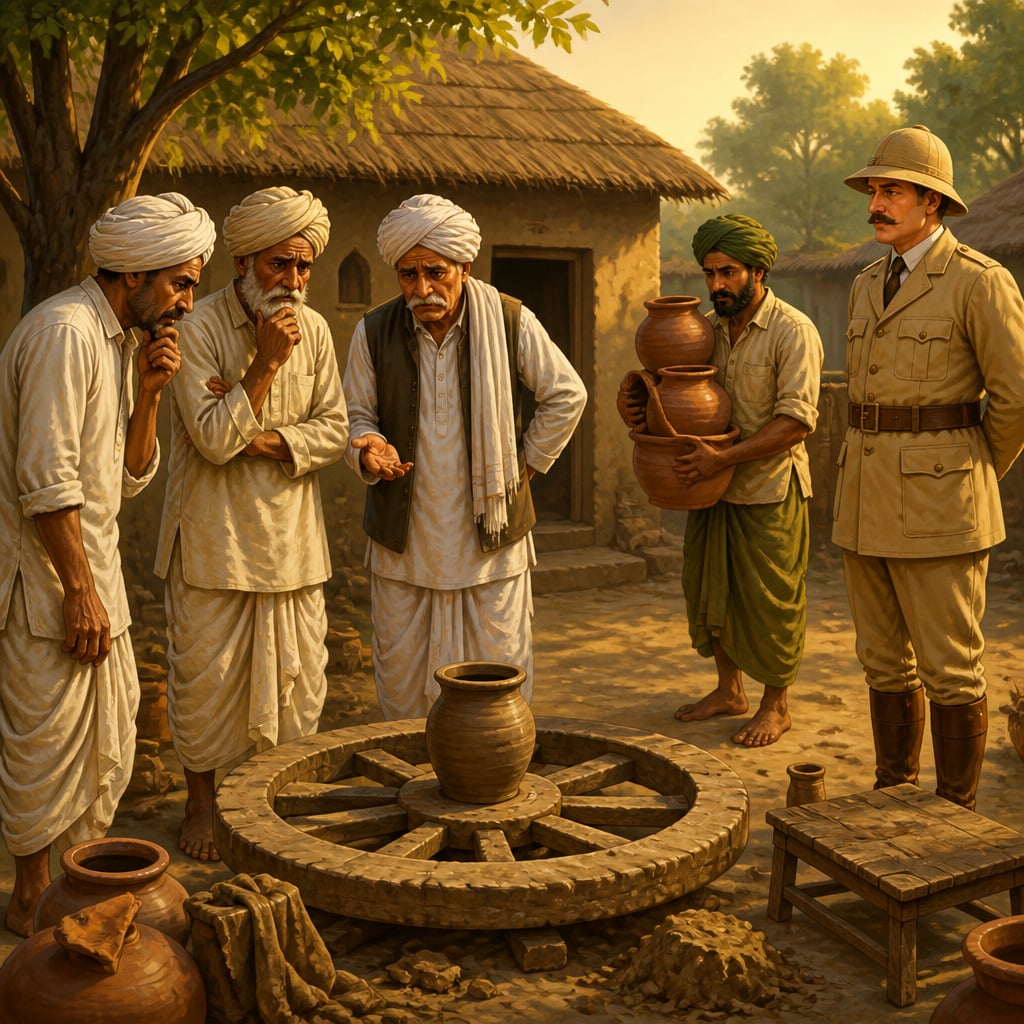
In 1905, a colonial officer named Malcolm Darling recorded an unusual event from a Punjab village. The village's only potter, Mangal Das, had died without sons. For three weeks, the village faced crisis. Not because they couldn't buy pots, nearby towns had potters aplenty. But because Mangal Das's death had torn a hole in the village's economic fabric.
Who would make the ceremonial vessels for the upcoming wedding? Who would provide the cooling gharas (water pots) for summer? The town potter wouldn't accept grain payment; he wanted cash. He wouldn't attend ceremonies; he had no ritual relationship with the village. When a potter from another village was finally adopted into Mangal Das's household, the village collectively sighed with relief. The system was whole again.
This wasn't sentimentality. It was economic logic.
The Architecture of Interdependence
The Indian village was not a collection of independent producers who happened to live near each other. It was an integrated economic organism where each occupational group was essential to all others. The Sanskrit term varna-sahayoga, inter-occupational cooperation, captures this reality.
The Bhagavad Gita articulates the principle:
"स्वे स्वे कर्मण्यभिरतः संसिद्धिं लभते नरः" "Sve sve karmany abhiratah samsiddhim labhate narah" "Each person, devoted to their own work, attains perfection."
But the verse continues: perfection comes not from isolation but from how each person's work contributes to the whole. The farmer achieves perfection by feeding the village; the potter by providing vessels; the priest by maintaining spiritual order. None can perfect their own work without the others doing theirs.
The Web of Dependencies
Consider the interconnections in a typical village. To grow wheat, the farmer needed:
- From the blacksmith (lohar): Ploughs, sickles, hoes, all metal tools
- From the carpenter (badhai): Plough handles, cart wheels, yokes
- From the potter (kumhar): Storage pots, cooking vessels, water containers
- From the leather-worker (chamar): Harnesses, bucket skins for wells, leather straps
- From the priest (pandit): Auspicious timing for sowing, ritual blessings for harvest
- From the barber (nai): Messages carried, ceremonial services, information network
- From the washerman (dhobi): Clean clothes for market days and ceremonies
In turn, each of these service providers depended on the farmer for grain. The blacksmith couldn't eat iron; the potter couldn't eat clay. The web was genuinely mutual.
Global Perspectives on Specialization and Interdependence
Western economists have extensively studied how specialization creates productivity. Their insights illuminate what Indian villages achieved, often through different mechanisms.
Alfred Marshall (1842-1924), the Cambridge economist, observed 'industrial districts' in Victorian England where specialized producers clustered geographically. In Principles of Economics (1890), he noted that knowledge 'is in the air', specialists learn from proximity to other specialists. Indian villages were natural industrial districts, with each occupation's expertise reinforcing others.
Michael Porter (1947-present), the Harvard strategist, developed 'cluster theory' showing that geographic concentration of related industries creates competitive advantage. His studies of Silicon Valley, Italian leather districts, and Bollywood echo what Indian villages achieved: complete ecosystems where complementary specialists generate more value together than apart.
Ronald Coase (1910-2013), Nobel laureate, asked in The Nature of the Firm (1937): why do firms exist at all? His answer: to reduce 'transaction costs' of market exchange. The village jajmani system reduced transaction costs even more radically, predetermined relationships eliminated negotiation entirely.
| Thinker | Key Insight | Indian Village Parallel |
|---|---|---|
| Alfred Marshall | Industrial districts create knowledge spillovers | Village occupations learned from each other through proximity |
| Michael Porter | Geographic clusters create competitive advantage | Complete villages were self-reinforcing productivity clusters |
| Ronald Coase | Firms exist to reduce transaction costs | Jajmani eliminated transaction costs through hereditary relationships |
Indian village specialization worked differently from Western markets. The blacksmith didn't sell tools to the highest bidder; he made tools for his jajman families. The potter didn't display wares for comparison shopping; her pots went to the families her family had always served. This created efficiency through relationship depth, not market competition.
The Balancing System
How did the village ensure that every essential occupation was filled? Through a remarkable self-balancing mechanism:
Demographic Balance: If a potter had many sons, the surplus might relocate to villages lacking potters. If a blacksmith died without heirs, the village collectively sought a replacement, sometimes adopting an outsider into the occupational community.
Economic Incentives: Occupations with too few practitioners became more lucrative (more families to serve, more grain income). Occupations with surplus saw income per family decline. Over generations, population adjusted to maintain balance.
Social Pressure: A village without a blacksmith was economically crippled. The community had strong incentive to ensure occupational completeness, including supporting kamin families during difficulties to prevent their departure.
The Twelve Essential Services
Ethnographic studies identified a core set of occupations present in most villages. While the exact composition varied by region, a typical North Indian village had:
- Farmers (kisan/jat) - Food production
- Brahmin priests (pandit) - Ritual and ceremonial services
- Blacksmiths (lohar) - Metal tools and repairs
- Carpenters (badhai) - Wood products and construction
- Potters (kumhar) - Ceramic vessels and storage
- Leather-workers (chamar) - Leather goods and dead animal disposal
- Barbers (nai) - Grooming and message-carrying
- Washermen (dhobi) - Laundry services
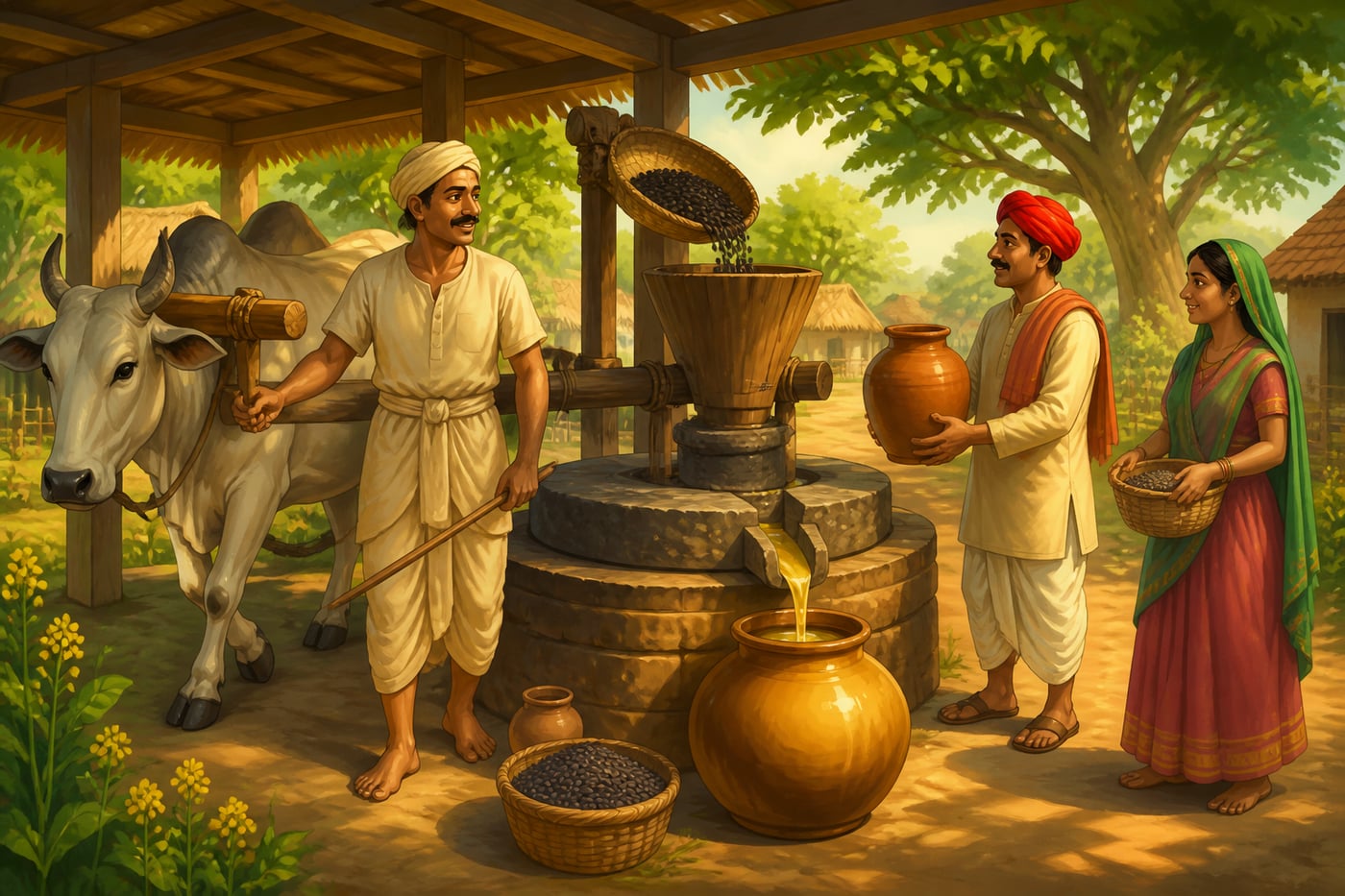
- Oil-pressers (teli) - Cooking oil production
- Weavers (julaha/koli) - Cloth production
- Sweepers (mehtar/bhangi) - Sanitation
- Watchmen (chowkidar) - Security and night patrol
Each occupation was essential. Remove any one, and the system degraded. This wasn't hierarchy in the sense of some being more important, it was ecosystem interdependence.
The Knowledge Dimension
Inter-occupational cooperation wasn't only about goods and services. It included knowledge flows.
The farmer knew agriculture but not metallurgy. When his plough blade needed a specific curve for the local soil type, he relied on the blacksmith's generations of accumulated knowledge. The blacksmith, in turn, knew nothing of when to sow or how to read monsoon signs, the farmer's expertise.
This distributed knowledge system meant the village collectively knew far more than any individual. It was an early form of what we now call collective intelligence, the whole knowing more than the sum of its parts.
Modern Parallels
The principle of varna-sahayoga, necessary interdependence among specialists, appears in modern contexts:
Technology Ecosystems: Apple's iPhone requires chip designers, software developers, interface specialists, supply chain experts, and marketers. No single function can succeed without the others. The ecosystem's value exceeds any component's contribution.
Medical Teams: Modern surgery requires surgeons, anesthesiologists, nurses, technicians, and administrators. Each specialist is essential; none can operate alone. This is varna-sahayoga in a hospital.

Startup Ecosystems: Bengaluru's tech scene comprises founders, engineers, designers, marketers, investors, and support services. The ecosystem's productivity exceeds what isolated specialists could achieve.
In 2024, NASSCOM reported that India's tech ecosystem productivity increased 40% over the decade, not because individual skills improved that much, but because ecosystem integration deepened. The village knew this principle millennia ago.
The Lesson of Wholeness
The village economic system embodied a profound insight: completeness creates resilience. A village with all essential occupations could weather almost any external disruption. A village missing key specialists was perpetually vulnerable.
This applies beyond economics. A life that cultivates only one dimension, only career, only family, only spirituality, is incomplete and fragile. A community that values only one type of contribution degrades. The dharmic insight is that wholeness requires diverse, interdependent parts.
Your Turn: Mapping Your Ecosystem
You exist within webs of interdependence, though they may be less visible than village jajmani ties. Who are the essential specialists your work depends on? Whose work depends on you? What happens when a key node in your ecosystem fails?
The village teaches that economic security comes not from independence but from being irreplaceably embedded in a functioning whole. Your value increases when you're essential to others, and when others are essential to you.
In our next lesson, we'll explore how these specialized skills were transmitted across generations, the hereditary knowledge transfer that made jajmani expertise possible.
Modern resilience theory emphasizes redundancy and completeness, exactly what village occupational structure achieved. Nassim Taleb's concept of 'antifragility' requires complete systems that don't depend on external inputs.
Villages institutionalized completeness rather than relying on markets to fill gaps. When the market couldn't provide, the village still functioned because it contained all essential capabilities internally.
British records note that 'complete' villages (all twelve services present) showed significantly lower famine mortality than 'incomplete' villages that depended on external markets for essential services.
Ricardo's comparative advantage theory shows that specialization increases total output, but requires trade. Village economics achieved this through jajmani rather than markets, but the principle is identical.
The village system made specialist interdependence explicit and permanent. You knew exactly who depended on you and whom you depended on. Modern economies obscure these dependencies through anonymous market transactions.
Studies of village economies show that specialist households achieved 2-3x higher output in their domain compared to generalist households, demonstrating specialization's productivity advantage.
Key terms
- Varna-Sahayoga
- Inter-occupational cooperation, the economic collaboration between different occupational groups (varnas) that made village self-sufficiency possible. Each group's work enabled and required the others'.
- Barah Balutedar
- The twelve village servants, the traditional set of service occupations that constituted a complete village economy. Though the exact composition varied regionally, the concept of essential occupational completeness was universal.
- Paraspar-Ashraya
- Mutual dependence, the economic reality that each occupational group relied on others for goods, services, and social recognition. No occupation was self-sufficient.
- Svadharma
- One's own duty or proper role, the work appropriate to one's birth, training, and position in the economic and social order. Svadharma meant that each person's excellence came through dedication to their designated role.
Verses
स्वे स्वे कर्मण्यभिरतः संसिद्धिं लभते नरः
Sve sve karmany abhiratah samsiddhim labhate narah
Each person, devoted to their own work, attains perfection.
This articulates the economic case for specialization: focused expertise produces greater excellence than diffused effort. But unlike Western specialization theory, it emphasizes that specialists achieve perfection through contribution to the whole, not individual achievement.
Bhagavad Gita, Chapter 18, Verse 45 (Eknath Easwaran)
ब्राह्मणोऽस्य मुखमासीद्बाहू राजन्यः कृतः। ऊरू तदस्य यद्वैश्यः पद्भ्यां शूद्रो अजायत
Brahmano'sya mukham asid bahu rajanyah krtah, uru tadasya yad vaishyah padbhyam shudro ajayata
From his mouth came the Brahmin, from his arms the warrior, from his thighs the merchant, and from his feet the laborer.
The body metaphor captures economic interdependence: no organ can claim superiority because each is essential. A society of only heads or only hands fails. Economic completeness requires functional diversity.
Rig Veda, Purusha Sukta (10.90.12) (Wendy Doniger)
Key figures
Vyasa
महाभारत और भगवद् गीता के रचयिता; स्वधर्म और कर्मयोग के दर्शन को समझाया · c. 500 BCE - 200 CE (traditional dating varies)
Through Krishna's teaching to Arjuna, Vyasa established that performing one's own duty, even imperfectly, is better than performing another's duty well. This principle supported occupational continuity and discouraged role-switching that would disrupt village ecosystems.
Malcolm Lyall Darling
ब्रिटिश अफसर और पंजाब के गाँवों की अर्थव्यवस्था पर किताबों के लेखक · 1880-1969
Unlike administrators who saw villages as backward, Darling recognized the economic logic of inter-occupational cooperation. His work preserved detailed records of how the twelve-service system operated before its decline.
M.N. Srinivas
समाज के संरचना पर प्रभावशाली सिद्धांत बनाने वाले समाजशास्त्री · 1916-1999
His fieldwork in Karnataka villages documented the economic interdependence among occupational groups while honestly addressing power imbalances. He showed that cooperation and hierarchy coexisted in complex ways.
Historical context
Village India across historical periods
Inter-occupational cooperation was the economic foundation of village India for millennia. The system required villages to maintain completeness, all essential occupations had to be represented for the village to function independently.
European feudalism had occupational structure but not the same degree of village-level integration. Chinese villages were more integrated into imperial economic circuits. India's combination of occupational specialization with village-level self-sufficiency was distinctive.
Census records from the 19th century show that typical villages had 15-25 distinct occupational groups, each comprising 1-5 households, demonstrating the fine-grained division of labor within small populations.
Understanding inter-occupational cooperation reveals that economic prosperity requires complete, integrated systems, not just individual excellence. Modern economies that neglect essential functions or fail to integrate specialists effectively lose the productivity benefits of cooperation.
Living traditions
The principle of varna-sahayoga, that prosperity requires complete, integrated systems, appears in modern ecosystem thinking, cluster development policies, and value chain approaches. India's success in IT services partly reflects deliberate ecosystem cultivation.
- Startup Ecosystem Development: Cities like Bengaluru deliberately cultivate complete startup ecosystems, founders, investors, engineers, marketers, legal advisors, recognizing that all elements must be present for innovation to flourish.
- Farmer Producer Organizations (FPOs): FPOs recreate village interdependence at scale, integrating production, processing, marketing, and finance within cooperative structures.
- Amul Dairy Ecosystem, Gujarat
- Dharavi, Mumbai
- Sri Venkateswara Temple (Tirumala): The world's richest temple operates with dozens of specialized service categories, archakas, cooks, cleaners, administrators, security, demonstrating complete ecosystem at religious institution scale
- Guruvayur Temple: Traditional temple with hereditary specialist categories, elephants keepers, musicians, cooks, ritual specialists, showing occupational interdependence in sacred context
Reflection
- The village achieved economic completeness through predetermined occupational roles. Modern economies achieve interdependence through markets. What does each approach gain and lose? Is there a synthesis?
- Map your professional ecosystem: Who are the specialists your work depends on? Whose work depends on you? What would happen if any key specialist disappeared? How might you strengthen these interdependencies?