Samajik-Pratidana: Economics of Social Reciprocity
Beyond Exchange: The Gift Economy of the Village
Explore how jajmani relationships extended beyond economic exchange to create webs of social obligation, gifts, rituals, and mutual support that bound families across generations while also reinforcing hierarchies and inequalities.
The Wedding Gift That Wasn't Optional
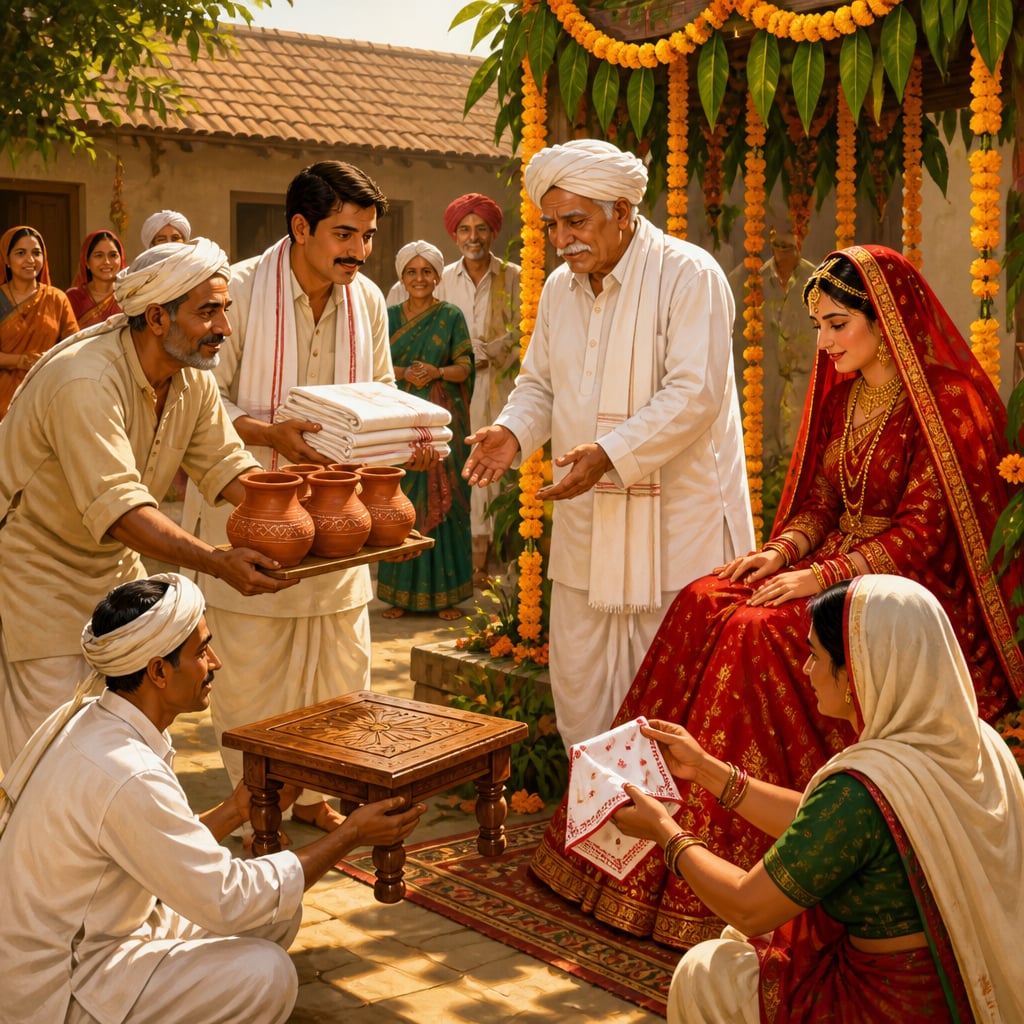
In 1955, anthropologist Oscar Lewis documented a wedding in village Rampur, near Delhi. The bride's family, prosperous farmers, gave gifts to their hereditary service families: 5 rupees and a new dhoti to the barber; 3 rupees and sweets to the washerman; grain and cloth to the carpenter who built the marriage pavilion; special payments to the priest, the drummer, the potter.
These weren't tips or charitable donations. They were dan, obligatory gifts that the service families expected and the patron families couldn't refuse without social disgrace. The economics of jajmani was inseparable from the economics of ritual reciprocity.
Beyond Market Exchange
The jajmani system wasn't purely economic, it was embedded in a larger system of social reciprocity that anthropologists call 'gift economy.' The Mahabharata articulates the principle:
"दातव्यमिति यद्दानं दीयतेऽनुपकारिणे" "Datavyam iti yad danam diyate'nupaakarine" "That gift which is given with the thought 'this ought to be given,' without expectation of return, this is sattvic."
Yet village gift-giving was more complex. Gifts created obligations. The barber who received wedding dan was obligated to provide extra services during family ceremonies. The farmer who received harvest help expected to reciprocate when the helper's family faced need. Reciprocity was expected, but not immediately and not in equivalent form.
The Structure of Village Reciprocity
Village reciprocity operated through multiple channels:
Lifecycle Events: Every birth, marriage, and death triggered gift flows. When a farmer's son was born, service families received neg (gifts). When a kamin's daughter married, jajman families contributed grain and cloth. These weren't optional generosities, they were social obligations enforced by community expectation.
Festival Exchanges: Major festivals, Diwali, Holi, harvest festivals, involved prescribed gift exchanges. Jajmans gave sweets, cloth, and grain to kamins; kamins provided services and ritual items. The exchanges reinforced relationships throughout the year.
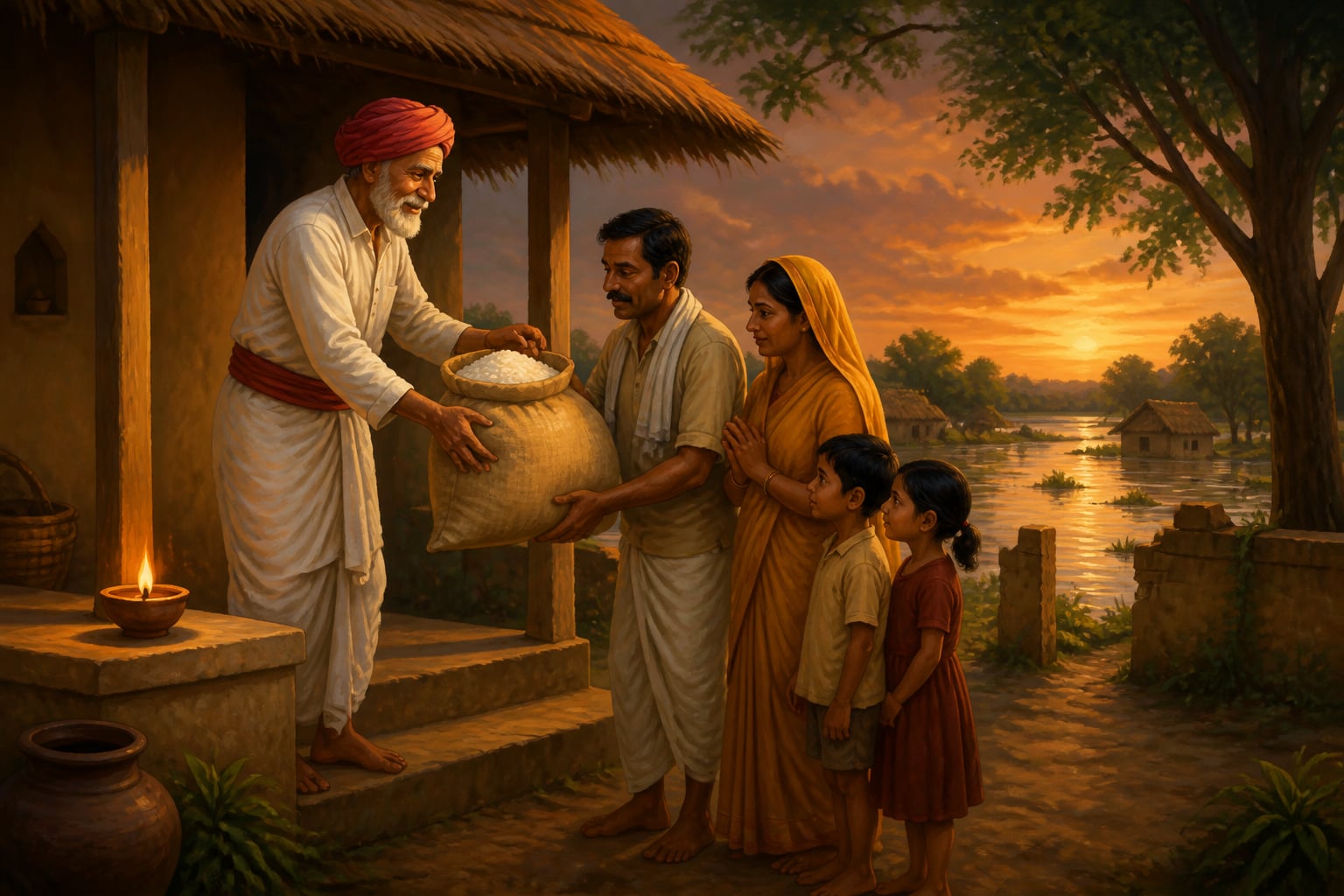
Crisis Support: When a family faced emergency, crop failure, illness, death, their jajmani network mobilized support. Jajmans provided grain advances; kamins provided extra services. This wasn't charity but reciprocal obligation, the helping families expected similar support when they faced difficulties.
Ritual Participation: Service families didn't just provide economic services, they participated in rituals. The barber carried the marriage palanquin; the washerman spread clean cloths for ceremonies; the drummer announced auspicious events. These ritual roles bound families together beyond economic transaction.
The Economics of Obligation
Why did gift economies exist alongside grain-based exchange? Because gifts solved problems that pure exchange couldn't:
Relationship Maintenance: Regular gift exchange kept relationships active between service events. A farmer who only contacted his barber for haircuts had a thin relationship; one who exchanged festival gifts maintained a thick, multi-dimensional bond.
Status Display: Gift-giving demonstrated prosperity and generosity, valued traits in village society. A farmer who gave generously at weddings earned social prestige that translated into influence and access.
Insurance Creation: The web of gift obligations created mutual insurance. Families that had given generously could expect generous support when they faced difficulties. Reciprocity over time distributed risk across the community.
Social Cohesion: Gift exchange created what sociologist Marcel Mauss called 'total social phenomena', relationships that were simultaneously economic, religious, moral, and social. Villages bound by multiple types of exchange were more cohesive than those connected only by market transactions.
The Shadow Side: Enforced Hierarchy
Honesty requires acknowledging that reciprocity wasn't equal. Jajmani gift exchange reflected and reinforced village hierarchies:
Asymmetric Obligations: Jajmans could delay or reduce gifts without severe consequence; kamins who failed to provide services faced exclusion. The reciprocity was formally mutual but practically asymmetric.
Status Marking: Gift exchanges often reinforced status differences. Kamins received gifts but were expected to show deference. The gifts came with expectations of respect, service, and subordination.
Debt Bondage: When kamins borrowed from jajmans during emergencies, the debt could become hereditary. Sons inherited fathers' debts, creating bondage that lasted generations.
Exclusion Mechanisms: Families that violated norms, including lower-status families who sought to rise above their position, could be excluded from reciprocity networks, facing economic and social isolation.
Global Perspectives on Gift Economy
Western scholars have extensively studied gift economies, often drawing on non-Western examples. Their insights illuminate what Indian villages practiced.
Georg Simmel (1858-1918), the German sociologist, analyzed in 'Faithfulness and Gratitude' (1908) how gratitude binds society together. He argued that gifts create 'invisible threads' connecting people through felt obligation. Village dan operated exactly as Simmel described, each gift spinning another thread in the web of village relationships.
Bronislaw Malinowski (1884-1942), the Polish anthropologist, documented the Kula ring in Melanesia, a ceremonial gift exchange system spanning islands. His 1922 work Argonauts of the Western Pacific showed that gift circuits create social cohesion across distance and time. Indian village reciprocity networks functioned similarly, binding communities across generations.
Claude Lévi-Strauss (1908-2009), the French anthropologist, argued in The Elementary Structures of Kinship (1949) that exchange, especially gift exchange, is the fundamental principle of social organization. For Lévi-Strauss, society itself is constituted through reciprocal obligations. Indian jajmani embodies this principle: the village existed because of, not merely alongside, its exchange relationships.
| Thinker | Key Insight | Indian Village Parallel |
|---|---|---|
| Georg Simmel | Gratitude binds society through felt obligation | Dan created ongoing obligations that bound families across generations |
| Bronislaw Malinowski | Ceremonial gift circuits create social cohesion | Jajmani networks connected all village families through prescribed gift flows |
| Claude Lévi-Strauss | Society is constituted through reciprocal exchange | The village existed through reciprocity, not just alongside it |
Western economies increasingly separate economic from social relationships, you buy bread without social obligation. Indian village economics refused this separation. Every economic relationship was also a social relationship. This made economies less 'efficient' in narrow terms but more embedded in community.
Modern Echoes
The gift economy persists in contemporary India, though transformed:
Wedding Gift Circuits: Urban Indians maintain elaborate gift-exchange networks around weddings. Families track what they received and reciprocate accordingly, direct descendants of village dan systems.

Festival Exchanges: Diwali gift-giving among professional networks serves similar functions to village festival exchanges, maintaining relationships, displaying status, creating obligations.
Professional Reciprocity: Business relationships often include gift elements, meals, favors, referrals, that create ongoing obligations beyond transactional exchange.
In 2024, India's wedding industry was valued at approximately $130 billion, testimony to the enduring importance of lifecycle gift exchange, now monetized but still structured by reciprocity logic.
Your Turn: Your Reciprocity Network
You operate within gift economies even if you don't recognize them as such. Who do you exchange favors with? Whom do you help expecting future help in return? What social obligations constrain your purely economic decisions?
The village system suggests that purely transactional relationships are impoverished. Economic security comes not just from wealth accumulation but from embedding in networks of mutual obligation where others are invested in your wellbeing and you in theirs.
But the village also warns about reciprocity's dark side, how gift obligations can reinforce inequality, create debt bondage, and enforce conformity. The question isn't whether to participate in reciprocity but how to structure it for mutual benefit rather than exploitation.
In our next lesson, we'll explore how jajmani principles appear in modern sharing economies, from cooperative dairies to digital platforms.
Sociologist Viviana Zelizer has documented how even modern economies contain 'relational packages', gifts and favors that create bonds markets cannot.
The village system maintained relationships through continuous gift exchange rather than relying on repeat transactions.
Studies of rural lending show that loans from jajmani networks had lower default rates than commercial loans, relationship-based lending created stronger obligations.
Economists have documented informal insurance systems in developing economies worldwide. Village reciprocity was a sophisticated version, risk pooling through gift networks.
Reciprocity insurance was embedded in relationships rather than contracts. Because it was social, not just economic, it included moral and reputational enforcement.
Studies show that villages with strong reciprocity networks showed 40% lower consumption volatility during shocks compared to villages with weaker networks.
Key terms
- Dan/Dana
- Gift or giving, in village economics, the obligatory gifts given at lifecycle events, festivals, and transitions that created and maintained social bonds beyond pure economic exchange.
- Neg
- Customary gifts given at lifecycle events, specifically the prescribed gifts that service families received at births, weddings, and deaths of their jajman families.
- Pratidana
- Return gift or reciprocal giving, the expected (though not immediate) return of gifts that maintained balance in village reciprocity networks over time.
- Rna
- Debt or obligation, in village economics, the moral and social debt created by receiving gifts, services, or help. Rna extended beyond financial debt to encompass all forms of obligation.
Verses
दातव्यमिति यद्दानं दीयतेऽनुपकारिणे
Datavyam iti yad danam diyate'nupaakarine
That gift which is given with the thought 'this ought to be given,' without expectation of return, this is sattvic giving.
Gift giving solves the 'trust problem' in relationships. Unlike market exchange where obligation ends with payment, gifts create ongoing relationships where parties remain invested in each other's welfare.
Bhagavad Gita, Chapter 17, Verse 20 (Eknath Easwaran)
प्रतिग्रहसमर्थोऽपि प्रसङ्गं तत्र वर्जयेत्
Pratigraha-samartho'pi prasangam tatra varjayet
Even one capable of receiving gifts should avoid attachment to receiving.
Gift economies create 'debt' that isn't monetary but social. This debt can provide security but also dependency. Managing this balance is crucial for healthy reciprocity.
Manusmriti, Chapter 4, Verse 227 (Patrick Olivelle)
Key figures
Manu
Legendary author of the Manusmriti (Laws of Manu); codified rules for giving, receiving, and reciprocity · c. 200 BCE - 200 CE (traditional dating much earlier)
Manu established that giving is not just generous but obligatory, different situations demanded different gifts. He also warned about the dangers of receiving, noting that habitual receipt creates dependency. His framework balanced the benefits of gift exchange against its potential for creating bondage.
Marcel Mauss
French sociologist who developed foundational theory of gift exchange · 1872-1950
Mauss showed that gifts are never 'free', they create three obligations: to give, to receive, and to reciprocate. This framework explains why village dan was obligatory.
Oscar Lewis
American anthropologist who documented Indian village life in detail · 1914-1970
His careful documentation of wedding gift circuits, festival exchanges, and crisis support revealed the complexity of village reciprocity, simultaneously economic, social, and ritual.
Historical context
Village India across historical periods
Gift exchange permeated village life, every lifecycle event, festival, and crisis triggered prescribed gift flows. This created dense networks of obligation that bound villages together but also reinforced hierarchies.
Gift economies exist worldwide, but Indian village systems were unusually formalized. The prescribed gifts at specific events created predictable, institutionalized reciprocity rather than informal exchange.
Anthropological studies estimate that 20-30% of a village household's annual grain production was distributed through gift channels rather than consumed or sold.
Understanding village reciprocity reveals that economic relationships are always embedded in social relationships. Pure market exchange, separated from social obligation, is historically unusual.
Living traditions
India's wedding industry ($130 billion), festival gifting market, and pervasive 'favor economy' in business all extend village gift economy principles.
- Corporate Diwali Gifting: Businesses exchange Diwali gifts with clients, employees, and partners, maintaining relationship networks through annual gift circuits.
- Community Crisis Support: Caste associations, alumni networks, and community groups mobilize support for members facing illness, death, or financial crisis.
- Wedding Functions Across India
- Temple Prasad Distribution
- Shirdi Sai Baba Temple: The temple trust manages massive donation flows and redistributes to education, healthcare, and feeding programs, institutionalized dan (giving) at scale
- Golden Temple (Harmandir Sahib): The langar (community kitchen) feeds 100,000+ people daily regardless of caste, creed, or economic status, the ultimate expression of dan without hierarchy
Reflection
- Village reciprocity created security through mutual obligation but also reinforced inequality. How might we design reciprocity systems that provide community benefits without perpetuating hierarchy?
- Map your own gift economy: Who do you exchange favors with? What obligations have you accumulated? Are there relationships where reciprocity has become one-sided?