Parivartana-Artha: Non-Monetary Exchange Systems

Economy Before Cash

Explore how Indian villages operated sophisticated economies with minimal cash, using grain as currency, labor as payment, and seasonal accounts that balanced at harvest time, creating a resilient system independent of coins and bankers.

The Village Without Rupees
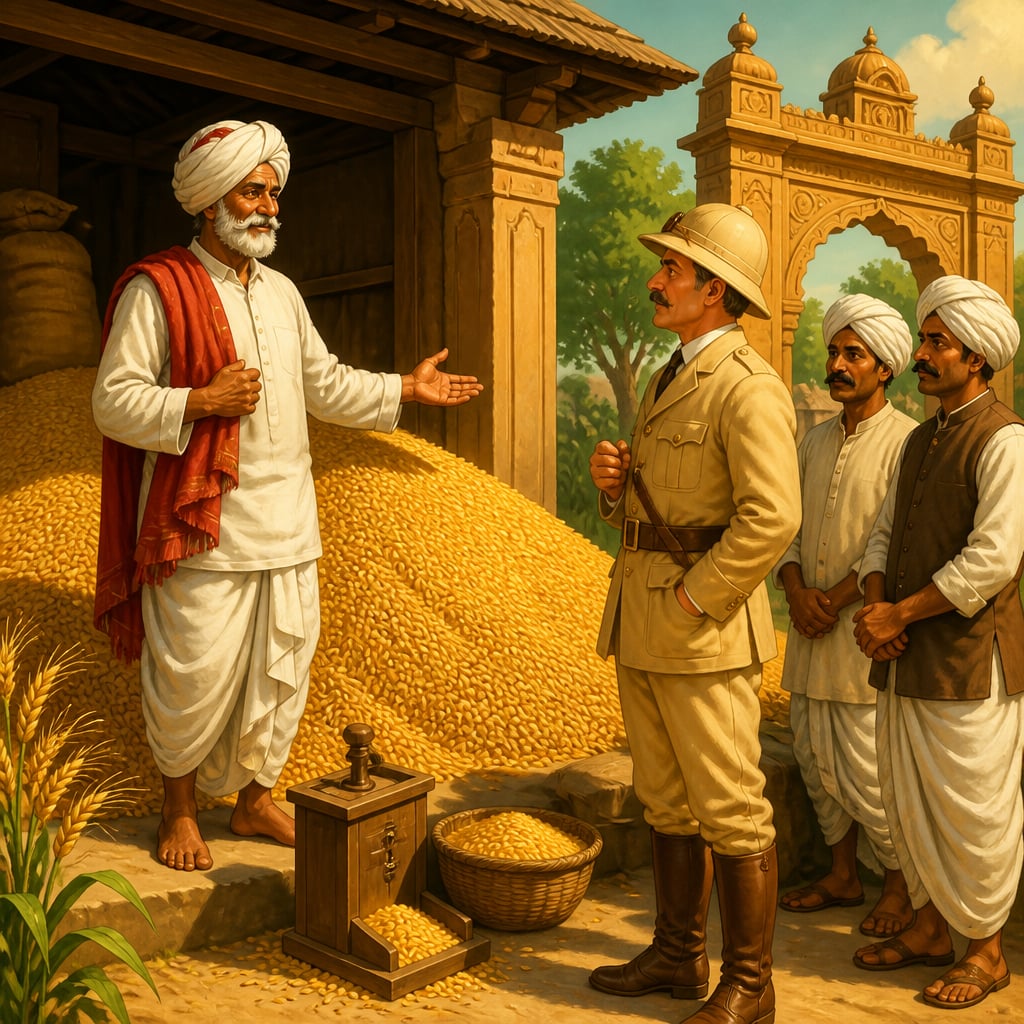
Punjab village headman explaining grain economy to Baden-Powell

In 1872, a British revenue officer named Baden Henry Baden-Powell conducted a detailed survey of village economics in Punjab. What he found astonished him. In village after village, he observed prosperous communities where coins almost never changed hands. Farmers, potters, blacksmiths, washermen, all seemed to live comfortably, yet Baden-Powell could trace very few monetary transactions.

"How does commerce happen?" he asked a village headman. The answer was simple: "Hum paisa nahin chalate, hum anna chalate hai." We don't circulate money; we circulate grain.

The Grain Standard

Indian village economics operated on what we might call a 'grain standard', a sophisticated non-monetary system where agricultural produce, primarily wheat and rice, served as the medium of exchange. This wasn't primitive barter. It was an alternative to money-based economics with its own logic and advantages.

The Arthashastra recognized this principle:

"धान्यं मूल्यमानं सर्वेषां पण्यानाम्" "Dhanyam mulyamanam sarvesham panyanam" "Grain is the measure of value for all commodities."

In practice, this meant that a village could function as a complete economic unit without coins. The farmer produced grain; the blacksmith, potter, barber, and priest all received shares of that grain as payment for their services. Each participant was both producer and consumer in a circular economy.

The Mechanics of Grain Payment

How did this actually work? Consider a typical annual cycle in a pre-colonial North Indian village:
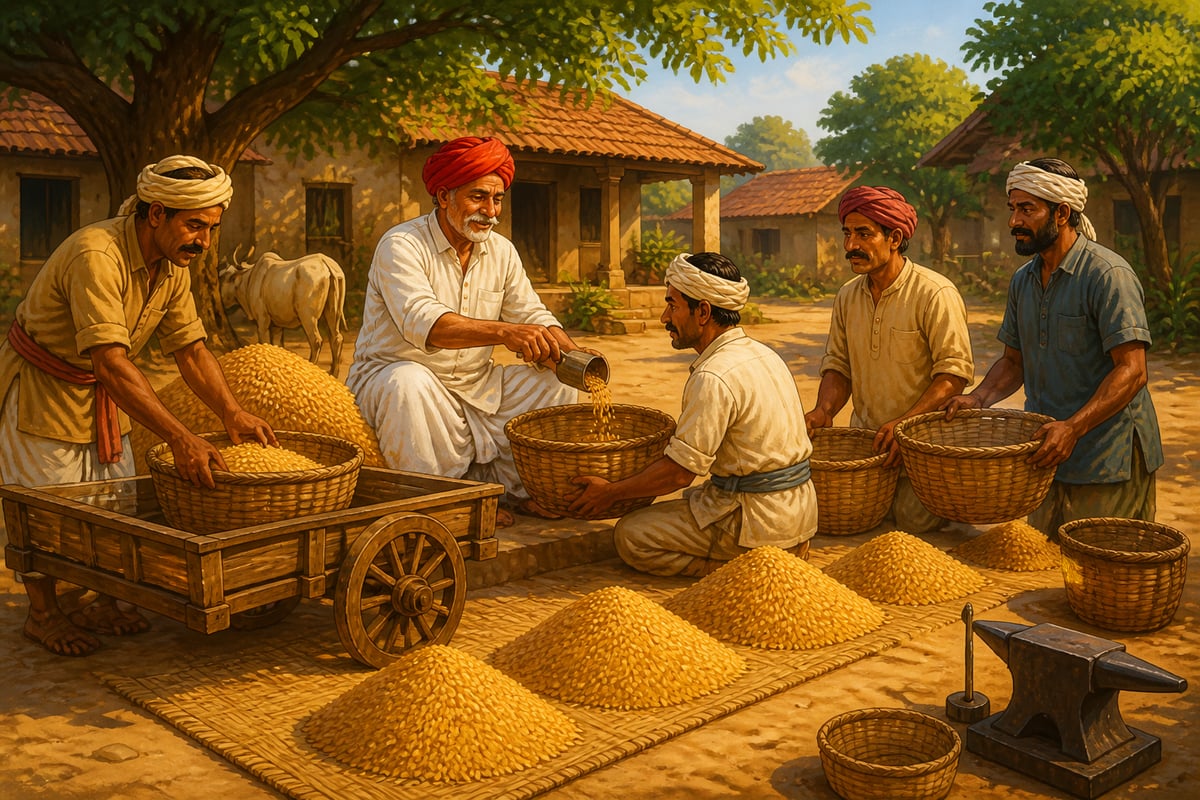
Annual rabi harvest grain distribution to service families

Rabi Harvest (April-May): The wheat crop came in. Each farmer set aside portions for:

Kharif Harvest (October-November): The rice or millet crop followed the same pattern.

A farmer with 10 acres might produce 50 quintals of wheat. His obligations:

The service families received grain, not coins. They consumed most of it, traded small amounts for items the village didn't produce (salt, iron, spices), and stored surplus against bad harvests.

Running Accounts Without Ledgers

The system's sophistication went beyond simple annual payments. Villages maintained complex running accounts, entirely in memory and oral tradition.

Seasonal Credit: When a blacksmith needed to eat before the harvest, he drew grain from his jajmans as an advance against future services. No interest was charged on these intra-village loans, the relationship itself was the collateral.

Emergency Support: If a kamin family faced a wedding or death, jajmans contributed extra grain. This wasn't charity but reciprocal obligation, the jajmans would receive extra services or grain gifts when they faced similar occasions.

Quality Adjustments: If the carpenter produced exceptional work, say, an ornate marriage bed, he might receive extra grain that year. If his work was shoddy, his share might be reduced. Quality control happened through social pressure, not price negotiation.

Why Grain, Not Coins?

Why did villages prefer grain over money? The reasons were both practical and philosophical.

Practical Advantages:

Philosophical Alignment: The Dharmasutras viewed money (hiranya) with suspicion. Coins, especially gold and silver, were associated with desire (kama) and accumulation (lobha). Grain, by contrast, was anna, food, sustenance, life itself. An economy based on anna was seen as more dharmic than one based on hiranya.

"अन्नं न निन्द्यात्, तद्व्रतम्" "Annam na nindyat, tadvratam" "Never disparage food, this is the sacred vow."

This verse from the Taittiriya Upanishad elevated grain to sacred status. An economy built on anna was participating in the cycle of life itself.

Global Perspectives on Non-Monetary Exchange

How do Western economists understand economies that operate without money? Their insights illuminate what Indian villages achieved.

Karl Polanyi (1886-1964), the Hungarian-American economic historian, argued in The Great Transformation (1944) that pre-modern economies were 'embedded' in social relationships. Exchange was governed by reciprocity and redistribution, not price mechanisms. Indian village economies perfectly exemplify Polanyi's thesis, grain payments were social obligations, not market transactions.

Marcel Mauss (1872-1950), the French anthropologist, analyzed gift economies in The Gift (1925). He showed that in traditional societies, exchange created social bonds rather than merely transferring goods. Village India's grain payments were gifts-that-obligate, not purchases. The farmer 'owed' the blacksmith grain; the blacksmith 'owed' the farmer service. These debts were never fully settled, they sustained the relationship.

Silvio Gesell (1862-1930), the German-Argentine economist, proposed 'demurrage currencies', money that loses value over time to encourage circulation. He would have recognized that grain is natural demurrage currency: it must circulate or spoil. Villages couldn't hoard grain the way they might hoard coins, the medium itself enforced circulation.

Thinker Key Insight Indian Village Parallel
Karl Polanyi Pre-modern economies embedded in social relations Grain payments were social obligations, not market prices
Marcel Mauss Gift exchange creates enduring social bonds Jajmani payments were ongoing gifts-that-obligate, not purchases
Silvio Gesell Demurrage (decaying) currency prevents hoarding Grain's perishability naturally enforced circulation

Medieval Europe monetized by the 12th century. China's copper cash penetrated villages under the Song dynasty. India's persistence of grain-based economics until the 19th century was historically unusual, villages chose to minimize monetary dependence even when coins were available.

The Decline and Modern Echoes

British colonial policy systematically monetized village India. The demand for land revenue in cash (not grain) forced farmers to sell produce rather than distribute it locally. Railways enabled grain export, integrating villages into global markets. By 1947, the grain-based economy was largely extinct.

Yet echoes persist. In 2024, some tribal areas of Jharkhand and Odisha still practice dhaan badli, grain exchange, for local services. More significantly, the principle of non-monetary exchange underlies modern institutions:

Kerala Kudumbashree time-bank meeting

Time Banks: In Kerala's Kudumbashree program, members exchange labor hours rather than money, exactly the principle behind traditional begari (labor exchange).

Barter Rings: Urban India has seen growth in service-for-service arrangements, particularly among professionals. Lawyers trade legal work for accountants' tax services, informal non-monetary circuits.

UPI and Digital Wallets: Ironically, India's digital payment revolution recreates some grain-economy features. UPI transactions settle instantly at zero cost, like grain transfers within a village. The 'frictionless' economy digital advocates celebrate existed in villages centuries ago.

Your Turn: Escaping Monetary Dependence

The grain-based economy offers a radical insight: money is optional. Communities can provision themselves without currency if they develop robust non-monetary exchange systems.

What does this mean for you? Consider: How much of your economic life is captured by monetary transactions? Could any of it be restructured as exchange, skills for skills, time for time? The villages knew something we've forgotten: the most resilient economies minimize their dependence on any single medium of exchange.

In our next lesson, we'll examine how different occupational groups cooperated within the village, the inter-occupational economic cooperation that made self-sufficiency possible.

Modern monetary theory increasingly recognizes that communities can create alternative exchange media during currency crises, exactly what Indian villages did systematically.

Indian villages institutionalized monetary diversification rather than treating it as crisis response. The grain-based economy was the default; coins were supplementary.

During the 1857 upheaval, when imperial currency systems collapsed across North India, village economies continued functioning through grain-based exchange, demonstrating the resilience advantage.

Use-value versus exchange-value, real assets versus financial assets

Modern economics distinguishes between 'real' economy (goods, services) and 'financial' economy (money, credits). The 2008 crisis showed how financial expansion disconnected from real production creates instability.

Village economics kept the real economy primary. Grain-based systems couldn't experience purely financial crises because the medium of exchange was itself a real good.

Key terms

Parivartana
Exchange or barter, the direct exchange of goods and services without monetary intermediation. In village economics, parivartana referred to the grain-based and labor-based exchanges that constituted most economic activity.
Anna
Food, particularly grain, but in village economics, anna served as the primary medium of exchange, unit of account, and store of value, functioning as money in non-monetary economies.
Begari
Labor exchange or labor contribution, work performed not for wages but as part of reciprocal village obligations. Farmers helped each other during planting and harvest through begari arrangements.
Hiranya
Gold, money, or coined wealth, viewed with suspicion in Dharmashastra literature as promoting greed and accumulation, in contrast to anna (grain) which sustained life.

Verses

धान्यं मूल्यमानं सर्वेषां पण्यानाम्

Dhanyam mulyamanam sarvesham panyanam

Grain is the measure of value for all commodities.

This anticipates modern concepts of 'commodity money' and 'numeraire', using a real good as the reference point for pricing other goods. Grain had advantages over precious metals: it was universally needed, locally produced, and relatively stable in value.

Arthashastra, Book 2, Chapter 15 (R.P. Kangle)

अन्नं न निन्द्यात्, तद्व्रतम्

Annam na nindyat, tadvratam

Never disparage food, this is the sacred vow.

By sacralizing grain, Indian tradition created cultural support for non-monetary economics. Accumulating grain was virtuous (ensuring food security); accumulating money was suspect (promoting greed). This shaped economic behavior toward grain-based systems.

Taittiriya Upanishad, Bhrigu Valli, Section 2 (Patrick Olivelle)

Key figures

Bhrigu

Vedic sage and teacher in the Taittiriya Upanishad; articulated the sacredness of anna (food/grain) · c. 800-500 BCE (traditional dating)

Through the famous 'annam na nindyat' (never disparage food) teaching, Bhrigu sacralized grain. An economy built on anna was thus participating in the sacred cycle of life, making grain-based exchange spiritually superior to money-based transactions.

Baden Henry Baden-Powell

British administrator and author of foundational studies on Indian land systems · 1841-1901

His field observations captured the mechanics of non-monetary village economics before colonial monetization destroyed them. His records remain primary sources for understanding how grain-based economies operated in practice.

R. Vaidyanathan

Economist specializing in India's informal and indigenous economic systems · Present (born 1949)

His work demonstrates that significant portions of Indian economic activity continue outside formal monetary circuits, echoing historical grain-based arrangements. He argues that India's economic resilience derives partly from these parallel non-monetary systems.

Historical context

Pre-colonial Indian villages (c. 500 BCE - 1857 CE)

For most of Indian history, the vast majority of economic transactions occurred without coins. The Mughal Empire minted enormous quantities of rupees, but these circulated primarily in urban areas and for long-distance trade. Village India remained grain-based.

Europe monetized much earlier, medieval European villages used coins for most transactions by the 13th century. China's paper money and copper cash penetrated villages by the Song dynasty. India's persistence of grain-based economics was historically unusual for a civilization of its sophistication.

Estimates suggest that even in 1800, less than 5% of transactions in a typical North Indian village involved coins. By 1900, this had risen to over 50% under colonial pressure, a dramatic transformation in a single century.

Understanding grain-based economics reveals that money is a social technology, not a necessity. Communities can prosper without currency if they develop alternative exchange institutions, a lesson relevant to debates about monetary alternatives today.

Living traditions

Time banks (pioneered by Kudumbashree in Kerala), skill-sharing platforms, and professional barter arrangements all extend the grain-economy principle: exchange without monetary intermediation.

Reflection

More in The Jajmani System: Economics of Mutual Service

All lessons in The Jajmani System: Economics of Mutual Service · Grama Swarajya: Village Economics course