Sahakari-Artha: Jajmani and Modern Sharing Economy

Ancient Principles in Platform Capitalism

Discover how jajmani principles appear in modern sharing economies, from cooperative dairies to digital platforms, and what ancient village economics teaches about the promises and perils of contemporary economic models.

The Dabbawala Lesson
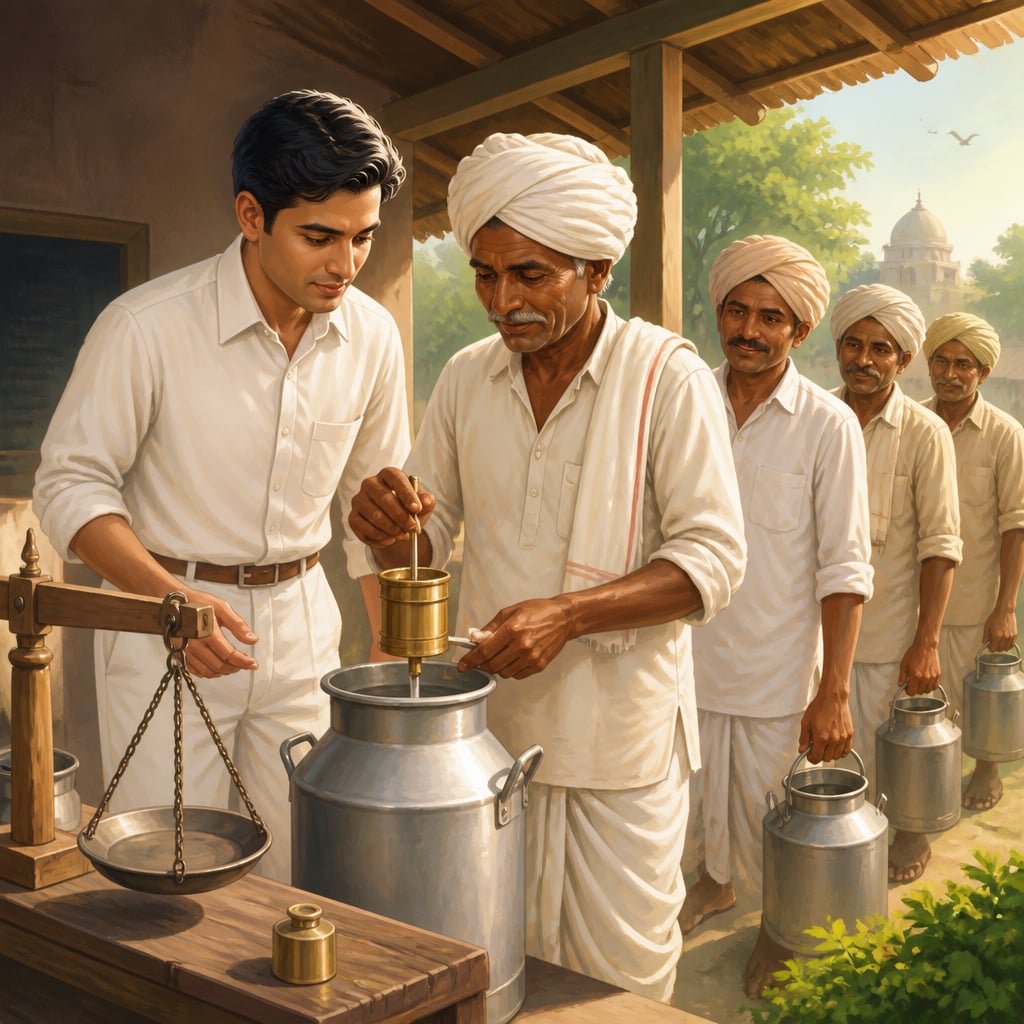
Verghese Kurien at the 1946 Kaira dairy collection point

Every day in Mumbai, 5,000 dabbawalas deliver 200,000 lunch boxes from homes to offices with legendary precision, one error in 16 million transactions, according to Forbes. Harvard Business School has studied them; Prince Charles visited them; Six Sigma experts marvel at them.

But the dabbawalas themselves describe their system in terms any village jajmani practitioner would recognize: fixed customer relationships, monthly payments (not per-delivery), hereditary participation (most dabbawalas are from the same Mauli caste), and mutual support during crises. They're not a Silicon Valley startup. They're a modern jajmani system.

The Jajmani Principles in Modern Form

Look beneath the surface of various modern economic arrangements, and jajmani principles emerge:

Long-Term Relationships Over Transactions: Jajmani rejected per-service payment for ongoing relationships. Modern subscription models, Netflix, SaaS products, gym memberships, operate on the same principle: pay for access and relationship, not each use.

Fixed Customer Allocation: Jajmani kamins served fixed patron sets. Modern franchise territories, insurance agent portfolios, and professional firm client assignments all allocate customers to providers rather than letting markets decide.

Non-Monetary Value Exchange: Jajmani included ritual participation, social support, and crisis assistance alongside grain payment. Modern businesses increasingly recognize that pure monetary compensation is insufficient, employees want purpose; customers want community.

Hereditary Knowledge Transfer: Jajmani transmitted skills through family apprenticeship. Family businesses, professional dynasties, and craft traditions continue this pattern even amid formal education systems.

The Cooperative Movement: Jajmani Scaled

India's cooperative movement represents perhaps the purest modern application of jajmani principles. Consider Amul:
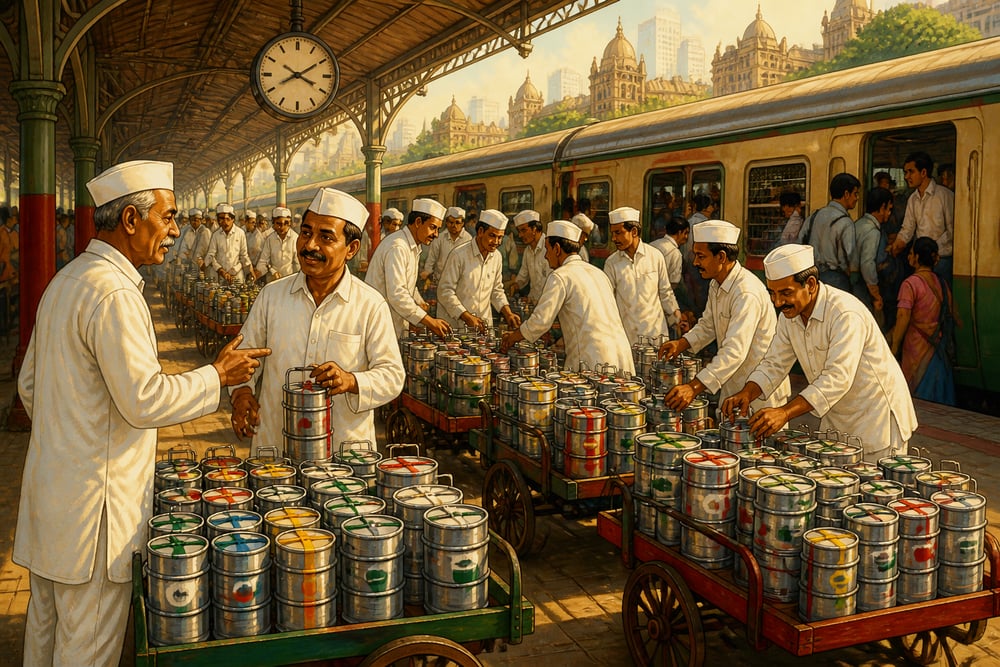
Mumbai dabbawalas sorting tiffin boxes at a railway station

In 1946, farmers in Kaira district, Gujarat, faced exploitative middlemen who controlled milk prices. Under Verghese Kurien's guidance, they created a cooperative where:

The result? Amul now has 3.6 million farmer members, processes 25 million liters of milk daily, and has made India the world's largest milk producer. This is jajmani scaled to industrial dimensions.

Platform Capitalism: Jajmani's Dark Mirror

Now consider Uber, Ola, Swiggy, Zomato, the gig economy platforms. They claim to be 'sharing economy' but compare them to jajmani:

Jajmani Feature Platform Reality
Fixed customer relationships Algorithmic assignment to any driver
Annual/seasonal payment Per-trip payment with no security
Mutual crisis support No sick leave, no health insurance
Hereditary knowledge transfer Deskilled, interchangeable workers
Community embedding Atomized, isolated 'partners'

Platform capitalism takes jajmani's worst feature, occupational lock-in, without providing jajmani's benefits, security, relationship, mutual support. Gig workers are trapped in 'flexibility' that means precarity.

The ancient critique applies: the Manusmriti warned about receiving without reciprocity creating bondage. Platform workers receive payment but not relationship, income but not security. They're in a one-sided jajmani with corporations that take but don't give.

Self-Help Groups: Jajmani Reimagined

Ela Bhatt with SEWA self-employed women in 1970s Ahmedabad

A more hopeful modern form appears in India's Self-Help Group (SHG) movement. With 89 million members organized in 8.3 million groups (as of 2024), SHGs recreate jajmani's reciprocity at massive scale:

Mutual Obligation: Members save together and guarantee each other's loans, exactly the mutual support that bound jajmani families.

Long-Term Relationships: Groups persist for years; members know each other intimately. This isn't transactional banking but relationship-based finance.

Knowledge Transfer: Experienced members train newcomers; successful groups mentor struggling ones. Parampara in a new form.

Crisis Support: When a member faces emergency, the group provides both financial and emotional support. The reciprocity network activates.

SHGs have delivered credit to populations banks ignored, reduced household consumption volatility, and empowered women economically and socially. They prove that jajmani principles can work without jajmani's hierarchies.

Global Perspectives on Cooperative Economics

Western thinkers have grappled with similar questions: How can economies serve workers, not just owners? How can cooperation compete with extraction?

Robert Owen (1771-1858), the Welsh industrialist and social reformer, founded the modern cooperative movement. At New Lanark in Scotland, he demonstrated that treating workers well increased productivity. His 'Village of Cooperation' vision directly parallels jajmani's community-embedded economics, but with democratic governance replacing hereditary hierarchy.

Elinor Ostrom (1933-2012), the American political economist and Nobel laureate, showed in Governing the Commons (1990) that communities can manage shared resources effectively without privatization or state control. Her research on fishing cooperatives, forest commons, and irrigation systems provides theoretical validation for India's cooperative traditions, local communities can govern resources sustainably when they have proper institutions.

Guy Standing (1948-present), the British economist, coined 'precariat' to describe workers with neither employment security nor social protection. His critique of the gig economy echoes ancient concerns: the Manusmriti warned that receiving without reciprocity creates bondage. Platform workers receive payment without relationship, they are precariat, not partners.

Thinker Key Insight Jajmani/Indian Parallel
Robert Owen Worker welfare increases productivity Jajmani's mutual support created stable, productive relationships
Elinor Ostrom Communities can govern commons without privatization Indian cooperatives show community-based resource governance works
Guy Standing Flexibility without security creates precariat Platform workers lack jajmani's reciprocal obligations and protections

These Western insights validate what India's cooperative movement practices: economic arrangements work better when they serve communities, not just capital.

The Modern Synthesis

What would a healthy modern jajmani look like? The best contemporary examples combine:

From Traditional Jajmani:

Without Jajmani's Flaws:

The Amul Model achieves much of this: permanent relationships with freedom to leave; mutual support without hierarchy; knowledge transfer without occupational restriction.

The Platform Model achieves none: pure transaction without relationship; extraction without reciprocity; flexibility that means precarity.

Your Turn: Building Modern Jajmani

As you navigate the modern economy, you have choices about which economic arrangements to participate in and create:

As a Consumer: Do you seek purely transactional relationships (cheapest Uber ride) or relational ones (the driver you know and trust)? Jajmani suggests that relationship-based consumption creates more value for both parties.

As a Worker: Are you building relationships that provide security and growth, or selling services transactionally? Long-term employer relationships, despite their constraints, may offer more security than gig 'flexibility.'

As an Entrepreneur: Will you build extractive platforms or cooperative arrangements? The jajmani question is: Does your business model create mutual benefit or one-sided extraction?

As a Citizen: Which economic policies support reciprocal arrangements versus pure marketization? Cooperatives, portable benefits, and worker ownership all reflect jajmani principles updated for modern conditions.

The village economy wasn't perfect, far from it. But it understood something we're relearning: economies work better when embedded in relationships of mutual obligation, when people are connected rather than atomized, when security comes from community rather than just individual accumulation.

In our final lesson, we'll synthesize what we've learned about jajmani and explore its relevance for India's development as we approach 2047.

Stakeholder capitalism theory argues that companies should serve all stakeholders. But cooperatives go further, making producers actual owners, not just consulted stakeholders.

India's cooperative sector is among the world's largest. The ownership model has proven effective across dairy, sugar, credit, and consumer goods, demonstrating that producer ownership works.

Dairy cooperatives in India return 70-80% of consumer price to producers, compared to 30-40% in private supply chains, demonstrating ownership's impact on value distribution.

European 'flexicurity' models attempt to combine flexible labor markets with strong social protection. Pure flexibility without security creates working poor; pure security without flexibility creates inefficiency.

India's challenge is providing security to informal workers who are already 'flexible.' SHGs, cooperatives, and portable benefits offer models for security without rigid employment.

Studies show that gig workers in India earn 10-15% less than comparable employees when accounting for lack of benefits, job security, and income volatility, the hidden cost of 'flexibility.'

Key terms

Sahakari
Cooperative, an organization owned and operated by its members for their mutual benefit, with democratic governance and shared surpluses.
Swavalamban
Self-reliance, the capacity to meet one's needs through one's own efforts and community resources rather than depending on external support.
Gig Arthavyavastha
Gig economy, economic arrangements where workers perform discrete tasks for various clients through digital platforms without traditional employment relationships.
Prekariyat (Precariat)
The precariat, workers who lack both employment security and social protection, living in chronic uncertainty despite continuous labor. A modern condition that jajmani's reciprocal security was designed to prevent.

Verses

परस्परं भावयन्तः श्रेयः परमवाप्स्यथ

Parasparam bhavayantah shreyah param avapsyatha

By nourishing each other, you will attain the highest good.

This describes positive-sum economics: arrangements where cooperation creates more value than competition. Modern cooperatives, partnerships, and ecosystems embody this principle.

Bhagavad Gita, Chapter 3, Verse 11 (Eknath Easwaran)

सहकारेण कार्याणि साधयन्ति मनीषिणः

Sahakarena karyani sadhayanti manishinah

The wise accomplish their works through cooperation.

This anticipates modern understanding of collective action problems. Some goals require organized cooperation, and the wise create institutions that enable it.

Arthashastra, Book 2, Chapter 1 (R.P. Kangle)

Key figures

Kamandaki

Author of Nitisara, a treatise on statecraft and governance that discusses collective action and mutual benefit · c. 400-600 CE

Kamandaki articulated principles of strategic cooperation, when to ally, how to maintain partnerships, and how collective strength exceeds individual capacity. These principles underlie modern cooperative thinking: together, people can achieve what none could alone.

Verghese Kurien

Father of India's cooperative dairy movement and architect of Operation Flood · 1921-2012

Under his leadership, Amul grew from a small Gujarat cooperative to a national movement that made India the world's largest milk producer. He demonstrated that cooperation could outperform both private enterprise and state control.

Ela Bhatt

Founder of SEWA (Self-Employed Women's Association) and pioneer of women's cooperatives · 1933-2022

SEWA, founded in 1972, now has 2.5 million members. Bhatt proved that cooperative principles could serve those at the margins, home-based workers, street vendors, waste-pickers, creating security without requiring hierarchy.

Historical context

20th-21st century India

India has the world's largest cooperative sector (850,000 cooperatives) and largest informal economy. The tension between cooperative and extractive models plays out across dairy, agriculture, retail, and transportation.

India's cooperative movement is comparable to European cooperative traditions but faces different challenges. Platform economy arrived later than in the US but is growing faster, with India having among the world's largest gig workforces.

By 2024, India had approximately 7.7 million gig workers and 89 million SHG members, two very different models of organizing economic activity for people outside formal employment.

The choice between cooperative and extractive economic models will shape India's development. Understanding jajmani principles helps evaluate modern alternatives and design better institutions.

Living traditions

The cooperative versus platform debate continues. ONDC (Open Network for Digital Commerce) represents an attempt to create platform benefits without platform extraction. Farmer producer organizations merge cooperative principles with market access.

Reflection

More in The Jajmani System: Economics of Mutual Service

All lessons in The Jajmani System: Economics of Mutual Service · Grama Swarajya: Village Economics course