Jajmani: Understanding Hereditary Service Relationships

The Invisible Contracts That Built Village India

Discover how India's villages operated through jajmani, a web of hereditary service relationships where every family had guaranteed customers and guaranteed providers, creating economic security without money and social bonds that lasted generations.

The Barber Who Never Advertised
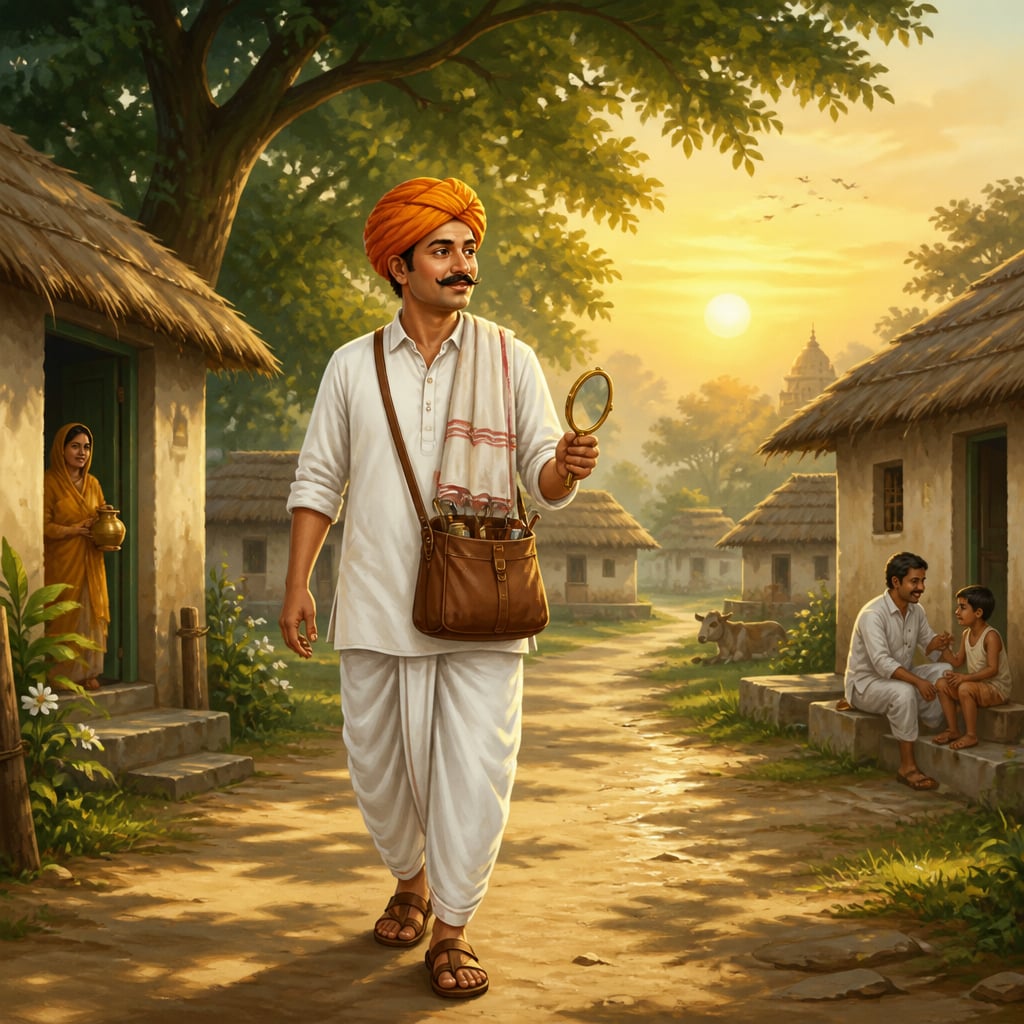
Village barber walking dawn rounds to his jajman families

In 1820, a British district collector named Charles Metcalfe sat in his office in the Central Provinces, puzzling over a mystery. He had just toured fifty villages, and not once had he seen a sign advertising services. No boards announced 'Barber Here' or 'Blacksmith Available.' Yet every village had a barber, a blacksmith, a potter, a washerman. How did villagers know whom to approach? And more strangely, why did no barber ever seem to lose customers to competition?

The answer was jajmani, a system so fundamental to Indian village life that the British would spend decades trying to understand it, and failing.

The Architecture of Mutual Obligation

Jajmani (from jajman, meaning patron or host) describes a system of hereditary service relationships that bound Indian villages together for centuries. Under jajmani, families didn't choose their service providers based on price or quality. Instead, service relationships were inherited, your barber served your family because his father served your father, and his grandfather served yours.

This wasn't merely tradition for tradition's sake. It was sophisticated economic engineering. The Dharmasutras capture the principle:

"कुलधर्मः परिपाल्यः, कुलवृत्तिः च रक्ष्यते" "Kuladharmah paripalyah, kulavrttih cha rakshyate" "The family's duty must be maintained, and the family's livelihood must be protected."

In practice, this meant that the village potter's family had a right to provide pots to their jajman families, and those families had a duty to accept pottery from their hereditary potter. The relationship was reciprocal, binding, and multi-generational.

How Jajmani Actually Worked

Consider how a typical North Indian village functioned in the 18th century:

The Jajman (Patron): Usually a landowning farmer family. They received services throughout the year from their hereditary service providers, the kamin or praja.

The Kamin (Service Provider): A family from a specialized occupation, barber (nai), washerman (dhobi), carpenter (badhai), potter (kumhar), priest (pandit), or sweeper (mehtar). Each kamin family served a fixed set of patron families, often 15-30 households.

The Payment: Not per-service but annual. At harvest time, the jajman paid the kamin a fixed share of grain, regardless of how many haircuts, pots, or ceremonies had occurred that year. This share was called birt or seer.

Ramdin the village blacksmith at his Sultanpur forge

The blacksmith Ramdin served twenty farmer families in village Sultanpur. Every harvest, each family gave him approximately 30 seers (about 25 kg) of grain. In return, Ramdin repaired their ploughs, sharpened their tools, made new implements when needed, all year, as often as required, with no per-service charge.

Global Perspectives on Hereditary Service Systems

How does jajmani compare to Western economic thought? The contrast is illuminating, and reveals what mainstream economics often misses.

Adam Smith (1723-1790) assumed in The Wealth of Nations (1776) that economic relationships were transactional, buyers and sellers meeting in markets, with competition driving efficiency. Under jajmani, there was no market for most village services. Competition was structurally impossible because clients were inherited, not acquired. Smith would have seen this as inefficient. Yet jajmani achieved something Smith's markets struggle with: universal employment.

Karl Polanyi (1886-1964), the Hungarian-American economic historian, would have recognized jajmani immediately. In The Great Transformation (1944), Polanyi argued that pre-modern economies were 'embedded' in social relationships, exchange was governed by reciprocity and redistribution, not price mechanisms. Jajmani is a textbook example of Polanyi's 'embedded economy': economic transactions were inseparable from social obligations.

Oliver Williamson (1932-2020), Nobel laureate in economics, developed transaction cost theory showing that long-term relationships reduce the overhead of repeated negotiation, monitoring, and enforcement. Jajmani anticipated this by millennia, hereditary relationships eliminated even the transaction cost of establishing new relationships each generation.

Thinker Key Insight Jajmani Parallel
Adam Smith Markets allocate through price competition Jajmani allocated through hereditary rights, no competition, but no unemployment
Karl Polanyi Pre-modern economies were embedded in social relations Jajmani was pure embedded economy, economic exchange inseparable from social obligation
Oliver Williamson Long-term contracts reduce transaction costs Hereditary relationships eliminated even relationship-formation costs

To Western observers, jajmani seemed primitive. But it solved problems that market economies still struggle with: unemployment, social insurance, and the erosion of community bonds through pure transactionalism.

The Economics Behind the System

Anthropologist William Wiser, who studied jajmani extensively in the 1930s, documented its economic logic. The system solved several problems simultaneously:

Risk Insurance: Annual grain payments meant service providers didn't suffer from seasonal demand fluctuations. A barber earned the same whether he gave ten haircuts or fifty.

Quality Maintenance: Because relationships were permanent, kamins had incentive to maintain quality. A shoddy blacksmith couldn't be fired, but he would face social shame and ritual exclusion.

Capital Access: Kamins could borrow from their jajmans during emergencies, essentially an informal credit line backed by future service obligations.

Social Security: During famines or crises, jajmans were expected to support their kamins, a form of mutual insurance that predated formal welfare systems.

The data supports this: British revenue records show that villages with strong jajmani systems weathered the 1876-78 Great Famine better than those where the system had eroded under colonial market pressures.

Living Echoes in 2025

Jajmani as a formal system declined through the 20th century as urbanization, cash economy, and constitutional protections transformed village India. Yet its principles persist in unexpected places.

Rural Indian women in a Self-Help Group saving circle

The dabbawala system of Mumbai, where 5,000 delivery workers transport 200,000 lunches daily with near-perfect accuracy, operates on jajmani logic. Customers have 'their' dabbawala, relationships are long-term, and payment is monthly regardless of individual deliveries.

India's Self-Help Group (SHG) movement, with 8.9 crore (89 million) members as of 2024, recreates jajmani's mutual obligation structure. Members guarantee each other's loans, creating reciprocal responsibility networks.

Your Turn: The Relationship Economy

You might think jajmani is irrelevant to your urban, digital life. But consider: Do you use 'your' mechanic? 'Your' doctor? 'Your' CA? These are informal jajmani relationships, ongoing service relationships based on trust rather than transaction-by-transaction shopping.

The question isn't whether relationship-based economics works, it clearly does. The question is how to preserve its benefits (trust, security, quality) while avoiding its costs (rigidity, inequality, exclusion).

In the next lesson, we'll explore how jajmani villages functioned largely without money, the non-monetary exchange systems that made cash almost irrelevant for daily life.

Transaction costs and relational contracting theory

Nobel laureate Oliver Williamson's work on transaction costs shows that long-term relationships reduce the overhead of repeated negotiation and monitoring, validating what jajmani villages practiced intuitively.

Jajmani went further than Western relational contracting by making relationships hereditary, eliminating even the transaction cost of establishing new relationships each generation.

Studies of Mumbai's dabbawalas show that relationship-based delivery achieves 99.999% accuracy, far exceeding algorithm-driven alternatives.

Labor market segmentation and occupational licensing

Modern occupational licensing (doctors, lawyers, electricians) recreates jajmani's entry restriction. These systems guarantee incumbent earnings but restrict competition and mobility.

Key terms

Jajman
The patron in a jajmani relationship, typically a landowning farmer family who received hereditary services and paid in grain at harvest time.
Kamin
The service provider in a jajmani relationship, a family from a specialized occupation who served a fixed set of patron families across generations.
Birt
The annual grain payment made by jajmans to their kamins at harvest time, a fixed share regardless of the number of services rendered during the year.
Kulavrtti
The hereditary family occupation or livelihood, the specific trade or service that a family practiced across generations and which defined their role in the village economy.

Verses

कुलधर्मः परिपाल्यः, कुलवृत्तिः च रक्ष्यते

Kuladharmah paripalyah, kulavrttih cha rakshyate

The family's duty must be upheld, and the family's livelihood must be safeguarded.

This principle created what modern economists call 'occupational closure', guaranteed employment within an occupation through restricted entry. It solved unemployment but at the cost of mobility.

Dharmasutras, Gautama Dharmasutra, Principle on Hereditary Duty (Patrick Olivelle)

स्वे स्वे कर्मण्यभिरतः संसिद्धिं लभते नरः

Sve sve karmany abhiratah samsiddhim labhate narah

A person attains perfection by being devoted to their own duty.

This is an early articulation of specialization benefits, what economists call 'learning by doing.' Hereditary occupations concentrated human capital within families, creating expertise through repetition across generations.

Manusmriti, Chapter 10, Verse 115 (Patrick Olivelle)

Key figures

Gautama

Author of Gautama Dharmasutra, one of the earliest legal-ethical texts codifying occupational duties · c. 600-400 BCE

Gautama established that occupational roles were not merely economic arrangements but sacred duties (svadharma). His codification gave hereditary service relationships religious sanction, making them more durable than purely contractual arrangements.

Charles Metcalfe

British administrator who famously described Indian villages as 'little republics' · 1785-1846

While Metcalfe's romantic description of 'village republics' has been critiqued by historians, his documentation of jajmani-type relationships preserved valuable ethnographic data about how villages actually functioned before colonial market intrusions.

William Wiser

American anthropologist who conducted the foundational study of the jajmani system · 1890-1961

Wiser documented how jajmani created a 'functional interdependence' between families of different occupations. His work showed that jajmani was not merely traditional but economically rational, solving problems of risk, credit, and employment that markets struggle with.

Historical context

Pre-colonial India (roughly 1500 BCE - 1800 CE)

Jajmani emerged in agrarian village India where 85-90% of the population lived in villages. The system's grain-based payment fit an economy where cash was scarce and agricultural output was the primary form of wealth.

No precise equivalent existed elsewhere. European guilds controlled production but not customer allocation. Japanese village systems had collective labor obligations but not hereditary service relationships.

Wiser's 1936 Karimpur study documented 24 distinct service occupations in a single village, each with hereditary practitioners serving fixed patron sets.

Understanding jajmani reveals that market-based employment is not the only viable economic system. Jajmani solved unemployment and social insurance through relationship-based economics.

Living traditions

The dabbawala system of Mumbai, cooperative dairy networks (Amul), and Self-Help Groups all embody jajmani principles: long-term relationships, mutual obligation, and collective support during crises.

Reflection

More in The Jajmani System: Economics of Mutual Service

All lessons in The Jajmani System: Economics of Mutual Service · Grama Swarajya: Village Economics course