Parivarik-Seva: Hereditary Skills and Knowledge Transfer

The University of the Household

Discover how village expertise was transmitted across generations without schools or textbooks, through apprenticeship from childhood, tacit knowledge embedded in daily practice, and family workshops that served as the world's longest-running vocational training institutions.

The Blacksmith's Five-Year-Old
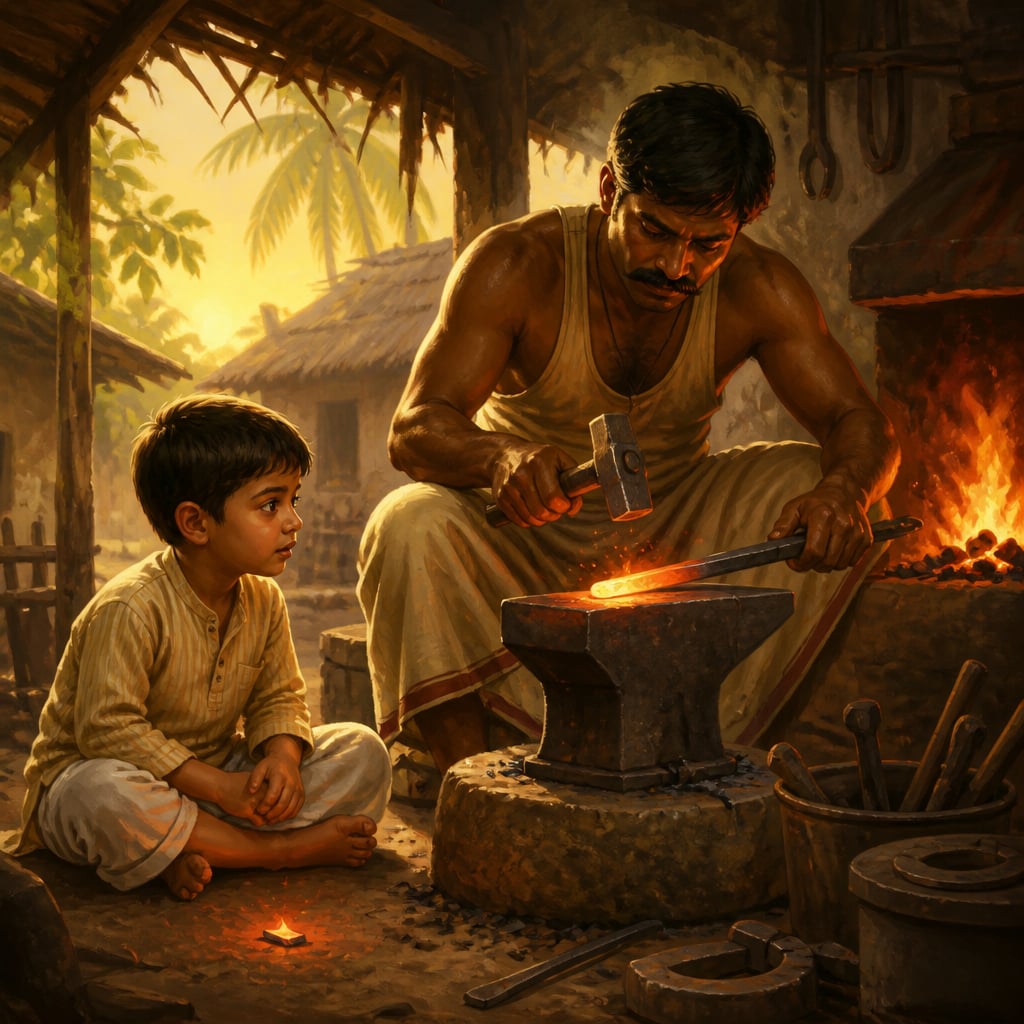
Blacksmith's five-year-old absorbing the craft at the forge

In 1912, anthropologist William Crooke observed something remarkable in a village near Allahabad. A five-year-old boy, son of the village blacksmith, was pumping the bellows. Not as play, as work. His hands, already callused, moved with rhythm. His eyes watched his father's hammer strikes with absorption no schoolroom could command.

By age eight, this boy would be shaping simple hooks and nails. By twelve, he'd repair basic tools. By sixteen, he'd forge new implements. By twenty, he'd know metallurgy his grandfather knew, and his grandfather's grandfather, accumulated expertise no textbook contained.

"Where did he learn?" Crooke asked the father. The answer was puzzled: "Learn? He lives here. He breathes the forge. How could he not know?"

The Knowledge System Without Schools

India's traditional economy achieved something modern education struggles with: reliable transmission of complex skills across generations. The jajmani system didn't just allocate customers, it created knowledge dynasties.

The Brihadaranyaka Upanishad articulates the principle:

"पुत्रे तु विद्या सम्प्रदेयेति" "Putre tu vidya sampradeyeti" "Knowledge is to be transmitted to the son."

This wasn't mere sentiment. It was the operational principle of an education system that worked for millennia. A blacksmith's son learned blacksmithing not because it was taught but because it was the air he breathed, the rhythm of his household, the identity of his family.

The Architecture of Hereditary Learning

How did this transmission system actually work? Through multiple reinforcing mechanisms:

Early Absorption (Ages 0-7): Children didn't 'begin' learning, they were born into knowledge environments. The potter's infant watched clay spinning. The weaver's toddler played with shuttles. By age five, children could identify tools, materials, and techniques they'd never been formally taught.

Apprentice Work (Ages 7-14): Children began helping with simple tasks. Not formal apprenticeship but household contribution. The barber's son fetched water, held mirrors, handed razors. Each task taught something: the angle of a blade, the texture of good soap, the art of conversation that made customers comfortable.

Journeyman Phase (Ages 14-20): Young adults performed substantial work under supervision. The carpenter's son built chairs; his father corrected errors and taught advanced techniques. Mistakes were teaching moments, not failures.

Master Status (Age 20+): Full practitioners inherited not just skills but customer relationships, reputations, and community standing. The transition happened gradually, there was no graduation ceremony, just growing competence recognized by the community.

Tacit Knowledge: What Cannot Be Written

Modern education emphasizes explicit knowledge, facts, formulas, procedures that can be written down. Hereditary transmission excelled at something harder: tacit knowledge, skills embedded in hands, eyes, and intuitions that resist verbal description.

How does a potter know when clay is the right consistency? Not by measuring moisture content but by how it feels between her fingers. How does a blacksmith know when iron is ready for shaping? Not by reading a thermometer but by the precise shade of orange glow.

This tacit knowledge could only be transmitted through years of proximity, observation, and practice. A textbook on blacksmithing contains information; a decade beside a master blacksmith creates capability.

Global Perspectives on Tacit Knowledge and Expertise

Western scholars have increasingly recognized what hereditary transmission systems understood: deep expertise requires more than formal instruction.

Michael Polanyi (1891-1976), the Hungarian-British philosopher, articulated in Personal Knowledge (1958) and The Tacit Dimension (1966) that 'we can know more than we can tell.' His concept of tacit knowledge, embodied expertise that resists verbal description, describes exactly what hereditary artisans transmitted. The potter's feel for clay, the blacksmith's eye for heated iron, these are Polanyi's tacit knowledge in action.

K. Anders Ericsson (1947-2020), the Swedish psychologist, demonstrated that expert performance requires approximately 10,000 hours of deliberate practice. Hereditary artisans far exceeded this: starting at age 5, a craftsman accumulated 40,000+ hours by age 25. Ericsson's research validates what Indian parampara achieved, massive practice accumulation from childhood.

Etienne Wenger (1952-present), the Swiss educational theorist, developed 'communities of practice' theory showing that learning happens through participation in expert communities. The hereditary household was a natural community of practice, children learned by legitimate peripheral participation, gradually moving from simple tasks to full mastery.

Thinker Key Insight Indian Parampara Parallel
Michael Polanyi Tacit knowledge cannot be fully articulated Gupta-vidya (hidden knowledge) transmitted through proximity
Anders Ericsson 10,000 hours of deliberate practice creates expertise Hereditary artisans accumulated 40,000+ hours by age 25
Etienne Wenger Learning through community participation Household as natural community of practice

Village artisans had understood these principles for millennia, Western academia is only now articulating what parampara practiced.

The Quality Control Mechanism

How did hereditary transmission maintain quality across generations? Through reputation effects that operated over decades:

Family Reputation: A blacksmith's work reflected on his father, grandfather, and entire lineage. Shoddy work shamed not just the individual but the family's multi-generational reputation. This created powerful incentives to maintain standards.

Long-Term Relationships: Jajmans knew their kamin families across generations. They remembered who made the excellent plough twenty years ago and whose work failed. This institutional memory enforced quality better than any inspection system.

Social Consequences: A craftsman who produced poor work faced not just economic loss but social marginalization. His family's standing in village ceremonies, their access to collective resources, their marriage prospects, all depended on maintaining craft honor.

Women's Knowledge Streams

Hereditary knowledge transmission wasn't exclusively male. Women maintained parallel knowledge streams crucial to household and village economics:

Village potter mother teaching her daughter at the wheel

Pottery: In many regions, women were the primary potters. Daughters learned from mothers the techniques for forming, firing, and decorating vessels, skills transmitted through female lineages.

Textile Production: Spinning, dyeing, and weaving were often women's domains. The knowledge of which plants produced which colors, how to prepare fibers, how to create patterns, all transmitted mother to daughter.

Food Processing: The conversion of raw grain into storable, edible forms, grinding, fermenting, preserving, constituted sophisticated technology transmitted through women's networks.

Midwifery and Medicine: Village healthcare, particularly for women and children, was maintained by female knowledge holders (dai) whose expertise passed through generations.

The Limitation: Occupational Lock-In

Honesty requires acknowledging what hereditary transmission cost. The system produced excellent craftsmen but prevented mobility. A blacksmith's son with aptitude for scholarship had no path to become a Brahmin. A farmer's daughter with talent for metalwork couldn't become a blacksmith.

This wasn't merely tradition, it was structural. The knowledge transmission system only worked when children were born into craft households. You couldn't create a blacksmith from scratch in one generation; the tacit knowledge required childhood immersion.

Modern education systems trade depth for breadth. Anyone can learn (in principle) any profession, but no one achieves the concentrated expertise that hereditary transmission produced.

Modern Echoes: Where Hereditary Learning Survives

In 2025, hereditary skill transmission persists in specific contexts:

Family Businesses: India's business families, Tatas, Birlas, Ambanis, practice modern versions of hereditary transmission. Children absorb business knowledge from childhood, intern in family enterprises, and gradually assume responsibility.

Performing Arts: Classical dance (Bharatanatyam, Kathak), music (gharana systems), and crafts (Thanjavur paintings, Kanchipuram weaving) still transmit through family lineages, with children beginning training at ages 4-5.

Professional Families: Medical, legal, and business families often show multi-generational continuity. A doctor's child grows up hearing medical conversations, visiting hospitals, absorbing the profession's culture before formal education begins.

Modern artisan under the PM Vishwakarma scheme

Artisan Revival: Government programs like PM Vishwakarma (2023) explicitly support hereditary artisans, recognizing that their skills represent irreplaceable knowledge accumulated over generations.

Your Turn: The Knowledge You Absorbed

You are the product of knowledge transmission, though perhaps not as formal as jajmani. What did you learn from your household that no school taught? What skills did you absorb simply by living in a particular environment?

The village system offers a challenge: Are there domains where hereditary-style deep immersion would produce better results than formal education's broad exposure? What are we losing when every generation starts from scratch rather than building on accumulated family expertise?

In our next lesson, we'll examine the system's shadow side, the economics of social reciprocity that bound families together but also perpetuated inequalities.

Anders Ericsson's '10,000 hours' research suggests that expert performance requires massive practice. Hereditary artisans accumulated 40,000+ hours by age 20, four times Ericsson's threshold.

Hereditary transmission started early (age 4-5) when learning capacity is highest and opportunity cost is lowest. Modern education delays specialized training until after general education, losing critical developmental windows.

Studies of traditional artisans show that hereditary-trained craftsmen achieve master-level proficiency 8-10 years earlier than apprentices who began training as adults, demonstrating early immersion's advantage.

Knowledge management theory distinguishes explicit (codifiable) from tacit (embodied) knowledge. Modern organizations struggle to transfer tacit knowledge; hereditary systems did it automatically through proximity.

Living alongside masters for years, apprentices absorbed not just techniques but judgment, intuition, and aesthetic sensibility, tacit dimensions that manuals cannot capture.

Research on craft production shows that explicitly-trained workers achieve 60-70% of hereditary craftsmen's quality, the 30-40% gap represents tacit knowledge that formal training fails to transmit.

Key terms

Parivarik-Seva
Family service, the concept that service to jajmans was not individual but familial, with entire households engaged in occupational practice and knowledge transmission from one generation to the next.
Parampara
Lineage or succession, the unbroken chain of transmission by which knowledge, skills, and practices pass from teacher to student or parent to child across generations.
Gupta-Vidya
Hidden or tacit knowledge, the expertise embedded in practice that cannot be fully articulated in words, transmitted only through prolonged observation, practice, and immersion.
Shilpa-Shiksha
Craft education, the systematic transmission of artisanal knowledge, skills, and values from master to apprentice, typically within hereditary family contexts but also through guru-shishya relationships.

Verses

पुत्रे तु विद्या सम्प्रदेयेति

Putre tu vidya sampradeyeti

Knowledge is to be transmitted to the son.

Hereditary transmission solves the 'knowledge investment' problem: families invest heavily in children's training because they (not outside employers) capture the returns. This alignment of incentives produced deep expertise that formal education rarely matches.

Brihadaranyaka Upanishad, 1.5.17 (Patrick Olivelle)

एवं परम्पराप्राप्तमिमं राजर्षयो विदुः

Evam parampara-praptam imam rajarshayo viduh

Thus received through succession, the royal sages knew this teaching.

Parampara creates 'knowledge capital' that accumulates over generations. Each generation doesn't start fresh but builds on predecessors' achievements. This is economic inheritance of the most valuable kind, accumulated human capital.

Bhagavad Gita, Chapter 4, Verse 2 (Eknath Easwaran)

Key figures

Vishwakarma

Divine architect and craftsman of the gods; patron deity of all artisans and craftspeople · Vedic period (mythological; worship documented from c. 1000 BCE)

The Vishwakarma tradition established that craft expertise is sacred knowledge (vidya), not mere manual skill. This elevated hereditary artisans from laborers to knowledge-keepers, justifying their role in parampara. The PM Vishwakarma scheme (2023) draws on this tradition to honor hereditary craftspeople.

William Crooke

British ethnographer and civil servant who documented Indian village crafts and customs · 1848-1923

His observation that craft learning was 'absorbed rather than taught' anticipated later academic understanding of tacit knowledge. His ethnographic records remain valuable sources for understanding how hereditary skill transmission actually functioned.

Jaya Jaitly

Crafts preservationist and founder of Dastkari Haat Samiti · Present (born 1942)

Through exhibitions, publications, and policy advocacy, Jaitly has demonstrated that hereditary craft knowledge represents irreplaceable cultural and economic assets. Her work connects ancient transmission practices to modern preservation efforts.

Historical context

Traditional India across periods

Hereditary knowledge transmission was the primary education system for craft and occupational skills throughout Indian history. Formal schooling was limited to Brahmin families; most Indians learned through family apprenticeship.

Medieval European guilds had apprenticeship systems, but these were formalized contracts between unrelated parties, not family transmission. Japanese iemoto systems for traditional arts most closely resemble Indian parampara.

Estimates suggest that pre-colonial India had approximately 3,000 distinct craft traditions, each maintained through hereditary transmission, representing an enormous repository of accumulated human capital.

Understanding hereditary transmission reveals that formal education is not the only path to expertise, and may not be optimal for all domains. Modern apprenticeship revivals draw on principles that village India understood millennia ago.

Living traditions

The apprenticeship revival movement, startup mentorship programs, and recognition of tacit knowledge in organizational learning all draw on hereditary transmission principles. India's craft GI (Geographical Indication) program explicitly recognizes hereditary knowledge as protectable intellectual property.

Reflection

More in The Jajmani System: Economics of Mutual Service

All lessons in The Jajmani System: Economics of Mutual Service · Grama Swarajya: Village Economics course