Tantuvaya: The Economics of Weavers

Apprenticeship and Family Training

Why did weaving families invest 10-15 years training each child? How did 'trade secrets' function as intellectual property before patents existed? Discover the economics of tacit knowledge - skills so complex they could only be transmitted through years of watching, doing, and becoming.

The Secret That Cannot Be Written
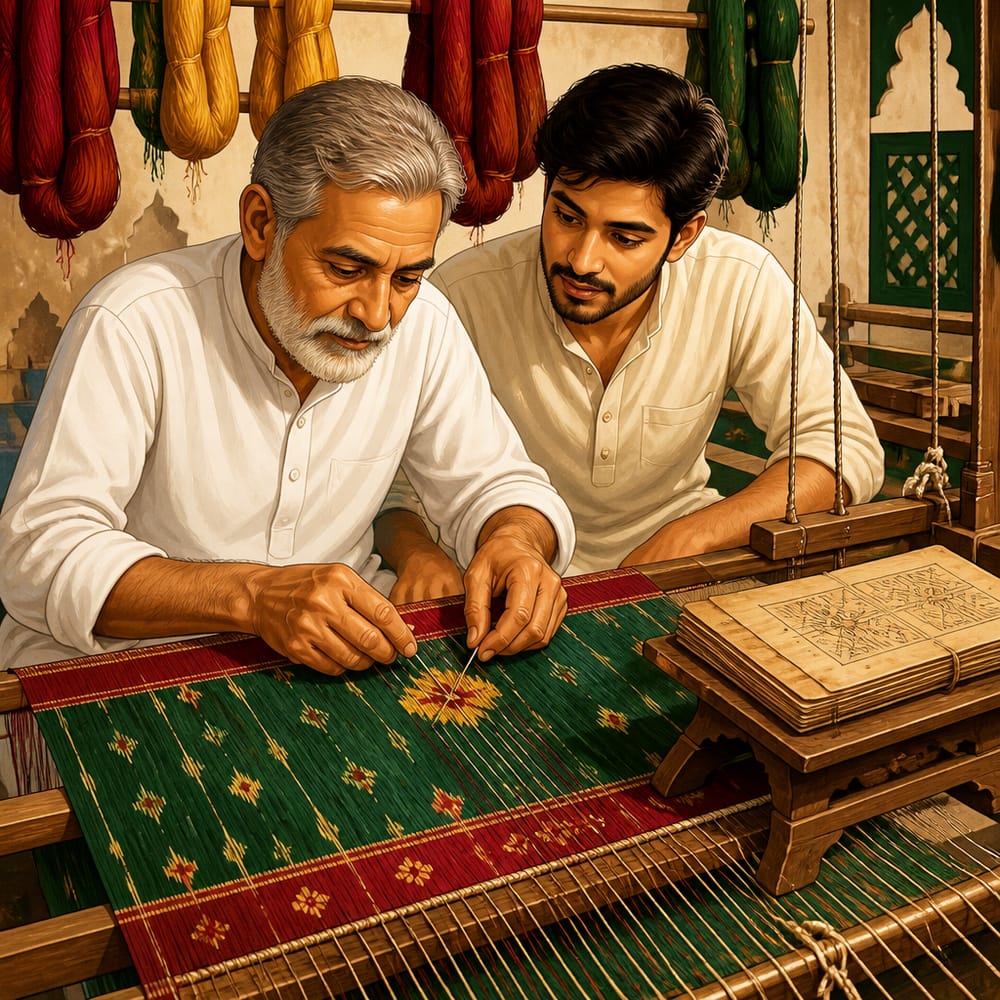
A Salvi master and son weave Patola double-ikat on a pit loom in Patan

In the old city of Patan, Gujarat, only three families remain who can create a Patola sari. The Salvi family has guarded this double-ikat technique for over 700 years - a process so complex that a single sari takes six months to complete. When asked to document the technique, master weaver Rohit Salvi shakes his head: "I can show you. I cannot tell you. My fingers know what my words cannot say."

This is the paradox at the heart of Indian weaving traditions: the most valuable knowledge was precisely the knowledge that couldn't be written down. And this "problem" was actually the solution to a profound economic challenge - how to protect intellectual property in an age before patents.

The Tacit Knowledge Economy

The Hungarian-British philosopher Michael Polanyi coined a phrase in 1966 that perfectly describes what Indian weavers had understood for millennia: "We know more than we can tell."

Consider the complexity of Banarasi brocade weaving. A master weaver coordinates 5,600 warp threads while simultaneously managing supplementary weft threads in gold and silver zari. The pattern exists only in his mind - no written notation can capture the subtle adjustments he makes as humidity changes, as threads vary, as the loom's tension shifts. His apprentice son sits beside him for twelve years, not reading instructions but absorbing rhythm, watching hands, developing the muscle memory that transforms chaos into silk.

This is tacit knowledge - knowledge embedded in the body, not the book. And it created a formidable economic moat.

Chola-era inscriptions from Kanchipuram (c. 1000 CE) document weaver guilds called saliyar who controlled temple textile production. These guilds didn't just regulate prices - they regulated knowledge. Apprenticeship lasted seven years minimum. Trade secrets were bound by religious oath. The punishment for teaching an outsider wasn't legal action - it was social death, expulsion from the community that gave your life meaning.

"Shilpa-vidya pitru-dhanah" - Craft knowledge is ancestral wealth.

This wasn't metaphor. In a world without banks, the family's accumulated skill WAS their wealth - more valuable than land because it couldn't be confiscated, more secure than gold because it couldn't be stolen.

The Economics of Twelve-Year Apprenticeships

A Banarasi master weaver guides his apprentice nephew at a jacquard loom

Why would any family invest 10-15 years training a child when they could put him to work immediately?

The answer lies in what economists call "skill premiums." A Banarasi master weaver in the 18th century earned 10-20 times what an unskilled laborer earned. The twelve-year investment paid compound returns for the next forty years of productive life. More importantly, it created an inheritable asset - the trained weaver could train his own sons, perpetuating family prosperity across generations.

The Salvi family's Patola technique illustrates this calculus perfectly. Today, a single Patola sari sells for ₹2-15 lakh. The technique cannot be replicated by machines. Only family members are trained. The 700-year investment in secrecy has created a product with near-zero competition - the ultimate economic moat.

But this system had a vulnerability: if transmission broke, the knowledge died.

Global Perspectives: Japan, Germany, and the Knowledge Problem

Michael Polanyi (1891-1976) articulated what weavers had always known. In his 1966 work "The Tacit Dimension," he argued that expert knowledge cannot be fully captured in rules or manuals. A master chef doesn't follow recipes - he knows when the sauce is right. This insight revolutionized how Western management understood organizational knowledge.

What Polanyi described philosophically, Indian weaving families had operationalized economically. Their "trade secrets" weren't secrets you could steal by reading a document - they were secrets embedded in hands, eyes, and decades of practice.

Japan's Ningen Kokuhō (Living National Treasures) system, established in 1950, offers a parallel approach. The Japanese government designates master craftspeople as "Important Intangible Cultural Properties" - acknowledging that their knowledge exists IN the person, not in any artifact. These living treasures receive stipends to train successors, ensuring tacit knowledge survives.

India has no equivalent national system, though individual states have begun recognizing master artisans. The UNESCO Intangible Cultural Heritage designation (which Banarasi weaving received) performs a similar function internationally.

Germany's Dual Apprenticeship System shows how the West institutionalized what India kept family-based. German apprentices spend 3-4 years combining classroom instruction with workshop practice. The key insight: some knowledge can only be transmitted through doing, not telling.

Tradition How Knowledge is Protected Transmission Mechanism
Indian Weaving Family secrecy, caste boundaries Father-son, 10-15 years
Japanese Crafts Government designation, stipends Master-disciple, lifetime
German Industry Guild certification, dual training Apprentice-journeyman, 3-4 years

The Indian system was more exclusive but also more fragile - knowledge died when families died out.

Modern Resonance: Gaurang Shah and the Revival Economy

A young weaver stands beside a loom he has smashed apart in despair

In 1998, fashion designer Gaurang Shah visited a village in Andhra Pradesh and watched a weaver destroy his loom. "My son became an auto driver," the weaver explained. "No one will continue. Why keep the loom?"

That moment transformed Shah's career. Over the next 25 years, he has worked with 800+ weavers across India, reviving 52 dying techniques including Jamdani, Paithani, and Uppada. His method isn't charity - it's market creation. By featuring handloom saris at Lakme Fashion Week and dressing Bollywood celebrities, he created demand that made traditional weaving economically viable again.

"The technique exists in the weaver's hands," Shah explains. "My job is to create a market where those hands are valued."

In 2024, India's handloom sector employs 43.3 lakh weavers - the second-largest source of rural employment after agriculture. The PM MUDRA Yojana and Handloom Weavers Comprehensive Welfare Scheme now provide credit and insurance to weaver families, addressing the economic precarity that drove the loom-burner's son to become an auto driver.

But the deepest challenge remains: knowledge transmission in an age of opportunity. When a weaver's son can earn more as a software developer, why spend twelve years at the loom?

Your Turn: The Value of What Cannot Be Taught

The weaving families understood something our education system often forgets: the most valuable skills are the hardest to teach.

Consider your own expertise. What do you know that you couldn't explain in a manual? What skills did you acquire through years of practice rather than instruction? That tacit knowledge - embedded in your experience, your intuition, your "feel" for the work - may be your most valuable asset.

In the next lesson, we'll explore what happened when this delicate transmission system met colonial policy - the systematic destruction of Indian handicrafts and the economic logic behind the tragedy.

Tacit knowledge as competitive advantage and barrier to entry

Warren Buffett speaks of 'economic moats' - sustainable competitive advantages. Patents are one moat; tacit knowledge is another. Tesla's battery technology can be reverse-engineered; a master weaver's touch cannot.

Indian craft traditions created 'natural monopolies' through tacit knowledge. The Patola technique isn't patented - it's simply impossible to learn without years of guided practice within the family.

A Patola sari sells for ₹2-15 lakh with near-zero competition - 700 years of tacit knowledge accumulation has created an unassailable market position

Modern MBA programs last 2 years; medical residencies 3-7 years. Indian weaving apprenticeships of 10-15 years reflect the true complexity of embodied expertise.

By accepting delayed returns, weaving families created multi-generational skill accumulation. A master at 30 could train his son for 15 years, creating a 50-year productive career that repaid the investment many times over.

Key terms

Tantuvaya
Weaver; one who works with threads to create textiles on a loom
Gupta Vidya
Secret knowledge; trade secrets passed within families or guilds, protected by oath and social sanction
Shiksha Kaal
The period of training; apprenticeship duration during which a student learns under a master's guidance
Parampara
Unbroken lineage of transmission; the chain of master-to-student teaching extending across generations

Key figures

The Salvi Family Lineage

Preserved one of the world's most complex textile techniques through 700 years of political upheaval, colonial disruption, and market transformation

Demonstrates both the power and fragility of family-based knowledge transmission - supreme protection but also supreme vulnerability to lineage extinction

Gaurang Shah

Proved that traditional weaving can compete in high fashion; created sustainable livelihoods for 800+ weavers by connecting tacit knowledge to premium markets

Shows that the 'demand problem' - not the 'knowledge problem' - was killing weaving traditions; when markets exist, knowledge transmission revives

Michael Polanyi

Gave philosophical articulation to what craftspeople always knew: some knowledge lives in the body, not the book, and can only be transmitted through practice

Polanyi's theory explains why weaving apprenticeships last 10-15 years and why 'secrets' can't simply be written down - they're not being hidden, they're being transmitted through the only possible medium: guided practice

Case studies

Banarasi Brocade: UNESCO Heritage and the 12-Year Master

Varanasi's brocade weaving tradition dates back 2,500 years. At its peak in the 18th century, over 100,000 looms operated in the city, producing silk and gold-thread textiles for Mughal courts and European aristocracy. By 2010, fewer than 50,000 weavers remained, with average daily earnings below ₹200. The technique's complexity is staggering: a kadwa (pure) Banarasi involves coordinating 5,600 warp threads while weaving real gold or silver zari into patterns like *jaal* (net), *butidar* (motifs), and *tanchoi* (Gujarati influenced). Master weaver Maqbool Hasan, whose family has woven for seven generations, explains: 'My son sat beside me from age 8. At 13, he touched the loom. At 20, he wove simple patterns. At 25, he attempted kadwa. He is 32 now and still learning the most complex designs.' In 2009, Banarasi brocade received Geographical Indication (GI) protection, distinguishing it from machine-made imitations flooding the market from Surat and China. In 2023, the Ministry of Textiles launched a comprehensive upskilling program with stipends for master weavers who take apprentices. Today, a master-woven Banarasi sells for ₹50,000-5,00,000, compared to ₹5,000 for a power-loom replica.

The Banarasi weaving community embodies the parampara principle - unbroken transmission across generations. What makes their knowledge valuable is precisely what makes it difficult to transmit: the tacit dimensions that require years of guided practice. The challenge today is economic, not technical. When a weaver's son can earn ₹30,000/month in IT after a 6-month coding bootcamp, why would he invest 12 years at the loom for uncertain returns? The dharmic response isn't to romanticize poverty but to create markets that value mastery. GI protection, e-commerce access, and premium branding are the modern equivalents of the old watan system - they create demand certainty that makes long training investments rational. Maqbool Hasan's son stayed at the loom because his father could show him a path to ₹50,000 saris, not ₹5,000 ones. The knowledge survived because the economics worked.

Banarasi weaving received UNESCO Intangible Cultural Heritage status in 2023. E-commerce platforms like Amazon Karigar and Taneira now connect weavers directly to consumers, with master-woven pieces commanding 10-100x the price of machine replicas. The number of young apprentices has increased 40% since GI protection, as families see viable futures in the craft.

Tacit knowledge survives when economics makes transmission rational. The Banarasi weavers' 2,500-year tradition endured not because of nostalgia but because master-woven brocade commanded prices that made 12-year apprenticeships worthwhile.

The premium for master-crafted goods is accelerating in a world of mass production. Hermes, whose artisans train for 3-5 years, commands a market cap exceeding $200 billion precisely because machine-made luxury cannot replicate hand-built quality. As AI automates more knowledge work, the economic value of irreplaceable tacit skills, whether in weaving, surgery, or haute cuisine, will only increase.

Price differential: Master-woven Banarasi ₹50,000-5,00,000 vs. Power-loom replica ₹5,000. The 10-100x premium reflects 12+ years of tacit knowledge accumulation.

Paithani: When the Chain Breaks - and How It Was Repaired

Paithani silk weaving, named after the town of Paithan in Maharashtra, was patronized by Maratha royalty and traded across the world. Each sari featured distinctive peacock and lotus motifs in 24-karat gold thread, with borders so intricate they took 3-6 months to complete. By the 1960s, the tradition was nearly extinct. Partition had disrupted raw silk supplies from Bengal. Competition from cheaper power-loom products had collapsed prices. Most critically, the knowledge chain had broken: master weavers had died without training successors, and their tacit knowledge died with them. In 1971, the Maharashtra government established the Yeola Cooperative to revive Paithani. But there was a problem: you can subsidize looms, but you cannot subsidize knowledge that no longer exists. The revival required finding the few remaining elderly masters - some in their 80s - and convincing them to train a new generation before they died. One such master was Tatya Kaka Dhamane, who at 85 agreed to train young weavers in techniques he had learned from his grandfather in the 1900s. The training took 7 years. Dhamane died in 1983, but his knowledge lived on in 12 apprentices who became the seed of Paithani's revival.

The Paithani case reveals the fragility of tacit knowledge systems. Unlike physical artifacts that can be preserved in museums, embodied knowledge exists only in living practitioners. When the chain of transmission breaks, the knowledge doesn't degrade gradually - it vanishes entirely. The revival succeeded because someone recognized urgency: Tatya Kaka Dhamane was 85. Another decade of neglect and his knowledge would have been irretrievably lost. The dharmic principle here is stewardship - each generation holds knowledge in trust for the next. The weavers who failed to train successors in the 1950s-60s weren't evil; they were economically rational. Training didn't make sense when the market had collapsed. The lesson is systemic: tacit knowledge requires economic conditions that make transmission worthwhile. Government intervention in 1971 didn't just provide subsidies - it created the demand certainty that made 7-year apprenticeships rational again.

Today, Paithan and Yeola have 8,000+ Paithani weavers. A handwoven Paithani sells for ₹50,000-15,00,000. The craft that nearly died is now a thriving industry and a GI-protected heritage. Dhamane's 12 apprentices became masters who trained hundreds more - the chain, once nearly broken, now extends another three generations.

Tacit knowledge can be revived, but only if you act while living masters remain. The window between 'endangered' and 'extinct' is a single generation. When an 85-year-old master dies without transmitting, the knowledge dies with them - forever.

Paithani's near-death experience is a warning for endangered crafts globally. UNESCO's Intangible Cultural Heritage list now includes 730+ traditions, many with fewer than 100 living practitioners. The revival formula, finding and supporting the last masters before they die, applies to everything from Japanese sword-making to Navajo weaving. One generation of neglect can erase centuries of accumulated skill.

Paithani weavers: Near-zero (1960s) → 8,000+ (2024). One 85-year-old master training 12 apprentices seeded an entire industry revival.

Historical context

Weaving Traditions and Knowledge Transmission (c. 1000 BCE - present)

India was the world's dominant textile producer for two millennia. Dhaka muslin was so fine it was called 'woven air'; Banarasi brocade clothed emperors from Delhi to Istanbul. This dominance rested on accumulated tacit knowledge - weaving techniques refined over generations and transmitted only through long apprenticeships. When colonial policies destroyed the economic basis for weaving, the knowledge chains broke within a generation.

China had silk weaving traditions of comparable antiquity but with different transmission structures (more state-controlled, less family-based). European guilds protected trade secrets but typically for shorter periods. The Indian system of family-based, religiously-sanctioned, decade-long apprenticeships was uniquely suited to preserving extremely complex tacit knowledge.

In 1750, India produced 25% of world GDP, with textiles as the largest export. By 1900, India was importing British cloth while traditional weavers starved. The lost knowledge represented millennia of accumulated human capital.

Understanding how tacit knowledge was transmitted and lost reveals both the fragility and resilience of traditional crafts. Revival is possible - but only if we act while living masters remain.

Living traditions

The Handloom Weavers Comprehensive Welfare Scheme provides health insurance and savings matching for 43.3 lakh registered weavers. The National Handloom Development Programme funds training programs that pair master weavers with apprentices. GI protection now covers 150+ textile products, creating market differentiation for traditionally-woven goods.

Reflection

More in Rural Crafts & Cottage Industries

All lessons in Rural Crafts & Cottage Industries · Grama Swarajya: Village Economics course