Loha-Kara: Blacksmiths and Metal Workers
Swadeshi Economics
From the ashes of destroyed handicrafts rose a revolutionary idea: economic choice as political weapon. The Swadeshi movement transformed consumption into resistance, the spinning wheel into a symbol of freedom, and proved that a colonized people could forge their own economic destiny.
The Forge That Would Not Die
In 1905, when Lord Curzon partitioned Bengal to weaken the nationalist movement, something unexpected happened. Across India, people began burning British cloth in public bonfires. Women removed their Manchester-made bangles and threw them into rivers. Students pledged to wear only swadeshi - goods made in their own land.
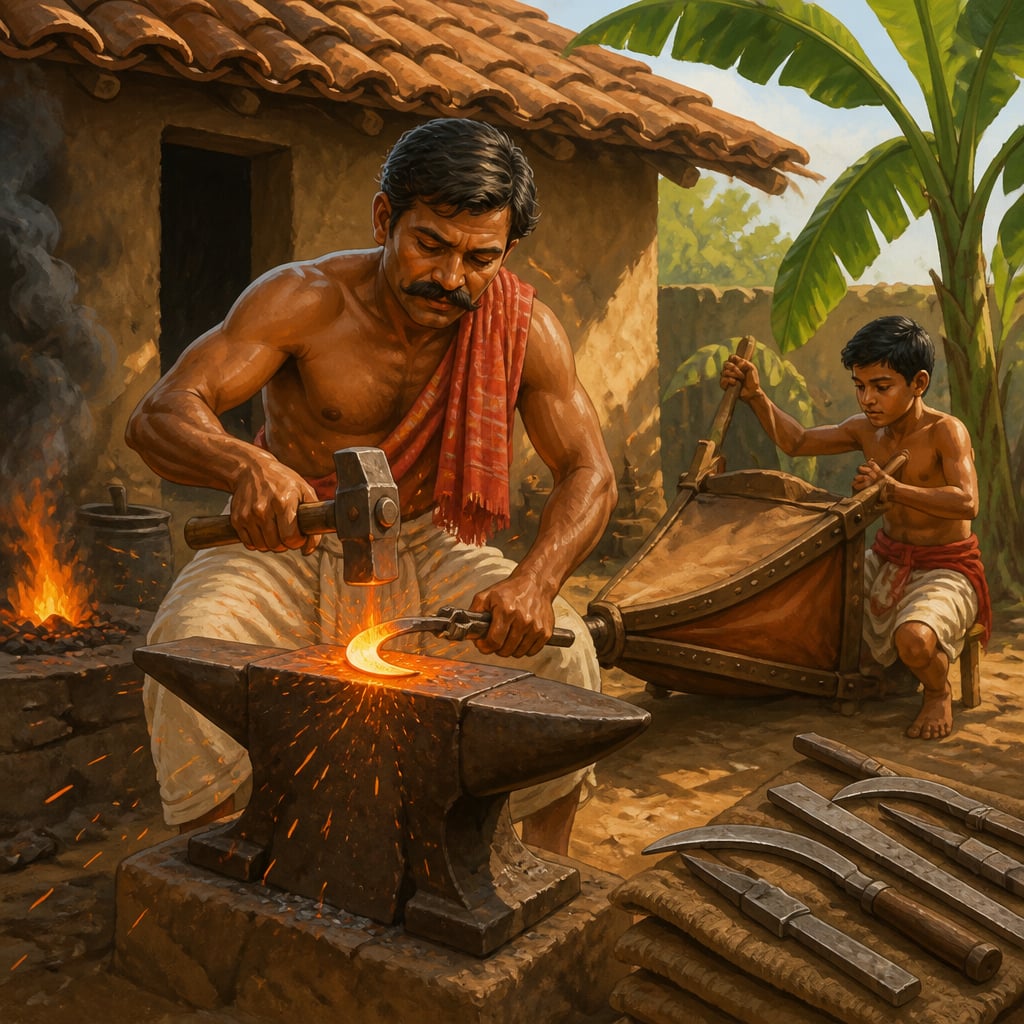
The loha-kara (blacksmith) of colonial India had watched his trade destroyed by Sheffield steel. His forge had grown cold as imported nails, tools, and implements flooded every village market. But now, the very destruction that had impoverished him became the fuel for a revolutionary fire. If British policy had killed Indian industry, Indian consumers could resurrect it through conscious choice.
This was the birth of Swadeshi as mass movement - the idea that every purchase is a political act, every economic choice a vote for or against colonial rule.
The Philosophy of Swadeshi: Beyond Boycott
Swadeshi was not simply a boycott of British goods. It was a comprehensive vision of economic self-reliance that drew on deep Indian traditions.
"Swadeshi is that spirit in us which restricts us to the use and service of our immediate surroundings to the exclusion of the more remote." - Mahatma Gandhi
The concept had roots in the grama swarajya (village self-rule) ideal - the vision of self-sufficient village republics that had characterized Indian civilization for millennia. The loha-kara who forged ploughs for local farmers, the kumbhakara who made pots for village households, the tantuvaya who wove cloth for community needs - this integrated economy was what colonialism had destroyed.
Swadeshi aimed to rebuild it, but with a crucial difference: now the rebuilding itself was an act of resistance.
Aurobindo Ghosh (1872-1950), the fiery nationalist who later became a spiritual philosopher, articulated Swadeshi's revolutionary potential in 1907: "The Swadeshi movement is not a mere business proposition; it is a religious movement. By our every act we must assert our independence and our intention to be free."
For Aurobindo, economic nationalism was the foundation of political freedom. You could not have one without the other. The loha-kara's forge wasn't just making tools - it was forging a nation.
The Economics of Resistance: How Swadeshi Worked

The Bengal Swadeshi movement (1905-1911) demonstrated how economic resistance could shake colonial power.
Phase 1: Boycott The immediate response to Partition was negative - reject British goods. Shops selling foreign cloth were picketed. Importers faced social ostracism. The value of British cotton cloth imports into Bengal fell 25% between 1905 and 1908.
Phase 2: Indigenous Production Boycott alone wasn't enough - you needed alternatives. Swadeshi entrepreneurs established:
- Textile mills producing Indian cloth
- Banks (Bengal National Bank, 1906) to keep Indian capital in Indian hands
- Insurance companies (Hindustan Cooperative Insurance)
- Shipping lines (Swadeshi Steam Navigation Company)
- Schools teaching in Indian languages (Bengal National College)
Phase 3: Economic Ecosystem The most ambitious vision was recreating the integrated village economy. The loha-kara would make tools for the farmer, the farmer would grow cotton for the weaver, the weaver would clothe the blacksmith's family. Money would circulate within the community rather than flowing to Manchester.
The British response was repression. Leaders were imprisoned. Meetings were banned. But the idea had taken root: economic freedom was the foundation of all freedom.
Gandhi's Transformation: From Boycott to Construction
Mahatma Gandhi (1869-1948) transformed Swadeshi from a protest movement into a constructive program. When he returned to India in 1915, he saw that boycott alone bred anger without building capacity.

The spinning wheel (charkha) became his answer.
"I claim for the charkha the honor of being able to solve the problem of economic distress in a most natural, simple, inexpensive, and businesslike manner," Gandhi wrote. "The charkha, therefore, is not only not useless but is a useful and indispensable article for every home."
The economics were precise:
- Spinning required no capital investment - just a simple wheel
- It could be done in spare time, especially during agricultural off-seasons
- It kept money in the village rather than sending it to distant factories
- It provided employment to women who had few other income sources
- The skill already existed in village memory, waiting to be revived
But Gandhi's genius was seeing beyond economics. The charkha was meditation in motion - each revolution of the wheel a prayer for freedom. The white khadi cloth became the uniform of nationalism, worn by everyone from peasants to Jawaharlal Nehru.
"Khadi to me is the symbol of unity of Indian humanity, of its economic freedom and equality," Gandhi declared. The loha-kara's forge and the spinner's wheel were forging something larger than tools or cloth - they were forging a nation's soul.
Global Perspectives: Park Chung-hee and State-Led Industrialization
Park Chung-hee (1917-1979), the South Korean military leader who ruled from 1961 to 1979, offers a striking parallel to Indian economic nationalism - and an instructive contrast.
Park inherited a Korea poorer than India in 1961 - per capita income was $82. He launched an aggressive state-led industrialization program:
- Five-Year Plans directing investment to strategic industries
- Export targets for companies, with rewards and punishments
- Protection of domestic industries until they were globally competitive
- Suppression of labor to keep costs low
By 1979, Korea was transformed. Per capita income had risen to $1,640. The chaebols (Samsung, Hyundai, LG) that dominate global markets today were built during this period.
Park explicitly studied Japan's Meiji industrialization and rejected the "free trade" advice of Western economists. "We had to protect our infant industries," he later wrote, "just as every developed nation had done."
| Approach | Swadeshi/Gandhi | Park Chung-hee |
|---|---|---|
| Scale | Village-based, decentralized | National, centralized |
| Technology | Appropriate (charkha, handlooms) | Heavy industry (steel, ships) |
| Capital | Indigenous, small-scale | Foreign loans, massive investment |
| Labor | Empowerment, self-employment | Discipline, factory work |
| Outcome | Independence, but slow growth | Rapid growth, but authoritarianism |
India after 1947 chose a middle path - state-led industrialization (Five-Year Plans, public sector) combined with protection for village industries (KVIC). Neither pure Gandhian Swadeshi nor pure Korean-style heavy industrialization.
Modern Resonance: Make in India and Atmanirbhar Bharat
The Swadeshi spirit never fully died. It resurfaces whenever India faces external economic pressure.
In 2014, "Make in India" aimed to transform India into a global manufacturing hub - the opposite of the colonial pattern where India exported raw materials and imported finished goods.
In 2020, "Atmanirbhar Bharat" (Self-Reliant India) was explicitly framed as completing the Swadeshi revolution. When the Prime Minister spoke of reducing import dependence, building domestic supply chains, and achieving self-reliance in critical sectors, he was channeling a century-old tradition.
The loha-kara of today might work in an MSME (Micro, Small, and Medium Enterprise) making auto components or agricultural machinery. The scale has changed, but the principle remains: economic sovereignty requires domestic productive capacity.
In 2024, India became the world's fifth-largest economy. The PLI (Production-Linked Incentive) schemes explicitly aim to build manufacturing capacity in electronics, pharmaceuticals, and defense - the 21st-century equivalents of textile mills and steel plants.
The forge that colonialism tried to extinguish is burning again.
Your Turn: Swadeshi in Your Life
Swadeshi asks a simple question: Where does your money go?
Every purchase sends a signal. Every economic choice supports a system. The shirt you wear, the phone you use, the food you eat - each connects you to a web of production, employment, and wealth creation.
Gandhi spun for an hour every day, calling it his "spiritual discipline." You don't need a charkha - but you can ask: Is there an Indian alternative to what I'm buying? Am I supporting local employment or distant factories? Is my consumption creating wealth in my community or draining it elsewhere?
In the next lesson, we'll explore how craft knowledge is being preserved and transmitted today - from GI tags to digital documentation, the modern tools protecting ancient wisdom.
Modern 'ethical consumption' movements - fair trade, organic, local food - echo Swadeshi logic. Consumers can shape production systems through purchasing choices.
Swadeshi demonstrated that mass consumer choice can challenge even powerful economic systems. The 25% drop in British cloth imports during Bengal Swadeshi proved that coordinated consumption is an economic weapon.
British cotton cloth imports to Bengal fell 25% between 1905-1908 due to Swadeshi boycott - consumer choice as economic warfare
Modern economic development theory recognizes that import substitution works best when combined with capacity building. Just blocking imports without building alternatives creates shortages.
Gandhi's genius was making production accessible. The charkha required no capital, could be used in spare time, and drew on existing skills. It was 'appropriate technology' before the term existed.
KVIC today supports 43 lakh khadi artisans; annual production exceeds ₹5,000 crore - Gandhi's construction program continues 75 years later
Key terms
- Loha-kara
- Blacksmith; one who works with iron and other metals to create tools, implements, and objects
- Swadeshi
- Of one's own country; the movement and philosophy of preferring indigenous goods and services as economic and political resistance to colonialism
- Charkha
- Spinning wheel; the hand-operated device for spinning cotton into thread, transformed by Gandhi into a symbol of self-reliance and resistance
- Khadi
- Hand-spun and hand-woven cloth, particularly cotton; became the uniform of Indian nationalism and symbol of Swadeshi
Key figures
Aurobindo Ghosh
Articulated the philosophical and spiritual foundations of Swadeshi; framed economic nationalism as religious duty and prerequisite for political freedom
Aurobindo represents the revolutionary phase of Swadeshi - intense, uncompromising, seeing every economic act as assertion of independence. His framing elevated consumption choices to spiritual significance.
Mahatma Gandhi
Transformed Swadeshi from boycott to constructive program; made the spinning wheel symbol of self-reliance; developed comprehensive vision of village-based economics
Gandhi represents the constructive phase of Swadeshi - building alternatives rather than just rejecting foreign goods. His charkha gave every Indian a tool for economic resistance.
Park Chung-hee
Demonstrated alternative path to economic sovereignty through state-led heavy industrialization; rejected Western free-trade advice; built Korea into industrial powerhouse
Park represents a different answer to the same question: how does a colonized/poor nation achieve economic sovereignty? His heavy-industry approach contrasts with Gandhi's village-industry vision.
Case studies
Khadi: Spinning Freedom Thread by Thread
In 1917, Gandhi visited Champaran in Bihar to address indigo farmers' grievances. There he saw the depths of rural poverty: families who couldn't afford clothes, children naked in winter. The colonial economy had destroyed local weaving while making imported cloth unaffordable. Gandhi's response was the charkha - the spinning wheel. He established the Sabarmati Ashram (1917) with spinning as central activity. The logic was precise: 1. **No Capital Required**: A simple charkha cost a few annas; anyone could start 2. **Time Utilization**: Spinning could be done during agricultural off-seasons, filling the '4-month unemployment' gap in rural calendars 3. **Women's Employment**: Unlike most work, spinning was socially acceptable for women across castes and communities 4. **Local Circulation**: Money spent on khadi stayed in the village rather than flowing to Manchester 5. **Skill Revival**: Spinning knowledge existed in village memory; it just needed reactivation By the 1920s, khadi had become the uniform of the independence movement. Gandhi made Congress members pledge to wear only khadi and spin regularly. The All India Spinners' Association (1925) organized production and distribution. The economic became political, and the political became spiritual - spinning was meditation. The British couldn't attack a spinning wheel as they could a bomb. Every grandmother spinning in her courtyard was a freedom fighter. Every white khadi garment was a walking protest.
The khadi movement embodied multiple dharmic principles: **Ahimsa (Non-Violence)**: Spinning was resistance without aggression. The British could imprison protestors, but they couldn't stop spinning. It was revolutionary peace. **Aparigraha (Non-Possessiveness)**: Khadi was deliberately simple. Gandhi rejected the 'more is better' logic of industrial production for sufficiency and dignity. **Seva (Service)**: Spinning for others - making cloth that would clothe your neighbor - transformed individual action into community care. **Swaraj (Self-Rule)**: The charkha was self-rule in miniature. If you could clothe yourself, you were no longer dependent on the colonizer. Political independence began with economic independence. The spinning wheel remains on India's national identity - the 24 spokes of the Ashoka Chakra on the flag echo the charkha's revolutionary symbolism.
Khadi production grew from near-zero in 1917 to millions of meters by 1947. The Khadi and Village Industries Commission (KVIC), established in 1956, continues this legacy. In 2023-24: - 43+ lakh artisans employed in khadi production - Annual production exceeds ₹5,000 crore - 8,000+ khadi retail outlets across India - Khadi has become fashionable, with designer collaborations bringing it to urban consumers The spinning wheel Gandhi introduced in 1917 is still spinning - thread by thread, freedom continues to be woven.
Economic resistance works best when it builds alternatives, not just rejects existing systems. Gandhi's charkha gave every Indian - regardless of caste, gender, or education - a tool for self-reliance. The simplest technology can become the most powerful weapon when it empowers millions.
Gandhi's charkha strategy anticipated the modern 'maker movement' and distributed manufacturing. 3D printing, desktop CNC machines, and open-source hardware give individuals production capability that was once reserved for factories. The principle is identical: when every household can produce, economic resilience is distributed and no central chokepoint can create dependency.
KVIC employment: 43+ lakh artisans. Annual khadi production: ₹5,000+ crore. Gandhi's 1917 experiment became a permanent economic institution.
Historical context
Swadeshi Movement and Economic Nationalism (1905 - 1947)
The Swadeshi movement transformed Indian nationalism from elite petition politics to mass economic resistance. The key insight was that colonial rule depended on Indian consumption of British goods - challenging this consumption was challenging the empire. The movement created lasting institutions (KVIC), lasting symbols (khadi, charkha), and lasting ideas about economic sovereignty that continue to shape Indian policy.
Other independence movements used economic nationalism differently. Korea under Japanese rule saw industrial development (for Japan's benefit). African colonies were pure extraction zones with little indigenous industry to revive. Ireland's Sinn Féin used economic resistance similar to Swadeshi. But India's movement was unique in scale, in its village-industry focus, and in its spiritual framing (spinning as meditation).
British cloth imports to Bengal fell 25% (1905-1908). By 1947, India had 420 cotton textile mills, largely built by Swadeshi entrepreneurs. Economic resistance created lasting productive capacity.
Swadeshi demonstrated that colonized peoples could challenge economic domination through consumption choices and indigenous production. The ideas remain relevant: 'Make in India' and 'Atmanirbhar Bharat' are contemporary expressions of Swadeshi principles.
Living traditions
The 'Vocal for Local' campaign launched in 2020 explicitly invokes Swadeshi. The Production-Linked Incentive (PLI) schemes for manufacturing are industrial-scale Swadeshi - building domestic capacity in electronics, pharmaceuticals, and defense. The Atmanirbhar Bharat vision frames self-reliance as national security, just as Swadeshi did a century ago.
- Gandhi Jayanti Khadi Promotion: Government institutions and many corporations encourage khadi wearing on October 2 and during freedom movement anniversaries.
- Government Khadi Procurement: Central and state governments preferentially procure khadi for uniforms, upholstery, and gifts.
- Sabarmati Ashram: Gandhi's ashram from 1917-1930; spinning wheels still operate; museum documents khadi movement
- Khadi Gramodyog Bhawan: KVIC's flagship retail store; wide range of khadi products from across India
- Weaving and Blacksmithing Villages: Working artisan communities continuing traditional production
- Sabarmati Ashram: While not a traditional temple, Gandhi's ashram functioned as a center of spiritual practice where the charkha (spinning wheel) became a meditation device; the integration of craft, spirituality, and economics exemplifies dharmic economics
- Dakshineswar Kali Temple: The temple was a center of the early Swadeshi movement; the spiritual nationalism of Ramakrishna and Vivekananda that emerged here provided the philosophical foundation for Swadeshi's integration of economics with dharma
Reflection
- Gandhi chose the charkha - simple, accessible, decentralized. Park Chung-hee chose steel mills - complex, capital-intensive, centralized. India post-1947 tried both approaches. In today's world of AI and semiconductors, what would a 21st-century Swadeshi look like? What should India prioritize for self-reliance?
- Gandhi spun for an hour every day as 'spiritual discipline.' Is there an equivalent practice you could adopt - a daily action that supports local/Indian production while developing your skills? What would your personal 'charkha' be?