GI Tags and Kala-Punaruddhar: Artisan Revival
E-commerce Meets Traditional Craft
How legal protection through GI tags and digital platforms are enabling village artisans to reach global markets while preserving authentic traditions.
The Weaver Who Went Global
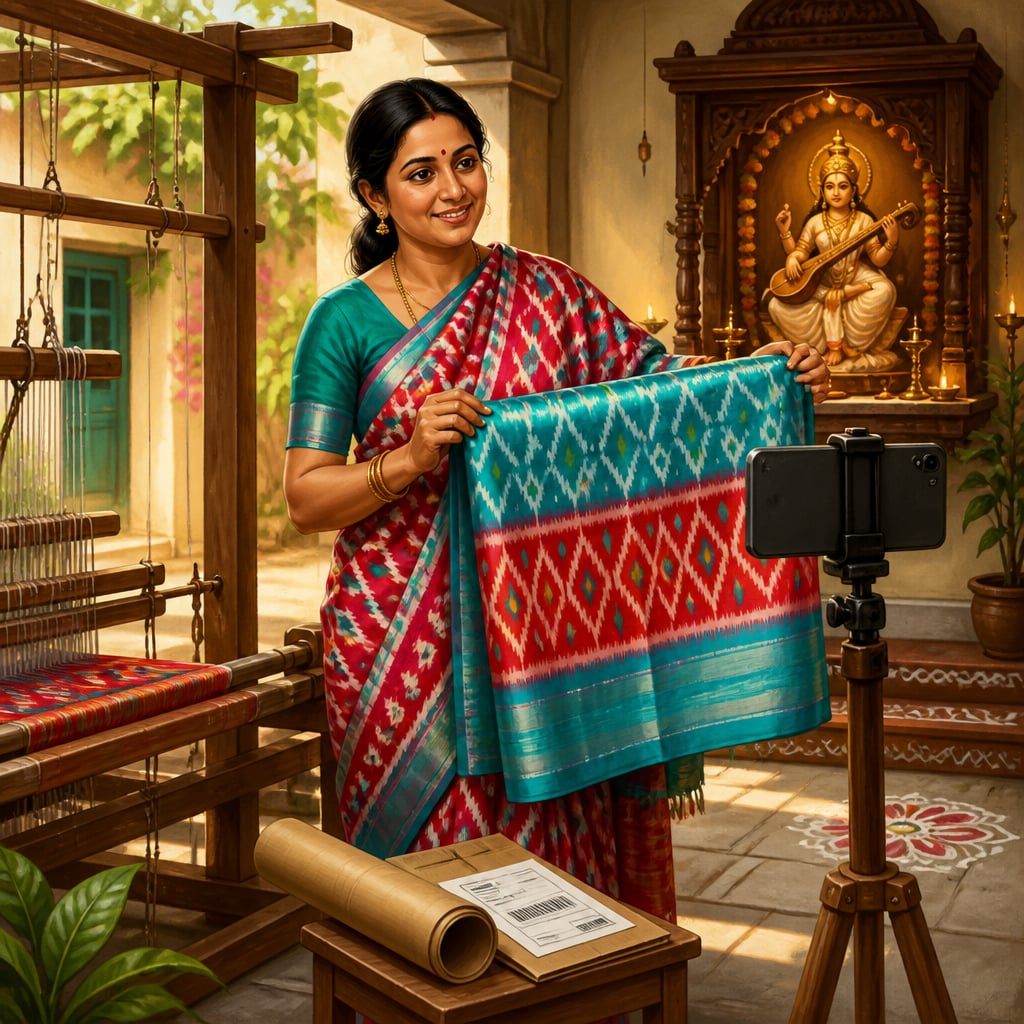
In 2019, Lakshmi Devi, a fifth-generation Pochampally weaver from Telangana, received an order that would have seemed impossible to her grandmother: 200 sarees for customers in New York, London, and Dubai. The order came not through any export house middleman who would take 60% margins, but directly through her smartphone via the Amazon Karigar platform. Her sarees carried the Pochampally Ikat GI tag, a legal guarantee that each piece was authentically handwoven in her village using traditional techniques passed down through centuries.
This convergence of ancient craft and modern technology represents a revolution in how traditional artisans can survive and thrive in the global marketplace. After nearly two centuries of decline, Indian handicrafts are experiencing a renaissance, not through government subsidy alone, but through the powerful combination of legal protection (GI tags) and digital access (e-commerce platforms). This is Kala-Punaruddhar: the revival of arts.
Understanding Geographical Indications
The concept of protecting regional products has ancient roots. The Arthashastra mentions that traders must accurately represent the origin of goods, recognizing that place of origin conferred special quality. Kautilya understood that a Varanasi silk was fundamentally different from silk produced elsewhere, not just in technique, but in the entire ecosystem of skills, materials, and traditions that made it unique.
Modern Geographical Indication (GI) tags formalize this ancient wisdom into legal protection. A GI tag certifies that a product possesses qualities or reputation essentially attributable to its geographical origin. Just as Champagne can only come from the Champagne region of France, Banarasi brocade can only be authentically produced in Varanasi.
India enacted the Geographical Indications of Goods Act in 1999, and Darjeeling Tea became the first Indian product to receive GI protection in 2004. Since then, over 400 Indian products have received GI tags, from Alphonso mangoes to Pashmina shawls, from Kolhapuri chappals to Mysore sandalwood oil. This legal framework provides several crucial protections:

Preventing Counterfeiting: Before GI protection, markets were flooded with 'Pashmina' shawls made from synthetic fibers or inferior wool. The GI tag allows authentic producers to legally prevent such fraud.
Premium Pricing Power: GI products can command 20-50% higher prices because buyers know they're getting authentic goods. A genuine Chanderi saree with GI certification sells for significantly more than imitations.
Community Ownership: Unlike trademarks owned by companies, GI tags belong to the entire community of producers in a region. No single entity can monopolize a centuries-old tradition.
The E-Commerce Revolution
Legal protection alone, however, cannot revive crafts if artisans have no access to markets. This is where digital platforms have become transformative. Traditional artisans faced three structural barriers to market access:
First, they were trapped in multi-layered supply chains where middlemen captured most of the value. A weaver might receive Rs. 2,000 for a saree that sold for Rs. 15,000 in urban markets. Second, they had no way to reach distant customers who might value their work. Third, they couldn't establish their individual or community brand identity, their work was simply absorbed into generic 'handicraft' categories.
E-commerce platforms have disrupted each of these barriers. Amazon's Karigar program, launched in 2016, specifically targets artisan communities. The platform provides not just market access but comprehensive support: product photography, listing optimization, logistics handling, and payment processing. Artisans can focus on their craft while the platform handles everything else.
GoCoop, founded in 2012 by Siva Devireddy, took a different approach, a cooperative model where artisan groups collectively own their digital storefront. The platform works directly with weaver cooperatives, ensuring that the cooperative structure that has sustained handloom communities for generations is preserved in the digital age.
The results have been remarkable. Amazon Karigar reports that artisans on the platform have seen average income increases of 30-40%. GoCoop claims to have improved livelihoods for over 50,000 weavers across 1,500 cooperatives. More importantly, these platforms have attracted younger family members back to traditional crafts, reversing decades of generational exodus.
The Shilpa-Sutra Principles at Work
This modern revival embodies ancient economic principles. The Shilpa-Sutras emphasized that artisans must receive fair compensation (nyaya-mulya) for their skill and labor. The elimination of exploitative middlemen through direct digital access is essentially the restoration of nyaya-mulya.
The texts also spoke of griha-kendra vyapara, trade centered on the household production unit. E-commerce enables exactly this: artisans can operate from their traditional family workshops, maintaining the guru-kula transmission of skills, while accessing global markets. The production remains rooted in tradition even as distribution becomes thoroughly modern.
Perhaps most significantly, the combination of GI tags and e-commerce addresses what the Arthashastra called vaidya-pramaana, the authentication of quality. Buyers in distant markets have no way to personally verify whether a 'Banarasi' saree is genuine. The GI tag provides institutional authentication, while platform reviews and ratings add social proof. Trust, the essential lubricant of all commerce, is rebuilt through modern mechanisms serving ancient purposes.
Global Parallels and Lessons
India's artisan revival through GI and e-commerce mirrors successful models worldwide. The European Union's Protected Designation of Origin (PDO) system has been protecting regional products since 1992. Parmigiano-Reggiano cheese, protected since 1996, now generates €2.4 billion annually for the Emilia-Romagna region, with strict controls ensuring that production methods remain traditional.
Etsy, the American platform founded in 2005, demonstrated that there's massive global demand for handmade, authentic products. The platform hosts over 5 million sellers, mostly individual artisans, and generated $13 billion in gross merchandise sales in 2022. This proves that despite mass industrialization, consumers increasingly seek the unique, the handmade, the story-rich.
Japan's approach offers another valuable model. The country protects traditional crafts through the Traditional Craft Products Industry Promotion Law (1974), which designates 'Dentou Kougeihin' (Traditional Craft Products). To qualify, products must be primarily handmade, use traditional techniques over 100 years old, and employ raw materials used historically. This framework has helped sustain 236 traditional craft categories.
Challenges in the Digital Revival
The e-commerce artisan model faces significant challenges that honest assessment must acknowledge. Digital literacy remains a barrier, many master artisans are elderly and unfamiliar with smartphones. Successful programs require extensive handholding, local language interfaces, and often intermediary 'digital navigators' who bridge the technology gap.
Quality consistency poses another challenge. Platform customers expect standardized products, but handmade items inherently vary. Managing customer expectations while preserving the authentic variability of handcraft requires careful communication and education.
There's also the risk of GI tag misuse or dilution. Enforcement remains weak, and counterfeiters continue to sell fake 'GI' products. The digital environment, while enabling authentic producers, also enables sophisticated counterfeiting. Blockchain-based authentication systems are being explored as potential solutions.
Finally, the very success of artisan e-commerce attracts corporate players who may dilute the model. When large retailers add 'artisan' collections, they often source from factories rather than genuine craftspeople, confusing consumers and undermining authentic producers.
The Path Forward
The revival of Indian crafts through GI protection and digital access represents a genuine success story, but it remains incomplete. Only a fraction of India's estimated 70 million artisans have access to these platforms. Many traditional crafts lack GI protection and the organizational capacity to seek it.
The key insight from this revival is that tradition and modernity need not be opposed. The Shilpa-Sutras' vision of honored artisans receiving fair compensation for excellent work can be realized through smartphones and GI certificates as effectively as through royal patronage. What matters is the outcome: sustainable livelihoods that preserve invaluable cultural heritage.
For the Dharmic economist, this points to a broader principle: economic systems should be evaluated not by their modernity or tradition, but by their alignment with eternal principles, fair exchange, skill preservation, community welfare, and the dignified treatment of those who create with their hands. When Lakshmi Devi ships her Pochampally sarees globally while working from her ancestral loom, she embodies this synthesis of the timeless and the timely.
Your Turn
Research one GI-tagged product from your region. Find out: How long has this craft existed? What makes it unique to this geography? What challenges do its producers face? Are they using digital platforms for sales? Consider how you might support authentic artisans in your consumption choices.
E-commerce and digital platforms are simply new tools for the ancient goal of connecting skilled makers with appreciative buyers. A smartphone in an artisan's hand doesn't change the nature of their craft, it just expands their reach. The danger comes only when technology is mistaken for the tradition itself. Authentic craft preservation must always privilege the skill and the maker, using technology as servant, not master.
GI tags work on this same principle, they protect an entire community of producers. When Pochampally Ikat receives GI protection, every weaver in the region benefits from the collective reputation, even though each weaver's work is individually distinctive. Digital cooperatives like GoCoop maintain this collective structure while enabling individual artisans to build personal reputations. The genius is combining community protection with individual empowerment.
Key terms
- Kala-Punaruddhar
- The revival or resurrection of traditional arts and crafts. 'Kala' means art or craft, 'Punaruddhar' means revival or upliftment. This concept encompasses all efforts to revive declining traditional crafts through market access, skill training, and cultural valorization.
- Bhaugolik Sanketaka (Geographical Indication)
- A sign used on products that have a specific geographical origin and possess qualities, reputation, or characteristics essentially attributable to that origin. In India, GI tags are governed by the Geographical Indications of Goods Act, 1999.
- Nyaya-Mulya
- Just or fair price. The concept that goods should be priced to provide fair compensation to all involved in production while remaining accessible to buyers. Central to Dharmic economics as opposed to purely market-determined pricing.
- Vaidya-Pramaana
- Authentication or certification of quality and genuineness. The process by which buyers can trust that a product is what sellers claim it to be. Essential for trade in specialty goods where quality cannot be immediately verified.
Key figures
Jaya Jaitly
Founded the Dastakari Haat Samiti in 1986, pioneering the model of direct artisan-to-consumer sales through craft bazaars. She worked for decades to give artisans dignity, fair prices, and direct market access long before digital platforms existed. Her book 'Craft Traditions of India' documented numerous endangered crafts.
Jaya Jaitly's work laid the philosophical and organizational groundwork for artisan revival. Her insistence that artisans should sell directly to consumers, receive fair prices, and be honored for their skills anticipated what digital platforms now enable at scale. She demonstrated that Indians would pay premium prices for authentic craft if they could access it.
Siva Devireddy
Founded GoCoop in 2012 as an e-commerce platform specifically designed for handloom weaver cooperatives. The platform preserves the cooperative ownership model while providing global market access. GoCoop works with over 1,500 cooperatives reaching 50,000 weavers, combining traditional collective organization with modern digital commerce.
Devireddy represents the new generation of social entrepreneurs who use technology to solve traditional problems. His insight was that e-commerce for artisans shouldn't disrupt successful traditional structures like cooperatives, but should strengthen them. GoCoop proves that digital platforms can work with rather than against traditional community organization.
European PDO System
The European Union's PDO system, established through Regulation (EEC) No 2081/92, created the most comprehensive geographical indication protection framework globally. It protects over 3,400 products with estimated market value exceeding €75 billion. Products like Parmigiano-Reggiano, Champagne, and Prosciutto di Parma have become global premium brands through this protection.
The European model demonstrates what robust GI protection can achieve at scale. While India's GI system is younger, it can learn from European successes: strict enforcement, aggressive prosecution of counterfeiting, consumer education about GI marks, and support for producer organizations. The European example proves that traditional products can compete globally when properly protected.
Living traditions
- Crafts Council of India Network Temples: Temple towns like Kanchipuram, Thanjavur, and Madurai remain centers of GI-protected crafts; the religious significance of these locations attracts tourism that supports artisan e-commerce and direct sales
- Rath Yatra and Craft Revival: The annual construction of Rath Yatra chariots sustains traditional woodworking and sculpture skills now protected by GI; this religious requirement maintains demand for skills that commercial production would not support
Reflection
- Why might artisans prefer selling through cooperatives like GoCoop rather than as individual sellers on large platforms like Amazon? Consider both economic and non-economic factors.
- How should we balance authenticity preservation (which GI tags require) with the need for innovation and adaptation to contemporary markets? Can traditional crafts evolve without losing their essential character?