Relevance in 2026 and Beyond
Village Crafts in an Age of AI and Automation
How the economics of village artisans offers surprising insights for navigating work, meaning, and community in an era of artificial intelligence and global supply chain disruption.
When Robots Make Everything
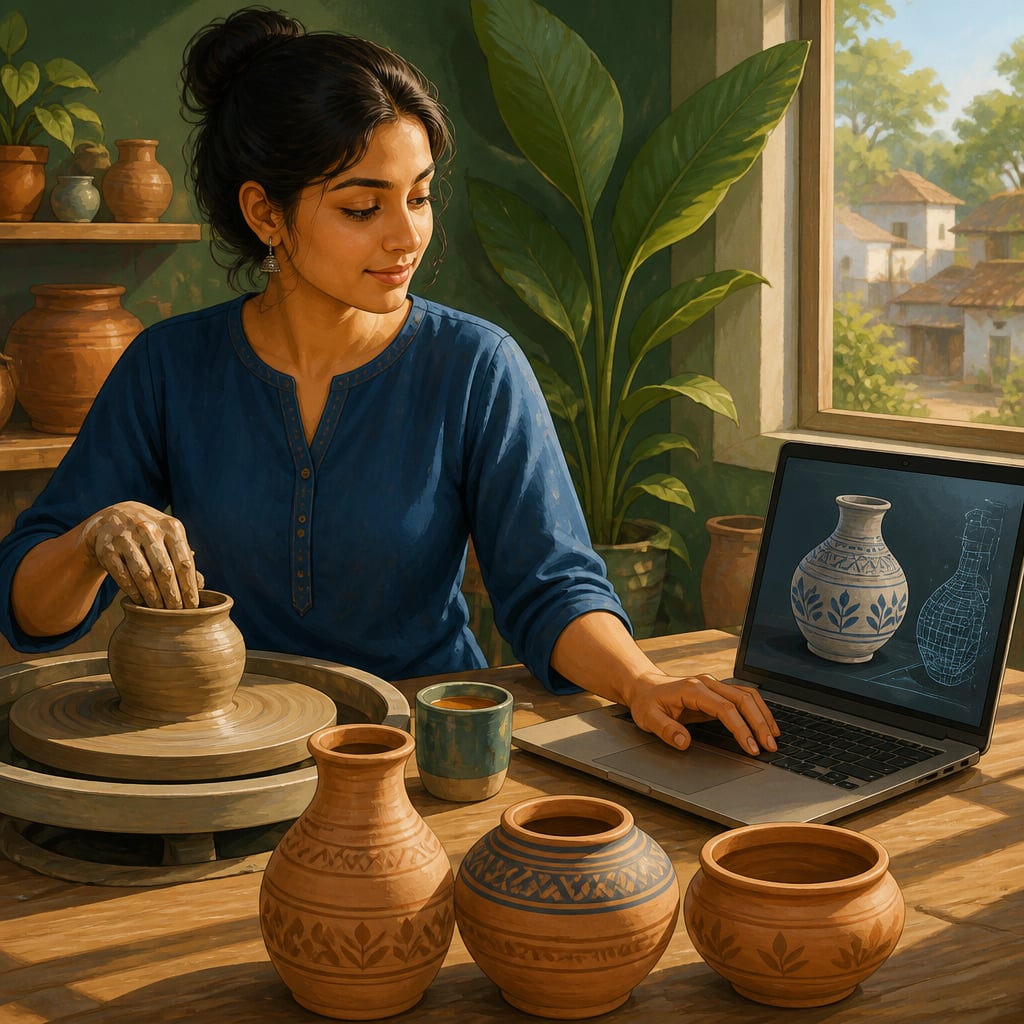
What happens when AI can generate art, write code, diagnose diseases, and compose music? In 2024, a friend showed me an AI-generated painting that won an art competition, and it genuinely moved me. Then came the vertigo: if machines can create beauty, what's left for humans? This question haunts our age. As ChatGPT writes essays and Midjourney creates images, we're forced to ask: what is the unique value of human work?
The village artisans we've studied faced a similar crisis two centuries ago. When British mills mass-produced cloth that was cheaper, more uniform, and more available, what was the point of a weaver spending days on a single saree? History's answer, that their livelihoods were destroyed but their traditions mattered, is incomplete. The real question is why those traditions are now experiencing revival.
The Modern Challenge: Meaning in the Age of Efficiency
We live in an unprecedented moment. Global supply chains can deliver almost anything, almost anywhere, at historically low costs. AI systems are automating cognitive tasks once thought uniquely human, legal research, medical diagnosis, creative writing, even code generation. The World Economic Forum estimates that AI will displace 85 million jobs globally by 2025 while creating 97 million new ones. But what kind of work will these be?
The crisis isn't just economic, it's existential. In developed economies, depression and anxiety rates climb even as material prosperity increases. Japan coined a word, ikigai, for the search for life's purpose. The WHO reports that mental health disorders cost the global economy $1 trillion annually in lost productivity. People have jobs but feel purposeless. They have stuff but feel empty.
Simultaneously, there's a counter-trend. The global handicraft market is projected to reach $1.2 trillion by 2027. Etsy's handmade marketplace generated $13 billion in sales in 2022. Premium consumers increasingly seek 'authentic,' 'artisanal,' 'handmade' products, paying 30-50% more for them. What's driving this? In an age where everything can be efficiently produced, why do people crave the deliberately inefficient?
The Ancient Insight: Work as Sadhana

The Shilpa-Sutras that governed Indian craft traditions had an answer we've forgotten: work is not merely economic activity but spiritual practice (sadhana). The artisan wasn't just producing a pot or weaving cloth, they were participating in creation itself. Vishwakarma, the divine craftsman, worked not for profit but as an expression of cosmic creativity.
This chapter revealed several principles that address our modern predicament:
Knowledge that cannot be codified: Tacit knowledge, the weaver's feel for tension, the potter's sense of clay, cannot be reduced to algorithms. Michael Polanyi called this 'knowledge we cannot tell.' It requires embodied practice and human transmission.
Community as economic unit: The shreni (guild) system understood that sustainable livelihoods require community structure, not just individual enterprise. Artisans weren't solo entrepreneurs but members of knowledge-preserving institutions.
Place-based authenticity: GI (Geographical Indication) protection recognizes what ancient Indians knew, that products carry the essence of their geography, their makers, their traditions. A Banarasi saree from a Varanasi loom contains something a factory cannot replicate.
Fair exchange over maximum extraction: Nyaya-mulya (just price) prioritized sustainable relationships over maximum profit. When weavers received fair compensation, they preserved traditions. When exploitation dominated, skills died.
The Bridge: Applications for 2026 and Beyond
For Personal Work and Career: As AI handles routine cognitive tasks, human advantage shifts to exactly what artisans specialized in: judgment born of experience, creativity rooted in tradition, and the ability to hold complexity without reducing it. Consider: what in your work requires the equivalent of a weaver's 'feel'? That's what will remain valuable.
This doesn't mean everyone should become a potter. It means orienting toward work that involves tacit knowledge, embodied skill, and contextual judgment. A doctor's bedside manner, a teacher's read of a struggling student, a designer's sense of what feels right, these are craft skills that automation cannot fully replicate.
For Organizations and Leadership: The shreni model offers insights for knowledge-intensive organizations. How do you transmit tacit knowledge? Not through documentation alone, but through apprenticeship-style relationships. Companies like Toyota (with its master-apprentice system) and traditional law firms (with their associate training models) preserve craft knowledge better than those relying purely on manuals.
For Economic Policy: The colonial destruction of Indian handicrafts shows what happens when efficiency becomes the only value. Britain's industrial exports were more efficient but destroyed an ecosystem of skills, communities, and meaning. Today's policymakers face similar choices: should we optimize purely for GDP growth, or protect the social fabric that makes life meaningful?
India's 'One District, One Product' (ODOP) initiative and GI tag expansion represent attempts to answer this. The goal isn't to freeze tradition but to create conditions where traditional skills can evolve while remaining rooted.
For Consumer Choices: Every purchase is a vote for a certain kind of economy. Buying GI-tagged products, supporting artisan cooperatives like GoCoop, or choosing handmade over mass-produced isn't just sentimentality, it's economic support for an alternative model of work and value.
Addressing Skepticism
'This sounds like nostalgia for a pre-industrial past,' skeptics might say. Fair concern. But the evidence suggests otherwise. The global craft revival isn't about rejecting modernity, it's about integration. Weavers using e-commerce, artisans with Instagram followings, GI tags enforced through modern legal systems. The combination of traditional skill and modern distribution is creating sustainable livelihoods.
'Can village crafts really compete with factory production?' For commodity goods, no. But that's not the market. The premium segment, people willing to pay more for authenticity, sustainability, and story, is growing faster than the commodity segment. There's a viable niche, and it may expand as AI makes everything else feel increasingly generic.
'Isn't it exploitative to keep people in "traditional" occupations?' Only if done coercively. When artisans choose to continue their craft because it provides meaningful work and fair income, it's not exploitation, it's preservation of options. The colonial period didn't preserve options; it destroyed them. The goal now is to restore choices.
The honest limitation: village crafts cannot absorb the millions displaced by automation. They're part of the answer, not the whole answer. But they demonstrate that alternatives exist, that efficiency isn't the only value, that meaning matters, and that human skill retains worth even in an age of machines.
Your Next Steps
Three practical applications from this chapter:
Audit your own work for craft elements: What in your work involves tacit knowledge, contextual judgment, or embodied skill? Invest in developing these, they're your sustainable advantage.
Support the craft economy: Identify GI-tagged or artisan-made products you can incorporate into your purchases. The economic vote matters.
Advocate for preservation: Support policies that protect traditional knowledge, from TKDL-style documentation to GI enforcement to artisan training programs.
The village artisans faced modernity's first wave, industrialization, and many didn't survive. We face modernity's next wave, AI and automation. Their experience offers not a template but a provocation: what do we value beyond efficiency? The answer will shape what kind of future we build.