Grama-Shilpi: Village Artisan Economics

Weavers, Potters, Smiths

Discover how India's village artisans formed the backbone of a self-sufficient economy for millennia - where the weaver, potter, and blacksmith weren't just workers but essential nodes in an intricate web of mutual service that sustained communities without external dependency.

The Loom That Never Stopped

In the village of Pochampally, Telangana, the rhythmic clack-clack of wooden looms has echoed through generations. When 78-year-old Lakshmi Devi sits at her pit loom at 4 AM, she's not just weaving cloth - she's continuing a 500-year-old tradition of ikat weaving that once clothed kings and today graces international fashion runways. Her grandson, studying computer science in Hyderabad, sends her videos of Pochampally saris selling for ₹50,000 on Amazon. "The loom fed your grandfather's grandfather," she tells him. "Now it can fund your startup."

This is the story of India's grama-shilpis - village artisans - and the economic system that made every Indian village a self-sustaining universe.

The Artisan Universe: How Villages Functioned
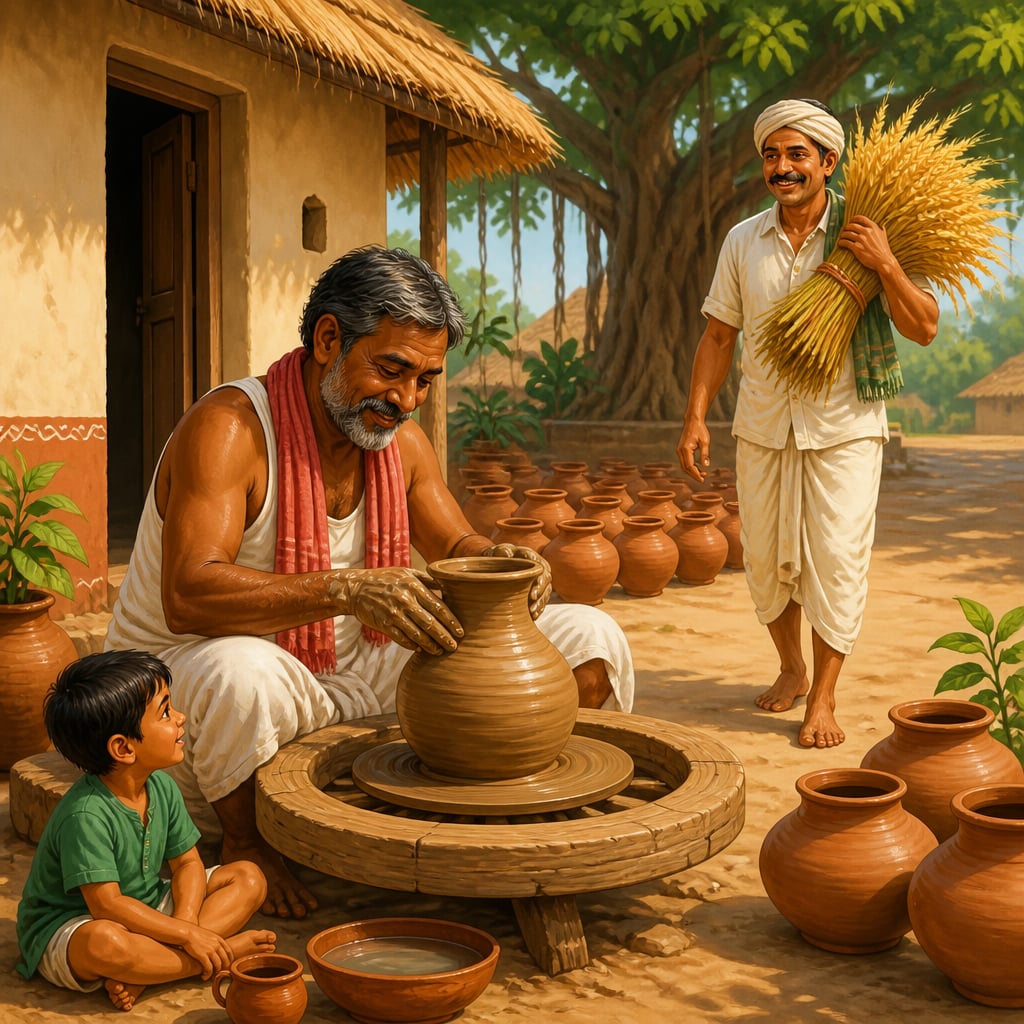
A village potter at his wheel receives grain from a farmer in the jajmani exchange

Imagine a village in 10th century Karnataka. The farmer grows rice but cannot forge his plough. The Brahmin teaches but cannot weave his sacred thread. The warrior protects but cannot fire his own clay pots. How does such a community survive?

The answer was the jajmani system - an intricate web of hereditary service relationships. The blacksmith (loha-kara) forged tools for twelve farming families; in return, each family gave him a fixed share of their harvest. The potter (kumbhakara) supplied vessels to the entire village; weddings, festivals, and deaths meant predictable demand. The weaver (tantuvaya) clothed everyone from the landlord to the laborer, receiving grain, vegetables, and social standing in return.

This wasn't barter - it was something more sophisticated. Each artisan family held a watan (hereditary service right) that guaranteed them a livelihood regardless of market fluctuations. The village needed 1,200 pots per year; the potter supplied them. No advertising. No competition. No uncertainty.

The Arthashastra captures this precision: "Let the superintendent of commerce ensure that artisans receive fair remuneration for their labor, for the prosperity of artisans is the prosperity of the realm." Kautilya understood what modern economists call "demand certainty" - artisans could invest in skill development because they knew their market wouldn't vanish.

The Vishwakarma Principle: Divinity in Craft

A village blacksmith offers a marigold garland to his anvil at Vishwakarma puja

But Indian artisan economics wasn't merely transactional. It was sacred.

"Shilpam sarva-vidyanam pradhaanam" - Of all knowledge, craft-skill is supreme.

This shloka from the Vishwakarma Prakash elevates the artisan's work to the highest form of learning. Vishwakarma - the divine architect who built the gods' palaces - became the patron deity of all craftspeople. When a Chola bronze-caster in Swamimalai created a Nataraja statue using the lost-wax technique, he wasn't manufacturing - he was performing puja.

This sacralization had profound economic effects. Craft secrets became family treasures, passed through generations with religious reverence. The kammalar (artisan castes) of Tamil Nadu developed bronze-casting techniques so sophisticated that modern metallurgists still study them. Quality wasn't enforced by regulation; it was embedded in identity. To produce shoddy work was to insult Vishwakarma himself.

Global Perspectives: Morris, Smith, and the Artisan Question

William Morris (1834-1896) would have recognized Pochampally's looms. The English artist-craftsman led the Arts and Crafts Movement, rebelling against industrial factories that reduced workers to machine-tenders. "I do not want art for a few, any more than education for a few," Morris declared. His vision - craftsmen taking pride in beautiful, handmade objects - mirrored what Indian villages had practiced for millennia.

Yet Morris failed where Indian villages succeeded. His handcrafted goods became luxury items for the wealthy, while factory products served the masses. The Indian system avoided this trap through the jajmani structure - artisan goods weren't luxuries but necessities distributed across the entire community.

Adam Smith (1723-1790) praised division of labor in pin factories, where workers repeated one task endlessly. Indian village economics offered an alternative model: the artisan who made the entire product - from raw cotton to finished dhoti - retained ownership of the creative process. The weaver wasn't alienated from her work; she was its author.

E.F. Schumacher (1911-1977), writing "Small Is Beautiful" in 1973, explicitly drew on Gandhian village economics. His concept of "appropriate technology" - human-scale, locally controlled, skill-enhancing - was essentially the grama-shilpi model translated for industrial societies.

Thinker Key Insight Indian Parallel
William Morris Handcraft preserves human dignity Vishwakarma tradition - craft as sacred duty
Adam Smith Specialization increases efficiency Jajmani - specialization within community reciprocity
Schumacher Small-scale is sustainable Grama swarajya - village self-sufficiency

Modern Resonance: The ₹3 Lakh Crore Revival

In 2024, India's handicrafts sector employs over 70 lakh artisans and generates ₹3.4 lakh crore in output. But the real story isn't in aggregate numbers - it's in individual transformations.

A rural weaver knots a hand-tied carpet at her home loom in Rajasthan

Nand Kishore Chaudhary left his family's shoe business to start Jaipur Rugs in 1978 with just two looms and nine weavers. His radical idea: bring the loom to the artisan, not the artisan to the factory. Today, 40,000+ rural artisans (80% women) weave carpets from their doorsteps, earning while remaining in their communities. A single carpet might pass through hands in five villages across Rajasthan before reaching a Manhattan apartment.

The Government of India's One District One Product (ODOP) scheme explicitly revives the grama-shilpi model. Chanderi silk in Madhya Pradesh, Phulkari embroidery in Punjab, Pattachitra painting in Odisha - each district cultivates its hereditary craft, but with modern market access.

In 2023, the Pochampally handloom cluster became India's first textile village to receive the UN World Tourism Organization's "Best Tourism Village" recognition. Lakshmi Devi's grandson might just build his startup around his grandmother's loom after all.

Your Turn: Thinking Like a Grama-Shilpi

The next time you purchase a handcrafted item, consider: you're not just buying a product. You're participating in an economic relationship that predates stock markets by three thousand years.

Ask yourself: Does the craftsperson know who will use their creation? Does the buyer know who made it? This mutual recognition - absent in industrial production - is what made village economics human.

In the next lesson, we'll enter the world of the tantuvaya - the weaver - and discover how families transmitted craft knowledge across centuries. The loom holds more secrets than cloth.

Modern labor economics shows that job insecurity reduces skill investment. Gig economy workers underinvest in training because they don't know if they'll have work tomorrow.

The watan/jajmani system provided cradle-to-grave demand certainty, enabling multi-generational skill compounding. A family could spend decades perfecting a technique because they knew the market would exist for their grandchildren.

Chola bronze-casters maintained the lost-wax technique for 1,000+ years - an R&D investment impossible under market uncertainty

Modern quality management relies on external inspection (ISO audits, QC departments). This is expensive and catches errors after production, not before.

Sacralizing craft internalized quality control. The artisan self-regulated because his identity was at stake. The Chola bronze-casters didn't need QC inspectors - their religious identity demanded perfection.

Swamimalai bronze icons have maintained metallurgical consistency across 1,000 years - without modern testing equipment, purely through transmitted knowledge and identity-based quality control

Key terms

Grama-Shilpi
Village artisan or craftsperson who provides essential goods and services within a rural community
Watan
Hereditary service right that guaranteed an artisan family exclusive access to serve a particular village or patron group
Jajmani
The traditional system of hereditary patron-client relationships between service-providing artisan castes and land-owning patron families
Kammalar
The artisan communities of Tamil Nadu, traditionally comprising five craft groups: blacksmiths, carpenters, bronze-casters, goldsmiths, and stonemasons

Key figures

Vishwakarma Tradition

Sacralized craftsmanship, creating a framework where quality was a religious duty and skill secrets were sacred family heritage

Vishwakarma tradition explains why Indian artisans invested so heavily in skill development - their work wasn't just livelihood, it was worship

Nand Kishore Chaudhary

Modernized the grama-shilpi model - proving that village artisans can access global markets without abandoning their communities

Demonstrates that traditional artisan economics can thrive in the 21st century with appropriate market linkages and dignity-preserving structures

William Morris

Articulated the philosophical case for handcraft in industrial societies; influenced design movements worldwide

Morris's partial failure highlights what made Indian village economics succeed: the jajmani system distributed artisan goods across ALL social classes, not just the wealthy

Case studies

Pochampally: From Dying Looms to UNESCO Recognition

In the 1990s, the ikat weavers of Pochampally, Telangana, faced extinction. Power looms had captured 90% of the textile market. The 15,000 weavers who had practiced the intricate tie-dye technique for 500 years saw their children flee to cities for construction work. Monthly earnings had dropped below ₹2,000. The geometric precision of Pochampally ikat - where warp and weft threads are resist-dyed before weaving to create patterns - seemed destined for museum displays. Then came a multi-pronged revival. The state government secured Geographical Indication (GI) status in 2005, legally protecting the Pochampally brand. The IKEA Foundation partnered with local weavers for contemporary designs. E-commerce platforms like Amazon Karigar and GoCoop created direct market access. Most critically, the weavers themselves formed cooperatives that cut out middlemen. In December 2023, Pochampally became the first Indian textile village to receive the UN World Tourism Organization's 'Best Tourism Village' award. Visitors now stay in weaver homes, learn the craft, and purchase directly. A single sari that fetched ₹2,000 from middlemen in 1995 now sells for ₹25,000-50,000 online.

The Pochampally revival embodies the grama-shilpi principle: artisans thriving within their community, not despite it. Unlike factory employment that uproots workers, this model kept families together and craft transmission alive. Critically, the revival worked because it restored 'demand certainty' - GI protection guaranteed that Pochampally ikat would remain distinct, e-commerce provided steady orders, and tourism created year-round income. The watan system has been reimagined for the 21st century. The dharmic dimension is visible in how weavers speak of their work. When Lakshmi Devi says, 'My patterns carry my grandmother's blessing,' she's expressing the Vishwakarma principle - craft as sacred transmission. This identity-based quality control is why Pochampally ikat commands premium prices without formal certification.

Today, Pochampally's 15,000+ weavers generate annual revenues exceeding ₹100 crore. Weaver family incomes have risen 10-15x since the GI recognition. Young people are returning to the loom - not out of desperation, but aspiration. The craft that seemed doomed in 1995 now has a 50-year waiting list for master weaver apprenticeships.

Traditional craft economies can not only survive but thrive in the 21st century - if they're given the three pillars the jajmani system provided: identity protection (GI), demand certainty (e-commerce/tourism), and community structure (cooperatives).

Pochampally's revival model is being replicated across India's 3,000+ craft clusters. The combination of geographic authentication (GI), digital market access (e-commerce), and cooperative structure mirrors how European artisan producers like Swiss watchmakers and Italian leather workers maintain premium positioning. Etsy's $13 billion marketplace proves that global consumer demand for handcrafted, place-based products is growing, not shrinking.

Pochampally weavers' monthly income: ₹2,000 (1995) → ₹25,000+ (2024). A 12x increase while staying in their ancestral village.

Historical context

Village Artisan Systems (c. 1000 BCE - 1800 CE)

For over two millennia, Indian villages operated as largely self-sufficient economic units. Each village had its complement of artisans - typically 10-15 craft families serving 200-500 agricultural households. The system required no external inputs except salt, metals, and luxury goods. Population growth was absorbed through new village formation rather than urban migration. This stability ended only with colonial intervention.

Medieval European guilds offered some parallels - hereditary crafts, quality standards, market protection. But European guilds were urban phenomena tied to town charters, while Indian artisan systems were rural and embedded in the agricultural cycle. Chinese village crafts existed but lacked the religious sacralization and hereditary service rights of the Indian system.

In 1750, India produced 25% of world manufacturing output. By 1900, this had fallen to 2%. The village artisan system was the foundation of this manufacturing dominance.

Understanding the village artisan system reveals an alternative to both pure market economics and centralized planning. It was a 'third way' that provided stability, quality, and community cohesion for millennia.

Living traditions

The One District One Product (ODOP) scheme explicitly aims to revive grama-shilpi economics. 740+ products across 700+ districts are being promoted as location-specific crafts. The PM Vishwakarma Scheme (2023) provides ₹15,000 crore support for traditional artisans, including training, credit, and market linkages.

Reflection

More in Rural Crafts & Cottage Industries

All lessons in Rural Crafts & Cottage Industries · Grama Swarajya: Village Economics course