Kumbhakara: Potters and Ceramic Traditions
Death of Indian Handicrafts
How did the world's greatest manufacturing economy become an impoverished exporter of raw materials in just one century? The systematic destruction of Indian village crafts - from Dhaka muslin to village pottery - reveals an economic crime whose effects persist to this day.
The Bones Bleaching on the Plains
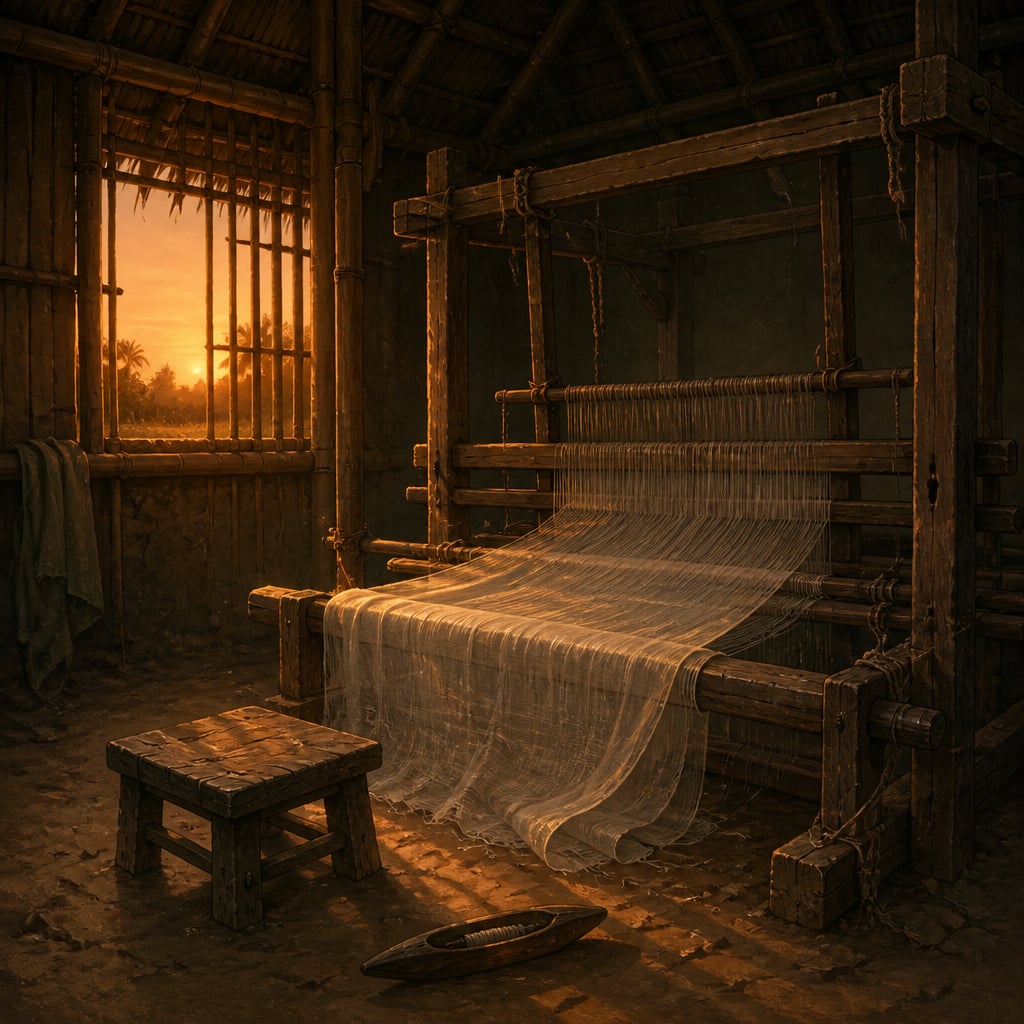
In 1834, the British Governor-General of India, Lord William Bentinck, made a confession that would echo through history: "The misery hardly finds a parallel in the history of commerce. The bones of the cotton weavers are bleaching the plains of India."
This was not metaphor. Across Bengal, skilled weavers who had clothed the world for centuries were starving to death. In Dhaka alone, the population collapsed from 150,000 to 30,000 in a single generation. The kumbhakaras (potters) who had supplied every village household with water vessels, cooking pots, and ritual objects watched as British ceramics flooded markets at prices they couldn't match. The loha-karas (blacksmiths) found their iron tools undercut by Sheffield steel.
This was not accident. It was policy.
The World's Workshop: What Was Destroyed
To understand the magnitude of what was lost, consider what existed before.
In 1750, India produced 25% of global GDP and dominated world manufacturing. Dhaka muslin - so fine it was called abrawan ("running water") or baft hawa ("woven air") - was worth more than its weight in gold. A 7-meter sari could pass through a finger ring. Roman emperors, Persian shahs, and Chinese mandarins competed for these textiles.
The kumbhakara tradition was equally sophisticated. Village potters produced not just utilitarian vessels but terracotta art of stunning complexity - the Bankura horses of Bengal, the Gorakhpur terracottas of Uttar Pradesh, the ritual pottery for every Hindu and Buddhist ceremony. Each village had its potter family, their techniques refined over centuries.
"Mritpatra kumbhakarasya shilpam" - The potter's craft transforms clay into life.
This wasn't primitive handicraft - it was advanced manufacturing embedded in a sophisticated supply chain. The village economy was self-sufficient not because it was isolated, but because it was complete.
The Mechanism of Destruction
How do you destroy the world's largest manufacturing economy?
The British employed a systematic three-step process that modern economists now recognize as "kicking away the ladder" - preventing others from using the same industrial policies that built Britain's own economy.

Step 1: Tariff Inversion (1700-1813)
Indian textiles were so superior that Britain couldn't compete. The response was not innovation but legislation. In 1700, Britain banned the import of printed Indian fabrics. By 1720, even wearing Indian cloth was prohibited. Meanwhile, Indian markets were forced open to British goods with minimal tariffs.
The numbers are stark: British goods entered India at 2-4% duty; Indian goods entering Britain faced 70-80% tariffs. This wasn't free trade - it was its opposite.
Step 2: De-industrialization (1813-1858)
With the 1813 Charter Act, British manufacturers gained unlimited access to Indian markets. Machine-made Manchester cotton flooded Bengal. The price differential was insurmountable: what took an Indian weaver a week to produce, British factories churned out in hours.
But price wasn't the only weapon. Colonial administrators actively discouraged Indian manufacturing. Weavers were forced to sell only to the East India Company at dictated prices. Those who resisted faced punitive taxation or outright destruction of their looms.
Step 3: Raw Material Extraction (1858-1947)
India was transformed from manufacturing powerhouse to raw material supplier. Raw cotton grown by Indian farmers was shipped to Manchester, woven into cloth, and sold back to India. The value addition - and the jobs - stayed in Britain.
By 1900, India's share of world manufacturing had collapsed from 25% to under 2%. The transformation was complete: the world's workshop had become a plantation.
Global Perspectives: Ha-Joon Chang and the Ladder
Ha-Joon Chang (1963 - present), the Korean economist at Cambridge University, has documented this pattern across colonized nations. In his influential work "Kicking Away the Ladder" (2002), he demonstrates that every developed nation - Britain, America, Germany, Japan, Korea - used protectionism to build their industries before preaching "free trade" to others.
India is Chang's primary example of forced de-industrialization. "The British did not merely out-compete Indian textiles," Chang writes. "They used state power to destroy an industry and then justified it as the natural operation of the market."
Friedrich List (1789-1846), the German economist, had made similar arguments a century earlier. List argued that free trade between unequal partners benefits only the stronger. His ideas influenced the Swadeshi movement and later India's post-independence industrial policy.
Karl Marx, writing in 1853, was blunt: "England has broken down the entire framework of Indian society, without any symptoms of reconstitution yet appearing... The British intruder broke up the Indian handloom and destroyed the spinning wheel."
| Economist | Key Insight | India Relevance |
|---|---|---|
| Ha-Joon Chang | Developed nations used protection, then preached free trade | India was forced to de-industrialize through rigged trade |
| Friedrich List | Free trade between unequals favors the strong | Inspired Swadeshi rejection of British goods |
| Karl Marx | Colonialism destroys existing economic systems | Documented destruction of Indian handicrafts in real-time |
The Potter's Lament: Ceramics and Colonial Competition
The kumbhakara's fate mirrored the weaver's.
British ceramics - Wedgwood, Staffordshire, Spode - were products of the Industrial Revolution. Factory production enabled prices that village potters couldn't match. But again, price wasn't the only factor.
Colonial administrators promoted British goods as "modern" while labeling Indian crafts as "primitive." Railways - built primarily to extract raw materials - made it easy to transport British ceramics to every market town. Local potters, whose distribution had always been village-based, couldn't compete with this reach.
The cultural dimension was equally devastating. British education taught Indians to despise their own crafts. Macaulay's famous 1835 Minute on Education explicitly aimed to create "a class of persons Indian in blood and colour, but English in tastes, in opinions, in morals and in intellect." Buying British became a mark of status; using village pottery became a sign of backwardness.
By 1900, the integrated village craft economy was shattered. Potters became agricultural laborers. Weavers starved. Blacksmiths abandoned their forges. The grama-shilpi system that had sustained Indian villages for millennia was destroyed in barely a century.
Modern Resonance: The Data of Devastation
The economic historian Utsa Patnaik has calculated that Britain extracted approximately £45 trillion (in today's value) from India between 1765 and 1938. This wasn't trade - it was tribute, extracted through manipulated exchange rates, forced exports, and taxation that Indians never benefited from.
The human cost was incalculable. The Bengal Famine of 1943 killed 3 million people while India exported rice to feed British troops. But famines had been recurring since the destruction of the village economy - the "equilibrium" of self-sufficiency had been deliberately broken.

Today, the pottery traditions survive in pockets - Khurja in Uttar Pradesh, Chinhat in Lucknow, Andretta in Himachal. The Khadi movement, launched by Gandhi, was explicitly a response to this destruction: if British policy had killed Indian industry, Indian consumers could revive it through conscious choice.
The Atmanirbhar Bharat (Self-Reliant India) vision of 2020 echoes this history. When the Prime Minister speaks of reducing import dependence and building domestic manufacturing, he's addressing an economic wound that is 200 years old.
Your Turn: Understanding Economic Violence
The destruction of Indian handicrafts wasn't a natural market process. It was policy - deliberate, systematic, and devastating.
When you hear arguments about "free trade" and "market forces," remember the bones bleaching on the plains of India. Markets don't exist in nature; they're created by policy. The question is always: whose policy, serving whose interests?
In the next lesson, we'll explore the response - the Swadeshi movement that turned economic choice into political resistance, and how the blacksmiths who lost their livelihoods helped forge a nation.
Economists often speak of 'free markets' as if they exist naturally. Karl Polanyi's 'The Great Transformation' showed that markets are always politically constructed - they require laws, enforcement, and infrastructure that states provide.
The destruction of Indian handicrafts proves that 'market outcomes' are really policy outcomes. Britain didn't win through better products - it won through tariffs, trade restrictions, and colonial power. Understanding this is essential for crafting modern industrial policy.
Tariff asymmetry: British goods entered India at 2-4% duty; Indian goods faced 70-80% tariffs in Britain. This wasn't free trade - it was rigged trade.
Johan Galtung's concept of 'structural violence' describes how economic systems can kill as surely as weapons. The Bengal Famine of 1943 killed 3 million - not through war but through policy choices about food distribution.
India's colonial experience provides the clearest historical case of economic policy as violence. Understanding this history is essential for evaluating contemporary economic policies that may have similar effects.
Dhaka's population: 150,000 (1800) → 30,000 (1840). An 80% population collapse in 40 years - not from plague or war, but from destroyed livelihoods.
Key terms
- Kumbhakara
- Potter; one who makes vessels from clay using a wheel and kiln
- Nir-audyogikarana
- De-industrialization; the systematic destruction of existing manufacturing capacity, transforming a producing economy into a consuming one
- Dhana Nishkasana
- Drain of wealth; the systematic transfer of economic value from colony to colonizer through rigged trade, taxation, and currency manipulation
- Swadeshi
- Of one's own country; the movement to reject foreign goods and revive indigenous industry as political and economic resistance
Key figures
Dadabhai Naoroji
First systematic economic analysis of colonial exploitation; proved with data that British rule impoverished India through wealth extraction
Naoroji's 'drain theory' provides the economic framework for understanding why village crafts were destroyed - they were casualties of a deliberate policy to make India a raw material supplier and captive market for British manufactures
Lord William Bentinck
Provided primary source documentation of colonial destruction from within the colonial administration itself
Bentinck's testimony proves that the destruction of Indian handicrafts was not an unintended consequence but a known, documented outcome of deliberate policy
Ha-Joon Chang
Provided rigorous economic analysis of how developed nations systematically prevented developing nations from industrializing
Chang's 'kicking away the ladder' thesis explains why Indian handicrafts were destroyed: Britain needed to eliminate competition and create captive markets for its own manufactures
Case studies
Dhaka Muslin: The Extinction of Perfection
In 1700, Dhaka muslin was the world's most valuable textile. So fine that a 50-meter sari could be folded into a matchbox, it was called 'abrawan' (running water) and 'baft hawa' (woven air). European merchants paid more per gram than for gold. The Mughal emperors' 'shamla' turbans required 30 meters of this fabric so sheer that it seemed to disappear against skin. The weavers of Dhaka had developed techniques over centuries that remain not fully understood today. They used a local cotton variety (Phuti karpas) grown only in specific riverside areas, spun in high-humidity conditions before dawn, and woven on specialized looms by candlelight. The finest counts - 1,800 threads per inch - have never been replicated. By 1817, British manufactured cloth was cheaper. But Dhaka muslin wasn't competing on price - it was a luxury good. So the East India Company deployed other weapons: punitive export duties made muslin uncompetitive in European markets; forced cultivation of indigo and jute displaced the specialized cotton; weavers were bound to Company contracts at dictated prices. The final blow was cultural. British education taught Indians that their crafts were primitive, their knowledge backward. The very elites who once commissioned muslin now preferred Manchester cotton as a mark of 'modernity.' By 1850, Dhaka muslin was extinct. The weavers had starved. The specialized cotton variety was lost. The techniques died with their masters. Dhaka's population collapsed 80% in forty years.
The Dhaka muslin case reveals colonial economics as cultural genocide. The destruction wasn't just economic - it was epistemic. Centuries of accumulated knowledge, refined techniques, and specialized cultivation were deliberately erased. From a dharmic perspective, this represents profound adharma - a violation of the cosmic order that values creation over destruction, knowledge over ignorance, life over death. The weavers weren't just producers; they were knowledge-keepers. Their craft was a form of sadhana - spiritual practice through material creation. The colonial justification was 'efficiency' - machine cloth was cheaper. But efficiency for whom? The weavers died. The knowledge was lost. The specialized ecosystem was destroyed. What was 'efficient' for Manchester was genocide for Dhaka. The dharmic response came later through Swadeshi - the recognition that economic choice is moral choice. Gandhi's spinning wheel wasn't just about cloth; it was about reclaiming the dignity and knowledge that colonialism had destroyed.
Dhaka muslin no longer exists. Despite modern efforts to revive it, the specialized cotton variety is extinct, the micro-climate conditions are altered, and the tacit knowledge died with the last masters. In 2020, the Bangladesh government launched a revival project that achieved 300-count thread - remarkable by modern standards but far from the 1,800-count of historical Dhaka muslin. Some knowledge, once lost, cannot be recovered.
Economic destruction can be irreversible. Unlike factories that can be rebuilt, accumulated craft knowledge dies with its holders. The destruction of Dhaka muslin wasn't a market correction - it was civilizational loss, permanent impoverishment of human capability.
The destruction of Dhaka muslin resonates in contemporary debates about de-industrialization. When manufacturing moves offshore (as with American textiles) or is destroyed by policy (as with British colonial deindustrialization), the knowledge loss is permanent even if the economic statistics recover. Countries pursuing 'reshoring' strategies today face this reality: factories can be rebuilt, but the accumulated craft knowledge of displaced workers cannot.
Dhaka population: 150,000 (1800) → 30,000 (1840). World's finest textile: 1,800 threads/inch (1700) → extinct (1850). This is what de-industrialization looks like in human terms.
Historical context
Colonial De-industrialization (1757 - 1947)
The 190 years of British rule transformed India from the world's largest manufacturing economy (25% of global GDP in 1750) to one of its poorest (2% by 1947). This wasn't decline but destruction - a deliberate policy of de-industrialization that converted India from producer to consumer of British goods. The village craft economy that had sustained Indian prosperity for millennia was systematically dismantled.
Other colonized regions faced similar destruction. Indonesia's textile industry was destroyed to benefit Dutch manufacturers. African economies were restructured for raw material extraction. But India's case was most dramatic due to its starting point - no other colonized region had such sophisticated manufacturing to destroy.
India's share of world manufacturing: 25% (1750) → 2% (1900). Share of world income: 23% (1700) → 4% (1950). This is the statistical signature of colonial de-industrialization.
Understanding colonial de-industrialization is essential for evaluating contemporary economic policy. When rich nations preach 'free trade' to developing countries, they're often recommending policies they themselves never followed - and actively prevented others from following.
Living traditions
The KVIC (Khadi and Village Industries Commission) supports pottery as a village industry. The National Handicrafts Award recognizes master potters. GI protection now covers several pottery traditions, creating price premiums for authentic products.
- Ritual Pottery Production: Specific vessels required for Hindu ceremonies - kalash (water pot), diya (lamp), handi (cooking pot) - maintained demand even during colonial period.
- Potter's Wheel Worship: Potters worship their wheel (chaak) as an embodiment of creative power, particularly during festivals like Diwali and Vishwakarma Puja.
- Khurja Pottery Town: India's largest pottery cluster with 500+ units; produces both traditional terracotta and modern ceramics; workshops welcome visitors
- Andretta Pottery: Founded by Sardar Gurcharan Singh in 1950 to revive pottery; combines Punjabi tradition with modern studio pottery
- Bankura Horse Artisan Villages: Traditional terracotta horse sculptures made by Kumbhakar families for centuries; now iconic symbol of Bengal craft
- Bishnupur Terracotta Temples: These UNESCO World Heritage Site temples feature elaborate terracotta panels created by Kumbhakar potters; temple patronage sustained the pottery tradition that survives in the Bankura horse and other traditions
- Jagannath Temple: The temple's elaborate prasadam distribution requires traditional clay pots, the only vessels considered pure enough for Mahaprasad; this religious requirement has sustained the local pottery tradition when commercial demand collapsed
Reflection
- When Lord Bentinck wrote that 'the bones of the cotton weavers are bleaching the plains of India,' he continued implementing the policies that caused this. How do we understand people who recognize harm yet continue causing it? Does this pattern exist in contemporary economic policy?
- The Swadeshi movement made purchasing decisions into political acts - buying khadi was a form of resistance. In your own life, what purchasing decisions carry ethical weight? How do you balance convenience, price, and the economic impact of your choices?