Sasya-Chakra: Crop Rotation and Sustainable Farming

The Ancient Science of Soil Renewal

For millennia, Indian farmers rotated cereals, pulses, and fallows in sophisticated cycles that maintained soil fertility without external inputs. This sasya-chakra (crop cycle) system understood nitrogen fixation and soil biology centuries before Western science. Discover why Punjab's monoculture crisis proves ancient wisdom was right, and how India's Millet Mission is bringing rotation back.

The Farmer Who Planted Nothing
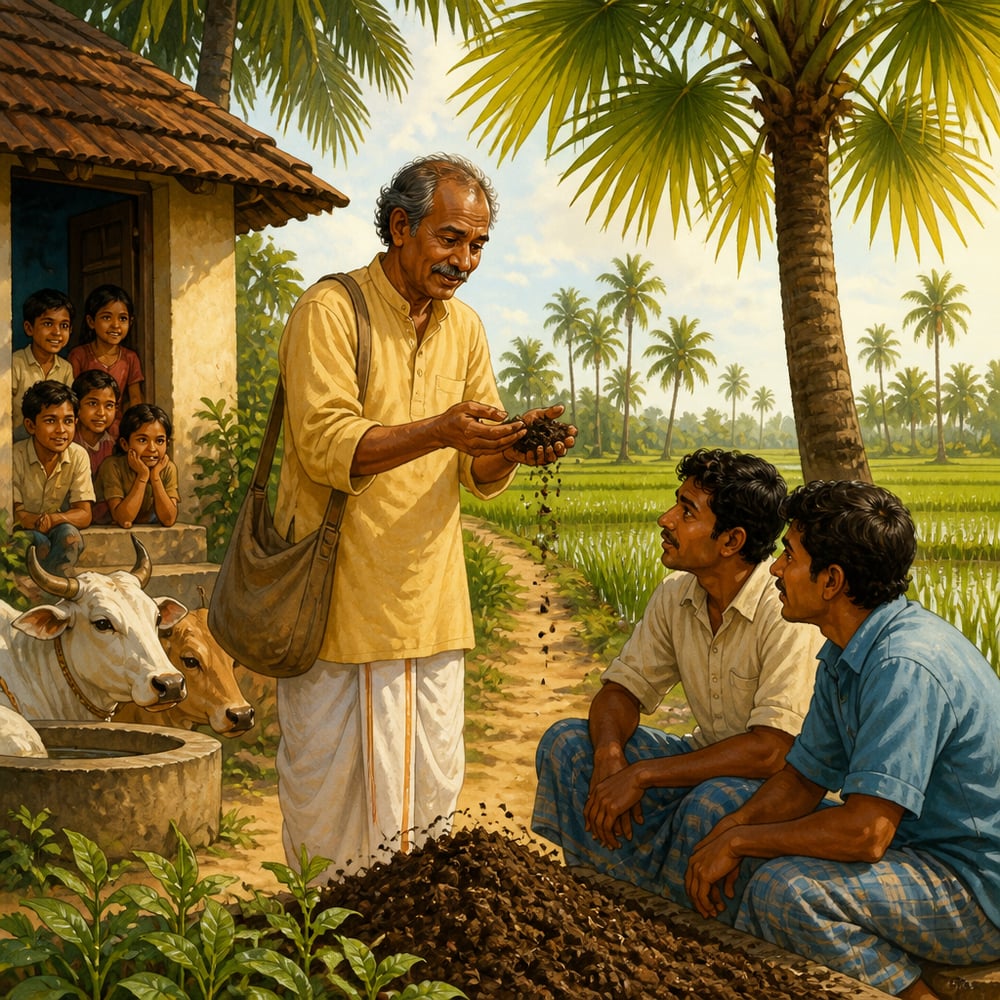
G. Nammalvar teaching farmers in Tamil Nadu in 1973

In 1973, in a village near Thanjavur, Tamil Nadu, a young agricultural officer named G. Nammalvar did something that shocked his colleagues. He resigned from his government job.

His reason was more shocking still: he believed the Green Revolution was destroying what it claimed to save.

For the next four decades until his death in 2013, Nammalvar walked through villages teaching farmers to do what their grandparents had done, rotate crops, rest land, grow pulses, reject chemicals. He was dismissed as a crank, a romantic, a Luddite.

Today, Punjab's soil is dying. Water tables have dropped 200 feet. Farmer suicides number in thousands. And India's agricultural policy is urgently promoting exactly what Nammalvar taught: sasya-chakra, the crop cycle that traditional farmers had practiced for three thousand years.

The Wheel of Crops

The term sasya-chakra literally means "crop wheel", a rotation system where different crops follow each other in a planned sequence across seasons and years.

The core insight was simple but profound: different crops take and give different things to the soil.

Varahamihira, the 6th-century polymath whose Brihat Samhita covered everything from astronomy to agriculture, documented the principles:

"शस्यं शस्यस्य पोषकं भवति" Śasyaṃ śasyasya poṣakaṃ bhavati "One crop becomes the nourisher of another."

A typical rotation might look like:

Season Crop Soil Effect
Kharif (monsoon) Rice/Millets Heavy nitrogen use
Rabi (winter) Pulses (dal) Nitrogen fixed back
Zaid (summer) Vegetables/Oilseeds Different nutrients
Fallow Nothing Soil rest and recovery

This wasn't arbitrary tradition, it was sophisticated soil science.

The Nitrogen Mystery

Pulses, urad, moong, masoor, chana, have nodules on their roots containing Rhizobium bacteria that "fix" atmospheric nitrogen into soil. Ancient farmers didn't know the biochemistry, but they observed the result: land planted with pulses yielded better grain the following year.

The Krishi Parashara prescribes:

"यवं माषं च मुद्गं च तिलं चैव विशेषतः। एतानि क्षेत्रशुद्ध्यर्थं वपेत्कृषिविचक्षणः॥"

"For purification of the field, the wise farmer plants barley, black gram, green gram, and especially sesame."

This "purification" was nitrogen restoration. Western science would only explain this mechanism in 1888 when German scientists discovered nitrogen-fixing bacteria. Indian farmers had been practicing it for at least two thousand years.

Global Perspectives on Crop Rotation

Charles "Turnip" Townshend (1674-1738), the English statesman, is credited with introducing the "Norfolk four-course rotation" to England, turnips, barley, clover, and wheat in sequence. This "agricultural revolution" helped end England's medieval three-field system and increased yields dramatically.

But Townshend's "revolution" arrived in England around 1730, roughly two millennia after Indian farmers had codified similar principles.

Justus von Liebig (1803-1873), the German chemist, analyzed soil chemistry and concluded that plants needed nitrogen, phosphorus, and potassium (NPK). His work launched the chemical fertilizer industry, which now supplies most of the world's nitrogen.

But Liebig's approach treats soil as an inert medium requiring external inputs. The Indian approach understood soil as a living system that could regenerate itself through proper rotation.

Sir Albert Howard (1873-1947), a British botanist stationed in India, spent 25 years studying Indian farming methods. In his landmark "An Agricultural Testament" (1940), he wrote:

"I found that the Indian peasant... could teach me much. The crops were generally healthy; their cultivators had learnt to work with nature rather than against her."

Howard developed the "Indore composting method" (named after the city in Madhya Pradesh) and is considered a founder of the organic farming movement, but he always credited Indian farmers as his teachers.

Thinker Innovation Indian Parallel
Townshend Four-field rotation Sasya-chakra with pulses, cereals, fallow
Liebig NPK fertilizer chemistry Panchagavya organic inputs, legume nitrogen
Howard Indore composting method Traditional kunapa (compost) preparation

The Fallow That Feeds

One of the most counterintuitive aspects of traditional farming was bhumivirama, resting the land.

Modern economics sees fallow as waste: unproductive land, lost opportunity cost. But traditional farmers understood that soil needs recovery time. During fallow, organic matter accumulates, soil microbiomes rebuild, and nutrients return to balance.

Varahamihira recommended fallow after three years of cultivation. Some village systems practiced rotating fallow, one-third of the land rested each year. This reduced total cultivable area but maintained long-term fertility.

The Green Revolution eliminated fallow. Punjab farmers were taught to plant rice-wheat-rice-wheat continuously, extracting nitrogen every season, replacing it with urea fertilizer. For a few decades, yields soared.

Then they didn't.

Punjab's Monoculture Disaster

A depleted Punjab stubble field at twilight

Punjab was the showpiece of India's Green Revolution. From 1960 to 1990, wheat and rice yields doubled, then tripled. The state became India's breadbasket.

But monoculture extracts specific nutrients relentlessly. Soil organic matter declined from 0.8% to 0.3%, approaching the level where soil becomes biologically dead. Groundwater tables dropped 200 feet as tube wells pumped water for thirsty rice paddies. Fertilizer use increased tenfold to compensate for declining soil fertility.

The economics became perverse: farmers spent more on inputs each year to get the same yields. By 2023, many Punjab farmers were caught in a debt spiral. They had followed government advice, and government advice had led them to ruin.

Nammalvar had predicted this in the 1970s. So had the Krishi Parashara three thousand years earlier:

"नित्यं वपेद्यश्च क्षेत्रं तस्य क्षेत्रं प्रणश्यति" "He who plants the same field constantly, that field perishes."

The Millet Mission: Rotation Returns

2023 was declared the International Year of Millets at India's initiative. But this wasn't just about nutrition, it was about rotation.

Millets (bajra, jowar, ragi) are drought-resistant, require minimal water, and grow on marginal lands. When rotated with pulses, they form a self-sustaining system:

Odia tribal women harvesting ragi in Koraput

The Odisha Millet Mission, launched in 2017, has converted over 1 lakh acres from rice monoculture back to traditional millet-pulse rotations. Farmers report 40% lower costs, comparable nutrition, and improved soil health.

PM-PRANAM (Promotion of Alternative Nutrients for Agriculture Management) incentivizes states to reduce chemical fertilizer use, essentially paying farmers to return to traditional rotation systems.

Even Punjab is changing. The state government now offers subsidies for crop diversification, encouraging farmers to break the rice-wheat cycle that is killing their land.

The Seasonal Wheel (Ritu-Chakra)

Traditional crop rotation wasn't just about which crops, it was about when. The ritu-chakra (seasonal cycle) aligned planting with monsoon patterns, temperature changes, and daylight hours.

Six seasons, not four:

Ritu English Months Agricultural Activity
Vasanta Spring Mar-May Summer crops, garden vegetables
Grishma Summer May-Jul Pre-monsoon preparation
Varsha Monsoon Jul-Sep Kharif sowing (rice, millets)
Sharad Autumn Sep-Nov Kharif harvest, rabi preparation
Hemanta Pre-winter Nov-Jan Rabi sowing (wheat, pulses)
Shishira Winter Jan-Mar Rabi growth, cold-weather vegetables

The nakshatra (lunar mansion) system in Krishi Parashara refined this further, each of the 27 nakshatras had specific agricultural implications. Modern analysis shows these often correlate with micro-climate patterns, monsoon phases, and pest cycles.

Your Turn

The soil beneath your feet is not dirt, it's a living community of billions of organisms that make agriculture possible. For three thousand years, Indian farmers maintained this living system through rotation, rest, and rhythm.

The Green Revolution taught farmers to treat soil as an inert chemical container, and for fifty years, it seemed to work. Now we're learning it didn't.

The question is whether we return to ancient wisdom before the soil dies, or after.

Next, we explore Jala-Niti, how ancient India built and managed the water infrastructure that made agriculture possible.

Biological Nitrogen Fixation vs. Industrial Nitrogen Production

The Haber-Bosch process (1909) enabled industrial nitrogen fertilizer production, using fossil fuels to fix atmospheric nitrogen. This powers modern agriculture, but also causes water pollution, soil degradation, and greenhouse gas emissions. Biological nitrogen fixation through legumes achieves the same result with zero industrial inputs.

Traditional rotation was carbon-negative, pulses absorbed CO2 while fixing nitrogen. Industrial fertilizer production is carbon-intensive (3-5% of global natural gas use). As climate concerns mount, the ancient method becomes economically superior again.

One hectare of pulses can fix 50-300 kg of nitrogen annually, equivalent to ₹2,500-15,000 worth of urea fertilizer. This 'free' nitrogen was why traditional farmers always included pulses in rotation.

Portfolio Diversification and Optionality in Agriculture

Modern portfolio theory (Markowitz, 1952) proves mathematically that diversification reduces risk. Traditional farmers practiced this intuitively, never concentrating in one crop, maintaining fallback options. The Green Revolution created 'concentrated portfolios' (wheat-rice monoculture) that maximized returns but also maximized risk.

Key terms

Sasya-chakra
Crop cycle or crop rotation, the practice of planting different crops in sequence to maintain soil fertility
Bhūmivirāma
Land rest or fallow, the practice of leaving land uncultivated for a season or year to allow soil recovery
Ṛtu-chakra
Seasonal cycle, the six Indian seasons that determined planting and harvest timing
Kṣetra-śuddhi
Field purification, the restoration of soil fertility through specific crops or practices

Key figures

Varahamihira

505-587 CE

G. Nammalvar

1938-2013

Charles "Turnip" Townshend

1674-1738

Case studies

Punjab's Monoculture Crisis: When the Green Revolution Turned Brown

Punjab was India's Green Revolution poster child. From 1960-1990, wheat and rice yields doubled, then tripled. The state produced 60% of India's food grain surplus. Farmers prospered. Punjab became India's wealthiest agricultural state. But the success was built on unsustainable extraction. Farmers were encouraged to grow wheat-rice-wheat-rice continuously, no rotation, no fallow, no pulses. By 2020, the consequences became undeniable: - Soil organic matter dropped from 0.8% to 0.3% - Groundwater fell 200+ feet in many districts - Fertilizer use increased 10x while yields plateaued - Farmer suicides reached crisis levels - Stubble burning created annual air pollution emergencies

The Green Revolution violated Parashara's explicit warning: 'He who plants the same field constantly, that field perishes.' The pursuit of maximum short-term yield destroyed long-term fertility. From a dharmic perspective, this was *adharmic* extraction, taking without giving back, treating soil as resource rather than living system. The soil was not honored as *bhūmi mātā* (Mother Earth) but exploited as industrial input. The tragedy is that farmers followed government advice in good faith. They were told science had replaced tradition. Now they're being told to return to what their grandparents knew.

Punjab is now attempting to reverse 50 years of monoculture. The state offers subsidies for crop diversification. The Mera Pani Meri Virasat scheme pays farmers to shift from rice to less water-intensive crops. Some districts are piloting pulse rotations. But soil recovery takes decades. The groundwater may never return. And an entire generation of farmers has lost the traditional knowledge their grandparents possessed. The Green Revolution's true cost is still being calculated.

Efficiency without sustainability is self-destruction on a delay. Punjab's monoculture produced impressive short-term yields by mining soil and water capital. When the capital ran out, so did the yields. Traditional rotation looked 'inefficient' but preserved capital for three thousand years.

Punjab's trajectory mirrors the American Midwest, where the Ogallala Aquifer is depleting at similar rates after decades of monoculture corn and soybean farming. California's Central Valley faces identical groundwater crises. The pattern is universal: when efficiency metrics ignore natural capital depletion, apparent productivity gains are actually borrowing from the future.

Punjab's groundwater is depleting at 33 cm per year. At current extraction rates, many districts will have no accessible groundwater by 2040. The Green Revolution's 'surplus' was borrowed from the future, and the debt is now due.

Odisha Millet Mission: A State Returns to Its Roots

In 2017, Odisha launched the Millet Mission, one of India's most ambitious attempts to revive traditional cropping patterns. The goal: convert 1 lakh acres from rice monoculture to millet-pulse rotations, primarily among tribal farmers who had been pressured to abandon their traditional crops. The intervention was multi-pronged: - Premium prices for millets to offset lower yields - Community-based seed banks for traditional varieties - Processing centers to add value locally - School mid-day meals incorporating millets (guaranteed market) - Farmer-to-farmer knowledge sharing on traditional rotations Critically, the Mission didn't just promote millets, it promoted the *system* of millet-pulse rotation that traditional farmers had practiced.

The Millet Mission represents a rare government acknowledgment that 'development' went wrong. Tribal farmers were told for decades that rice was 'modern' and millets were 'backward.' Now the state is paying them to return to what they knew. The dharmic insight: traditional knowledge wasn't primitive, it was adapted. Millets evolved with tribal communities over millennia, suited to local soils, rainfall, and food systems. Replacing them with rice required inputs (irrigation, fertilizer) that these marginal lands couldn't sustain. *Sva-dharma* (one's own duty/nature) applies to crops as well as people. Growing what belongs in a place is dharmic; forcing what doesn't belong is adharmic.

By 2023, the Millet Mission had: - Enrolled 1.2 lakh farmers across 19 districts - Increased millet cultivation area by 60% - Reduced farmer input costs by 40% (no fertilizer/pesticide needed) - Improved nutrition in participating households - Created 500+ processing units for local value addition More significantly, traditional knowledge is being transmitted again. Elderly farmers who remember rotation practices are teaching younger ones who never learned. The chain of wisdom, nearly broken, is being repaired.

Sometimes 'development' means going back, not forward. The Millet Mission shows that traditional systems, properly supported, can outperform industrial agriculture on marginal lands. The question is whether this insight will scale before more traditional knowledge is lost.

Millets are now the fastest-growing grain category in global health food markets. Companies like Kellogg's and ITC have launched millet-based products targeting urban health-conscious consumers. What tribal farmers in Odisha always knew, nutritional science confirmed: millets are superior to rice in protein, fiber, iron, and glycemic index.

Millet-pulse rotations in Odisha require zero external inputs, no purchased seeds, fertilizers, or pesticides. Compared to rice cultivation requiring ₹15,000-20,000/acre in inputs, the traditional system is not just sustainable but economically superior.

International Year of Millets 2023: India Takes Its Case Global

In 2023, at India's initiative, the United Nations declared the International Year of Millets. This was more than symbolism, it was India positioning traditional grains as a global solution to food security, climate resilience, and sustainable farming. The diplomatic effort brought together unlikely allies: - Climate activists (millets need 70% less water than rice) - Nutritionists (millets have higher protein, fiber, and micronutrients) - Economists (millet farming costs a fraction of rice/wheat) - Cultural preservationists (millets are foundation of tribal identity) PM Modi personally championed millets at international forums, serving millet dishes at G20 events and positioning India as a leader in sustainable agriculture.

The millet campaign represents India reclaiming civilizational confidence, asserting that ancient agricultural wisdom has global relevance. For two centuries, India was told its traditions were backward. Now India is teaching the world. This is the dharmic principle of *yathā rājā tathā prajā* (as the king, so the people) applied internationally. By championing millets at the highest levels, leadership signals that traditional crops are not shameful but prestigious. More deeply, millets represent *svadeshi* (self-reliant) agriculture. They require no imports, no patented seeds, no chemical inputs, no irrigation systems. Every farmer can produce their own inputs. This is economic sovereignty at the field level.

Millet exports from India increased 70% in 2023. Domestic millet consumption rose for the first time in decades. Major food companies launched millet products. States competed to promote their traditional varieties. Whether this translates to lasting crop rotation remains to be seen. Marketing millets is easier than changing farming systems. But the cultural shift, from 'poor people's food' to 'superfood', may enable the policy changes that sustainable agriculture requires.

Changing agricultural practices requires changing cultural narratives. For 50 years, Green Revolution PR made rice/wheat 'modern' and millets 'backward.' The Millet Year attempts to reverse that framing. Economic incentives help, but identity matters, farmers grow what they're proud of.

The International Year of Millets catalyzed a shift visible in grocery aisles worldwide. From 'ancient grain' branding at Whole Foods to millet-based baby food in Indian e-commerce, the cultural reframing is working. Millet startups in India raised over Rs 500 crore in venture funding between 2022-2024, proving that changing the narrative around 'backward' grains unlocks real commercial value.

India produces 41% of global millets but consumes only 20% domestically. The export opportunity is significant, but so is the opportunity to improve Indian nutrition. Millet consumption in India has fallen 80% since 1960. The Year of Millets aims to reverse this.

Historical context

Vedic period to present; rotation systems documented from c. 500 CE

Crop rotation in India evolved from observation over millennia. Each region developed rotations suited to its climate, soil, and crops. The Indo-Gangetic plain had different rotations than the Deccan or coastal regions. This localized knowledge was transmitted orally and through practice until the Green Revolution imposed standardized methods.

Every agricultural civilization discovered rotation independently, Roman three-field systems, Chinese mixed cropping, European four-field rotation. The principle is universal agricultural science. But India's documented codification (Krishi Parashara, Brihat Samhita) predates European agricultural manuals by 1,500+ years.

Pre-Green Revolution, Indian farms grew an average of 10-15 crop varieties. Post-Green Revolution, two crops (rice and wheat) occupy 75% of irrigated farmland. This concentration increased yields but also increased vulnerability, a single pest or disease can devastate the entire crop.

Understanding rotation history reveals that India abandoned a sustainable system for an extractive one, not because the old system failed, but because the new system offered short-term gains. The current crisis (Punjab's dying soil, farmer suicides, groundwater depletion) is the consequence of ignoring traditional wisdom.

Living traditions

Reflection

More in Krishi: Agricultural Economics of Ancient India

All lessons in Krishi: Agricultural Economics of Ancient India · Grama Swarajya: Village Economics course