Kautilya-Krishi: Arthashastra's Agricultural Policies
State, Market, and Moral Economy
How Kautilya's statecraft principles shaped agricultural policy, from price controls to cooperative farming, and their remarkable relevance to modern food security debates.
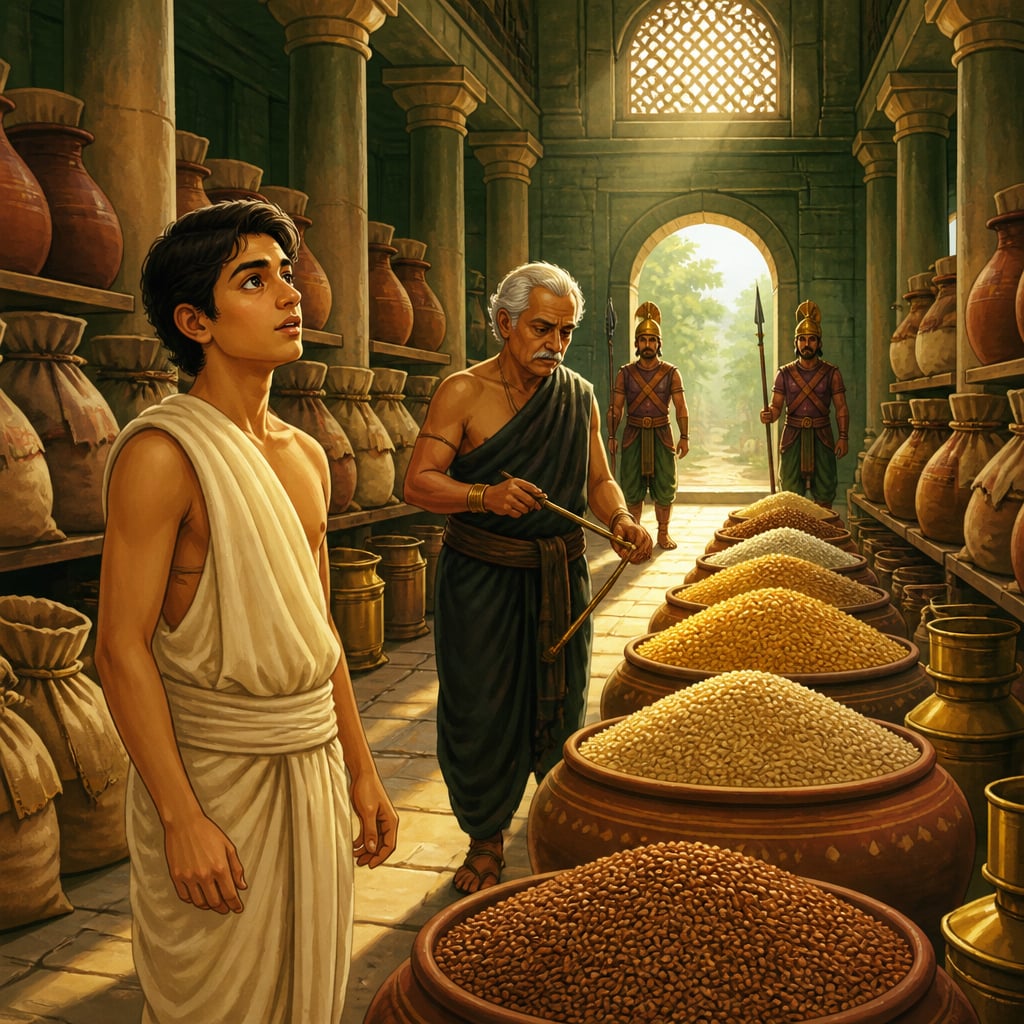
In the village of Paatalipura, young Devadatta worked as an apprentice in the royal granary during the reign of the Mauryas. His grandfather, a grizzled supervisor who had served three kings, often spoke of the times before the great Chanakya organized the empire's food systems.
"When I was young," the old man recalled, "each village hoarded its grain during famines. Traders would triple their prices. The hungry suffered while speculators prospered."
Devadatta looked at the vast warehouse before him - grain from a hundred villages, catalogued and stored, ready for distribution at fixed prices during scarcity. "Acharya Kautilya changed everything," his grandfather continued. "He understood that food is not merely a commodity - it is the foundation of rajya-dharma itself."
The Arthashastra's Revolutionary Framework
The Arthashastra, composed around the 4th century BCE, represents the world's most comprehensive ancient treatise on political economy. While often studied for its strategic principles, its agricultural economics reveals a sophisticated understanding of food security, market regulation, and rural development that anticipates modern policy debates by two millennia.
Kautilya begins with a fundamental principle: "Kṛṣi pradhāna sarva dharmāṇām" - agriculture is primary among all occupations. This wasn't mere rhetoric. The Arthashastra provides detailed guidelines for land settlement, irrigation investment, crop selection, storage systems, and market intervention that formed a complete agricultural policy framework.
Sita: State-Managed Agriculture
Perhaps the most distinctive feature of Mauryan agricultural policy was "sita" - crown lands directly managed by the state. Kautilya recommended that the state should maintain substantial agricultural operations for several purposes:
Strategic Reserves: State farms produced grain specifically for strategic reserves, ensuring food security during wars, famines, and natural disasters. The superintendent of agriculture (sitadhyaksha) maintained detailed records of production, storage, and distribution.
Price Stabilization: When private markets experienced price spikes, state-held grain could be released to stabilize prices. Conversely, during surplus periods, state purchases prevented prices from collapsing and ruining farmers.
Model Practices: State farms served as demonstration centers for improved techniques. New seeds, irrigation methods, and crop rotations were tested here before being promoted to private cultivators.
This mixed economy approach - neither fully state-controlled nor entirely market-driven - represents a "middle path" that many modern economists now advocate for developing nations.
Panyadhyaksha: Market Regulation
The Arthashastra established the office of "panyadhyaksha" (superintendent of trade) with specific powers over agricultural commodities. This officer was tasked with:
Fair Pricing: Setting reasonable margins for traders and preventing excessive speculation. The text specifically prohibits cornering (sangha) and hoarding (utsanga) of essential commodities.
Quality Standards: Ensuring that grain sold in markets met quality standards. Adulteration of food was considered a serious offense with substantial penalties.
Market Infrastructure: Maintaining proper marketplaces (hatta) with standardized weights and measures, dispute resolution mechanisms, and transparent pricing.
Kautilya's framework recognized that free markets work well for luxury goods but require oversight for essential commodities upon which lives depend.
Cooperative Farming: Sangha-Krishi
The Arthashastra contains remarkable passages on collective agricultural enterprises. While private farming was the norm, Kautilya recognized that certain activities - particularly those requiring large capital investments or coordinated action - benefited from cooperative organization.
Irrigation works, forest conservation, and pastoral activities were specifically recommended for sangha (cooperative) management. The text provides guidelines for:
- Contribution of labor and resources proportional to landholding
- Distribution of benefits according to contribution
- Resolution of disputes through village assemblies
- Protection of common resources from enclosure
These principles would reemerge in India's cooperative movement two thousand years later.
Verghese Kurien: Kautilyan Principles Reborn

When Verghese Kurien arrived at the Kaira District Cooperative Milk Producers' Union in 1949, he encountered a system remarkably aligned with Kautilyan principles. The cooperative - which would become AMUL - embodied the sangha concept: collective action by producers to counter exploitative middlemen.
Kurien expanded these principles through Operation Flood (1970-1996), creating a national milk grid that:
Eliminated Middlemen: Like Kautilya's market regulations, the cooperative structure ensured that producers received fair prices while consumers paid reasonable amounts.
Built Infrastructure: State investment in processing plants, cold chains, and transportation mirrored Kautilya's emphasis on public infrastructure for agriculture.
Maintained Quality: Rigorous quality controls echoed the Arthashastra's concern with food standards and adulteration prevention.
Stabilized Markets: The cooperative network functioned as a price stabilization mechanism, protecting farmers from market volatility.
The result transformed India from a milk-deficit nation to the world's largest milk producer - a testament to the enduring wisdom of combining cooperative organization with strategic state support.
Adam Smith's Different Path
The comparison with Adam Smith's market philosophy illuminates what makes Kautilya's approach distinctive. Writing in 18th-century Britain, Smith argued that the "invisible hand" of market competition would naturally produce optimal outcomes, including for food distribution.
Smith specifically opposed government intervention in grain markets: "The unlimited, unrestrained freedom of the corn trade... is the only effectual preventative of the miseries of a famine."
Kautilya would have disagreed. The Arthashastra recognizes that food markets during crises don't behave like markets for luxury goods. When people face starvation, they cannot simply "choose" to reduce consumption or wait for prices to fall. Speculators can exploit this desperation, extracting maximum payment while providing minimum relief.
Modern experience has validated Kautilya's skepticism. The Bengal Famine of 1943, which killed an estimated 2-3 million people, occurred not from absolute food shortage but from market failures, hoarding, and inadequate government intervention - precisely the scenarios Kautilya's system was designed to prevent.
The Modern MSP Debate

Kautilya's principles find contemporary expression in India's Minimum Support Price (MSP) system. Established in 1966-67, MSP guarantees farmers a minimum return on certain crops, with government procurement when market prices fall below this level.
The system embodies several Arthashastra principles:
Price Floors: Preventing the exploitation of farmers during surplus years when prices collapse.
Strategic Reserves: Procured grain fills the Public Distribution System (PDS), ensuring food security for 800 million Indians.
Market Stabilization: Government procurement and release stabilizes prices for both farmers and consumers.
The 2020-21 farmer protests against proposed agricultural reforms reflected this Kautilyan heritage. Farmers feared that weakening MSP and procurement would expose them to the vagaries of unregulated markets - precisely the scenario Kautilya designed his system to prevent.
Critics argue that MSP distorts markets and encourages water-intensive crops in unsuitable regions. Defenders respond that pure market solutions ignore power asymmetries between individual farmers and large corporations. Both arguments have merit, reflecting the enduring tension between market efficiency and social protection that Kautilya navigated two millennia ago.
Infrastructure as Foundation
The Arthashastra's emphasis on agricultural infrastructure remains remarkably relevant. Kautilya specified that the state should provide:
- Irrigation works (setu) with proper maintenance funds
- Roads connecting villages to markets
- Storage facilities (koshthaagara) at multiple levels
- Processing facilities for value addition
Modern India's agricultural challenges - inadequate cold storage causing 30% post-harvest losses, poor rural roads limiting market access, insufficient irrigation coverage - reflect departures from Kautilyan principles that emphasized public investment in agricultural infrastructure.
The PM Gati Shakti program (2021) and Agricultural Infrastructure Fund (2020) represent returns to this understanding: that private agricultural activity requires robust public infrastructure.
Dharmic Lens: The Moral Economy
Kautilya's agricultural economics operates within an explicitly dharmic framework. The king who fails to ensure food security commits a moral failure, not merely a policy error. "The king who enjoys his subjects' suffering partakes of their sins," the Arthashastra warns.
This moral economy perspective differs fundamentally from purely efficiency-focused modern economics. It asks not only "What produces the most output?" but "What ensures that all members of society have enough to live with dignity?"
The concept of "rajya-dharma" - the dharma of governance - requires rulers to balance multiple considerations:
- Efficiency (getting maximum production from available resources)
- Equity (ensuring fair distribution across social groups)
- Security (maintaining reserves against future crises)
- Sustainability (preserving productive capacity for future generations)
Modern sustainable development frameworks, with their emphasis on economic, social, and environmental dimensions, echo this multidimensional approach.
Living Traditions: Cooperative Renaissance
Kautilyan principles live on in India's cooperative sector - the largest in the world with 800,000+ cooperatives covering agriculture, dairy, fisheries, and more. The National Agricultural Cooperative Marketing Federation (NAFED) continues the tradition of cooperative procurement and marketing.
Recent initiatives extend this heritage:
Farmer Producer Organizations (FPOs): The government's initiative to establish 10,000 FPOs by 2024 represents cooperative principles adapted for contemporary conditions.
e-NAM (National Agriculture Market): This digital platform connects physical markets across states, improving price discovery while maintaining market oversight.
PM-KISAN: Direct income support to farmers reflects Kautilya's concern with farmer welfare, though through transfer payments rather than market intervention.
The challenge lies in balancing Kautilya's wisdom about market regulation with contemporary realities of global trade, climate change, and technological transformation.
Conclusion: Ancient Wisdom, Modern Relevance
The Arthashastra's agricultural economics offers neither a blueprint for simple implementation nor an artifact of merely historical interest. Instead, it provides a framework for thinking about food systems that remains remarkably relevant.
Kautilya understood that agriculture is too important to be left entirely to market forces, but also too complex to be fully state-controlled. His mixed economy approach - strategic state intervention, cooperative organization, regulated markets, and public infrastructure - anticipates debates that modern economists are still conducting.
As climate change threatens agricultural systems worldwide and food security becomes increasingly precarious, Kautilya's integrated approach to agricultural policy deserves renewed attention. The wisdom that guided the Mauryan Empire's food security may yet inform solutions for the 21st century's agricultural challenges.
Devadatta's grandfather had it right: food is not merely a commodity. It is the foundation of rajya-dharma - and of civilization itself.
Key terms
- Sita
- Crown-managed agricultural lands in the Arthashastra, operated directly by the state for strategic reserves, price stabilization, and demonstration of improved practices
- Panyadhyaksha
- Superintendent of trade in Kautilyan administration, responsible for regulating markets, preventing hoarding, and ensuring fair prices for agricultural commodities
- Sangha-Krishi
- Cooperative farming enterprises recommended in the Arthashastra for activities requiring collective action, such as irrigation and forest management
- Koshthagara
- Granary or storage facility in ancient Indian kingdoms, maintained at village, district, and central levels for food security and price stabilization
Key figures
Kautilya (Chanakya)
Authored the Arthashastra, establishing comprehensive principles for agricultural policy including state farming (sita), market regulation, price controls, and cooperative organization that anticipated modern food security frameworks by two millennia.
Verghese Kurien
Father of India's White Revolution, who built AMUL and Operation Flood on cooperative principles echoing Kautilyan sangha concepts, transforming India into the world's largest milk producer through farmer-owned institutions.
Adam Smith
Scottish economist whose advocacy for free markets and opposition to government intervention in grain trade represents a contrasting approach to agricultural economics, whose limitations became apparent during famines.
Living traditions
- Cooperative Marketing Networks: AMUL, IFFCO, and thousands of agricultural cooperatives implement Kautilya's sangha-krishi principles, collective organization enabling small producers to access markets, negotiate fair prices, and build infrastructure individually unaffordable.
- MSP Procurement System: The Minimum Support Price system implements Arthashastra's principle that the state must stabilize food markets, government procurement at guaranteed prices prevents the exploitation of farmers during surplus years that Kautilya specifically warned against.
- AMUL Dairy, Anand: The birthplace of India's White Revolution. Visitors can see the cooperative system from village collection to processing, Kautilya's sangha principles made visible.
- Krishi Bhavan: The Ministry of Agriculture headquarters where Kautilyan principles meet modern policy, from MSP decisions to FPO promotion to cooperative policy.
- Sri Venkateswara Temple (Tirumala): The world's richest temple demonstrates Kautilyan economic principles at massive scale, sophisticated supply chains, strategic reserves (prasadam serves 100,000+ daily), and the integration of religious and economic functions that the Arthashastra prescribed
- Golden Temple (Harmandir Sahib): The Langar (community kitchen) feeding 100,000+ people daily exemplifies Kautilya's vision of food security as dharmic duty, strategic reserves, efficient distribution, and collective organization providing food regardless of social status
Reflection
- How do Kautilya's principles for regulating food markets compare with modern debates about agricultural market reforms in India?
- In what ways does the cooperative model (from AMUL to FPOs) embody the Arthashastra's sangha principles? Where does it diverge?