Bija-Sanrakshana: Seed Preservation and Distribution

The Commons That Corporations Enclosed

For millennia, Indian farmers saved, selected, and shared seeds freely, creating thousands of crop varieties adapted to every microclimate. This decentralized 'seed commons' was maintained by women, governed by tradition, and required no patents or payments. Discover how this system worked, and why modern seed corporations threaten what farmers maintained for free.

The Woman Who Saved a Thousand Seeds
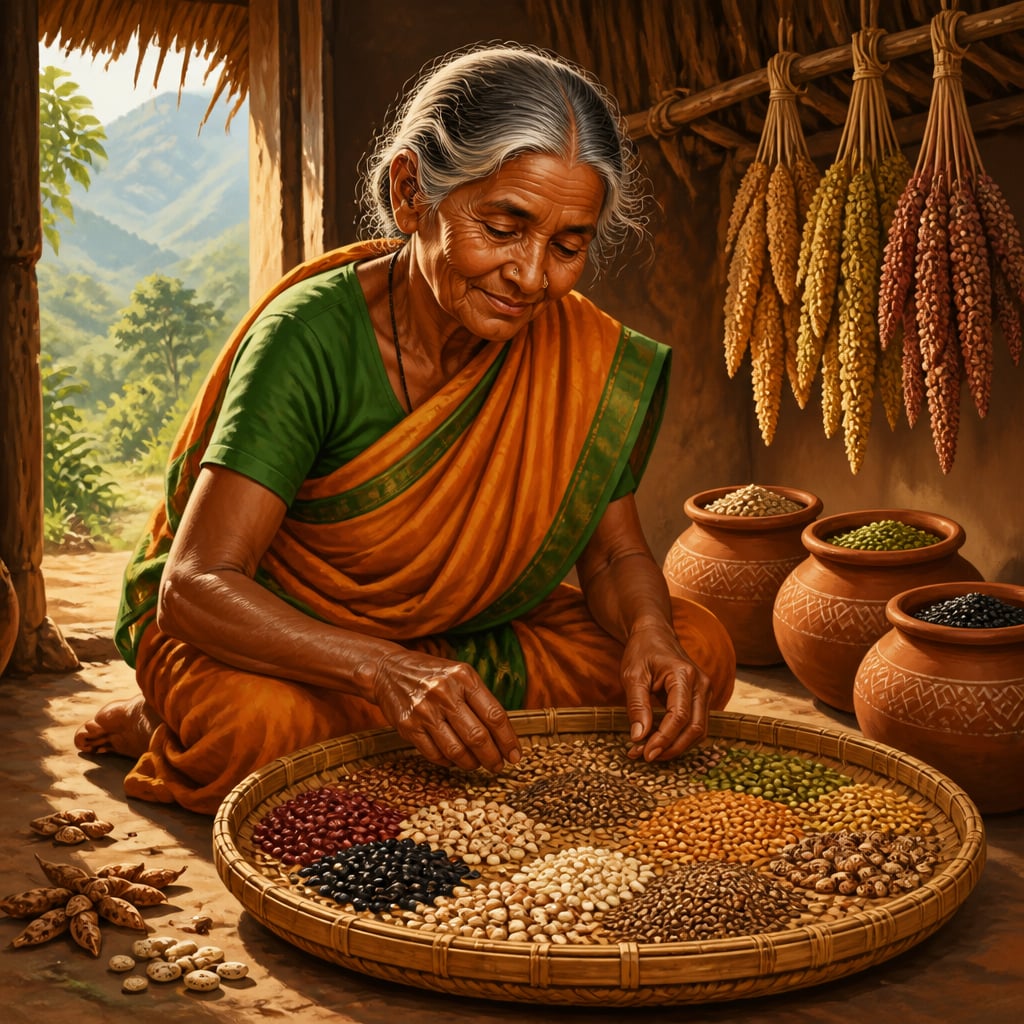
Kamala Pujari sorting saved seeds in Koraput

In the hills of Koraput, Odisha, Kamala Pujari tends a small farm that holds more biodiversity than many nations.

At 73, this Adivasi farmer has spent her life doing what her mother and grandmother did: saving seeds. Not randomly, but with scientific precision passed down through generations. She can identify over 100 rice varieties by grain shape, aroma, cooking quality, and disease resistance. She knows which varieties survive drought, which resist specific pests, which ripen early for hungry seasons.

In 2019, Kamala Pujari received the Padma Shri, India's fourth-highest civilian honor, for her seed conservation work.

The irony is bitter: a lifetime of preserving what corporate agriculture tried to destroy, now recognized by the same government that promoted that destruction.

The Seed Commons

For three thousand years, Indian agriculture operated on a principle that modern economics calls impossible: seeds were a commons.

Every farmer saved seeds from harvest. The best specimens, healthiest plants, largest grains, disease-free, were selected for next season. This was bija-pariksha (seed testing), practiced not in laboratories but in fields and granaries across the subcontinent.

The Charaka Samhita, primarily an Ayurvedic medical text (c. 300 BCE), includes detailed protocols for seed selection:

"बीजं शुद्धं प्रयत्नेन गृह्णीयात्" Bījaṃ śuddhaṃ prayatnena gṛhṇīyāt "One should carefully select pure, clean seeds."

Charaka understood that seed quality determined plant health, which determined medicine quality. The same principle applied to food crops: healthy seeds produced healthy plants produced healthy communities.

How the Commons Worked

The traditional seed system had features that made it resilient:

Decentralized Storage: Every household maintained seed stocks. No single failure could destroy the system. When one village lost crops to flood, neighboring villages shared seeds.

Continuous Selection: Over generations, farmers selected for local adaptation. Rice varieties evolved to match specific microclimates, this village's soil, that slope's drainage, another region's pest pressure.

Free Exchange: Seeds moved freely between farmers, villages, and regions. There was no concept of "intellectual property" in seeds, they were gifts from ancestors, to be passed on.

Women's Domain: Seed selection and storage was primarily women's work. Women held the knowledge of which varieties to save, how to store them, when to plant. This wasn't marginal work, it was civilization's foundation.

Vavilov's Warning

Nikolai Vavilov (1887-1943), the Soviet botanist, devoted his life to understanding where our crops came from. He identified eight "centers of origin", regions where specific crops were first domesticated. India was a primary center for rice, cotton, mango, and dozens of other crops.

Vavilov understood that crop diversity was humanity's insurance policy. When a disease struck wheat in Europe, resistant varieties could be found in wheat's center of origin. When climate changed, the genetic diversity to adapt existed somewhere in traditional farming systems.

He traveled the world collecting seeds, over 250,000 samples from 64 countries. His seed bank in Leningrad (now St. Petersburg) was one of the world's largest.

Then Stalin's regime turned against genetics. Vavilov was arrested in 1940, accused of "sabotaging Soviet agriculture." He died in prison in 1943, of starvation, surrounded by the seeds he had spent his life collecting.

Vavilov's warning was prophetic: lose crop diversity, and you lose the ability to adapt. The Green Revolution would prove him right.

The Green Revolution's Bargain

In the 1960s, India faced a choice: adopt high-yielding varieties (HYVs) or face famine.

The HYVs, developed by Norman Borlaug and others, produced dramatically more grain per acre. But they required a package: chemical fertilizers, pesticides, irrigation. And they couldn't be saved, farmers had to buy new seed each year.

The bargain seemed worth it. Yields doubled. Famine receded. India became food self-sufficient.

But something was lost.

Metric Pre-Green Revolution Post-Green Revolution
Rice varieties in India 100,000+ ~6,000 (cultivated)
Wheat varieties 30,000+ ~20 dominant
Seed source Farm-saved (free) Purchased (paid)
Input costs Near zero ₹15,000-45,000/hectare

By 2000, an estimated 90% of traditional crop varieties had been lost or marginalized. The genetic diversity that Vavilov knew was essential, gone in a generation.

The Bt Cotton Tragedy

Nowhere was the seed crisis more devastating than in cotton.

In 2002, Monsanto introduced Bt cotton to India, genetically modified to resist bollworm. Farmers were promised higher yields and lower pesticide costs. The seeds cost 4-5 times more than traditional varieties, and they couldn't be saved, farmers had to buy new seed each year.

Initially, Bt cotton seemed successful. Bollworm damage dropped. Yields rose.

Then the problems began:

Between 2002 and 2015, over 300,000 Indian farmers committed suicide, the largest wave of recorded suicides in human history. While many factors contributed, debt from seed and input costs was consistently cited.

The traditional cotton farmer saved seeds for free. The modern cotton farmer paid ₹2,000-4,000 per packet each season, with no guarantee of returns. The seed commons had been enclosed.

Vandana Shiva and Navdanya

Vandana Shiva, the physicist-turned-activist, saw what was happening and acted.

Vandana Shiva at the Navdanya seed bank in Doon Valley

In 1991, she founded Navdanya ("nine seeds"), a network dedicated to preserving traditional seeds and the knowledge systems around them. The premise was simple: if corporations were enclosing the seed commons, farmers needed to build alternative systems.

Navdanya has now:

Vandana Shiva's argument isn't merely practical, it's philosophical. Seeds, she argues, are not "intellectual property" that can be owned. They are life itself, inherited from ancestors, belonging to the commons. When corporations patent seeds, they enclose what was always shared.

"Seed is not just the source of life. It is the very foundation of our being." , Vandana Shiva

Critics call her anti-science. But she's not against agricultural research, she's against privatizing its results. Traditional farmers did agricultural research for three thousand years, and they shared the results freely.

The Community Seed Bank Movement

Across India, a quiet revolution is underway. Community seed banks, local collections of traditional varieties, maintained by and for farmers, are proliferating.

The model varies:

Uttarakhand: The Beej Bachao Andolan ("Save the Seeds Movement") has preserved traditional varieties of rice, millets, and vegetables in the Himalayan foothills since 1989. Farmers exchange seeds at annual fairs, reviving varieties that had nearly disappeared.

Jharkhand: Adivasi communities maintain seed banks that preserve drought-resistant millets and rice varieties adapted to poor soils, precisely the genetics that climate change will require.

Odisha: Building on the Millet Mission, communities have established seed banks for traditional millet varieties. Elderly farmers who remember pre-Green Revolution varieties teach younger ones.

Tamil Nadu: The CIKS (Centre for Indian Knowledge Systems) works with women farmers to maintain traditional rice varieties, documenting the knowledge that accompanies each variety.

What unites these efforts is a recognition: the seed commons that corporations enclosed still exists, in memory, in marginal farms, in Adivasi communities that never fully adopted Green Revolution methods. It can be revived.

Women: The Original Seed Scientists

Three generations of women selecting paddy seeds

The traditional seed system was largely women's work, and this wasn't coincidence.

Women selected seeds during harvest, deciding which plants showed the best characteristics. Women stored seeds, knowing which containers, which treatments, which conditions preserved viability. Women remembered which varieties suited which conditions, knowledge passed from mother to daughter.

This wasn't "unskilled labor." It was empirical science conducted over generations. The thousands of crop varieties that existed before the Green Revolution were the product of women's systematic observation and selection.

The Green Revolution marginalized this knowledge. "Scientific" seed selection moved to laboratories, conducted by (mostly male) scientists. Women's knowledge was dismissed as "tradition" or "superstition."

Now, as traditional varieties are recognized as essential genetic resources, women's knowledge is being rediscovered. The irony: what agricultural science dismissed, agricultural science now desperately needs.

Parashara's Wisdom: Seeds from Your Own Soil

We return to a verse from the Krishi Parashara that encapsulates traditional seed wisdom:

"स्वभूमिजं बीजं श्रेष्ठं परभूमिजमधमम्" Sva-bhūmijaṃ bījaṃ śreṣṭhaṃ para-bhūmijaṃ adhamam "Seeds from one's own soil are supreme; seeds from foreign lands are inferior."

Modern genetics confirms this. Seeds saved and selected over generations on the same land develop specific adaptations, disease resistance, climate tolerance, soil compatibility, that imported varieties lack. This is why traditional varieties often outperform "improved" varieties in local conditions.

The Green Revolution inverted this principle. Seeds were developed in research stations (often in other countries), then distributed universally. The specificity that made traditional varieties resilient was sacrificed for standardization that made industrial production efficient.

Your Turn

Every seed contains millennia of accumulated knowledge, the result of countless farmers observing, selecting, preserving. When a traditional variety disappears, that knowledge is lost forever.

The question for our generation is whether we recognize seeds as commons, shared heritage to be preserved, or as property to be owned. The answer will shape not just agriculture but civilization.

Next, we explore Kautilya-Krishi, how the Arthashastra organized agricultural policy at the state level, and what it teaches about the proper relationship between government and farming.

Industrial seed systems require laboratory testing, certification, and professional expertise, creating dependency on external institutions. Traditional systems put quality control in farmers' hands, requiring no external resources or credentials.

Traditional testing is free and requires no formal education. Any farmer can learn to float seeds in water or observe germination. This democratized knowledge prevented the asymmetric power relationships that characterize modern seed markets.

The water flotation test accurately identifies non-viable seeds with 80-90% accuracy, comparable to laboratory methods. Traditional farmers achieved this accuracy for free, while modern certification costs ₹500-2,000 per sample.

When seed science moved to laboratories (dominated by men), women's millennia of empirical knowledge was dismissed as 'traditional' or 'unscientific.' The varieties women had developed became raw material for 'improved' seeds, without acknowledgment or compensation.

Communities that maintained traditional seed systems also maintained women's agricultural knowledge. In areas where Green Revolution penetration was incomplete (Adivasi regions, hill areas), women's seed knowledge survives. This knowledge is now being recognized as essential for climate adaptation.

Studies in Odisha and Jharkhand show that women farmers can identify 50-100+ rice varieties by visual and tactile characteristics, knowledge that takes decades to acquire. This expertise, previously dismissed, is now valued by seed conservation programs.

Key terms

Bīja-saṃrakṣaṇa
Seed preservation and protection, the practice of saving, storing, and maintaining seeds for future planting
Bīja-parīkṣā
Seed testing, examination of seed quality before sowing to ensure viability and health
Bīja-svarājya
Seed sovereignty, the right of farmers to save, exchange, and breed seeds without corporate or state interference
Deśī bīja
Indigenous or native seeds, traditional varieties developed and adapted locally over generations, as opposed to imported or laboratory-developed varieties

Key figures

Charaka

c. 300 BCE - 200 CE (text compilation)

Vandana Shiva

1952-present

Nikolai Vavilov

1887-1943

Case studies

Navdanya: Building the Alternative Seed System

In 1991, as India liberalized its economy and opened to multinational seed corporations, Vandana Shiva founded Navdanya ("nine seeds"). The premise was simple: if corporations were enclosing the seed commons, farmers needed alternatives. Navdanya began by collecting traditional varieties, rice, wheat, millets, vegetables, that were being displaced by Green Revolution hybrids. Farmers who still saved seeds were identified and enrolled as 'seed keepers.' The model was decentralized: 150+ community seed banks across 22 states, each maintaining local varieties suited to local conditions. Farmers deposited seeds and withdrew different varieties, an exchange that preserved diversity. Navdanya also established Bija Vidyapeeth ('Seed University'), training farmers in organic methods and seed saving. Over 900,000 farmers have been trained.

Navdanya embodies *bīja dāna* (seed as gift), the traditional understanding that seeds are to be shared, not sold. This is *aparigraha* (non-possessiveness) applied to agriculture: seeds belong to no one because they belong to everyone. The organization's model also reflects *svāvalambana* (self-reliance). When farmers save seeds, they don't depend on corporations. When communities maintain seed banks, they don't depend on distant institutions. This is dharmic economics: prosperity through autonomy rather than dependency.

As of 2024, Navdanya has: - Preserved 5,000+ crop varieties (some found nowhere else) - Established 150+ community seed banks - Trained 900,000+ farmers in 22 states - Created markets for traditional varieties at premium prices - Influenced national policy on seed sovereignty More importantly, Navdanya proved the model works. Community seed banks can maintain diversity. Farmers can be trained. Traditional varieties can compete economically. The seed commons can be rebuilt.

Alternatives to corporate enclosure are possible, but they require deliberate construction. The seed commons didn't collapse because it was inherently weak; it was actively destroyed by policies favoring corporate seeds. Rebuilding requires equal intention and effort.

The global seed sovereignty movement has gained momentum as corporate seed concentration intensifies. Just four companies (Bayer, Corteva, Syngenta, BASF) now control over 60% of global commercial seeds. Farmer-saved seed networks in India, Latin America, and Africa represent the primary counterweight, preserving genetic diversity that corporate breeding programs systematically narrow.

Navdanya farmers report 200-300% higher incomes than chemical farmers, due to zero seed and input costs plus premium prices for organic produce. The 'inefficient' traditional system outperforms the 'efficient' industrial system economically.

Community Seed Banks: The Grassroots Revival

Beyond Navdanya, hundreds of community seed banks have emerged across India, often without national coordination or external funding. **Beej Bachao Andolan (Uttarakhand):** Since 1989, this 'Save the Seeds Movement' has preserved traditional varieties of rice, millets, and vegetables in Himalayan villages. Annual seed fairs bring farmers together to exchange varieties, reviving seeds that had nearly disappeared. **Basudha (Odisha):** Scientist Debal Deb's farm conserves 1,400+ traditional rice varieties, the largest rice diversity collection in Eastern India. Each variety is documented with its growing characteristics, culinary uses, and cultural significance. **Green Foundation (Karnataka):** Working with small farmers, this organization maintains seed banks for drought-resistant millets and pulses, varieties developed for the difficult conditions of the Deccan plateau. What unites these efforts: recognition that the genetic diversity concentrated in traditional farming systems is irreplaceable, and that if farmers don't preserve it, no one will.

The community seed bank movement reflects *gram swaraj* (village self-rule), Gandhi's vision of self-sufficient villages. When a community controls its seeds, it controls its food supply. When it depends on external seeds, it is economically colonized. These movements also embody *lokasangraha* (welfare of all beings). Seed diversity isn't just for current farmers, it's for future generations, for crop breeders who will need these genes, for humanity's food security. Preserving seeds is service to beings not yet born.

Community seed banks across India now conserve: - Over 10,000 rice varieties (including many otherwise extinct) - Hundreds of millet, pulse, and vegetable varieties - Associated knowledge of cultivation, storage, and use Several varieties preserved in community seed banks have proven resistant to emerging diseases and climate stresses, validating Vavilov's thesis that traditional diversity is insurance against unknown future challenges.

Decentralized conservation works. Expensive centralized gene banks (like the Svalbard Vault) are valuable, but community seed banks, maintained by farmers who use the seeds, preserve not just genetic material but living knowledge. Seeds in a freezer are different from seeds in cultivation.

Community seed banks have become critical infrastructure for climate adaptation. As weather patterns shift, farmers need access to diverse, locally adapted varieties, not uniform commercial hybrids bred for yesterday's conditions. The Svalbard Global Seed Vault stores backup copies, but living seed banks maintained by farming communities preserve the growing knowledge that makes seeds useful in practice.

India's national gene bank (NBPGR) holds approximately 430,000 accessions, but many are duplicates or have lost viability. Community seed banks, though holding fewer varieties, maintain living seeds in active cultivation, a fundamentally different form of conservation.

Historical context

Continuous practice from Neolithic to present; disrupted by Green Revolution (1960s-present)

India was one of Vavilov's primary centers of crop origin, for rice, cotton, mango, citrus, and many other crops. This diversity developed over 10,000 years of farmer selection, creating an estimated 100,000+ distinct varieties. The Green Revolution reduced this to a handful of dominant varieties in a single generation.

The Svalbard Global Seed Vault (Norway) attempts to preserve global crop diversity in a single frozen location. But it stores seeds, not knowledge. Traditional systems preserved both, seeds in granaries, knowledge in communities. When knowledge is lost, seeds become less useful.

India had an estimated 100,000+ rice varieties before the Green Revolution. Today, fewer than 6,000 are cultivated, and perhaps 50 account for 75% of production. This is a 94%+ reduction in cultivated diversity within a single lifetime.

Seed diversity is the raw material for agricultural adaptation. When climate changes, when new diseases emerge, when conditions shift, the genes to adapt exist somewhere in traditional varieties. Lose those varieties, and you lose the ability to respond. This is not abstract: it's humanity's food supply.

Living traditions

Reflection

More in Krishi: Agricultural Economics of Ancient India

All lessons in Krishi: Agricultural Economics of Ancient India · Grama Swarajya: Village Economics course