Jala-Niti: Irrigation Economics and Tank Management
The Commons That Didn't Collapse
Ancient India built over 500,000 water tanks managed not by states but by villages, a decentralized water commons that defied Karl Wittfogel's theory that irrigation requires despotism. Discover how kudimaramat (community labor) and temple tanks created resilient water systems that monsoons couldn't break, and why their neglect created modern water crises from Chennai to Bengaluru.
The Man Who Brought Rivers Back
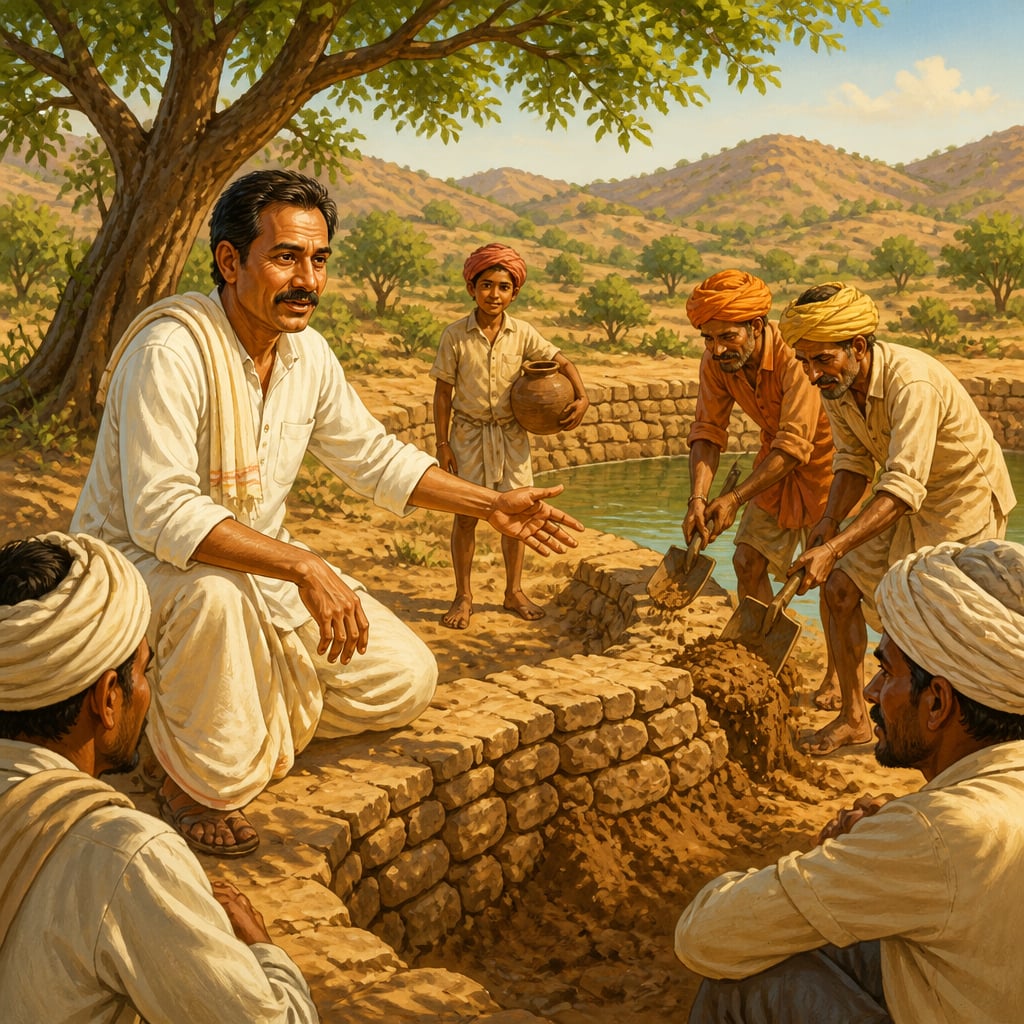
In 1985, Rajendra Singh, a young Ayurveda doctor, arrived in the drought-ravaged Alwar district of Rajasthan. What he found was a paradox: villages surrounded by ancient structures called johads, earthen rainwater harvesting tanks, that had been abandoned for decades.
The villagers told him these structures were obsolete. The government had built tube wells. Modern irrigation had replaced primitive tanks.
But the tube wells were failing. Groundwater had dropped 300 feet. Rivers that once flowed year-round had become seasonal, then vanished entirely.
Rajendra Singh began rebuilding johads. Not with government funds or foreign aid, but with shramdan, voluntary community labor. One tank at a time, one village at a time.
Thirty years later, the Arvari River, which had been dead for decades, flows again. Five other rivers have revived. Groundwater levels have risen. Alwar is no longer classified as a "dark zone" for water scarcity.
The solution wasn't new technology. It was remembering what the ancestors knew.
The Tank Civilization
India may have built more water tanks than any civilization in history. Estimates suggest over 500,000 tanks existed before British rule, a density of water infrastructure unmatched anywhere in the world.
These weren't primitive ponds. They were engineered systems:
Cascade Design: Tanks were connected in chains. Overflow from one tank fed the next, channeling monsoon water across landscapes. The famous tank systems of Tamil Nadu connected hundreds of tanks across dozens of kilometers.
Sluice Gates: Stone and metal gates controlled water release for irrigation. Farmers downstream received water on scheduled turns.
Desilting Protocols: Annual maintenance removed accumulated silt, maintaining storage capacity.
Bunds and Channels: Earthen embankments and distribution channels directed water to fields.
King Bhoja's Lake
Bhoja of Dhar (1010-1055 CE), the Paramara king of central India, was a polymath, author of texts on astronomy, architecture, and yoga. But his most lasting contribution may be water.
Bhoja constructed Bhojtal, a massive lake near modern Bhopal covering 650 square kilometers at its peak. The lake was created by damming the Betwa River, storing monsoon water for irrigation and urban use.
For 400 years, Bhojtal fed agriculture across the region. When Hoshang Shah breached the dam in 1434, it took 30 years for the lake bed to dry, testament to the engineering.
The Arthashastra, written over a millennium before Bhoja, prescribed:
"तडागं सर्वकालीनं कारयेत्" Taḍāgaṃ sarvakālīnaṃ kārayet "He should construct tanks suitable for all seasons."
This wasn't advice, it was royal duty. Water infrastructure was rajadharma, the king's moral obligation.
Wittfogel's Error
Karl Wittfogel (1896-1988), the German-American historian, developed a famous theory of "hydraulic despotism." He argued that civilizations dependent on irrigation inevitably become authoritarian because water control requires centralized power.
Wittfogel pointed to Egypt, Mesopotamia, and China, where massive irrigation systems were built and controlled by centralized states. He concluded that water = power = despotism.
But Wittfogel never seriously studied India.
India's tank systems were decentralized by design. Villages built and maintained their own tanks. The state might construct major dams (like Bhojtal), but the majority of water infrastructure was community-owned and community-managed.
Elinor Ostrom (1933-2012), the Nobel Prize-winning economist, spent her career studying exactly these systems. Her research on South Indian tanks proved that community management of common resources could be more effective than either state or market control, directly contradicting both Wittfogel and the "tragedy of the commons" theory.
Ostrom identified the key features that made Indian tanks work:
- Clear boundaries (who could use which tank)
- Rules matched to local conditions
- Collective choice arrangements (villagers made their own rules)
- Monitoring by users themselves
- Graduated sanctions for violations
- Conflict resolution mechanisms
- Recognition by external authorities
The Dutch "waterschappen" (water boards), dating to the 13th century, provide another parallel: community-governed bodies managing dikes and drainage. Like Indian tanks, they demonstrate that water management doesn't require despotism, it requires community.
| Theorist/System | Claim | Indian Reality |
|---|---|---|
| Wittfogel | Irrigation requires centralized despotism | India's 500,000 tanks were village-managed |
| Hardin | Commons inevitably degrade (tragedy) | Tank commons persisted for millennia |
| Ostrom | Community governance can work | Indian tanks were her primary evidence |
Kudimaramat: The Labor That Sustained
The Tamil term kudimaramat literally means "repairs by tenants/residents." It was the system by which village communities maintained their water infrastructure.

Every household contributed labor for annual tank maintenance:
- Desilting before monsoon
- Repairing bunds and sluices
- Clearing channels
- Strengthening embankments
This wasn't charity, it was self-interest organized collectively. The tank served everyone; everyone maintained it. The system created what economists call "skin in the game."
British rule disrupted kudimaramat catastrophically. The colonial government claimed ownership of tanks, removed village governance rights, and neglected maintenance. By 1900, an estimated half of South India's tanks had fallen into disrepair.
What villages had maintained for millennia, the state destroyed in decades.
Temple Tanks: When Water Became Sacred
Many of India's most enduring water structures are temple tanks (kovil kulam in Tamil, pushkarini in Sanskrit). These weren't primarily irrigation structures but ritual bathing pools attached to temples.
Yet they served crucial water functions:
- Recharged groundwater (temples were often sited at aquifer points)
- Provided drinking water for communities
- Created microclimate cooling
- Preserved biodiversity (many temple tanks are fish sanctuaries)
The genius was motivation. People maintained temple tanks not because government mandated it, but because neglecting a sacred water body was papa (sin). Religion accomplished what bureaucracy could not.

The famous Mariamman Teppakulam in Madurai, one of India's largest temple tanks, has been maintained for over 1,000 years. Nearby government tanks built in the 20th century have silted up and been abandoned.
The Modern Water Crisis
In June 2019, Chennai, a city of 10 million, approached "Day Zero." The four reservoirs that supplied the city were empty. Trains carried water from 200 kilometers away. The IT sector threatened to relocate.
How did Chennai run out of water?
The city sits on land that once had over 600 tanks, locally called eris. Most were filled for construction. The remaining were encroached, silted, or polluted. Natural drainage patterns were blocked by development.
Chennai's "water crisis" wasn't a failure of rainfall, the monsoon had been below average but not catastrophic. It was a failure of storage. The tank systems that had harvested monsoon water for millennia had been destroyed.
The contrast is stark: villages in Rajasthan with revived johads have water security. India's most modern city didn't.
Revival Movements
Across India, traditional water systems are being revived:
Tarun Bharat Sangh (Rajendra Singh's organization) has rebuilt over 11,500 johads across 1,200 villages. Five rivers have been revived. The organization received the Magsaysay Award ("Asia's Nobel") in 2001 and the Stockholm Water Prize in 2015.
Karnataka Tank Restoration uses a combination of government funding and community participation (shramdan) to restore traditional tanks. The state has restored over 10,000 tanks, increasing irrigation coverage and groundwater recharge.
Mission Kakatiya in Telangana has restored over 45,000 tanks since 2014. The program explicitly revives the kudimaramat principle, communities contribute labor alongside government funding.
The recognition is spreading: traditional water management wasn't primitive. It was sophisticated, sustainable, and, with community ownership, self-maintaining.
Jal Shakti Abhiyan: The State Remembers
In 2019, the Government of India launched Jal Shakti Abhiyan, a water conservation campaign that explicitly promotes traditional water harvesting. The Jal Jeevan Mission (₹3.6 lakh crore) aims to provide tap water to every rural household by 2024.
But the deeper recognition is that pipes without sources don't work. You can build distribution infrastructure, but if there's no water to distribute, it's useless. The ancient systems understood this, they focused on harvesting and storing water, not just moving it.
Atal Bhujal Yojana (₹6,000 crore), focused on groundwater management, explicitly incorporates community participation modeled on traditional governance. The program requires "Water User Associations", essentially reviving kudimaramat for the 21st century.
Your Turn
The next time you turn on a tap, consider: where does that water come from? In ancient India, every user knew their tank, its capacity, its condition, their responsibility for maintaining it. Modern piped supply has created "hydraulic amnesia", we consume water without understanding its source.
The village tank was not just infrastructure, it was relationship. Communities knew their water because they built it, maintained it, and shared it. That relationship created the incentives that kept tanks functioning for millennia.
The question for modern India is whether we can recreate those relationships at scale, or whether we'll continue pretending that water falls from pipes rather than sky.
Next, we explore Bija-Sanrakshana, how ancient India preserved and distributed seeds, and why modern seed corporations threaten what farmers maintained for millennia.
Garrett Hardin's 'Tragedy of the Commons' (1968) argued that shared resources inevitably degrade because individuals have incentive to over-use and under-maintain. Elinor Ostrom's Nobel Prize-winning research on Indian tanks showed this wasn't inevitable, kudimaramat systems prevented the tragedy through community governance.
Kudimaramat was self-enforcing because exclusion was possible. The tank community was small enough that free-riders could be identified and sanctioned. Large, anonymous systems (like modern urban water supply) lack this enforcement mechanism.
British abolition of kudimaramat in the 19th century led to an estimated 50% decline in functional tanks within 50 years. Tanks that villages had maintained for centuries fell into disrepair when the community governance system was dismantled.
Modern economics assumes people respond primarily to material incentives, money, goods, services. But research in behavioral economics shows that non-material factors (identity, meaning, social approval, spiritual reward) often drive behavior more powerfully. Temple tanks demonstrate this ancient understanding.
Secular government tanks, built in the 20th century, often fell into disrepair within decades. Temple tanks built 1,000 years ago continue functioning. The difference isn't engineering, it's motivation. Sacred status created enduring incentives that bureaucratic mandate could not.
Chennai has thousands of neglected secular tanks. But the Kapaleeshwarar Temple tank (Mylapore) and the Parthasarathy Temple tank (Triplicane) continue to be maintained, because communities feel religious obligation that they don't feel for government infrastructure.
Key terms
- Jala-nīti
- Water policy or water governance, the principles and practices for managing water resources
- Kuḍimaramat
- Community maintenance of water infrastructure through mandatory labor contributions from households
- Taḍāga
- Tank or reservoir, artificial water body created by damming or excavating to store rainwater or river water
- Puṣkariṇī
- Temple tank or sacred pond, water body attached to a temple, used for ritual bathing and often serving community water needs
Key figures
Bhoja of Dhar
1010-1055 CE
Rajendra Singh
1959-present
Karl Wittfogel
1896-1988
Case studies
Tarun Bharat Sangh: How One Man Revived Five Rivers
In 1985, Rajendra Singh, a young Ayurveda doctor, arrived in Gopalpura village in Alwar district, Rajasthan. The region was classified as a 'dark zone', groundwater critically depleted, rivers dried, villages abandoning land. Local elders showed Singh ancient structures called *johads*, earthen rainwater harvesting tanks that had been abandoned for decades. Government policy had dismissed them as 'primitive' and promoted tube wells instead. But the tube wells were failing as groundwater dropped 300 feet. Singh began rebuilding johads with *shramdan*, voluntary community labor. No government funding, no foreign aid, just villagers rebuilding what their grandparents had built. The first johad cost ₹400 in materials. The labor was free. One johad became ten. Ten became a hundred. A hundred became a thousand.
Singh's work exemplifies *aparigraha* (non-possessiveness) and *shramdan* (gift of labor). He didn't create new technology, he helped communities remember what they knew. The johads work not because of engineering innovation but because of social innovation: reviving kudimaramat-style community ownership. The dharmic insight is that water is *sanrakshya* (to be protected), not *shoshya* (to be exploited). Government tube wells treated groundwater as a resource to be pumped. Traditional johads treated rain as a gift to be harvested. The difference is extraction versus relationship.
By 2024, Tarun Bharat Sangh has: - Built 11,500+ johads across 1,200+ villages - Revived five rivers (Arvari, Ruparel, Sarsa, Bhagani, Jahajwali) that had been dead for decades - Raised groundwater levels by 50-100 feet across the region - Transformed Alwar from 'dark zone' to 'white zone' (water surplus) Rajendra Singh received the Magsaysay Award (2001), Stockholm Water Prize (2015), and is regularly called the 'Waterman of India.'
Traditional water systems work when community governance is restored. The johads aren't technically superior to tube wells, they're socially superior. They create relationships of maintenance and stewardship that groundwater pumping doesn't. Technology without community fails; community with simple technology succeeds.
Rajendra Singh's johad revival model has been adopted in drought-prone regions across Africa and Latin America. The World Bank now promotes community-managed watershed development as more cost-effective than large dams. Israel's drip irrigation technology gets headlines, but community water harvesting structures deliver similar results at 1/100th the cost in contexts where social capital exists.
Cost per hectare of irrigation: Government canal ₹5-10 lakh. Tube well ₹50,000-1 lakh. Johad ₹5,000-10,000. The 'primitive' solution is 10-100 times more cost-effective, and self-maintaining.
Karnataka Tank Restoration: When the State Becomes Partner
Karnataka has over 40,000 tanks (locally called *keres*), one of the densest concentrations in India. By 2000, an estimated 60% were silted, encroached, or non-functional. Ancient irrigation systems that had supported agriculture for millennia were dying. In 2002, Karnataka launched the Tank Development Authority, later expanded to a comprehensive restoration program. The approach was hybrid: - Government provides funding and technical expertise - Communities contribute 20% through shramdan (voluntary labor) - Tank User Associations govern water allocation - Traditional maintenance practices revived The program explicitly recognized that state-only or community-only approaches had failed. What was needed was partnership.
Karnataka's approach embodies the dharmic principle of *sahayoga* (cooperation, working together). Neither the extractive modern state nor the idealized autonomous village was sufficient. What worked was collaboration, state resources combined with community governance. The 20% shramdan requirement isn't just cost-sharing, it's commitment mechanism. When villagers invest their labor, they have 'skin in the game' and maintain the tank. Government-only projects, with no community investment, often fail within years.
By 2023, Karnataka has: - Restored over 10,000 tanks - Increased tank irrigation by 3 lakh hectares - Formed 40,000+ Water User Associations - Seen groundwater recharge improve across restored tank catchments The model is now being studied nationally. Tamil Nadu, Andhra Pradesh, and Telangana have launched similar programs.
Neither state nor community alone can manage water in modern conditions. The ancient system worked because villages were autonomous and self-governing. That autonomy eroded under colonialism and centralized planning. Revival requires rebuilding community capacity, but with state partnership, not state domination.
The tank restoration model maps directly to urban stormwater management challenges. Cities like Melbourne, Singapore, and Copenhagen now invest in 'sponge city' infrastructure that mimics traditional tank systems. The insight that governance matters more than engineering applies equally to modern water utilities, where well-governed systems consistently outperform better-funded but poorly governed ones.
Tanks with active Water User Associations have 90% maintenance compliance. Tanks without WUAs have less than 30%. The difference isn't the structure, it's the governance.
Chennai Water Crisis 2019: A Modern City Forgets Its Tanks
In June 2019, Chennai, India's sixth-largest city, approached 'Day Zero.' The four reservoirs supplying the city were nearly empty. Trains carried water from 200 kilometers away. IT companies threatened to relocate. Residents queued for hours at water trucks. The monsoon that year was below average, but not catastrophically so. Chennai receives 55 inches of rain annually, more than London. The problem wasn't rainfall; it was storage. The city had once had over 600 water tanks (*eris*). By 2019, most had been filled for construction, encroached for slums, or silted into uselessness. Natural drainage patterns were blocked by development. When rain fell, it ran off into the sea rather than being captured. Chennai's 'water crisis' was a crisis of memory, forgetting that the city had been built on and sustained by its tanks.
Chennai exemplifies *hydraulic amnesia*, forgetting where water comes from. The city's planners saw tanks as 'waste land' to be developed, not as infrastructure to be maintained. This is *artha* (material gain) divorced from *dharma* (right conduct), short-term economic value destroying long-term sustainability. The tank system had managed Chennai's water for centuries. It was destroyed in decades by a development model that externalized the consequences. Future generations, and present-day residents, pay for decisions made by those who won't bear the costs.
The 2019 crisis catalyzed change: - Chennai now has mandatory rainwater harvesting for all buildings - Several tanks are being restored - The state is investing in 'managed aquifer recharge' - Awareness of traditional water systems has increased But decades of encroachment can't be undone quickly. Many filled tanks are now under buildings. The city remains vulnerable.
Modern urban planning that ignores traditional water infrastructure creates crises that modern technology cannot solve. You can build desalination plants (Chennai now has one), but you cannot replace the aquifer recharge that hundreds of tanks once provided. Prevention through preservation is cheaper than cure through technology.
Chennai's crisis foreshadowed Cape Town's 'Day Zero' (2018) and Mexico City's ongoing water emergency. Every major city built over filled-in lakes or degraded watersheds faces the same reckoning. Bengaluru, built over 262 historical lakes of which fewer than 80 survive, is widely predicted to be India's next urban water crisis. The pattern is consistent: cities that destroy their traditional water infrastructure eventually spend 10-100x more on engineered replacements.
Chennai's 2019 desalination plant cost ₹1,100 crore and provides 100 MLD. The 600 tanks, if maintained, could have harvested 500+ MLD of rainwater, at a fraction of the cost. Traditional infrastructure was destroyed; now taxpayers fund the replacement.
Historical context
2nd millennium BCE to present; tank building peaked under Cholas (9th-13th century CE)
India's tank systems developed from the understanding that monsoon rainfall is abundant but temporally concentrated. The solution wasn't to find more water but to store what falls in 100 days for use in 365. This insight, harvest and store rather than extract and deplete, shaped water management for three millennia.
The Dutch developed their waterschappen (water boards) in the 13th century, community-governed bodies managing dikes and drainage. Like Indian tanks, these demonstrate that water management doesn't require despotism (contra Wittfogel). But India's tank density and longevity remain unmatched globally.
Pre-colonial India had an estimated 500,000+ tanks. By 1900, under British rule, perhaps half were non-functional. Today, estimates suggest 70% of traditional tanks are defunct or severely degraded. This is the largest collapse of water infrastructure in human history.
Understanding tank history reveals that India's water crisis is not natural but constructed. The systems that managed water for millennia were destroyed by colonial and post-colonial policies. Revival requires not new technology but recovered governance, community ownership, maintenance obligations, and respect for traditional knowledge.
Living traditions
- Johad Rebuilding in Rajasthan: Tarun Bharat Sangh and similar organizations continue building and maintaining traditional earthen tanks across Rajasthan. Communities contribute shramdan (voluntary labor) annually for maintenance, a direct continuation of kudimaramat.
- Temple Tank Maintenance: Many temple tanks continue to be maintained by devotee communities. The Mariamman Teppakulam (Madurai), Kapaleeshwarar tank (Chennai), and Lolark Kund (Varanasi) are examples of sacred water bodies maintained for centuries.
- Katta (Check Dam) Building: In Maharashtra and parts of Karnataka, communities still build traditional check dams (katta) across streams to slow water and enhance infiltration. Organizations like Paani Foundation promote this through competitions.
- Tarun Bharat Sangh Campus: Rajendra Singh's organization headquarters, surrounded by revived johads and the Arvari River. Offers education programs on traditional water management.
- Mariamman Teppakulam: One of India's largest temple tanks, maintained for over 1,000 years. The annual float festival (Teppam) celebrates the tank and the goddess.
- Virupaksha Temple Tank: Ancient stepped tank attached to the Virupaksha Temple, part of the UNESCO World Heritage Hampi site. Demonstrates Vijayanagara-era water architecture.
- Gangaikondacholapuram Temple: The Chola Emperor Rajendra I's capital featured one of ancient India's most sophisticated irrigation systems, the temple complex integrated massive tank infrastructure with religious architecture, demonstrating jala-niti at imperial scale
- Padmanabhaswamy Temple: The temple's elaborate water management system including the sacred Padmatheertham tank demonstrates how religious institutions managed water for both ritual and agricultural purposes across Travancore
Reflection
- Traditional villages knew their water, built it, maintained it, shared it. Modern urban consumers experience water as a commodity that comes from pipes, without understanding its source. How has this 'hydraulic amnesia' affected your relationship with water? What would it mean to truly know where your water comes from?
- Kudimaramat worked because beneficiaries were also maintainers, those who used the tank contributed to its upkeep. Consider shared resources in your life, family home, workplace, community spaces, digital commons. Where do you benefit without contributing to maintenance? How might you apply the kudimaramat principle?