Krishi Parashara: The World's Oldest Agricultural Treatise
When Farming Was Sacred Science
Discover Krishi Parashara, humanity's oldest surviving agricultural manual, written over 3,000 years ago. Learn how ancient India developed sophisticated farming systems that modern organic agriculture is only now rediscovering, from soil classification to rainfall prediction to seed preservation.
The Farmer Who Read the Stars
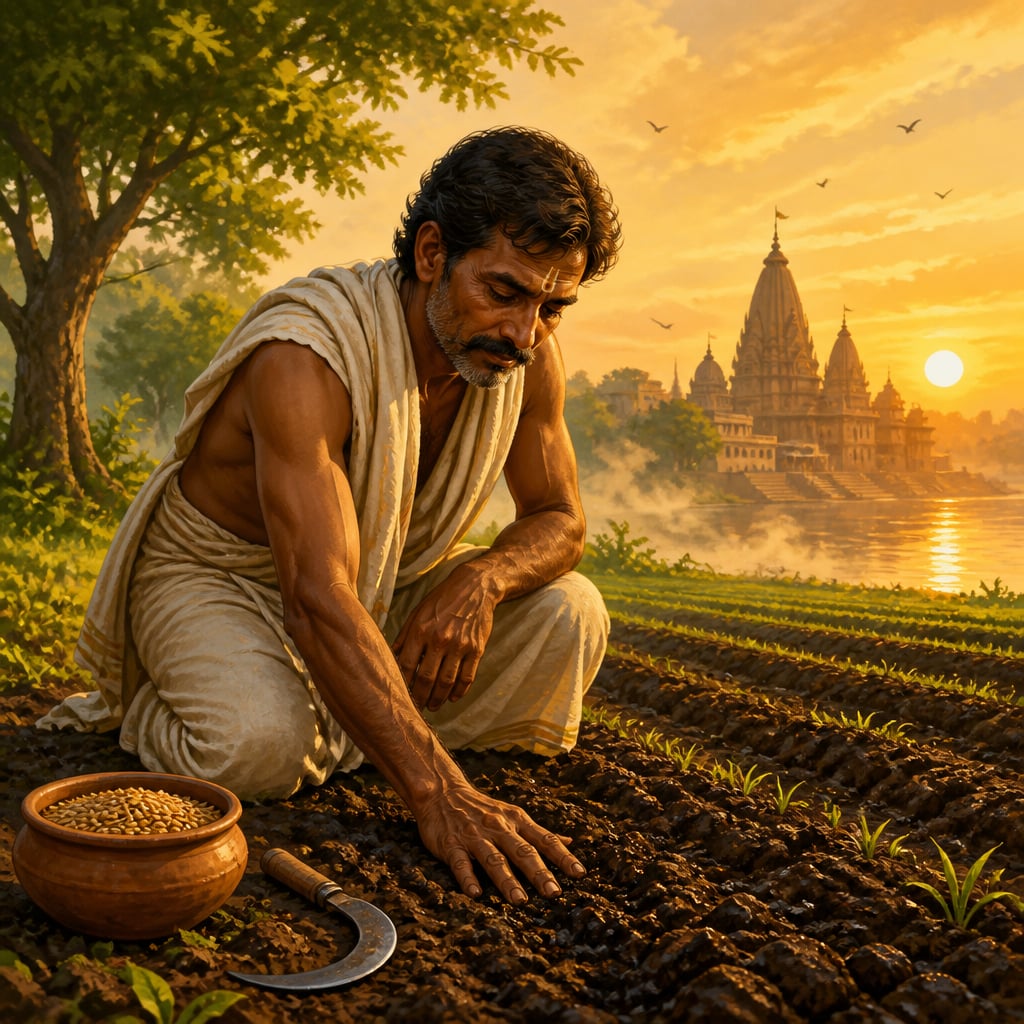
In the dim hours before dawn, Govinda pressed his palm into the earth of his field near Varanasi. The soil was cool, slightly moist, exactly as his grandfather had taught him. Above, the constellation Rohini hung low on the eastern horizon. Tonight, he would sow his rice seeds.
This was not superstition. This was Krishi Parashara.
Govinda was following instructions written over 3,000 years ago by the sage Parashara, the same rishi who fathered Vyasa, the compiler of the Vedas. But Parashara was more than a spiritual teacher. He was, in modern terms, an agricultural scientist who codified centuries of farming wisdom into 243 verses that would guide Indian farmers for millennia.
The Treatise Time Forgot
While the world credits Jethro Tull (1674) with inventing the seed drill and launching "scientific agriculture," Indian farmers had been following systematic agricultural science since at least 1000 BCE. The Krishi Parashara predates European agricultural manuals by over 2,500 years.
What makes this text remarkable isn't just its age, it's its sophistication.
Parashara opens not with planting instructions, but with a fundamental truth:
"कृषिं धर्मं परं विद्धि"
Krishim dharmam param viddhi
"Know agriculture to be the highest dharma."
This wasn't poetic flourish. Parashara understood that feeding people was sacred work, that the farmer who sustained life was performing the most essential service to society. In an era when warrior kings and Brahmin priests claimed highest status, a rishi declared the krishaka (farmer) as dharma's foundation.
A System of Systems
The Krishi Parashara is organized around an integrated view of farming that modern "systems thinking" is only now articulating. Parashara saw the farm not as isolated fields, but as a living network connecting:
1. Sky (Nakshatra): The 27 lunar mansions determined planting times. Each constellation carried specific agricultural implications, Rohini for sowing, Mrigashira for irrigation, Ardra for transplanting rice.
2. Soil (Bhumi): Parashara classified soils into 12 types based on color, texture, smell, and taste. Urvara (fertile black soil) differed from Ushara (saline soil), and each demanded different crops and treatments.
3. Seed (Bija): Detailed testing protocols, floating seeds in water to check viability, examining color and weight, storing in specific vessels.
4. Rain (Varsha): Perhaps most remarkably, Parashara developed rainfall prediction methods based on observing cloud formations, wind patterns, animal behavior, and planetary positions.
5. Cattle (Go): The cow wasn't merely an animal but the center of a circular economy, dung for fertilizer, urine for pest control, milk for nutrition, bullocks for labor.
Global Perspectives on Agricultural Science
Parashara's integrated approach stands in fascinating contrast to Western agricultural development:
Masanobu Fukuoka (1913-2008), the Japanese farmer-philosopher who developed "natural farming," spent decades trying to prove what Parashara had written millennia earlier, that minimal intervention, working with nature rather than against it, produces sustainable yields. Fukuoka's famous "One-Straw Revolution" (1975) shocked modern agronomists by demonstrating that rice could be grown without flooding, plowing, or chemicals. Yet Parashara's text described similar principles: "Sva-bhumijaṃ bījaṃ śreṣṭham", seed from one's own land is best.
Jethro Tull (1674-1741), often called the father of modern British agriculture, invented the seed drill and advocated row planting. His methods increased efficiency but began agriculture's long march toward mechanization and monoculture, the very approach now causing soil degradation worldwide.
Norman Borlaug (1914-2009), the Nobel Prize-winning architect of the Green Revolution, developed high-yield wheat varieties that saved a billion lives. But the same revolution created India's current crisis: depleted aquifers in Punjab, poisoned soils, and farmer suicides. Parashara's system required no external inputs, everything came from within the farm.
| Thinker | Key Innovation | Parashara's Parallel |
|---|---|---|
| Fukuoka | Natural farming, minimal intervention | Prakrti-anusara (following nature) |
| Tull | Systematic row planting | Sita-raksha (furrow protection) |
| Borlaug | High-yield varieties | Bija-pariksha (seed selection for local conditions) |
The Rainfall Prophet
One of Krishi Parashara's most striking sections concerns Varsha-prabodhana, awakening to rain. Parashara taught farmers to predict monsoon patterns months in advance:

"यदा पुष्पफलैर्वृक्षाः समृद्धाः शोभिता दिशः। तदा वर्षं समायाति शस्यानां च शुभावहम्॥"
"When trees are abundant with flowers and fruits, and the directions appear beautiful, then beneficial rains for crops are approaching."
This wasn't mysticism, it was ecological observation codified. Trees flowering out of season, ants building higher mounds, behavior of specific birds, all served as indicators in an era before satellites and supercomputers.
Amazingly, India's traditional Panchang (almanac) still incorporates these methods. In 2023, when IMD (India Meteorological Department) predicted a normal monsoon but traditional forecasters in Maharashtra warned of delayed rains, it was the ancient system that proved more accurate for specific micro-regions.
The Modern Resurrection
For two centuries, colonial and post-colonial India dismissed indigenous agricultural knowledge as "primitive." The Green Revolution of the 1960s explicitly replaced traditional methods with chemical-intensive farming.
But something remarkable is happening in 2025.

Subhash Palekar, a Padma Shri recipient, has built a movement of over 40 lakh farmers practicing Zero Budget Natural Farming (ZBNF), a system that essentially operationalizes Parashara for the 21st century. ZBNF uses Jeevamrita (a fermented cow dung solution) and Bijamrita (seed treatment) that directly echo Parashara's prescriptions.
The Government of India's Soil Health Card Scheme, launched in 2015 and now covering 23 crore cards, is essentially a digital version of Parashara's soil classification system. Farmers receive personalized recommendations based on their soil's unique composition, precisely what the sage prescribed when he wrote that each kshetra (field) has its own svabhava (nature).
The PM-PRANAM scheme (2023) incentivizes states to reduce chemical fertilizer use, a policy recognition that Parashara's organic approach may be economically superior. And the Namo Drone Didi initiative is training 15,000 women as drone pilots for precision agriculture, ancient wisdom meeting cutting-edge technology.
Your Turn
The next time you eat a meal, consider this: somewhere in its ancestry is knowledge that predates the Pyramids. The rice on your plate may trace its cultivation techniques through an unbroken chain to a sage who watched the stars and pressed his palm into the earth.
Krishi Parashara teaches that farming is not merely an economic activity, it is yoga, the union of human effort with cosmic rhythms. Modern agriculture forgot this. The question for India, and the world, is whether we can remember in time.
In our next lesson, we'll explore Bhumi-Vibhajana, how ancient India classified and distributed land, and why those systems produced stability that British land reforms would later destroy.
Friedrich Hayek argued that economic knowledge is dispersed, no central planner can know local conditions as well as local actors. Modern agricultural extension services struggle with 'last-mile' advice because they lack this granular knowledge.
Parashara's system trained every farmer as a micro-scientist. The knowledge was embodied in practice, transmitted through apprenticeship, and constantly refined through local observation, a distributed intelligence network that industrial agriculture destroyed by standardizing practices.
India's Soil Health Card Scheme has issued 23 crore cards, but studies show only 10% of farmers understand them. Traditional knowledge required no literacy, it was taught through doing.
Modern economics speaks of 'externalities', costs imposed on others (pollution, soil degradation) that producers don't pay for. The Ellen MacArthur Foundation now promotes 'circular economy' as a revolutionary concept, but Parashara's farm was circular by design.
Industrial agriculture externalizes costs, aquifer depletion, soil degradation, farmer health impacts from pesticides, that will be paid by future generations. Parashara's system had zero externalities because everything was accounted for within the farm.
Punjab, poster child of the Green Revolution, has lost 50% of its soil organic matter since 1970. Water tables drop 1 meter per year. These are externalized costs now coming due. ZBNF farms show soil improvement within 3 years.
Key terms
- Kṛṣi
- Agriculture, farming, cultivation
- Nakṣatra
- Lunar mansion, star constellation used for timing agricultural activities
- Bīja-parīkṣā
- Seed testing, examination of seed quality before sowing
- Pañcagavya
- Five products derived from the cow, milk, curd, ghee, urine, and dung, used as fertilizer and pest control
Key figures
Sage Parashara
c. 1000-500 BCE (composition period)
Subhash Palekar
1949-present
Masanobu Fukuoka
1913-2008
Case studies
Sikkim's Organic Revolution: A State Goes Back to the Future
In 2003, Sikkim's Chief Minister Pawan Kumar Chamling announced an audacious goal: make Sikkim India's first fully organic state. Critics called it economic suicide, how could a state feed itself without chemical fertilizers and pesticides? The implementation took 13 years. By 2016, Sikkim had converted all 75,000 hectares of agricultural land to certified organic farming. Chemical fertilizers and pesticides were banned. Farmers were trained in traditional methods, many of which directly echoed Krishi Parashara: using cow dung and urine as fertilizer, neem-based pest control, and local seed varieties. The transition was not easy. Yields initially dropped 20-30% as degraded soils recovered. Farmers faced pest pressures they hadn't seen in decades. But by 2016, yields had stabilized, and Sikkim's organic produce commanded 20-50% premium prices.
Conventional economics would have called this irrational, sacrificing short-term yields for uncertain future benefits. But dharmic economics asks different questions: What is the true cost when we include soil health, water quality, farmer health, and ecosystem services? Sikkim's gamble was that Parashara's circular, self-sustaining system would outperform the extractive industrial model over time. The state essentially applied *dīrgha-dṛṣṭi* (long-term vision) over short-term optimization, choosing to rebuild soil health rather than continue mining it with chemicals.
In 2018, Sikkim won the UN Future Policy Award (Gold), the 'Oscar for best policies', beating 51 countries. Farm tourism increased 70%. Sickim's organic branding attracts 1.4 million tourists annually. Farmer incomes rose despite lower yields because of premium prices and eliminated input costs. More significantly: no farmer suicides have been reported in Sikkim since the transition. In contrast, chemical-intensive states like Maharashtra see thousands annually. The human cost of the Green Revolution is being paid in lives, a cost Sikkim chose to reject.
Parashara's 'backward' methods proved more economically sustainable than 'modern' chemical agriculture. Sikkim demonstrated that ancient wisdom, properly applied, can outperform industrial systems, not despite being traditional, but because of it.
The organic farming movement globally, valued at $200+ billion, validates Sikkim's bet. Companies like Whole Foods and platforms like BigBasket Premium charge 30-50% premiums for organic produce. Consumer willingness to pay for chemical-free food converts traditional farming methods from 'backward' to 'premium positioning.'
Sikkim's groundwater quality improved by 30% within 5 years of going organic. Soil organic carbon, which had been declining, began increasing. These are economic assets that don't appear in GDP but determine whether farming can continue.
Andhra Pradesh's ZBNF Mission: Scaling Ancient Wisdom
In 2015, Andhra Pradesh faced a crisis: 2,000+ farmer suicides annually, mounting agricultural debt, and declining soil fertility. Rather than doubling down on chemical inputs, Chief Minister Chandrababu Naidu made a counterintuitive decision: he invited Subhash Palekar to implement Zero Budget Natural Farming statewide. The goal: convert 6 million farmers to ZBNF by 2024. The method: train farmers in Palekar's techniques, Jeevamrita, Bijamrita, and Acchadana, which are essentially Krishi Parashara for the 21st century. The economic model: eliminate all input purchases, bringing farmer costs to zero. By 2023, over 1 million farmers had adopted ZBNF. Andhra established 3,000 farmer-to-farmer training programs, creating a knowledge-sharing network that resembles the oral tradition through which Parashara's wisdom originally spread.
ZBNF represents a return to the Parashara model: the farm as a self-sustaining system where inputs are produced internally. This inverts the Green Revolution's economics, which created farmer dependency on purchased seeds, fertilizers, and pesticides, a dependency that was profitable for corporations but ruinous for farmers. The dharmic insight: true agricultural prosperity is *svavalambanam* (self-reliance). When farmers depend on external inputs, they become vulnerable to market fluctuations, corporate pricing, and debt spirals. When everything comes from the farm, the farmer is sovereign.
Studies by the Institute of Development Studies (UK) found ZBNF farmers reduced costs by 50-70% with yields comparable to chemical farming. Net income increased despite similar gross output. More importantly, farmers reported reduced stress and improved health from eliminating pesticide exposure. The World Bank has cited Andhra's ZBNF as a model for climate-resilient agriculture. Its emphasis on mulching and soil biology creates farms that withstand drought better than chemical-dependent systems. In 2023, ZBNF farms showed 10-20% better yields during a heat wave that devastated conventional crops.
Parashara's circular, input-free system isn't just philosophically beautiful, it's economically superior. When true costs are counted (farmer debt, health, soil degradation, water depletion), the 'efficient' modern system is catastrophically expensive. The ancient way may be the only sustainable way.
ZBNF's zero-input-cost model has direct parallels in the regenerative agriculture movement adopted by companies like General Mills and Danone. When corporations calculate the true cost of chemical farming (soil degradation, water pollution, farmer debt cycles), traditional methods consistently show superior long-term economics.
Average input cost for conventional farmers: ₹35,000-45,000 per hectare per season. ZBNF input cost: ₹0 (everything produced on-farm). This difference explains why chemical farmers carry average debt of ₹2-3 lakh while ZBNF farmers are debt-free.
Historical context
1000-500 BCE (composition); practiced until 1960s Green Revolution
India during Parashara's era was transitioning from the Vedic pastoral economy to settled agriculture. The Indo-Gangetic plains were being cleared and cultivated. Rice cultivation was spreading. Villages were becoming self-sufficient economic units. Parashara's text codified the accumulated wisdom of this agricultural revolution.
While Egyptian and Mesopotamian agriculture depended on predictable rivers and centralized state management, Indian agriculture had to adapt to the unpredictable monsoon. This bred the sophisticated observation systems (nakshatras, weather prediction) that appear in Parashara, flexibility and local adaptation over standardization.
Ancient India achieved rice yields of 1-2 tons per hectare using Parashara's methods. Modern organic farms achieve 2-3 tons. The Green Revolution's chemical methods achieve 4-5 tons, but at the cost of soil degradation, water depletion, and farmer debt that make those yields unsustainable.
Understanding Krishi Parashara's historical context shows it wasn't primitive, it was sophisticated adaptation to monsoon-dependent, village-based agriculture. Modern industrial methods were designed for European climates and plantation economics. Their imposition on India may have been a civilizational mismatch we are still paying for.
Living traditions
- Panchagavya Preparation: Farmers across India still prepare panchagavya (five cow products) and Jeevamrita for fertilization. In Tamil Nadu, 'panchagavya spray' is sold in agricultural supply shops. The tradition has gone commercial while retaining its ancient form.
- Nakshatra-Based Planting: Traditional farmers, especially in South India, still consult the Panchang (lunar calendar) for planting times. The Rohini nakshatra for rice sowing, prescribed by Parashara, is still observed in villages across Karnataka and Andhra.
- Community Seed Banks: In response to hybrid seed dependency, over 100 community seed banks have emerged across India, preserving indigenous varieties. Organizations like Navdanya (founded by Vandana Shiva) maintain collections of traditional seeds, a living archive of what Parashara called 'sva-bhumijaṃ bījaṃ.'
- Navdanya Biodiversity Farm: A 20-acre farm conserving 5,000+ crop varieties, demonstrating traditional agricultural methods. Offers courses in organic farming and seed saving.
- ZBNF Demonstration Farms: The state agriculture department maintains demonstration farms where visitors can see Zero Budget Natural Farming in practice.
- Sikkim Organic Farms: Any agricultural area in Sikkim is now an organic farm. Visit Rumtek or Gangtok districts to see fully organic cultivation.
- Brihadeeswarar Temple (Big Temple): The Chola-era temple sits at the heart of the Kaveri delta's traditional rice cultivation region, temple inscriptions document sophisticated agricultural management including crop cycles, tank maintenance, and farmer welfare systems
- Ranganathaswamy Temple: One of India's largest temple complexes, Srirangam's inscriptions contain detailed records of land grants, crop management, and agricultural labor arrangements, a living archive of traditional farming economics
Reflection
- Parashara declared agriculture the 'supreme dharma' (kṛṣiṃ dharmaṃ paraṃ), above even priestly and warrior duties. What does it mean to treat food production as sacred work rather than mere economic activity? How might our agricultural policies change if we truly believed farmers were performing the highest service to society?
- Parashara's system required zero external inputs, everything the farm needed came from within. Consider your own life or work: where are you dependent on external inputs that make you vulnerable? What might a 'zero-budget' approach look like in your context, reducing dependency, building internal capacity, closing resource loops?