Bhumi-Vibhajana: Land Classification and Tenure
Who Owned the Land?
Ancient India developed sophisticated land tenure systems that balanced individual cultivation rights with communal ownership and state interest. This layered system, gram-bhumi, raja-bhumi, and personal holdings, created stability for millennia, until British land reforms catastrophically dismantled it. Discover why understanding these systems matters for India's land policy today.
The Village That Wouldn't Sell
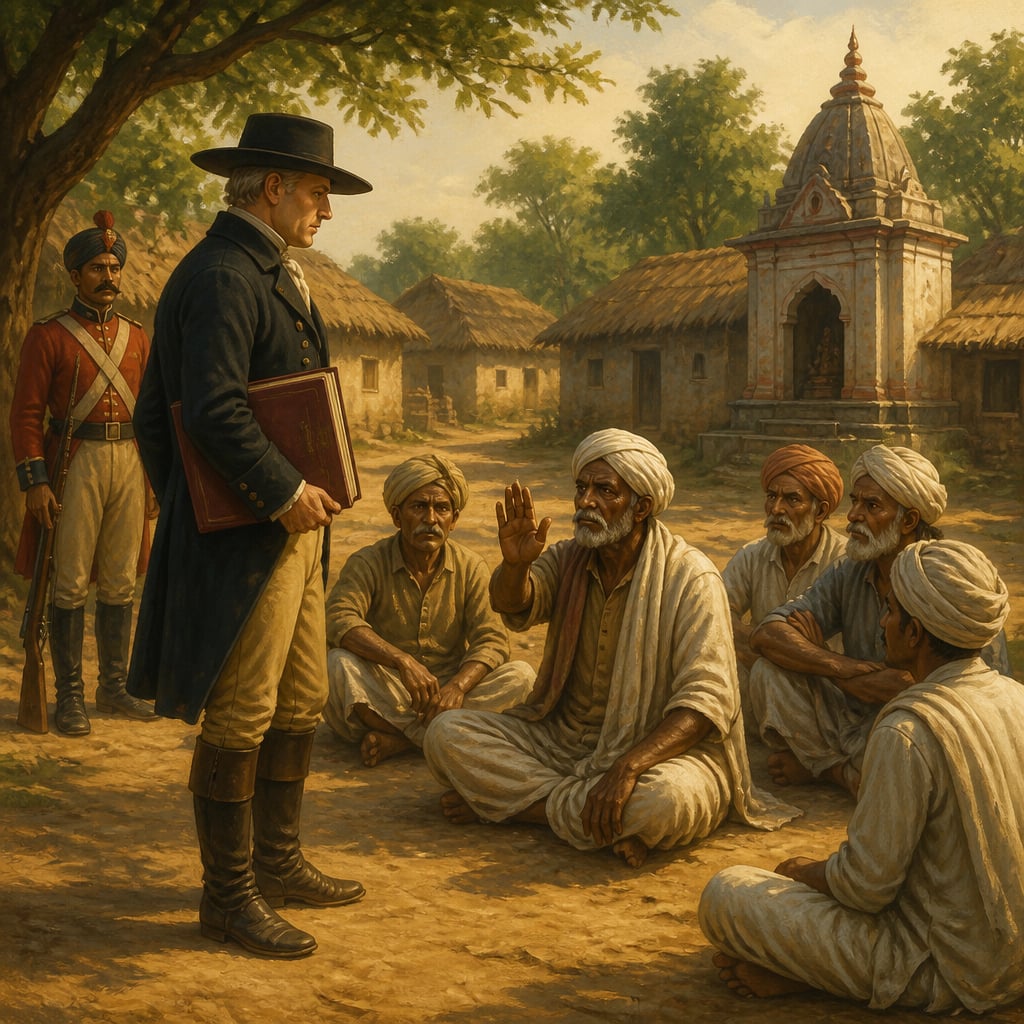
In 1790, a British revenue officer named Charles Grant arrived at a village near Bhagalpur in Bihar. He carried orders to implement the new Permanent Settlement, a system that would convert Indian land into British-style private property. The local zamindar would become the absolute owner; the village would become his estate.
But the villagers resisted. Not with weapons, but with a question that baffled Grant: "How can the zamindar own what no one owns?"
Grant couldn't understand. In England, land was property, owned, bought, sold. But these villagers operated from a different mental universe. They spoke of gram-bhumi (village commons), raja-bhumi (crown land), devadana (temple endowments), and khudkasht (self-cultivated plots). Land wasn't a commodity; it was a web of relationships.
Within fifty years, Bihar would have the highest concentration of landless laborers in India. The British "reform" had created a dispossession that took generations to reverse, if it ever was.
The Three-Layered System
Ancient Indian land tenure was neither fully communal nor fully private. It was layered sovereignty, multiple rights existing simultaneously on the same land.
Layer 1: Raja-Bhumi (Crown Land) The king claimed theoretical sovereignty over all land. But this was not ownership in the Western sense. Kautilya's Arthashastra is explicit: the king's claim entitled him to revenue (typically one-sixth of produce), not to dispossession. A king who seized cultivated land was acting adharmic, against cosmic order.
"भूमिस्वामिनो राजा न वा कर्षकः" Bhūmi-svāmino rājā na vā karṣakaḥ "The king is lord of the land, but the cultivator is not thereby dispossessed."
Layer 2: Gram-Bhumi (Village Commons) Every village had common lands, forests, pastures, water bodies, waste land, that belonged to no individual but to the grama (village) as a collective. These saman-bhumi (shared lands) were managed by the village sabha or panchayat.
Remarkably, this created what modern economists call "common pool resource management" without creating the "tragedy of the commons." The village enforced usage rules: when to graze cattle, which forests to harvest, who could draw water. Private encroachment on commons was a serious offense.
Layer 3: Personal Holdings (Khudkasht) Individual families held cultivation rights to specific plots, but these were usufruct rights (right to use and benefit), not absolute ownership. You could cultivate, bequeath to heirs, even sell your cultivation rights, but you couldn't alienate the land from its fundamental relationship to village and state.
Global Perspectives on Land Tenure
John Locke (1632-1704), the English philosopher whose ideas shaped Western property law, argued that property rights arise when a person "mixes his labor" with the land. In Locke's famous formulation: "Whatsoever then he removes out of the state that nature hath provided... he hath mixed his labour with, and joined to it something that is his own, and thereby makes it his property."
This created the intellectual foundation for absolute private property, land as commodity, freely bought and sold, with the owner holding complete dominion.
Henry George (1839-1897), the American economist, challenged this orthodoxy. In "Progress and Poverty" (1879), he argued that land differs from other property: no one created it, so no one can rightfully own it absolutely. He proposed that land should be commonly owned, with private holders paying a "land value tax" to the community.
Hernando de Soto (1941-present), the Peruvian economist, argued in "The Mystery of Capital" (2000) that clear, formal property rights are essential for economic development. Without them, the poor cannot use their land as collateral, cannot prove ownership, and remain trapped in informal economies.
| Thinker | Core Argument | Indian Parallel |
|---|---|---|
| Locke | Labor creates property right | Karshaka (cultivator) rights from tilling |
| George | Land value belongs to community | Gram-bhumi commons, raja's revenue share |
| de Soto | Formal titles enable development | SVAMITVA scheme, Dharani digitization |
The Indian system anticipated elements of all three: cultivators had secure rights (Locke), the community claimed a share (George), and there were formal recognition systems through village records and copper-plate grants (de Soto), but without reducing land to pure commodity.
Women and Land: The Forgotten Rights
One of the most striking features of ancient Indian land law was women's property rights. Stridhan, a woman's personal wealth including land, was legally protected.
The Yajnavalkya Smriti explicitly states that a woman's stridhan remains hers alone: her husband cannot claim it, and it passes to her daughters before sons. Widows retained rights to their husband's land; they could not be dispossessed.
The Arthashastra goes further: it prescribes that women who work as agricultural laborers must be paid equally for equal work, a principle that wouldn't enter Western law until the 20th century.
British law erased much of this. The colonial courts, trained in English common law where married women had no separate legal existence, systematically denied Indian women's land claims. Hindu Succession Acts of 1956 and 2005 have only partially restored what was lost.
The British Destruction
When the British arrived, they brought assumptions shaped by England's enclosure movement, which had converted common lands into private estates over two centuries. They saw India's layered tenure as "feudal chaos" requiring "reform."
The Permanent Settlement of 1793 (Bengal, Bihar, Orissa) converted zamindars, originally tax collectors, into absolute landlords on the English model. Cultivators who had tilled land for generations became tenants who could be evicted.
The Ryotwari System (Madras, Bombay) went the opposite direction: it made each ryot (peasant) individually responsible for revenue, breaking village solidarity. When monsoons failed, there was no collective insurance, individual farmers lost their land to moneylenders.
Both systems had the same effect: they destroyed the layered tenure that had balanced individual and collective interests for millennia.
Between 1860 and 1900, agricultural debt in India increased by 700%. By 1900, an estimated 50% of cultivated land had passed from cultivators to moneylenders and new landlord classes. This was the genesis of India's persistent land inequality.
The Modern Resurrection
Independent India attempted land reform, but with mixed results. Zamindari abolition (1951-1956) eliminated the British-created landlord class, but zamindars often evaded reform by transferring land to relatives or converting to "personal cultivation" claims.

The Bhoodan Movement (1951-1969), led by Vinoba Bhave with Jayaprakash Narayan's support, took a dharmic approach: voluntary land donation. Walking village to village, Vinoba asked landlords to donate one-sixth of their land for redistribution, invoking the same bhagya principle from the Arthashastra. The movement collected over 4 million acres, though much was of poor quality.
Jayaprakash Narayan went further, proposing Gramdan (village gift), entire villages would collectively own land, reviving the ancient gram-bhumi concept. Though never implemented at scale, Gramdan influenced India's panchayati raj system and cooperative movements.
Today, India is using technology to solve what centuries couldn't:

SVAMITVA Scheme (2020) uses drones to survey 6.62 lakh villages, providing property cards to rural households, many of whom have cultivated land for generations without formal documentation. This is, in effect, digitizing the ancient khudkasht system.
Telangana's Dharani Portal has digitized all land records in the state, eliminating the patwari (village record-keeper) who had become a source of corruption. Farmers can now access, verify, and transfer land online, secure tenure for the digital age.
Your Turn
The land beneath your feet carries centuries of contested claims. Whether you live in a city apartment or rural village, the tenure systems that govern your property trace back through colonial reforms to ancient principles, and the conflicts between them remain unresolved.
Consider: What is land? A commodity to be bought and sold? A sacred trust to be stewarded? A web of relationships between cultivator, community, and cosmos? The answer you give shapes not just property law, but civilization itself.
Next, we explore Sasya-Chakra, how ancient India developed crop rotation and sustainable farming systems that maintained soil fertility for millennia.
Modern property economists speak of a 'bundle of rights', ownership is not a single thing but a collection of distinct rights (use, exclusion, transfer, etc.) that can be separated. Locke and British law collapsed this into absolute ownership. The Indian system kept the bundle intact but distributed its sticks to different holders.
Layered sovereignty created what game theorists call 'veto players', multiple actors whose consent was needed for major changes. This made the system resistant to both state tyranny and private encroachment. It sacrificed some 'efficiency' for stability and equity.
Indian agricultural output remained stable for millennia under layered tenure. Within 100 years of British 'reform,' famines killed 30+ million people. The supposedly 'inefficient' old system had maintained food security; the 'efficient' new system created catastrophe.
Trusteeship vs. Absolute Ownership; Intergenerational Equity
Gandhi developed his 'trusteeship' theory for industrial property directly from this land tenure principle. Modern ESG (Environmental, Social, Governance) frameworks and stakeholder capitalism echo trusteeship, the idea that property holders have obligations beyond profit maximization.
Trusteeship prevented the concentration of land that plagues societies with absolute property. When land can't be freely alienated, distressed sale doesn't create permanent landlessness. British reforms enabled exactly this: moneylenders could seize land as collateral, creating the landless class that didn't exist before.
Key terms
- Bhūmi-vibhājana
- Land classification and distribution; the system of dividing land into different categories with distinct ownership and usage rights
- Grāma-bhūmi
- Village commons, land owned collectively by the village community, not by individuals or the state
- Strīdhana
- A woman's personal property, including land, over which she has exclusive control and which cannot be claimed by husband or in-laws
- Khudkāśt
- Self-cultivated land; plots where the cultivator directly works the land (as opposed to tenant cultivation)
Key figures
Kautilya (Chanakya)
c. 350-275 BCE
Jayaprakash Narayan
1902-1979
John Locke
1632-1704
Case studies
Telangana's Dharani Portal: Digitizing Tenure for the 21st Century
For decades, Telangana's land records were a source of corruption and confusion. The *patwari* (village land record keeper), a legacy of Mughal and British administration, controlled who could prove land ownership. Disputes could take decades in courts. Farmers couldn't access bank credit because they couldn't prove title. In 2020, Telangana launched 'Dharani', a complete digitization of all land records. The *patwari* system was abolished. All 1.45 crore land parcels were mapped, records digitized, and made accessible online. Farmers could now view, verify, and transfer land through a digital portal. Registration that once took weeks now takes minutes. The name 'Dharani' means earth in Sanskrit, a conscious invocation of the ancient understanding of land as sacred trust, now protected by modern technology.
The patwari system, though useful in its time, had become a source of corruption, exactly what Kautilya warned against when he described 40 ways officials could embezzle. Dharani applies the ancient principle of *vyavahara-shuddhi* (procedural purity), ensuring that the process of establishing rights is itself uncorrupted. More deeply, Dharani restores certainty of tenure. When a farmer knows her land claim is secure, digitally verified, and beyond corruption, she can invest, improve, and plan for generations. This is the *kshetra-vishwasa* (field-confidence) that traditional systems provided and colonial disruption destroyed.
Within two years, over 95% of land transactions in Telangana moved to Dharani. Land disputes dropped 60%. Bank credit to farmers increased as clear titles enabled collateral. The World Bank cited Dharani as a global model. But challenges remain: tenant farmers (who don't own but cultivate) aren't in the system. Women's joint ownership is often unrecorded. The digital divide excludes some. Ancient wisdom required multiple stakeholder recognition, Dharani currently privileges formal ownership over layered rights.
Technology can restore the tenure security that ancient systems provided, but only if it recognizes the full complexity of land relationships. Dharani succeeds in providing clear ownership records; the next step is recognizing the layered rights (tenants, women, communities) that traditional systems protected.
Telangana's Dharani portal anticipated the global push for digital land registries. Countries from Rwanda to Georgia now use blockchain-based land records to reduce corruption and speed transactions. The core challenge remains what Dharani discovered: digitization works only when it captures the full complexity of existing rights, not just formal ownership.
Dharani processed 5 lakh registrations in its first year. Average registration time fell from 30 days to 30 minutes. Land-related litigation in Telangana courts dropped by 40%. Technology made the ancient goal of secure tenure achievable at scale.
SVAMITVA: Drones and Property Cards for Rural India
In 2020, Prime Minister Modi launched SVAMITVA (Survey of Villages Abadi and Mapping with Improvised Technology in Village Areas), using drones to map every property in India's 6.62 lakh villages. The goal: provide 'Record of Rights' property cards to an estimated 50 crore rural Indians who had cultivated land for generations without formal documentation. The scheme addresses a paradox: families have occupied homesteads and farmed plots for centuries, with clear social recognition of ownership, but no legal documentation. They cannot use land as bank collateral, cannot prove ownership in disputes, and remain vulnerable to encroachment. SVAMITVA provides what Hernando de Soto called 'formal property', converting 'dead capital' into legally recognized assets.
Traditional villages had clear tenure through social memory and village records, the gram-sevak knew who owned what, disputes were settled by panchayat. British and post-British systems required formal documentation that most rural Indians never obtained. SVAMITVA essentially formalizes what villages always knew. The drone survey confirms social reality rather than imposing external claims. This differs from colonial surveys, which often dispossessed traditional holders. SVAMITVA's dharmic legitimacy comes from documenting existing rights rather than creating new ones.
By 2024, SVAMITVA had surveyed over 3 lakh villages and distributed property cards to over 1.5 crore households. Bank credit to these households increased measurably. Land disputes in surveyed areas dropped. However, challenges mirror Telangana's: the survey maps current occupation, which may not reflect traditional communal lands now encroached. Women's names are often missing from property cards. And the technology that documents tenure could also be used to challenge it, the same map that proves ownership can be used to evict.
Formalizing tenure can be empowering, or dispossessing, depending on what rights are recognized. SVAMITVA works when it documents social reality. It risks harm if it imposes a simplified ownership model over complex layered rights. The ancient wisdom: recognize all stakeholders, not just formal owners.
SVAMITVA's drone-based mapping parallels efforts in Sub-Saharan Africa where organizations like Cadasta Foundation use satellite imagery to formalize land rights for communities without documentation. Hernando de Soto's research shows that formalizing property rights unlocks an estimated $9.3 trillion in 'dead capital' globally. The risk in all these programs is the same: simplifying layered rights into binary ownership.
Before SVAMITVA, only 23% of rural properties had any formal documentation. The scheme targets providing property cards to 100% by 2025. This would be the largest tenure documentation in human history, recognizing what villages always knew, but states never recorded.
Bihar Zamindari Abolition: Undoing 150 Years of Dispossession
In 1950, Bihar, ground zero of the Permanent Settlement's destruction, passed the Bihar Land Reforms Act, abolishing zamindari. The act transferred over 21 lakh acres from zamindars to the state for redistribution to actual cultivators. The political moment was extraordinary: zamindars had dominated Bihar for 157 years. They controlled not just land but local courts, police, and politics. Many were genuinely loved as local patrons; others were brutal exploiters. The abolition was India's first major attempt to reverse colonial land policy. But implementation was tortured. Zamindars transferred lands to relatives, claimed 'personal cultivation' exemptions, and used court delays. Decades later, much redistributed land remained in dispute.
From a dharmic perspective, zamindari itself was an *adharmic* system, it broke the layered sovereignty where cultivators had protected rights. The zamindar as absolute owner was a British invention; traditional *zamindars* had been revenue collectors, not landlords. Abolition attempted to restore dharmic balance, returning land to those who worked it. But it used state coercion rather than voluntary transformation. Jayaprakash Narayan's alternative (Bhoodan) sought the same goal through persuasion. Neither fully succeeded, suggesting that reversing 150 years of institutional destruction requires more than legislation.
Bihar today remains India's most land-unequal state. The top 10% own over 40% of agricultural land. Landlessness, which didn't exist before the Permanent Settlement, affects over 40% of rural households. Caste and land inequality overlap almost perfectly. Yet abolition wasn't nothing: it ended legal feudalism, created a class of owner-cultivators, and enabled later reforms. The lesson is that reversing institutional destruction takes generations, not legislation.
Colonial land reforms created inequalities that persist 75 years after abolition laws. Institutional damage is easier to inflict than repair. This underscores why the original layered tenure system, with its multiple checks against concentration, was so valuable.
Post-colonial land reform challenges persist worldwide. South Africa's ongoing land redistribution debate, Brazil's MST movement, and Myanmar's land conflicts all trace back to colonial-era dispossession that created artificial ownership concentration. The pattern Bihar illustrates, where damage takes generations to undo even after unjust laws are repealed, repeats across every formerly colonized economy.
In 1793, before the Permanent Settlement, Bihar had almost no landless agricultural laborers. By 1900, over 30% were landless. Today, the figure is over 40%. Two centuries of dispossession cannot be undone by a single law, but the law was necessary to begin.
Historical context
Vedic period to present (continuous evolution)
Land tenure in India was never static, it evolved from Vedic pastoral rights through Mauryan codification, Gupta elaboration, regional variations under Cholas and Vijayanagara, Mughal overlays, and finally British transformation. Yet through all changes, the core principle of layered sovereignty persisted, until the British deliberately dismantled it.
England's enclosure movement (1750-1850) similarly destroyed commons, creating a landless proletariat for industrial factories. But England industrialized immediately; dispossessed peasants became factory workers. India de-industrialized under colonial rule; dispossessed cultivators had nowhere to go, creating rural poverty that persists today.
At the time of the Permanent Settlement (1793), approximately 90% of Bengal's cultivators had secure tenure rights. By 1900, over 50% were either tenants-at-will or landless laborers. The single policy decision created a century of dispossession.
Understanding land tenure history explains why India's land inequality, which didn't exist in this form before colonialism, is so persistent. Modern reforms (SVAMITVA, Dharani, FRA) are still attempting to restore what the British destroyed. The ancient system wasn't primitive; it was sophisticated. Its destruction wasn't reform; it was violence.
Living traditions
- Patta and Chitta Systems: In Tamil Nadu and Karnataka, traditional land records (patta: ownership document, chitta: land extract) still use terminology and concepts from pre-British systems. These are now being digitized but retain ancient categorizations.
- Tribal Customary Land Rights: In Scheduled Areas, tribal communities continue traditional collective ownership. The Forest Rights Act 2006 legally recognized these 'community forest resource' rights, effectively codifying ancient gram-bhumi for tribal forests.
- Village Commons and Panchayat Lands: Many villages still maintain common grazing lands, community forests, and shared water bodies managed by panchayats. These gram-bhumi continue ancient practices of collective stewardship.
- Mendha Lekha, Maharashtra: A tribal village that secured Community Forest Rights under FRA 2006. The entire forest is communally owned and managed, a living example of ancient gram-bhumi governance.
- Ralegan Siddhi, Maharashtra: Anna Hazare's model village, which revived community management of watershed, forest, and grazing lands. Demonstrates how traditional collective ownership can be restored.
- Land Records Museums: These archives contain copper-plate land grants (tamra-patra) from Chola, Chalukya, and other dynasties, physical evidence of ancient tenure systems.
- Uttaramerur Temple and Village Complex: This 10th-century Chola site contains inscriptions detailing sophisticated village governance including land classification, revenue collection, and committee-based administration, the most complete record of ancient local self-governance
- Virupaksha Temple Complex: Vijayanagara-era inscriptions at Hampi document elaborate land grant systems including devadana (temple lands), brahmadeya (Brahmin grants), and village commons, demonstrating the layered tenure system in practice
Reflection
- The ancient Indian land tenure system balanced individual use-rights with community claims and state revenue, layered sovereignty rather than absolute ownership. What might a modern economy look like if we applied this principle to other resources: water, airwaves, genetic information, digital data? Are there resources that should not be 'ownable' as private property?
- Consider assets you hold, property, savings, investments, knowledge. Are you treating them as absolute owner or as trustee for family, community, and future generations? What decisions might you make differently if you fully embraced the trusteeship principle, that you received these assets and will pass them on, rather than owning them absolutely?