PM Gati Shakti: Infrastructure Transformation

Connecting India

Factories need roads, ports need railways, manufacturing needs power. PM Gati Shakti is the masterplan connecting India, ₹100+ lakh crore in infrastructure investment, 16 ministries on one platform, 1,500 km freight corridors. The physical backbone that makes digital and manufacturing revolutions possible.

The Train That Took Three Days

In 2019, moving a container from Delhi to Mumbai by rail took three days. The same distance by road took four days. In China, equivalent distances took one day.

The problem wasn't the trains or trucks. It was everything around them:

The result: logistics cost 14% of GDP, double China's 8%. Every product made in India carried a hidden "inefficiency tax" that made it uncompetitive globally.
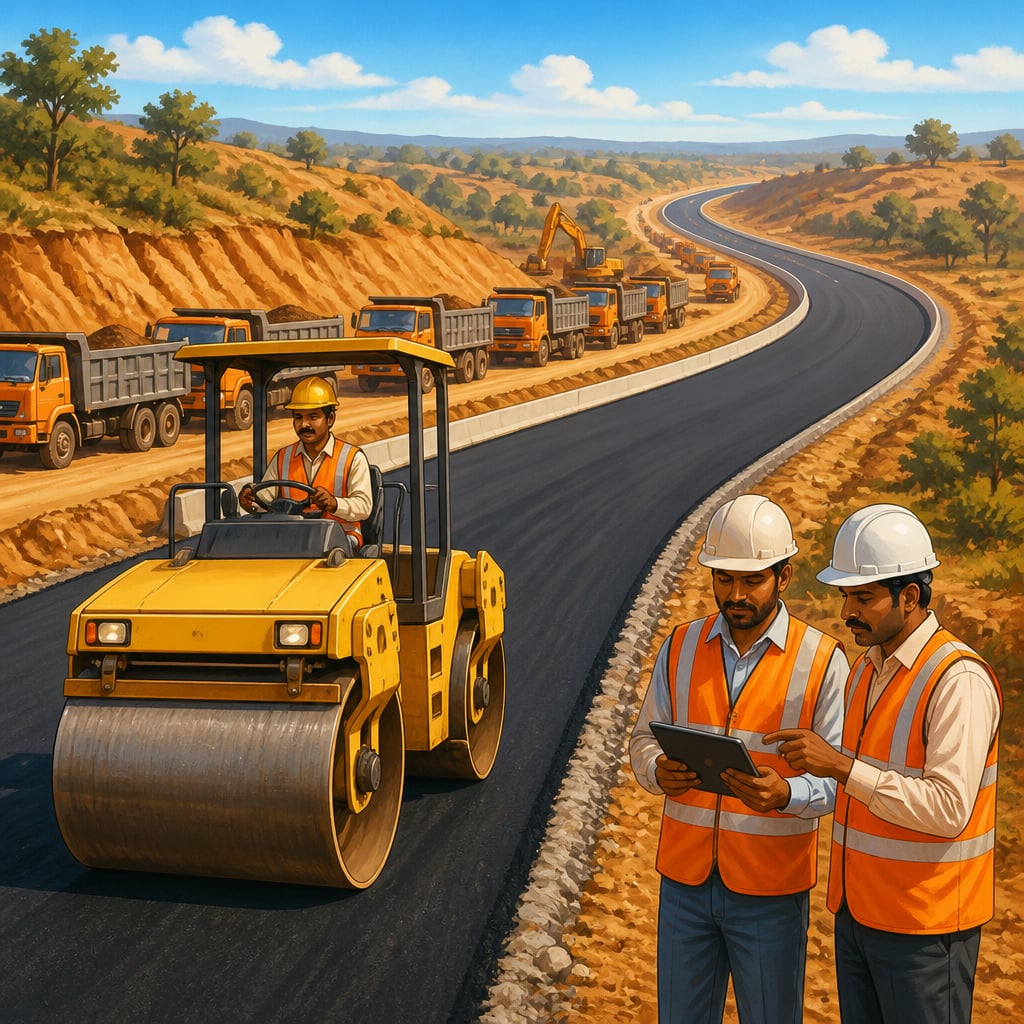
Delhi-Mumbai Expressway construction crew at work

PM Gati Shakti, launched in October 2021, attacks this problem systematically. It's not just another infrastructure scheme. It's a planning revolution, putting all infrastructure ministries on one platform, one map, one vision.

The Ancient Principle: Rajamarga as State Duty

The Arthashastra devotes extensive chapters to infrastructure, what Kautilya called rajamarga (king's road) and janapatha (people's path):

"मार्गश्च राजमार्गश्च जनपथश्च" Margashcha rajamaargashcha janapathashcha "Roads, king's highways, and people's paths [must be maintained]."

Kautilya specified exact standards: royal highways should be 4 dandas (24 feet) wide, with drainage, shade trees, and rest houses. Roads weren't just convenience, they were state infrastructure that enabled trade, taxation, and administration.
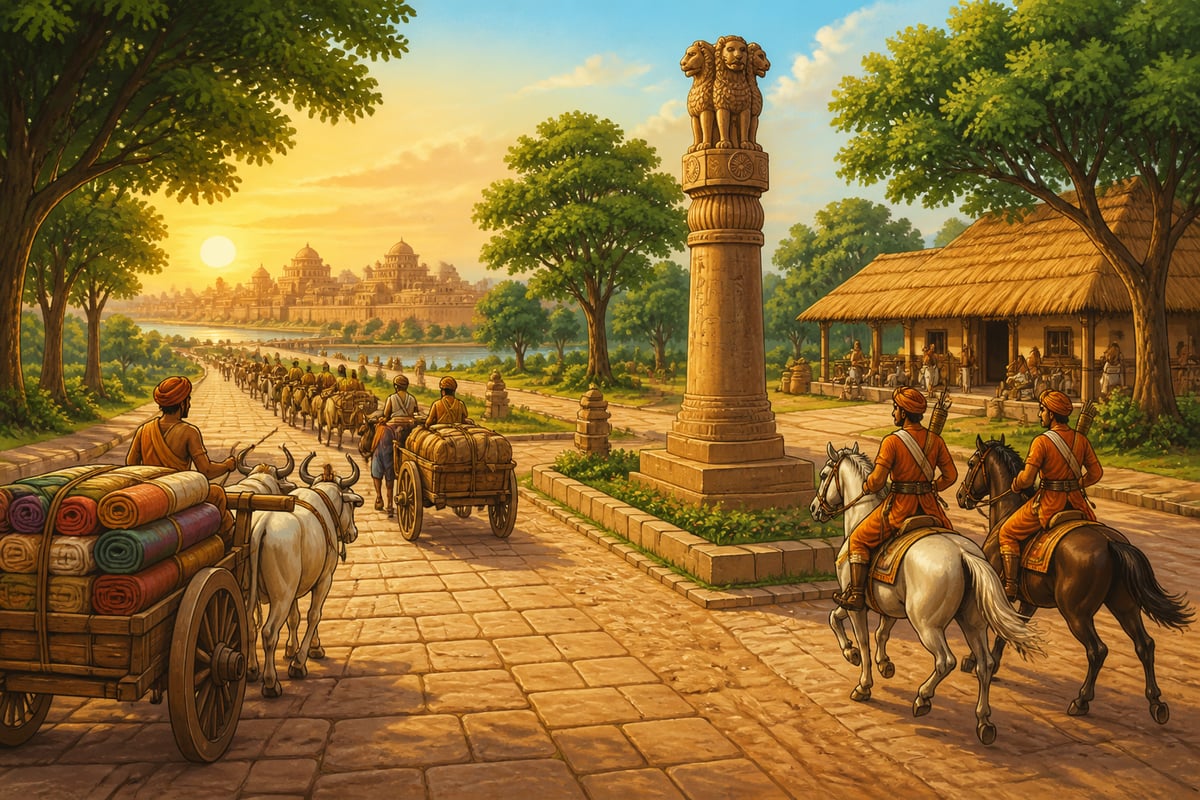
Mauryan royal highway near Pataliputra at dawn

The Mauryan road network, connecting Taxila to Pataliputra, was one of the ancient world's best. Chinese traveler Megasthenes marveled at its maintenance. This infrastructure enabled the empire's commerce and control.

Colonial India built railways, but for extraction, moving raw materials from interior to ports. Post-independence infrastructure expanded but remained fragmented: railways disconnected from ports, highways from factories, states from each other.

Gati Shakti attempts what Kautilya envisioned: integrated infrastructure where every road, rail, port, and pipeline serves a coherent national purpose.

How Gati Shakti Works: The Planning Revolution

PM Gati Shakti is fundamentally a coordination mechanism. Its core innovation:

Single Digital Platform:

Integrated Planning: Before Gati Shakti, ministries planned separately. Railways would build a station; two years later, Roads would build a highway nearby, but not connected. Ports would expand, but no dedicated freight corridor would serve them.

Now, planning is synchronized:

Master Plan Approach: Gati Shakti identified seven engines of growth: Roads, Railways, Airports, Ports, Mass Transit, Waterways, and Logistics Infrastructure. Each engine has specific targets through 2025:

Engine Key Targets
Roads 2 lakh km National Highways by 2025
Railways 100% electrification; Dedicated Freight Corridors
Airports 220 airports (from 74 in 2014)
Ports 10,000 MTPA port capacity
Logistics 35 Multi-Modal Logistics Parks

Global Perspectives: Infrastructure as Transformation

Franklin D. Roosevelt (1882-1945), America's 32nd President, faced the Great Depression with massive infrastructure spending. His New Deal built:

Roosevelt understood that infrastructure serves multiple purposes:

His famous statement: "The only thing we have to fear is fear itself", but his action was building. The infrastructure from the 1930s still serves America today.

Dwight Eisenhower (1890-1969), as President (1953-1961), built the Interstate Highway System, 41,000 miles of controlled-access highways that transformed American commerce and society. His military experience in WWII (moving troops across inadequate roads) convinced him of infrastructure's strategic importance.

China's infrastructure miracle under various leaders (Deng Xiaoping, Jiang Zemin, Hu Jintao, Xi Jinping) built:

China's logistics cost fell from 18% of GDP (2000) to 8% (2020). This infrastructure advantage explains much of China's manufacturing competitiveness.

The Nitin Gadkari Effect

Nitin Gadkari, Minister of Road Transport and Highways since 2014, has transformed infrastructure delivery in India:

Gadkari's philosophy:

"Infrastructure creates its own demand. Build the road, and the factories will come. Build the port, and the ships will arrive. India's infrastructure gap is also India's infrastructure opportunity."

His operational innovations:

The M. Visvesvaraya Legacy

M Visvesvaraya inspecting the Krishnaraja Sagara Dam

Sir M. Visvesvaraya (1861-1962), India's most celebrated engineer, built:

As Diwan of Mysore (1912-1918), Visvesvaraya planned industrialization systematically. His philosophy:

"Industrialize or perish."

He understood that infrastructure precedes development, you must build roads before factories, dams before farms, ports before trade. His birthday (September 15) is celebrated as Engineer's Day in India.

Visvesvaraya's approach anticipated Gati Shakti:

Modern Resonance: The Numbers

India's infrastructure investment has transformed:

Capital Expenditure:

Physical Progress:

Efficiency Gains:

Investment Pipeline:

Your Turn: Do You Feel the Infrastructure?

Infrastructure is invisible when it works. You notice potholes, not smooth roads. You remember flight delays, not on-time arrivals.

But think about how India has changed:

Every time you use Google Maps and find traffic lighter than expected on a new expressway, that's infrastructure working. Every time a package arrives from across the country in two days, that's logistics infrastructure.

The test: compare your experience today with ten years ago. Roads smoother? Flights more frequent? Trains faster? The change is incremental but cumulative.

In the final lesson, we'll look forward: what do all these reforms, Jan Dhan to Gati Shakti, mean for India in 2026 and beyond?

Economists debate whether infrastructure follows demand or creates it. Evidence from China, Korea, and historical US suggests that building ahead of demand accelerates development. Waiting for demand creates bottlenecks that choke growth.

India's infrastructure push is deliberately ahead of demand. Expressways are being built to industrial areas before factories arrive. Airports are being built in tier-2 cities before traffic justifies them. The bet: build it, and they will come.

China built 40,000 km of high-speed rail in 15 years, often through areas with low initial demand. The infrastructure created the demand: new cities, new industries, new mobility patterns.

Economists call this 'coordination economies', the value of A increases when B exists. A road to a port is more valuable when the port is modern. A freight corridor is more valuable when factories cluster along it. Integrated planning captures these synergies.

Gati Shakti's GIS platform is precisely about capturing coordination economies. Before, road ministry didn't know port ministry's plans. Now, all 200+ data layers visible together. This visibility enables synergistic planning impossible before.

The Delhi-Mumbai Industrial Corridor integrates: Dedicated Freight Corridor (rail) + Expressway (road) + Industrial townships + Smart cities + Logistics parks. Each element makes others more valuable.

Key terms

Gati Shakti
Speed-power; PM Gati Shakti is the national masterplan for integrated multi-modal infrastructure development, connecting all transport and logistics networks
Samarpit Maal Galiyara
Dedicated Freight Corridor; railway lines exclusively for goods trains, separate from passenger traffic, enabling faster and more reliable freight movement
Bahuviddh Logistics Park
Multi-Modal Logistics Park (MMLP); integrated facilities connecting road, rail, and waterways with warehousing, cold storage, and customs clearance
Poonjigat Vyay
Capital expenditure (CapEx); government spending on assets (roads, railways, buildings) that create long-term productive capacity, as opposed to revenue expenditure on current consumption

Key figures

Sir M. Visvesvaraya

Engineer, statesman, Diwan of Mysore, father of Indian engineering

Nitin Gadkari

Minister of Road Transport and Highways (2014-present)

Franklin D. Roosevelt

32nd President of the United States (1933-1945)

Case studies

Dedicated Freight Corridor: Rail Revolution for Manufacturing

Indian Railways had a problem: passenger and freight trains shared the same tracks. Fast Rajdhanis and slow coal trains competed for space. The result: - **Freight speed: 25 km/hour average** (vs. 60 km/hour in China) - **Transit time Delhi-Mumbai: 3+ days** (vs. 1 day in China for equivalent distance) - **Rail freight share falling**: From 89% (1951) to 30% (2020), goods moved to road The Dedicated Freight Corridor project, conceived in 2005 and accelerated post-2014, builds **separate rail lines exclusively for freight**: **Western DFC**: Delhi-Mumbai (1,504 km) - Connects JNPT (India's busiest container port) to North India industrial hubs - Designed for double-stack container trains (twice the capacity) - Private freight terminals along the corridor **Eastern DFC**: Delhi-Kolkata (1,318 km) - Serves coal movement from eastern mines to power plants - Connects to Bangladesh border for trans-shipment - Links to Sagarmala port modernization Construction required: - Land acquisition across 6 states - 100+ flyovers and bridges - Complete signaling and electrification - Last-mile connectivity to industrial clusters

The Arthashastra principle of 'margashcha rajamaargashcha' (the state must maintain roads) extends to all transport infrastructure. Kautilya would recognize the DFC as rajamarga (king's highway), state-built infrastructure for commerce. But the deeper principle is integration. The DFC isn't just a rail line, it's designed as part of an ecosystem: - Industrial townships along the corridor (DMIC, Delhi-Mumbai Industrial Corridor) - Multi-modal logistics parks where road meets rail - Port connectivity for export-oriented manufacturing - Power and telecom infrastructure aligned This is the ancient principle of 'janapadaniveshe sthaapatya yojanaa' (integrated planning in territory development). The DFC succeeds only when all pieces work together. Building rail alone, without factories and ports, would be empty infrastructure. The dharmic approach integrates.

**By 2024:** - Western DFC: 1,100+ km operational (70%+ complete) - Eastern DFC: 600+ km operational (50%+ complete) - Full completion expected: 2025 **Expected Impact:** - **Transit time**: Delhi-Mumbai freight from 3 days to 1 day - **Train speed**: 25 km/hour to 100 km/hour - **Capacity**: Double-stack containers (2x current capacity per train) - **Rail freight share**: Target reversal of decline, capturing freight from road **Industrial Development:** - **11 industrial nodes** being developed along Western DFC - **₹1 lakh crore+ investment** attracted to corridor region - **Model industrial townships**: Aurangabad, Dahej, Khushkhera **Global competitiveness:** - Logistics cost reduction enabling manufacturing exports - Apple, Samsung suppliers locating near DFC nodes - Competing with China's developed logistics infrastructure

Infrastructure transformation requires patience and integration. DFC was conceived in 2005, construction began 2008, and completion expected 2025, 17 years from concept to completion. But the payoff, transforming India's manufacturing competitiveness, justifies the wait. Quick fixes can't replace systematic infrastructure building.

Global supply chain disruptions since 2020 have made logistics infrastructure a national security issue. The DFC's integration with industrial corridors and port connectivity follows the same logic as China's Belt and Road, but directed inward: building the transport backbone that makes domestic manufacturing globally competitive.

The Dedicated Freight Corridor will reduce logistics cost for industries along the route by 20-30%, equivalent to a massive hidden subsidy for manufacturing competitiveness, funded by infrastructure investment rather than direct handouts.

Historical context

Infrastructure Development (1947-2025)

India's infrastructure gap is both challenge and opportunity. Decades of underinvestment created bottlenecks: congested ports, slow railways, poor highways. But this also means: every new road, rail line, and airport has high marginal impact. The infrastructure-to-GDP ratio suggests significant room for growth-multiplying investment.

China invested 8-10% of GDP in infrastructure for three decades, building world-class highways, railways, and ports. India invested 4-5% until recently. The result: China's logistics cost is 8% of GDP; India's was 14%. Closing this gap is central to manufacturing competitiveness. India's current 7%+ investment rate is catching up but from a lower base.

India's logistics performance improved significantly: World Bank Logistics Performance Index rank improved from 54 (2014) to 38 (2023). Still behind China (19) and developed countries, but the fastest improvement among large developing economies.

Infrastructure is the foundation on which all other reforms rest. Jan Dhan needs telecom networks. GST needs highways. Make in India needs ports. DBT needs power. Every digital and manufacturing transformation depends on physical infrastructure working. Gati Shakti is the connective tissue of India's development.

Reflection

More in New India: Reforms for 1.4 Billion (2014-Present)

All lessons in New India: Reforms for 1.4 Billion (2014-Present) · Viksit Bharat: India's Development Journey course