Make in India and PLI: Manufacturing Revival
Building the World's Next Factory
In 2014, India had 2 mobile phone factories. By 2024, it had 200+. From importing 78% of its electronics to becoming the world's second-largest mobile manufacturer, the story of how strategic industrial policy is transforming India from a service economy to a manufacturing powerhouse.
The Factory That Didn't Exist
In 2014, when Prime Minister Narendra Modi launched Make in India, critics asked a pointed question: "Make what in India?"
The numbers were damning. India manufactured almost nothing in electronics. Of the 220 million mobile phones sold in India that year, 78% were imported, mostly from China. India had 2 mobile phone factories. China had thousands.
India had become a paradox: the world's largest young workforce, but no factories to employ them. The world's fastest-growing consumer market, but almost nothing made domestically. A nation that could send satellites to Mars but couldn't make the phones that tracked them.
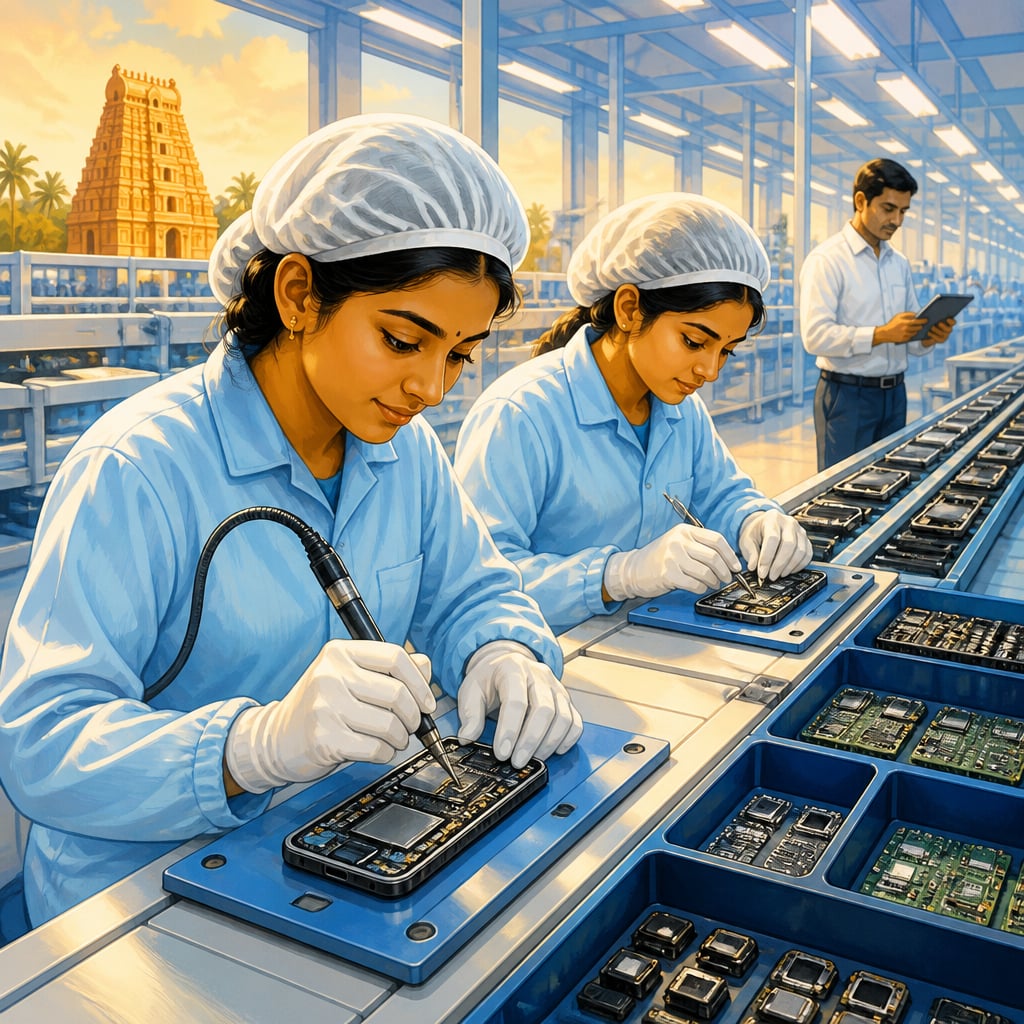
Ten years later, the transformation is visible:
- 200+ mobile phone factories operating in India
- India is the world's second-largest mobile manufacturer (after China)
- Apple iPhones assembled in Tamil Nadu and Karnataka
- $14 billion in mobile phone exports (2023-24), from near zero
- 1.2 million jobs created in electronics manufacturing alone
How did this happen? Through a deliberate industrial policy that India's planners had abandoned in 1991, but learned to deploy differently.
The Ancient Wisdom: State and Industry Together
The Arthashastra devotes entire sections to state-industry relations. Kautilya recognized that manufacturing creates wealth, employment, and state power:
"कर्मान्तानां प्रवर्तनम्" Karmantanam pravartanam "The promotion of productive enterprises."
Kautilya's state wasn't socialist, it didn't run all industries. But it wasn't laissez-faire either. The state created conditions for industry to flourish: infrastructure, security, skilled labor, and when necessary, direct support for strategic sectors.
The Mauryan Empire had state-owned armories and textile workshops, but private merchants dominated trade. Kautilya's principle: the state enables and guides; the market delivers. This is precisely what PLI (Production-Linked Incentive) schemes attempt.
The colonial destruction of Indian manufacturing is well-documented. India, which produced 25% of world manufacturing in 1750, produced 2% by 1900. The British systematically de-industrialized India, breaking looms, taxing exports, dumping machine-made goods.
Independent India tried state-led industrialization (License Raj, 1950-1991), which built heavy industry but stifled innovation. Then came liberalization (1991-2014), which opened markets but didn't rebuild manufacturing capacity.
Make in India represents a third approach: strategic industrial policy using targeted incentives rather than state ownership or blanket protection.
The PLI Model: How It Works
Production-Linked Incentives offer companies a cash incentive (4-6% of incremental sales) for manufacturing in India. The key features:
Conditional on Output: You don't get money for building a factory. You get money for producing goods, and the incentive rises with production volume.
Time-Bound: PLI schemes run for 5-6 years. Companies must scale quickly or lose the benefit. No perpetual subsidies.
Sector-Specific: Not every industry gets PLI. Only strategic sectors: electronics, semiconductors, pharmaceuticals, automobiles, textiles, telecom equipment, drones, etc.
Performance Targets: Recipients must meet investment commitments, employment targets, and production thresholds. Fail to deliver, lose the incentive.
| PLI Sector | Outlay (₹ Cr) | Expected Investment | Expected Employment |
|---|---|---|---|
| Mobile/Electronics | 40,951 | ₹11,000 Cr | 2 lakh+ jobs |
| Semiconductors | 76,000 | ₹1.5 lakh Cr | 1 lakh+ jobs |
| Automobiles | 25,938 | ₹67,690 Cr | 7.5 lakh+ jobs |
| Pharmaceuticals | 15,000 | ₹17,275 Cr | 1 lakh+ jobs |
| Textiles | 10,683 | ₹19,077 Cr | 7.5 lakh+ jobs |
| Total (14 sectors) | ₹1.97 lakh Cr | ₹4 lakh Cr+ | 60 lakh+ jobs |
The multiplier logic: ₹2 lakh crore in incentives should generate ₹4 lakh crore in investment and 6 million jobs. The state spends money, but only when manufacturers deliver.
Global Perspectives: How Nations Industrialize
Every manufacturing powerhouse used industrial policy. None became rich through pure free markets.

Park Chung-hee (1917-1979), South Korea's president from 1961-1979, transformed a poor agrarian country into an industrial giant. His method:
- Identified strategic industries (steel, shipbuilding, electronics, automobiles)
- Directed cheap credit to chosen companies (chaebols like Samsung, Hyundai)
- Protected domestic markets until companies could compete globally
- Demanded export performance in exchange for support
South Korea's GDP per capita rose from $79 (1960) to $33,000 (2023). Samsung, a small trading company in 1960, is now the world's largest semiconductor manufacturer.
Lee Kuan Yew (1923-2015), Singapore's founding father, had no natural resources. His strategy:
- World-class infrastructure (ports, airports, industrial parks)
- Aggressive courting of multinational corporations
- Education system aligned with industry needs
- Zero tolerance for corruption that increases business costs
Singapore went from a fishing village to the world's most competitive economy in one generation.
China combined both approaches under Deng Xiaoping (1904-1997):
- Special Economic Zones with favorable policies for exporters
- Massive infrastructure investment (roads, ports, power)
- Cheap, disciplined labor force
- Technology transfer requirements for foreign investors
The lesson: industrialization doesn't happen automatically. States that want manufacturing must create conditions for it, through incentives, infrastructure, skills, and strategic targeting.
India's Moment: Why Now?
Why didn't Make in India succeed earlier? Because manufacturing requires an ecosystem: reliable power, efficient logistics, skilled workers, stable policy. India lacked these.
What changed by 2020:
Infrastructure: PM Gati Shakti is connecting ports to factories. National Highways expanded from 91,000 km (2014) to 145,000+ km (2024). Dedicated Freight Corridors move goods faster.
Power: India added 190 GW of power capacity since 2014. Renewable energy crossed 180 GW. Most industrial areas now have reliable 24/7 power.
Logistics: GST eliminated checkpost delays. E-way bills digitized movement. Logistics cost as percentage of GDP fell from 14% to 10%.
Skills: Skill India trained 1.5 crore+ workers. ITIs modernized. Company-specific training programs proliferate.
Geopolitical moment: COVID-19 exposed the danger of depending on China. Western companies want to diversify supply chains. Apple, Samsung, Google, all are actively seeking alternatives. India is the obvious choice: large market, English-speaking workforce, democratic governance.
Commerce Minister Piyush Goyal captured this:
"The world is looking for a reliable partner, and India is ready. We have the market, the talent, and now the policy framework. The next decade will be India's manufacturing decade."
The JRD Tata Legacy

JRD Tata (1904-1993) built India's industrial base before liberalization. He created:
- Tata Steel: India's first integrated steel plant (1907)
- Air India: India's first airline (1932)
- Tata Motors: India's first automobile company
- TCS: India's IT giant (though it flourished after his time)
JRD operated under the License Raj's constraints, yet built world-class companies. His philosophy:
"I believe in the effectiveness of freedom and free enterprise, but I also believe that freedom must be regulated and enterprise made responsible."
This balance, free enterprise guided by strategic policy, is what PLI attempts. The state doesn't run factories; it creates conditions where Tata, Reliance, Mahindra, and global companies build them.
Your Turn: What Are You Buying?
Every purchase you make is a vote for where manufacturing happens.
When you buy a phone assembled in India (check the box, it says "Assembled in India" or "Made in India"), you're supporting local jobs and building supply chains. When you buy unbranded imports, you're funding factories elsewhere.
This isn't protectionism. Quality and price matter. But awareness matters too.
The transformation is visible if you look: those mobile phone boxes that once said "Made in China" increasingly say "Made in India." The question is whether we notice, and whether we support the transition.
In the next lesson, we'll see the infrastructure backbone that makes manufacturing possible: PM Gati Shakti, the masterplan connecting India's factories to ports, markets, and the world.
Classical economics (Adam Smith, Ricardo) suggested countries should specialize in existing comparative advantages. Strategic trade theory (Paul Krugman, Nobel 2008) showed that comparative advantage can be created through deliberate policy, what a nation produces is a choice, not a fate.
India's comparative advantage in services (IT, BPO) emerged from 1980s-90s investments in IITs and telecom infrastructure. PLI aims to create similar comparative advantage in manufacturing, electronics, semiconductors, pharmaceuticals, through strategic investment now.
South Korea's Samsung spent 15 years losing money on semiconductors before becoming world leader. Patient strategic investment, supported by state policy, created today's dominance. PLI's 5-6 year timeframe supports similar patient capability building.
Traditional industrial policy often gave subsidies upfront (build the factory, get the money). This created moral hazard, recipients could take money without delivering. PLI inverts this: deliver first, get paid later.
India's License Raj gave protection without demanding performance. Companies stayed small and inefficient. PLI's performance linkage, incentives tied to production targets, ensures only successful manufacturers get support. Failure doesn't get subsidized.
Under PLI, companies must achieve 40-60% incremental production to qualify for incentives. Those who miss targets don't get paid. This performance discipline ensures government spending creates real output.
Key terms
- Utpadan Sambaddh Protsahan
- Production-Linked Incentive (PLI); government incentive (4-6% of incremental sales) paid to manufacturers who achieve production targets in strategic sectors
- Make in India
- National program launched in 2014 to transform India into a global manufacturing hub through policy reforms, infrastructure development, and investor facilitation
- Atmanirbhar Bharat
- Self-reliant India; the policy framework announced in 2020 emphasizing domestic manufacturing capability while remaining globally integrated
- Vinirman Kendra
- Manufacturing hub; concentrated industrial ecosystem with suppliers, skilled workers, and infrastructure supporting large-scale production
Key figures
JRD Tata
Industrialist, Chairman of Tata Group (1938-1991), pioneer of Indian industry
Piyush Goyal
Minister of Commerce and Industry, architect of PLI implementation
Park Chung-hee
President of South Korea (1961-1979), architect of Korean industrial miracle
Case studies
Mobile Phone Manufacturing: From 2 Factories to 200+
In 2014, India's mobile phone story was embarrassing: - **2 mobile phone factories** in the country - **78% of phones imported** (mostly from China) - **Zero exports** of mobile phones - Even Indian brands (Micromax, Lava, Karbonn) manufactured in China India was the world's fastest-growing smartphone market, but contributed nothing to global manufacturing. The government launched a multi-pronged intervention: 1. **Phased Manufacturing Programme (2016)**: Differential tariffs that made importing finished phones expensive but importing components cheap, incentivizing assembly in India 2. **PLI for Large-Scale Electronics (2020)**: ₹40,951 crore incentive for mobile and electronics manufacturing 3. **Component ecosystem development**: Supporting PLIs for display, battery, charger, and other component manufacturing Global companies responded: - **Samsung** built the world's largest mobile factory in Noida (2018) - **Foxconn** (Apple supplier) expanded to Tamil Nadu, Karnataka, Telangana - **Pegatron and Wistron** (Apple suppliers) set up Indian operations - **Dixon Technologies** became India's largest contract manufacturer
The Arthashastra principle of 'karmantanam pravartanam' (promotion of productive enterprises) was applied strategically here. The government didn't try to manufacture phones itself. It created conditions, tariffs, incentives, infrastructure, that made manufacturing in India rational for private companies. This is the dharmic balance between state and market. The state provides the framework; the market provides the execution. Neither can succeed alone. Pure free markets wouldn't have created Indian manufacturing (the China ecosystem was too strong). Pure state control would have created inefficient factories (as in License Raj). The phased approach, first assembly, then components, then design, mirrors Kautilya's advice on gradual capability building. You don't become world-class overnight. You build step by step, each capability enabling the next.
**By 2024:** - **200+ mobile phone factories** operating in India - India is **world's second-largest mobile manufacturer** - **99% of phones sold in India are made in India** - **$14 billion in mobile exports** (2023-24), from zero - **Apple iPhones** now manufactured in India (first in 2017, scaled massively since 2022) - **12 lakh+ jobs** in mobile ecosystem **Value addition trajectory:** - 2016: Assembly only (~5% value add) - 2020: Sub-assembly, testing (~15% value add) - 2024: Component manufacturing beginning (~25% value add) - Target 2030: Design and R&D (~50% value add) The next frontier: semiconductor fabrication. India can't make the chips inside phones, yet. That's what the semiconductor PLI aims to change.
Industrial transformation is possible but requires strategic sequencing. You can't leap to advanced manufacturing, you build capabilities step by step. India started with assembly (easy), graduated to sub-assembly (medium), and is now attempting components (hard). Each stage creates skills, supply chains, and confidence for the next.
Apple manufacturing $14 billion worth of iPhones in India annually signals a broader shift in global supply chains away from China-dependence. The PLI scheme's phased approach, starting with assembly and moving toward components, mirrors the exact industrialization sequence that made China the world's factory three decades ago.
Apple now manufactures over $14 billion worth of iPhones in India annually, up from zero in 2016. This single company shift represents India's emergence as a credible manufacturing alternative to China.
Historical context
Manufacturing Policy Evolution (1950-2025)
India's manufacturing trajectory contrasts sharply with East Asia. South Korea, Taiwan, and China used industrial policy aggressively from the 1960s-90s. India's License Raj was industrial policy, but of the wrong kind (protection without performance). Make in India attempts to correct this: strategic support with market discipline.
China's manufacturing share of GDP is 28%; South Korea's is 25%; India's is 17%. China has 600+ industrial clusters; India has a few. The gap is decades of different policy choices. PLI aims to close this gap, not by copying China but by building India's own manufacturing ecosystem suited to its democratic, federal structure.
India's share of world manufacturing rose from 1.8% (2014) to 2.8% (2023). Still far behind China (28%) but the fastest improvement among large economies. The direction has changed; the question is speed.
Services alone cannot employ India's workforce. 1.2 crore young people enter the job market annually. Only manufacturing can create jobs at that scale. Make in India isn't just economic policy, it's about giving India's youth productive employment.
Reflection
- India tried state-led industrialization (License Raj) and pure market liberalization (1991-2014). Both had limited success in manufacturing. PLI represents a third way: strategic state support with market discipline. What's the right balance between state guidance and market freedom in building industries? Can you think of examples where each approach succeeded or failed?
- Look at the electronic devices around you, phone, laptop, TV, appliances. Check where they're manufactured (usually printed on the device or packaging). How many say 'Made in India' vs. 'Made in China' or elsewhere? If you were buying a new device, would 'Made in India' influence your choice? What would make you choose Indian-made products?