DBT: Direct Benefit Transfer Revolution

Cutting the Middleman

Rajiv Gandhi famously said only 15 paise of every rupee meant for the poor actually reached them. Three decades later, DBT delivers the full rupee, ₹36 lakh crore transferred directly, ₹2.2 lakh crore saved from leakage. The story of how India finally solved its welfare delivery problem.

The 15 Paise Problem
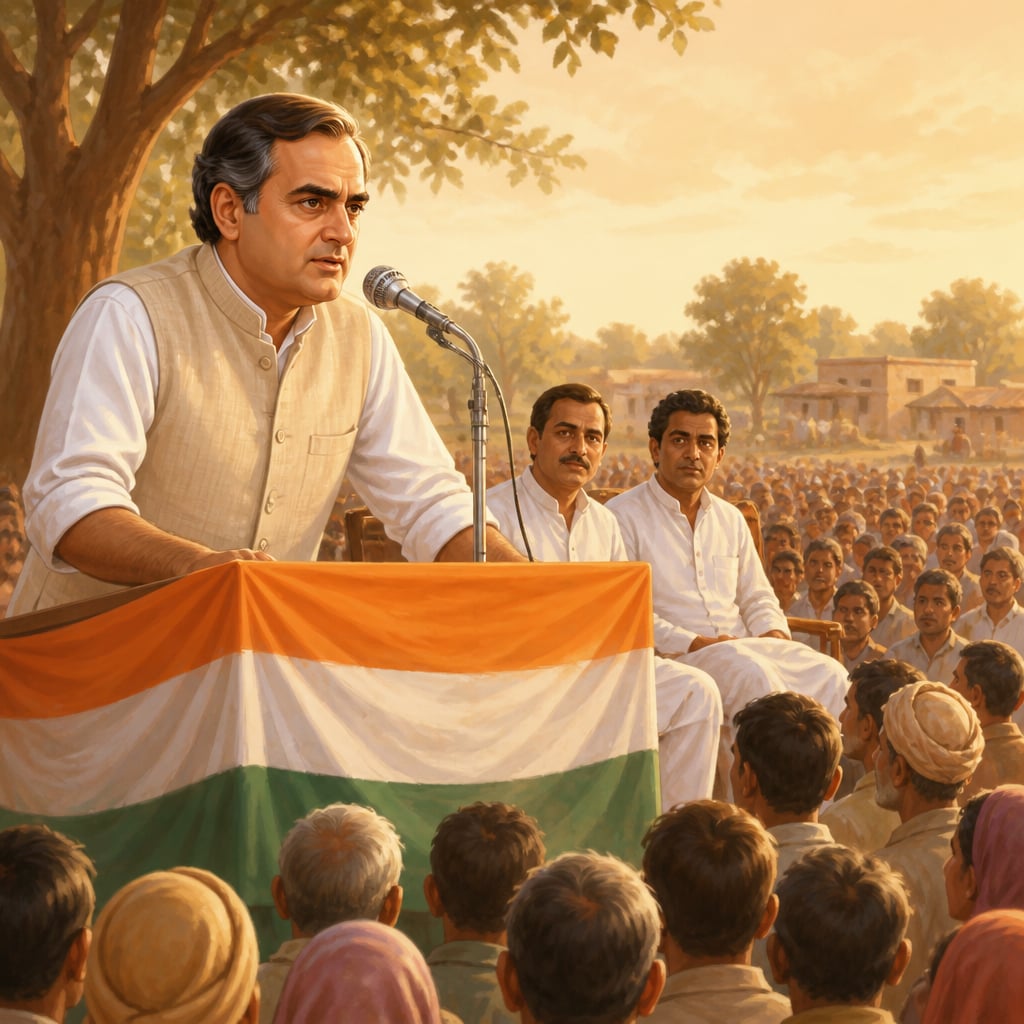
Rajiv Gandhi at a 1985 podium delivering the fifteen-paise statement

In 1985, Prime Minister Rajiv Gandhi made a statement that would haunt Indian governance for three decades:

"Out of every rupee spent by the government for the poor, only 15 paise reaches them."

The diagnosis was devastating but accurate. Between the treasury in Delhi and the beneficiary in the village stood layers of intermediaries: central ministries, state departments, district offices, block offices, panchayats, and finally the ration shop owner or local contractor. At each layer, money disappeared.

Late 1990s village ration shop with unfair scales

The Public Distribution System (PDS) alone lost an estimated 40-60% to leakage. Kerosene meant for poor families powered rich farmers' tractors. Ration rice fed not the hungry but the black market. Fake names on beneficiary lists, "ghost beneficiaries", consumed crores that existed only on paper.

For thirty years after Rajiv Gandhi's diagnosis, nothing fundamentally changed. The problem wasn't lack of awareness. It was lack of mechanism.

The Ancient Insight: Delivery Is Dharma

The Arthashastra addresses this problem directly. Kautilya wrote extensively about welfare delivery and the corruption that inevitably accompanies it:

"आत्मनः प्रतिकूलानि परेषां न समाचरेत्" Atmanah pratikulani paresham na samacharet "One should not do unto others what is harmful to oneself."

But Kautilya was a realist. He knew that moral exhortation alone wouldn't prevent corruption. His solution was systematic:

"यथा नोदके मत्स्याः पिबन्तो ज्ञातुं न शक्याः, तथा राजधनं भक्षयन्तः कर्मचारिणः" "Just as it is impossible to know when fish swimming in water are drinking, so it is impossible to detect officials embezzling state wealth."

Kautilya's insight: if you can't eliminate the fish, change the water. Don't rely on officials being honest, design systems where theft becomes difficult.

This is precisely what DBT does. By transferring money directly to beneficiary bank accounts verified by Aadhaar, there's nothing left for middlemen to steal. The fish are still there, but the water they swim in has no nutrients to steal.

How DBT Works: The Architecture

Direct Benefit Transfer sounds simple: instead of routing subsidies through intermediaries, send money straight to beneficiaries. But the execution requires infrastructure that didn't exist before 2014:

Step 1: Identify (Aadhaar) Who is the beneficiary? Before Aadhaar, this was unknowable. Ration cards were duplicate. BPL lists were fake. Ghost beneficiaries outnumbered real ones in some districts. Aadhaar's biometric verification ensures the beneficiary is real and unique.

Step 2: Locate (Jan Dhan) Where should the money go? Before Jan Dhan, 65% of Indians had no bank account. Even when the government wanted to transfer directly, there was nowhere to transfer. Jan Dhan created 530 million financial addresses.

Step 3: Deliver (NPCI/PFMS) How does the transfer happen? The Public Financial Management System (PFMS) and National Payments Corporation (NPCI) enable real-time, traceable transfers. Every rupee has an audit trail.

Step 4: Notify (Mobile) How does the beneficiary know? SMS alerts confirm receipt instantly. The beneficiary knows their entitlement and can complain if it doesn't arrive.

The genius is the integration. Each piece alone is insufficient. Together, they create a system where theft becomes algorithmically difficult.

Global Perspectives on Cash Transfers

The idea of giving cash directly to the poor, rather than subsidized goods or services, has a long intellectual history.

Milton Friedman (1912-2006), the Nobel laureate economist, proposed the "Negative Income Tax" in 1962. His argument: instead of running expensive bureaucracies to deliver specific services, just give poor people money. They know their needs better than bureaucrats. Let them decide.

Friedman was a free-market conservative, but his idea attracted support across the political spectrum. If a poor family needs food, give them money, they'll buy food. If they need medicine, they'll buy medicine. Cut out the bureaucracy; trust the poor.

Esther Duflo (1972-present), the Nobel laureate economist, provided empirical validation. Her randomized controlled trials across developing countries showed that cash transfers:

Lula da Silva, President of Brazil, implemented Bolsa Familia in 2003, Latin America's largest conditional cash transfer. It reached 14 million families and lifted 36 million Brazilians out of poverty. But it remained conditional (tied to school attendance, health checkups) and limited in scale.

Program Country Beneficiaries Approach
Bolsa Familia Brazil 14 million families Conditional, targeted
Oportunidades Mexico 5 million families Conditional, targeted
DBT India India 42 crore+ individuals Mixed (some conditional, some universal)

India's DBT dwarfs all precedents, not just in scale but in scope. It covers 300+ schemes: fertilizer subsidies, scholarship payments, MGNREGA wages, widow pensions, farmer support, LPG subsidies, and more.

The Numbers That Changed Governance

Nirmala Sitharaman delivering the 2024 Union Budget

Finance Minister Nirmala Sitharaman reported the following in her 2024 Budget speech:

NITI Aayog CEO Amitabh Kant tracked the micro-details. His team found:

The ₹2.2 lakh crore saved exceeds the entire annual budget of most Indian states. That money now reaches real beneficiaries instead of feeding phantom ones.

Rajiv Gandhi's Answer, Finally Delivered

Remember the 15 paise problem? DBT is the answer Rajiv Gandhi couldn't implement because the infrastructure didn't exist.

Consider the journey of a PM-KISAN payment:

Every intermediate step was an opportunity for leakage. DBT eliminates almost all of them. The ₹2,000 sanctioned in Delhi reaches the farmer in Bihar within days, traceable, accountable, direct.

This is the Kautilyan vision realized. Don't exhort officials to be honest; design systems that make dishonesty difficult. Change the architecture, not the actors.

Your Turn: Where Is Leakage in Your Life?

DBT principles apply beyond government welfare. Consider:

In organizations: How many intermediaries sit between a decision and its execution? Each layer adds delay, cost, and potential distortion. Can you reduce handoffs?

In personal finance: How many fees do you pay to intermediaries, brokers, agents, advisors, for services you could access directly? DBT's lesson: direct pathways are usually cheaper and faster.

In communication: How many people does a message pass through before reaching its intended recipient? Each relay adds noise and delay.

The dharmic insight is universal: intermediaries are necessary sometimes, but they always extract value. Design systems with the minimum necessary intermediation.

In the next lesson, we'll see how India applied the same logic to taxation, creating one unified national market through GST, replacing 17 different taxes and countless intermediaries.

Modern economics calls this the 'principal-agent problem', agents (officials) don't always act in principals' (citizens') interests. The standard solution is monitoring and incentives. DBT goes further: eliminate the agent entirely.

India's DBT doesn't just reduce the principal-agent problem, it eliminates most agents. When money flows directly from treasury to beneficiary, there's no one in between to steal. The system assumes distrust and designs accordingly.

The 3.4 crore fake LPG connections discovered under PAHAL weren't created by criminal masterminds. They were artifacts of a system that trusted intermediaries. DBT removed the trust, and the fraud disappeared.

Paternalistic economics assumes the poor will waste cash on alcohol/tobacco. Esther Duflo's research disproves this: cash transfers increase food consumption, education spending, and productive investment. The poor aren't poor because they're stupid; they're poor because they lack resources.

DBT respects citizen agency. Instead of deciding what the poor need (subsidized grain, free kerosene), it gives them money to decide themselves. The PM-KISAN farmer uses the ₹6,000 as they see fit, seeds, fertilizer, school fees, medical expenses.

World Bank research on PM-KISAN found that transfers increased agricultural investment by 22%, the poor invested in productivity, not consumption. Trust was vindicated.

Key terms

Pratyaksha Labh Hastantaran
Direct Benefit Transfer; the system of transferring subsidies, scholarships, and welfare payments directly to beneficiary bank accounts, bypassing all intermediaries
Bhoot Labharthi
Ghost beneficiary; a fake or duplicate entry in welfare rolls, receiving benefits that should go to real people or that don't exist at all
Risav
Leakage; the loss of government funds to corruption, ghost beneficiaries, and administrative inefficiency between allocation and actual delivery
Lok Vittiya Prabandhan Pranali
Public Financial Management System (PFMS); the central IT platform that tracks every government payment from sanction to beneficiary receipt

Key figures

Rajiv Gandhi

Prime Minister of India (1984-1989)

Nirmala Sitharaman

Finance Minister of India (2019-present)

Milton Friedman

Nobel laureate economist, father of monetarism

Case studies

COVID-19 Relief: ₹68,000 Crore in Weeks

On March 24, 2020, India announced a complete lockdown with four hours' notice. Millions of daily-wage workers suddenly had no income. Migrants were stranded far from home. The informal sector, 60% of India's workforce, had no safety net. The government announced PM Garib Kalyan Yojana within days: ₹1.7 lakh crore in relief. The challenge: how to reach 80 crore people who needed immediate help, when physical distribution was impossible due to lockdown. DBT infrastructure answered. Within weeks: - **20 crore Jan Dhan women** received ₹500/month (₹30,500 crore total) - **8 crore farmers** received advanced PM-KISAN installments - **3 crore senior citizens and widows** received ₹1,000 ex-gratia - **MGNREGA wages** were transferred directly despite worksites being closed Total: **₹68,000 crore to 42 crore beneficiaries**, in weeks, not months.

The Arthashastra is explicit: the state's duty in crisis is immediate relief. Kautilya wrote of opening state granaries during famine, forgiving taxes during disaster, and prioritizing prajakushala (citizen welfare) above all. COVID tested whether India's governance infrastructure could fulfill this duty. Physical delivery systems collapsed, ration shops couldn't operate, roads were blocked, offices were closed. But digital infrastructure worked. This is the modern yantra (mechanism) that Kautilya envisioned: a system that functions even when individual parts fail. The treasury didn't depend on the district collector's presence; money flowed through Aadhaar-linked accounts directly. The dharmic lesson: welfare systems must be designed for crisis, not just normalcy. DBT infrastructure, built during calm years, proved its worth when the storm hit.

**Speed:** First transfers reached beneficiaries within 10 days of lockdown announcement **Scale:** 42 crore individuals reached, more than the entire population of South America **Accuracy:** Aadhaar verification ensured money reached real people, not ghost beneficiaries **Contrast:** In the US, stimulus checks took 2-3 months and millions never arrived; UK benefit fraud exceeded £5 billion The IMF and World Bank cited India's COVID response as a global model for crisis welfare delivery. Countries that lacked digital infrastructure, even wealthy ones, couldn't match India's speed.

Infrastructure built for normal times saves lives during crisis. The Jan Dhan accounts opened in 2014, the Aadhaar enrollments completed by 2019, the UPI rails tested through millions of transactions, all paid off when COVID struck. Invest in systems before you need them.

The US stimulus checks during COVID took weeks to reach Americans, many of whom lacked bank accounts. India's pre-built digital infrastructure delivered relief 10x faster to a far larger population. This speed gap has made India's DPI stack a model for crisis-preparedness planning worldwide.

India's COVID relief reached beneficiaries 10x faster than comparable programs in developed countries. The infrastructure cost years to build; the payoff came in days.

Jharkhand PDS Reform: From Ration Shops to Bank Accounts

Jharkhand's Public Distribution System was notorious. Studies showed **40-60% of PDS grain** never reached beneficiaries. Ration shop owners diverted subsidized rice to the black market. Ghost beneficiaries consumed crores. The genuinely hungry went home empty-handed while "entitled" grain fed middlemen. In 2017, Jharkhand began a radical experiment: instead of subsidized grain through ration shops, give beneficiaries cash directly and let them buy grain in the open market. The pilot covered 3 districts initially, then expanded. The challenges were immense: - Would beneficiaries actually buy food, or spend on other things? - Would local markets have sufficient grain supply? - Would cash transfers work for populations with low financial literacy? The government tracked everything: nutritional outcomes, market prices, beneficiary satisfaction, leakage rates.

The PDS reform tested two competing philosophies: **Paternalism:** 'The poor can't be trusted with money. They'll waste it on alcohol/tobacco. We must give them grain directly.' **Empowerment:** 'The poor know their needs better than we do. Give them resources and respect their choices.' Milton Friedman's insight, trust the poor, was validated. Studies showed that cash transfer beneficiaries: - Maintained or improved nutritional intake - Reduced time spent in ration shop queues (freeing time for work) - Reported higher satisfaction than in-kind beneficiaries - Did NOT increase spending on alcohol/tobacco The paternalistic assumption was wrong. The poor used their agency responsibly. The dharmic approach, respecting human dignity, proved more effective than bureaucratic control.

**Leakage:** Reduced from 40-60% to near-zero under cash transfer **Beneficiary satisfaction:** Higher than in-kind delivery (no waiting in queues, no shopkeeper rudeness) **Market development:** Local grain markets strengthened as demand increased **Time saved:** Average beneficiary saved 2-3 hours per month (no queue time) **Nutritional outcomes:** Maintained or improved vs. in-kind delivery The pilot's success led to debates about national PDS reform. While full nationwide rollout hasn't happened (political resistance from the ration shop lobby), Jharkhand demonstrated that cash transfers work even for food security.

Cash transfers respect agency; in-kind transfers assume incapacity. When given a choice, the poor choose wisely. The paternalistic assumption, that the poor need to be managed, is both disrespectful and ineffective. Trust scales; micromanagement doesn't.

Universal Basic Income pilots in Kenya, Finland, and Stockton (California) are testing the same hypothesis: that cash transfers respect individual agency better than in-kind handouts. Jharkhand's results, showing higher satisfaction and better outcomes from cash than grain, provide real-world evidence for the global UBI debate.

Jharkhand cash transfer beneficiaries reported 85% satisfaction vs. 65% for traditional PDS recipients, even though they received the same value. Dignity matters.

Historical context

Welfare Delivery Reform (1985-2025)

India's welfare state expanded massively after independence, PDS, MGNREGA, various subsidies, but delivery mechanisms remained colonial-era. Paper records, manual verification, physical distribution, all created opportunities for leakage. The gap between welfare intent and welfare delivery was India's defining governance failure.

Brazil's Bolsa Familia reached 14 million families with sophisticated conditionality (school attendance, health checkups). India's DBT is larger (42 crore+ beneficiaries) and simpler (mostly unconditional). The Indian approach trades conditionality precision for scale and speed, a tradeoff that proved critical during COVID.

Between 2013 (DBT pilot) and 2024, cumulative transfers crossed ₹36 lakh crore, equivalent to roughly 15% of India's annual GDP flowing through direct benefit channels.

DBT represents the solution to India's oldest governance problem. The '15 paise' diagnosis has been partially reversed, more of every rupee now reaches the poor. This isn't just efficiency; it's trust. When citizens see benefits actually arriving, they trust the state more.

Reflection

More in New India: Reforms for 1.4 Billion (2014-Present)

All lessons in New India: Reforms for 1.4 Billion (2014-Present) · Viksit Bharat: India's Development Journey course