GST: One Nation, One Tax
The Economic Unification of India
In 1947, Sardar Patel unified 562 princely states into one political nation. In 2017, GST unified 29 states and 7 union territories into one economic nation. The story of how India finally became a single market of 1.4 billion consumers, and why trucks that once waited 20 hours at state borders now cross in minutes.
The Truck That Took 20 Hours to Cross a Border
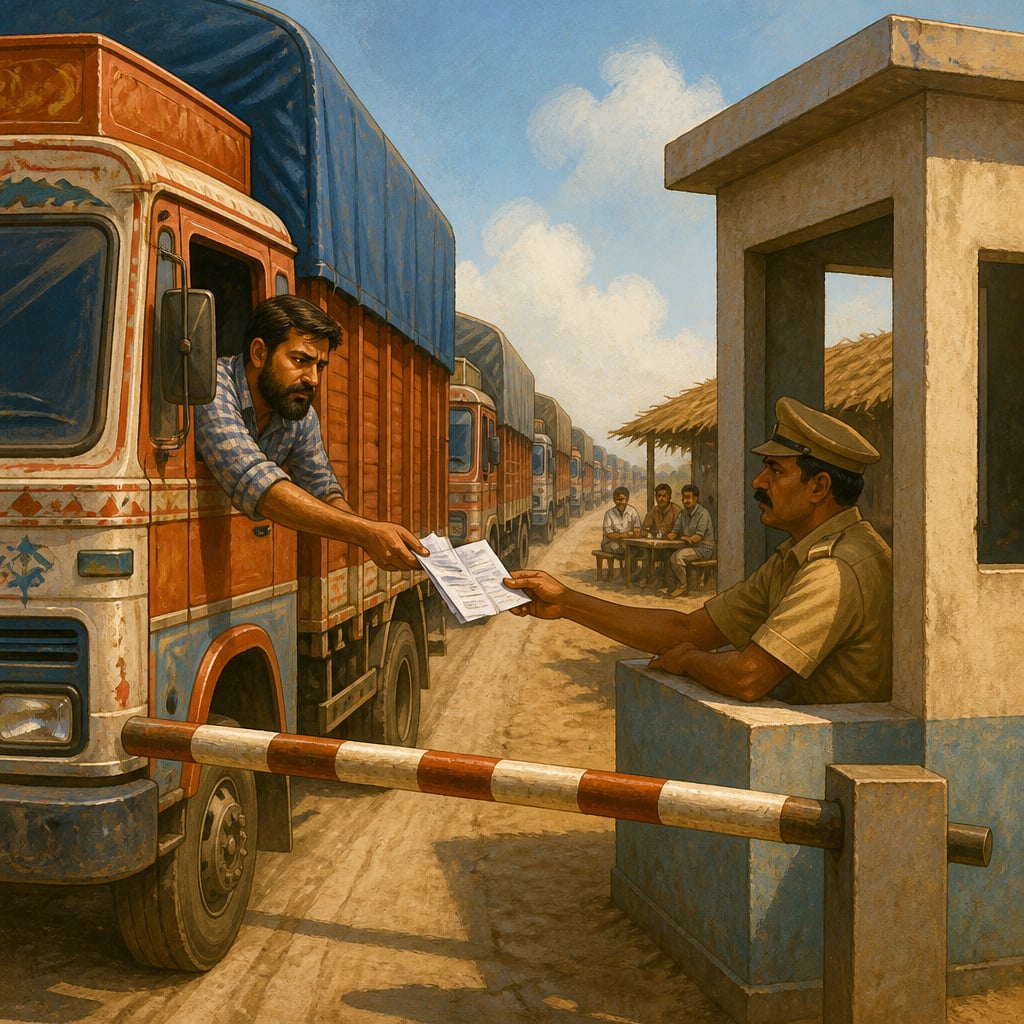
In 2016, a truck carrying goods from Chennai to Delhi would stop at eight state border checkposts. At each stop: paperwork, inspection, bribes. The driver might wait 20+ hours just crossing borders, not driving, just waiting.
The problem wasn't the distance. It was that India wasn't one market. It was 29 different tax jurisdictions, each with its own rules, rates, and revenue officers. Moving goods across state lines required:
- 17 different taxes (Central Excise, Service Tax, VAT, Entry Tax, Octroi, etc.)
- Multiple registrations in each state of operation
- Paper-based permits checked at every border
- Inspector raj at every checkpost
For a country that had been politically unified since 1947, this was an economic absurdity. Sardar Patel had merged 562 princely states into one nation. Seventy years later, India still wasn't one market.
The Ancient Vision: One Kingdom, One System
The Arthashastra envisions a unified economic zone under coherent administration. Kautilya writes:
"एकं शासनं एका नीतिः एकं कोषम्" Ekam shasanam eka nitih ekam kosham "One governance, one policy, one treasury."
Kautilya understood that economic fragmentation weakens the state. When each region has different rules, trade suffers, revenues leak, and the kingdom cannot compete with unified rivals.
The Mauryan Empire, which Kautilya helped build, had standardized weights, measures, and taxation across its vast territory. A merchant from Taxila could trade in Pataliputra without learning a new tax code. This integration was a source of strength.
Colonial India inherited this fragmentation. The British created separate taxation for their presidency towns (Bombay, Madras, Calcutta) while leaving princely states with their own systems. Post-independence India perpetuated this: the Constitution gave states power over sales tax, creating 29 different tax regimes.
GST restored the Kautilyan vision: one nation, one tax system, one market.
How GST Works: The Architecture
GST (Goods and Services Tax) replaced 17 central and state taxes with one unified tax:
Taxes Subsumed:
- Central: Excise Duty, Service Tax, CVD, SAD, Central Sales Tax
- State: VAT, Entry Tax, Purchase Tax, Luxury Tax, Entertainment Tax, Octroi
The New Structure:
- CGST: Central GST (goes to Centre)
- SGST: State GST (goes to State)
- IGST: Integrated GST (for inter-state trade)
When you buy something within your state, you pay CGST+SGST. When goods move across state lines, you pay IGST (which is later apportioned between origin and destination states).
The genius is the Input Tax Credit (ITC) chain. Every business in the supply chain can claim credit for GST paid on inputs. This creates:
- Self-policing: Buyers want sellers to be GST-compliant (otherwise no ITC)
- Formalization: Informal businesses must register to participate in supply chains
- Transparency: Every transaction is tracked through GST Network (GSTN)
Global Perspectives: The Long Road to Unified Markets
Jean-Baptiste Colbert (1619-1683), finance minister to France's Louis XIV, faced the same problem 350 years ago. France had internal customs barriers, goods moving from Bordeaux to Paris paid tolls at every provincial boundary. Colbert abolished internal tariffs, creating a unified French market.
His famous lament:
"The art of taxation consists in so plucking the goose as to obtain the largest amount of feathers with the least possible amount of hissing."
Colbert's reform transformed France into Europe's dominant economy. The principle: unified markets enable specialization, trade, and growth. Fragmented markets trap regions in self-sufficiency.
Alexander Hamilton (1755-1804), America's first Treasury Secretary, faced similar challenges. The 13 colonies had different currencies, tariffs, and regulations. Hamilton unified the fiscal system, assuming state debts and creating federal revenue, enabling the United States to become an economic power.
The European Union spent 50 years (1957-2007) creating a single market across 27 nations. They still don't have fully unified VAT rates, though they've harmonized the structure.
| Reform | Scale | Time to Implement | Result |
|---|---|---|---|
| Colbert's France | 1 country, ~20 provinces | 20+ years | French economic dominance |
| Hamilton's USA | 13 states | 10+ years | American fiscal union |
| EU Single Market | 27 countries | 50+ years | Still incomplete VAT harmonization |
| India's GST | 29 states + 7 UTs | 17 years (proposal to implementation) | One market of 1.4 billion |
India achieved in one reform what the EU still hasn't completed: a single tax system across a continent-sized economy.
The Political Achievement
GST wasn't just an economic reform. It was a political miracle.
The Constitution Amendment required two-thirds majority in Parliament plus ratification by half the state legislatures. In India's fractious politics, where states fiercely guard revenue powers, this seemed impossible.

Finance Minister Arun Jaitley built consensus through years of negotiation:
- GST Council: A federal body where Centre and states vote together (states have 2/3 weightage)
- Compensation guarantee: States guaranteed 14% revenue growth for 5 years
- Rate flexibility: Multiple rates (0%, 5%, 12%, 18%, 28%) to accommodate diverse goods
The GST Council became a model of cooperative federalism. Decisions require 75% majority, meaning neither Centre nor states can dominate. In 50+ meetings since 2017, most decisions have been unanimous.
Hasmukh Adhia, Revenue Secretary who designed the implementation, noted:
"GST Council is perhaps the only forum in India where the Finance Minister of Maharashtra sits with the Finance Minister of Nagaland and they vote with equal weight per capita."
Modern Resonance: The Numbers
Seven years after implementation, the results are clear:
Revenue:
- Monthly GST collections crossed ₹1.8 lakh crore (December 2023)
- ₹20 lakh crore+ annual revenue, double pre-GST indirect tax collections
- 1.4 crore GST registrations, massive formalization of previously informal businesses
Logistics:
- Truck transit time reduced by 30-40% (elimination of checkposts)
- Logistics costs as percentage of GDP: 14% → 10% (still higher than developed countries but improving)
- 4 billion+ e-way bills generated, replacing paper permits
Compliance:
- 98%+ returns filed monthly by registered taxpayers
- Real-time matching of buyer-seller invoices detecting fraud
- State revenue base broadened (previously only large businesses paid; now supply chains are captured)
The Sardar Patel Parallel

In 1947, Sardar Vallabhbhai Patel faced 562 princely states, each with its own ruler, army, and laws. Sceptics said unification was impossible. Patel achieved it through negotiation, persuasion, and when necessary, firmness.
GST is the economic equivalent. India in 2016 had 29 states and 7 UTs, each with its own tax regime, rate structure, and revenue bureaucracy. The GST Council, through negotiation, compensation guarantees, and cooperative federalism, achieved what seemed politically impossible.
Patel gave India political unity. GST gave India economic unity. Both required:
- Vision of what a unified India could achieve
- Patient consensus-building across diverse interests
- Mechanisms that respected state autonomy while enabling national integration
Your Turn: Are You Part of the Chain?
GST affects you even if you don't realize it.
Every time you see "Price inclusive of GST" on a bill, you're participating in a unified national market. The goods you buy, whether manufactured in Gujarat, distributed from Maharashtra, or sold in Tamil Nadu, flow seamlessly because of GST infrastructure.
But consider: Do you ask for proper GST invoices? When you deal with informal vendors, you're outside the GST chain, which means the system's self-policing mechanism doesn't work. Formalization happens when consumers demand compliance.
The next time you hire a service or buy from a small business, ask for the GST invoice. You're not being bureaucratic, you're participating in the infrastructure that makes India one market.
In the next lesson, we'll see how India is using this unified market to revive manufacturing: Make in India and the Production-Linked Incentive schemes that are bringing factories back.
Nobel laureate Ronald Coase identified 'transaction costs' as key to economic organization. Every border crossing, form filing, and compliance check is a transaction cost. Pre-GST India had among the highest internal transaction costs of any large economy.
GST's unification reduced transaction costs dramatically. A business that previously needed registration in 29 states now needs one. Multiple tax returns became one. Physical checkposts became digital e-way bills. The savings are economy-wide.
World Bank estimates that GST reduced logistics costs from 14% to 10% of GDP, saving ₹4-5 lakh crore annually in an economy where logistics is 10% of product cost.
Modern mechanism design theory (Nobel Prize 2007) studies how to create systems where following rules is in everyone's self-interest. GST's Input Tax Credit is a perfect example: buyers want sellers to be compliant (otherwise no credit), creating mutual enforcement.
Pre-GST, tax evasion was a competitive advantage, non-compliant businesses undercut compliant ones. Under GST, the ITC chain reverses this: compliant businesses are preferred partners because buyers can claim credits. The system made honesty profitable.
GST registrations grew from 65 lakh (pre-GST indirect tax registrants) to 1.4 crore, millions of informal businesses formalized because their customers demanded GST invoices.
Key terms
- Vastu evam Seva Kar
- Goods and Services Tax (GST); a unified indirect tax that replaced 17 central and state taxes, creating one national market
- Input Tax Credit
- The mechanism allowing businesses to claim credit for GST paid on inputs, preventing cascading taxation and creating self-policing compliance
- E-Way Bill
- Electronic waybill; a digital document required for moving goods worth ₹50,000+ across state lines, replacing physical permits and checkpost inspections
- GST Parishad
- GST Council; the constitutional body comprising Centre and state finance ministers that decides GST rates, rules, and exemptions through federal consensus
Key figures
Sardar Vallabhbhai Patel
Deputy Prime Minister of India, architect of Indian political unification
Arun Jaitley
Finance Minister of India (2014-2019)
Jean-Baptiste Colbert
Finance Minister to King Louis XIV of France
Case studies
The Truck That Stopped Stopping: Border Checkpost Elimination
Before GST, the Mumbai-Delhi route had **checkposts at every state border**: Maharashtra, Madhya Pradesh, Rajasthan, Haryana, Delhi. Each stop meant: - **2-4 hours waiting** for document verification - **Paperwork**: Showing different tax forms for each state - **Informal payments**: ₹200-500 per checkpost to expedite clearance - **Inspection risk**: Goods could be offloaded and checked A truck that could drive the 1,400 km in 20 hours spent **another 10-15 hours** at checkposts. Drivers worked in shifts not because of road conditions but because of waiting time. The transport industry estimated that **30% of total transit time** was spent at borders, not moving, just waiting. On July 1, 2017, GST abolished inter-state tax variations. Checkposts lost their purpose. Within months, most state borders had no stopping requirement for goods vehicles.
Kautilya's Arthashastra describes 'shulka-sthana' (toll stations) as necessary evils, required for revenue but sources of delay and corruption. He warns administrators to ensure tolls don't hamper trade more than they generate revenue. Pre-GST checkposts violated this principle. The revenue collected at borders was dwarfed by the economic loss from delays. Studies estimated that border waiting cost the economy **1-2% of GDP annually**, far exceeding any tax collected. GST's elimination of checkposts restored Kautilyan balance: taxation happens (through GST returns), but trade flows freely. The 'toll' is now digital, not physical. The Arthashastra's vision of efficient revenue collection without trade disruption is finally realized.
**Transit time reduction:** - Mumbai-Delhi: 3-4 days → 24-30 hours - Chennai-NCR: 6-7 days → 3-4 days - Average reduction: **30-40%** nationwide **Economic impact:** - Logistics cost as % of GDP: 14% → 10% - Truck utilization increased 20%+ (same truck makes more trips) - Inventory carrying costs reduced (faster delivery = less warehousing) - Perishable goods losses reduced (faster transit = less spoilage) **Human impact:** - Truck drivers spend nights driving, not waiting - Reduced bribes (no checkpoint = no extortion opportunity) - Better working conditions for 8 million+ truck drivers
Physical barriers to trade are always costly, whether between nations or within them. The 'checkpost raj' was an artificial friction that benefited no one except the inspectors. Removing it created value for everyone else. Always question barriers: who benefits from them?
The EU's single market eliminated border checks across 27 countries. India's GST achieved the same within a single country of 1.4 billion people. The logistics cost reduction is directly comparable: both demonstrate that removing internal trade barriers produces economic gains that compound year after year.
The Logistics Performance Index improvement post-GST moved India from rank 54 (2014) to rank 38 (2023), better than many middle-income countries and catching up with developed ones.
E-Way Bill: 4 Billion Digital Permits
The e-way bill system, launched in April 2018, digitized what paper permits had done for decades, but made it instant, traceable, and corruption-resistant. **How it works:** 1. Transporter generates e-way bill online before moving goods worth ₹50,000+ 2. Bill contains: goods description, origin, destination, vehicle number, GST details 3. Bill is valid for defined period based on distance (1 day per 100 km) 4. Verification happens through RFID readers and mobile apps, no physical stopping **The scale:** - **4 billion+ e-way bills** generated since launch - **5+ crore bills generated monthly** at peak - Average generation time: **under 1 minute** - Integration with RFID: Vehicle passes reader, bill verified automatically What previously required stopping at a checkpost, showing papers, waiting for verification, now happens as a truck passes a RFID reader without slowing down.
The e-way bill embodies the Arthashastra principle of 'janpad' (documentation) without 'vigna' (obstruction). Kautilya wanted records of trade flows, for revenue, for security, for planning. But he also wanted trade to flow freely. Paper permits achieved documentation at the cost of obstruction. Each verification stopped the truck. E-way bills achieve documentation without obstruction, the truck doesn't stop, but the system knows exactly what's moving where. This is the dharmic use of technology: achieving the same regulatory purpose (tracking goods, collecting tax) while eliminating the burden on citizens. The goal (compliance) is unchanged; the method (digital) is transformed.
**Compliance improvement:** - Invoice matching between buyer and seller enabled - Fake invoicing (for false ITC claims) detected in real-time - **₹1+ lakh crore** in fraudulent claims detected and prevented **Operational efficiency:** - No physical document checking required - Risk-based inspection (flag unusual patterns, not every truck) - Real-time tracking of goods movement nationwide **Data-driven governance:** - Economic activity mapping at granular level - Supply chain visibility for policy making - Early indicators of economic trends (e-way bill volumes correlate with GDP)
Digitization isn't just about convenience, it's about achieving the same outcome (in this case, tax compliance and goods tracking) with dramatically lower friction. The goal isn't to eliminate regulation but to make compliance effortless.
Blockchain-based supply chain tracking by companies like Maersk and Walmart follows the same principle as the e-way bill: digitize documentation to eliminate fraud and friction. India's 4 billion e-way bills represent one of the world's largest real-time supply chain monitoring systems, built by the government rather than private enterprise.
E-way bill analytics detected ₹35,000 crore in fake invoicing in 2022 alone, fraud that paper systems would never have caught. The data trail that enables compliance also enables enforcement.
Historical context
Tax Reform Era (2000-2025)
India's indirect tax chaos was a colonial inheritance. The British created separate systems for presidency towns vs. princely states. Post-independence, the Constitution gave states sales tax powers, creating 29 different regimes. Every reformer since the 1980s proposed unification; none succeeded until 2017.
Over 160 countries have VAT/GST systems. France pioneered it (1954), then the EU adopted it (harmonized since 1967). India is the largest economy to implement comprehensive GST covering both goods and services. The multi-rate structure (0%, 5%, 12%, 18%, 28%) is more complex than most countries but reflects Indian political compromises.
GST subsumed 17 taxes administered by 2 governments (Centre and States), 37 different legislations, and uncountable local variations. The unification was unprecedented in scale.
GST transforms India from a collection of small markets into one continental market. A business in Sikkim can now sell seamlessly to customers in Kerala. This enables scale, specialization, and competition that fragmented markets never could. For India to become a manufacturing hub, it needed this unified market.
Reflection
- GST took 17 years from first proposal (2000) to implementation (2017). Many reforms never happen because consensus seems impossible. What made GST finally succeed? What does this teach about achieving change in complex systems with many stakeholders?
- Think about your recent purchases, both formal (with bills) and informal (without). When you don't ask for a GST invoice, you're participating in the informal economy outside the tax net. This week, consciously ask for GST invoices. Notice: which vendors can provide them easily? Which struggle? What does this tell you about formalization progress?