Jan Dhan Yojana: 500 Million Bank Accounts
The Financial Inclusion Revolution
How India opened more bank accounts in two years than the entire population of the United States, and why this wasn't charity but the restoration of an ancient dharmic principle: that every person deserves a place in the economic system.
The Woman Who Had Never Seen a Bank
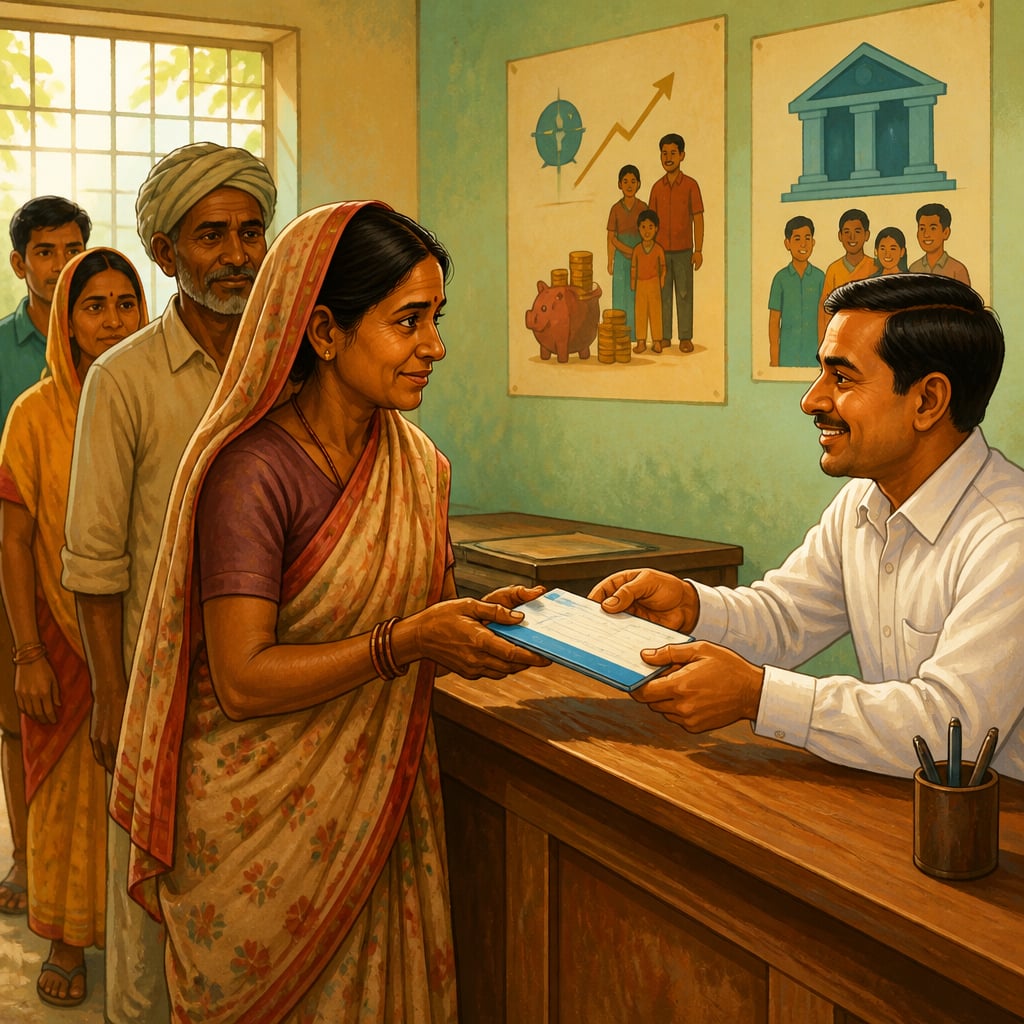
In August 2014, Ranjana Devi, a daily-wage laborer in Bihar's Muzaffarpur district, walked into a bank for the first time in her fifty years of life. She didn't understand the forms. She couldn't sign her name, her thumb impression would do. The bank manager, following new government orders, opened her account anyway. Zero balance. Zero fees. Just a piece of paper that said she now existed in India's financial system.
Within three months, 115 million accounts like hers were opened. By 2024, the number crossed 530 million, more bank accounts than the entire population of the United States, European Union, and Japan combined.
This wasn't just a government scheme. It was the reversal of centuries of financial exclusion.
The Long Shadow of Exclusion
For most of India's post-independence history, banking was a privilege of the urban and the educated. In 1969, when Indira Gandhi nationalized 14 major banks, only 14% of Indian adults had bank accounts. The stated goal was financial inclusion. The reality? By 2011, forty-two years later, only 35% of Indians had accounts.
The reasons were structural. Opening an account required proof of address, identity documents, minimum balances, and often bribes to bank staff. For a migrant laborer like Ranjana Devi, who moved between villages following harvests, these requirements were impossible.
But the problem ran deeper than bureaucracy. Dadabhai Naoroji, writing in 1901, had identified the root cause: colonial economic extraction systematically drained wealth from villages, leaving nothing to save, nothing to bank. The British built banks in India, but for British commerce, not Indian farmers. When independence came, the infrastructure remained extractive: designed to move money from villages to cities, not to serve the rural poor.
The Arthashastra principle was violated at the most fundamental level:
"कोषमूलो हि धर्मः" Koshamulo hi dharmah "The treasury is the root of dharma."
Kautilya meant that a state cannot fulfill its dharmic duties, protection, welfare, justice, without a strong treasury. But he also meant something deeper: every person needs access to the economic system to live a dharmic life. A person without savings, without credit, without a place in the financial system, cannot plan for the future, cannot weather emergencies, cannot participate fully in society.
The Principle Revealed: Financial Identity as Dharmic Right

On August 28, 2014, Prime Minister Narendra Modi launched Pradhan Mantri Jan Dhan Yojana (PMJDY) from the ramparts of Red Fort. The timing was deliberate, Independence Day's echoes still fresh. The message was clear: this was a second independence, an economic one.
The scheme was radical in its simplicity:
- Zero balance required to open account
- No minimum documents, self-attestation accepted
- RuPay debit card for every account holder
- Overdraft facility up to ₹10,000 for active accounts
- Accident insurance of ₹2 lakh included
The philosophy came from Finance Minister Arun Jaitley, who articulated it in Parliament:
"Financial inclusion is not charity. It is recognition that every citizen, however poor, deserves a place in the formal economy. It is their right, not our generosity."
This was the Arthashastra vision made modern. Kautilya wrote that the king's duty was to ensure "prajakushala", the welfare of all subjects. He specified that even the poorest should have access to state granaries during famine and state loans during hardship. The assumption was always that everyone is part of the system.
Colonial and post-colonial banking had inverted this. The poor were explicitly excluded, by design, not accident. Jan Dhan restored the original dharmic architecture.
Global Perspectives on Financial Inclusion
India's approach was not invented in isolation. Three global thinkers shaped the intellectual context:
Muhammad Yunus (1940-present), the Bangladeshi economist and Nobel laureate, pioneered microfinance through Grameen Bank. His insight: the poor are creditworthy; they repay loans at higher rates than the rich. But Grameen's model, small groups, group liability, high-touch supervision, couldn't scale to 500 million.
Hernando de Soto (1941-present), the Peruvian economist, argued in The Mystery of Capital that the poor are "locked out" of formal systems not by lack of assets but lack of documentation. His prescription: simplify the paperwork. Jan Dhan took this literally, self-attestation replaced bureaucratic proof.
Abhijit Banerjee (1961-present), the Indian-American Nobel laureate, co-founded J-PAL (Poverty Action Lab) to test what actually works for the poor. His research showed that access to banking changes behavior: people save more, invest more, plan longer-term. Jan Dhan was, in effect, a massive nationwide experiment validating Banerjee's findings.
| Thinker | Key Insight | Jan Dhan Implementation |
|---|---|---|
| Muhammad Yunus | The poor are creditworthy | Overdraft facility for active accounts |
| Hernando de Soto | Reduce documentation barriers | Self-attestation, zero KYC for small accounts |
| Abhijit Banerjee | Access to banking changes behavior | Universal access + financial literacy programs |
But India's scale dwarfed all precedents. Brazil's Bolsa Familia reached 14 million families. Mexico's Oportunidades covered 5 million. Jan Dhan opened 530 million accounts in a decade, the largest financial inclusion program in human history.
Modern Resonance: The Infrastructure That Enabled Everything
Jan Dhan wasn't the endpoint. It was the foundation.
Without bank accounts, the JAM Trinity (Jan Dhan + Aadhaar + Mobile) couldn't exist. Without JAM, Direct Benefit Transfer couldn't work. Without DBT, pandemic relief in 2020 would have been impossible.

Consider the numbers:
- ₹36 lakh crore ($430 billion) transferred directly to beneficiaries via DBT since 2014
- ₹2.2 lakh crore in savings from eliminating fake beneficiaries ("ghost" ration cards, duplicate accounts)
- 200 million women received ₹500/month directly during COVID-19 lockdown, within days of announcement
In April 2020, when the pandemic locked down India, the government announced ₹1,500 per woman account holder. The money reached 20 crore women within two weeks. No intermediaries. No leakage. No delays.
Compare this to the United States, where stimulus checks took months and many never arrived. Or to Britain, where benefit fraud during COVID exceeded £5 billion. India's infrastructure, built on Jan Dhan foundations, proved its worth precisely when it was needed most.
Your Turn: What Does Inclusion Mean?
You might be reading this on a smartphone, with multiple bank accounts, perhaps investment apps. Financial inclusion seems like someone else's problem.
But ask yourself: how many people in your extended family, grandparents in villages, domestic help, the guard at your building, still operate primarily in cash? How many of them could access their own money in an emergency without traveling to a bank branch?
The Jan Dhan revolution isn't complete. As of 2024, nearly 15% of accounts remain dormant, opened but never used. Financial literacy lags behind access. Digital fraud targets the newly banked.
The infrastructure exists. The challenge now is making it meaningful, ensuring that Ranjana Devi's account isn't just a number on a government report, but a genuine gateway to economic participation.
In the next lesson, we'll see how Jan Dhan combined with Aadhaar and Mobile to create something unprecedented: a digital public infrastructure that the world now wants to copy.
Traditional Western banking theory said: wait for demand, then serve it. Muhammad Yunus proved the poor would borrow; Abhijit Banerjee proved they would save. But both still expected demand. Jan Dhan inverted this: create supply (accounts), and demand (savings, transactions) follows.
The Indian approach, create universal access first, let behavior follow, is more dharmic. It doesn't judge who 'deserves' banking; it assumes everyone does. This creates inclusion rather than perpetuating exclusion.
Of 530 million Jan Dhan accounts, 55% are held by women and 67% are in rural/semi-urban areas, precisely the groups traditional banking excluded.
Reaganomics/trickle-down theory assumed that enriching the top would benefit the bottom. Decades of data show this failed. The Kautilyan approach, prajaasukhe sukham, says focus on the bottom; prosperity will spread upward.
Jan Dhan inverted the banking model. Instead of 'serve the profitable, ignore the poor,' it said 'serve everyone, make it profitable.' UPI, Jan Dhan, and DBT now generate economic activity that benefits banks, businesses, and GDP, all from including the excluded.
The Reserve Bank estimates that Jan Dhan accounts now hold ₹2.1 lakh crore in deposits, savings that previously existed outside the formal system, now funding economic growth.
Key terms
- Jan Dhan
- People's wealth; the philosophy that financial resources belong to and should serve all citizens, not just the privileged
- Vittiya Samaveshan
- Financial inclusion; the process of ensuring all citizens have access to useful and affordable financial products and services
- Praja Kushala
- Welfare of subjects; the Arthashastra principle that the state's primary duty is ensuring the wellbeing of all its people
- Shunya Balance
- Zero balance; the revolutionary feature of Jan Dhan that removed the minimum deposit requirement that had excluded millions from banking
Key figures
Dadabhai Naoroji
Economist, nationalist leader, first Asian elected to British Parliament
Arun Jaitley
Finance Minister of India (2014-2019)
Abhijit Banerjee
Nobel laureate economist, MIT professor, co-founder of J-PAL
Case studies
PM-KISAN: When 110 Million Farmers Became Visible
Before 2019, government support to farmers was a patchwork of middlemen, leakages, and delays. Fertilizer subsidies went to manufacturers, not farmers. Crop insurance claims took months. Loan waivers required political connections. PM-KISAN, launched in February 2019, changed everything. The scheme promised ₹6,000 per year to every small farmer, transferred directly to their bank accounts in three installments. The requirement? A Jan Dhan or any bank account, linked to Aadhaar. The scale was unprecedented: **110 million farmer families** receiving ₹2,000 every four months, directly, with no intermediaries. By December 2024, total transfers crossed **₹3 lakh crore**, the largest direct farmer support program in world history.
The Arthashastra principle of praja-kushala (citizen welfare) demands that the state reach every citizen, not just those with connections. Colonial and post-colonial agricultural policy violated this, subsidies often enriched middlemen while farmers remained poor. PM-KISAN restored the dharmic relationship: direct connection between state and citizen, no intermediary extracting value. The state's dharma (duty) is fulfilled only when the intended recipient receives the benefit. The prerequisite was Jan Dhan. Without bank accounts, direct transfer was impossible. The 2014 decision to open 500 million accounts created the infrastructure that made PM-KISAN possible in 2019, a five-year investment in inclusion that now returns value annually.
As of 2024: - **₹3 lakh crore+** transferred directly to farmer accounts - **110 million farmer families** receiving regular payments - **Average time from sanction to receipt: 3-5 days** (vs. months under earlier schemes) - **Leakage reduced to near-zero** through Aadhaar-linked verification When COVID-19 struck in 2020, the PM-KISAN infrastructure enabled immediate relief: the April 2020 installment was advanced and expanded, reaching farmers within days of the lockdown announcement.
Infrastructure investment precedes visible results by years. Jan Dhan in 2014 made PM-KISAN in 2019 possible. Patient, unglamorous work on inclusion creates the foundation for transformative programs that follow.
PM-KISAN's direct transfer model is being studied by agricultural economies worldwide. Indonesia launched a similar direct farmer transfer in 2024, and Nigeria is piloting one. The principle that subsidies should reach the farmer directly, not through input manufacturers or middlemen, is reshaping agricultural policy globally.
A World Bank study found that PM-KISAN transfers increased agricultural investment by 22% among recipient farmers, money went into seeds, fertilizer, and equipment, not consumption. Inclusion enabled investment.
PAHAL: Saving ₹70,000 Crore by Counting Correctly
LPG (cooking gas) subsidies were India's biggest welfare leak. The government subsidized cylinders for the poor, but the rich bought them too. Worse, 'ghost beneficiaries', fake names on rolls, claimed millions of cylinders that never existed. In 2013, before Jan Dhan, an attempt at direct transfer (DBTL - Direct Benefit Transfer for LPG) flopped: only 35% of beneficiaries had bank accounts. The scheme was paused. PAHAL (Pratyaksh Hanstantrit Labh) relaunched in 2015, after Jan Dhan. The model: buy cylinders at market price, receive subsidy directly in bank account. Simple. Transparent. Verifiable. The results shocked everyone. Within months, **3.4 crore fake connections** were identified and eliminated. People who had received subsidies for years, for connections that never existed, simply stopped claiming them when they had to prove they were real.
Kautilya devoted an entire chapter of the Arthashastra to detecting embezzlement and fraud. His insight: most corruption is enabled by opacity, not malice. Remove the ability to hide, and most fraud disappears. PAHAL proved this. The 'ghost beneficiaries' weren't criminal masterminds, they were artifacts of a system that never verified. Once verification happened (Aadhaar-linked bank account), the ghosts vanished. This is dharmic economics in action: the system should make righteousness easy and adharma difficult. When claiming a fake subsidy requires creating a fake identity, fake bank account, and fake address, most people simply stop trying.
- **3.4 crore fake connections** eliminated - **₹70,000 crore+** saved in cumulative savings by 2024 - **28 crore+ genuine beneficiaries** now receive subsidy directly - **Guinness World Record** for largest direct benefit transfer (2015) The poor who genuinely needed subsidies continued receiving them, faster and more reliably than before. The non-poor who were gaming the system (or didn't need it) voluntarily surrendered connections via 'Give It Up' campaign.
Corruption often isn't individual moral failure but systemic design failure. When systems are opaque, leakage follows. When systems are transparent and direct, dharmic behavior emerges naturally. Build the right architecture, and the right behavior follows.
India's GiveitUp campaign, where 1.3 crore households voluntarily surrendered LPG subsidies, demonstrated that transparency enables civic participation. When citizens can see where public money goes, many choose to redirect it to those who need it more. This voluntary redistribution model has no parallel in any other country.
PAHAL's 28 crore beneficiaries make it the world's largest direct benefit transfer program. The ₹70,000 crore saved exceeds the entire annual budget of many Indian states.
Historical context
Post-Independence Banking to Digital India (1947-2025)
India's banking history is a story of incomplete promises. Nationalization (1969) promised inclusion but delivered primarily to the urban middle class. Self-help groups (1990s-2000s) reached women but at high rates and limited scale. Jan Dhan finally achieved what had been promised for fifty years: genuine universal access.
Brazil's Bolsa Familia (2003) reached 14 million families with conditional cash transfers. Kenya's M-Pesa (2007) enabled mobile banking for the unbanked. But Jan Dhan's scale, 530 million accounts in a decade, dwarfs all precedents. India didn't just adopt global best practices; it created a new benchmark.
The World Bank's Findex report (2021) showed India's banked population jumped from 35% (2011) to 80% (2021), the fastest improvement in financial inclusion ever recorded globally.
Jan Dhan represents the infrastructure layer on which all subsequent innovations, UPI, DBT, PM-KISAN, PAHAL, are built. Understanding its history explains why India could respond to COVID-19 with unprecedented speed while wealthy nations struggled to reach their own citizens.
Reflection
- Kautilya wrote 'Koshamulo hi dharmah', the treasury is the root of righteous action. How does financial exclusion prevent dharmic living? Consider someone who cannot save, cannot access credit, cannot receive government benefits, how are their choices constrained in ways that the financially included never experience?
- Identify one person in your life, family member, domestic help, local vendor, who may not fully use their bank account. This week, have a conversation with them: Do they know their balance? Have they used UPI? What would help them use banking services more confidently? Consider how you might help bridge their capability gap.