JAM Trinity: Digital Public Infrastructure

The Three Pillars of Digital India

How three seemingly simple technologies, bank accounts, identity numbers, and mobile phones, combined to create an infrastructure so powerful that 60+ countries are now studying India's model. The story of how India built public digital rails that bypass Silicon Valley altogether.

The Phone Call That Changed Everything
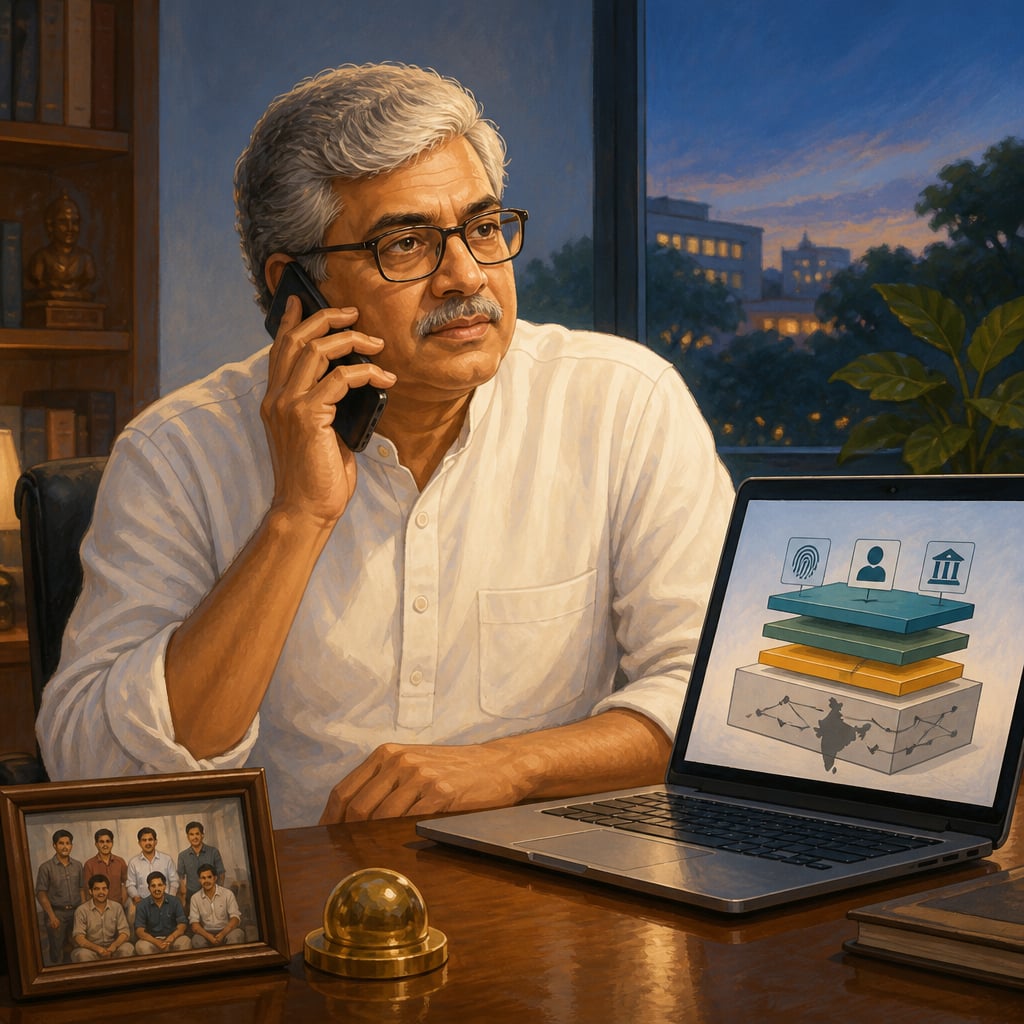
Nandan Nilekani taking a World Bank call about India Stack

In December 2016, Nandan Nilekani received a call from the World Bank. They wanted to understand something puzzling: how had India enrolled 1 billion people in a biometric identity system in just six years? The previous record, Indonesia's national ID program, had taken decades and covered barely 100 million.

Nilekani's answer was simple: "We didn't just build an identity system. We built infrastructure."

That infrastructure, the JAM Trinity of Jan Dhan (bank accounts), Aadhaar (identity), and Mobile (connectivity), is now being studied by governments from Singapore to Saudi Arabia. The IMF calls it "a leapfrog moment." The World Bank estimates it could save developing countries $220 billion annually in welfare leakage alone.

But how did three ordinary technologies become something extraordinary?

The Vision: Technology as Servant, Not Master

The JAM philosophy didn't emerge from Silicon Valley. Its roots trace to Vikram Sarabhai, founder of India's space program, who in 1969 articulated a radical idea:

"There are some who question the relevance of space activities in a developing nation. To us, there is no ambiguity of purpose. We do not have the fantasy of competing with the economically advanced nations... But we are convinced that if we are to play a meaningful role nationally, and in the community of nations, we must be second to none in the application of advanced technologies to the real problems of man and society."

Sarabhai wasn't talking about rockets. He was talking about technology as public infrastructure, built by the state, serving all citizens, not extracting from them. When he launched India's first satellite television experiment (SITE, 1975), the goal wasn't profit. It was bringing education to 2,400 villages that had never seen a television.

This philosophy, technology for inclusion, not extraction, runs directly through Aadhaar and India Stack.

The Three Pillars Explained

JAM isn't just an acronym. Each letter represents a specific problem solved:

J - Jan Dhan: The Financial Gateway Before 2014, 65% of Indians had no bank account. Government benefits went to middlemen. The poor were invisible to the financial system. Jan Dhan opened 530 million accounts, giving every citizen a financial address.

A - Aadhaar: The Identity Layer Before Aadhaar, proving identity required documents most poor Indians didn't have. Ration cards were fake. Voter IDs were duplicate. Birth certificates didn't exist. Aadhaar gave 1.4 billion people a verifiable identity, a 12-digit number linked to biometrics that cannot be forged.

M - Mobile: The Connectivity Backbone India went from 100 million mobile users (2005) to 1.2 billion (2024). When Jio launched in 2016 with free 4G data, internet access ceased to be a luxury. Mobile became the delivery channel through which JAM services reach the last mile.

The genius wasn't any single pillar. It was how they interoperate:

"Aadhaar proves you are you. Jan Dhan gives you a place to receive money. Mobile lets you access both from anywhere."

This is the Arthashastra principle of yantra (system/mechanism) applied to digital governance:

"यन्त्रं सर्वार्थसाधनम्" Yantram sarvarthasadhanam "The mechanism is the means to all ends."

Kautilya understood that good intentions without effective delivery mechanisms are meaningless. JAM is the mechanism that makes India's welfare intentions actually reach citizens.

Global Perspectives: Why India's Model Is Different

Digital identity and payments exist everywhere. What makes India's approach unique?

Tim Berners-Lee (1955-present), inventor of the World Wide Web, envisioned the internet as open, interoperable, and non-proprietary. But Silicon Valley turned it into walled gardens, Facebook's social graph, Google's search monopoly, Apple's closed ecosystem. Each platform extracts value from users.

India's digital public infrastructure (DPI) is deliberately different:

Feature Silicon Valley Model India Stack Model
Ownership Private corporations Public infrastructure
Access Platform-controlled Open APIs for all
Data Monetized by platform Controlled by citizen
Interoperability Walled gardens Open standards
Goal Profit maximization Inclusion maximization

Jack Ma's Alipay in China processes more transactions than Visa and Mastercard combined. But it's private, Ant Financial profits from every transaction. When the Chinese government wanted to rein it in, they had to stop Ma's $37 billion IPO.

UPI, India's payment layer, is public infrastructure. No company owns it. Any bank, fintech, or app can plug in. When PhonePe and Google Pay compete, they compete on the infrastructure, not for the infrastructure. The rails remain public.

This is the difference between extractive and inclusive technology, a distinction the Arthashastra makes repeatedly.

Hernando de Soto (1941-present), the Peruvian economist, argued that the poor lack not assets but documentation. Without papers proving ownership, their assets are "dead capital." Aadhaar and DigiLocker solve this: your identity, your documents, your credentials, all verifiable, all portable, all yours.

Modern Resonance: India Stack Goes Global

In February 2023, something remarkable happened. Singapore launched UPI-PayNow linkage, an Indian at a hawker stall in Singapore could pay using Google Pay from their Indian bank account. No forex fees. Instant settlement.

By 2024:

Bengaluru chai vendor accepting a UPI payment

The Reserve Bank of India now talks about UPI becoming a "WhatsApp of payments", a global standard, not just an Indian system.

Consider the numbers:

When the IMF's Kristalina Georgieva visited India in 2024, she called India Stack "a revolution that other countries should replicate."

The Mechanism That Changed Governance

JAM's impact goes beyond payments. Consider:

PM-KISAN: ₹6,000/year to 110 million farmers, transferred directly to Jan Dhan accounts verified by Aadhaar, accessible via mobile.

PAHAL: LPG subsidies to 28 crore households, 3.4 crore fake connections eliminated because ghosts don't have Aadhaar-linked bank accounts.

Rural Maharashtra CoWIN vaccination centre

CoWIN: 2 billion+ COVID vaccines tracked, each dose linked to Aadhaar, each certificate on DigiLocker, each appointment booked via mobile.

Scholarship DBT: 4 crore+ students receive scholarships directly, no college middlemen extracting "fees."

The mechanism works because it's trustless, not in the crypto sense, but in the Kautilyan sense. You don't need to trust the local official. The system verifies automatically. Dharma is encoded in the architecture.

Your Turn: Are You Using the Infrastructure?

You might use UPI daily without realizing you're using JAM.

Every QR code payment, every DigiLocker document, every DBT received, all flow through the same public rails. You're not using "Google Pay" or "PhonePe" as much as you're using UPI with their interface.

But ask yourself: Do you have your documents on DigiLocker? Your PAN, Aadhaar, driving license, vaccine certificates, all can be stored, verified, and shared without paper. If you haven't set it up, you're carrying documents that the infrastructure has already replaced.

The infrastructure is built. The question is whether you're using it fully, and whether you're helping others (parents, household help, local vendors) access it too.

In the next lesson, we'll see JAM's most powerful application: Direct Benefit Transfer, how ₹36 lakh crore reached citizens without the middlemen who had stolen welfare for decades.

Silicon Valley's dominant model is platforms, Facebook, Google, Amazon, that create value by controlling access. Users become products. Data becomes currency. India Stack inverts this: the infrastructure is public, the data belongs to users, and private companies compete on top of shared rails.

Because UPI is public infrastructure, transaction costs are zero. Because Aadhaar is public, any private service can verify identity. This creates competition at the service layer while keeping infrastructure neutral, exactly what Kautilya's 'yantra' was meant to do.

UPI processes 12 billion transactions/month at zero cost to users. If India used the Visa/Mastercard model (2-3% fees), that would be ₹6+ lakh crore extracted annually from the economy.

Facebook's value comes from locking in your social graph, you can't export your friends list to a competitor. This is a 'moat' (competitive advantage) built on user lock-in. India Stack has no moats by design: any app can access the same infrastructure as any other.

Open systems grow faster than closed ones. Because UPI is interoperable, network effects benefit the entire ecosystem, not just one company. A PhonePe user can pay a Google Pay merchant, competition happens on service quality, not network size.

In 2016, India had negligible digital payments. By 2024, UPI alone processes more transactions than Visa and Mastercard combined in India. Interoperability enabled growth that closed systems couldn't achieve.

Key terms

JAM Trikon
The JAM Trinity, Jan Dhan (financial access), Aadhaar (identity verification), and Mobile (connectivity), the three pillars of India's digital public infrastructure
India Stack
The layered digital infrastructure built on JAM, including UPI (payments), DigiLocker (documents), eSign (authentication), and consent layer (data sharing), all as open, interoperable public goods
Yantra
Mechanism, instrument, or system; in governance context, the delivery apparatus that transforms policy intention into citizen benefit
Antarsanchalaniyata
Interoperability; the ability of different systems, applications, and institutions to work together seamlessly through common standards and open interfaces

Key figures

Vikram Sarabhai

Founder of Indian Space Research Organisation (ISRO), pioneer of technology-for-development

Nandan Nilekani

Co-founder of Infosys, Chairman of UIDAI (Aadhaar), architect of India Stack

Tim Berners-Lee

Inventor of the World Wide Web, founder of World Wide Web Consortium (W3C)

Case studies

DigiLocker: 1.5 Billion Documents, Zero Paper

Before DigiLocker, applying for a passport meant carrying stacks of documents: birth certificate, educational certificates, address proofs, income certificates, all original or notarized. Government offices demanded papers that other government offices had issued. Citizens became couriers between departments. DigiLocker, launched in 2015, changed this completely. It's a cloud-based platform where government-issued documents are stored digitally, linked to Aadhaar. When you need to prove your degree, DigiLocker fetches it directly from the university's system. No paper. No notarization. No "original for verification." By 2024: - **1.5 billion+ documents** stored - **250+ issuing organizations** (universities, transport departments, tax authorities) - **35+ requesting agencies** that accept DigiLocker instead of paper - **25 crore+ registered users**

The Arthashastra principle of 'yantra' (mechanism) is perfectly demonstrated here. The problem wasn't that documents didn't exist, it was that the delivery mechanism was broken. Citizens spent days obtaining papers that the government already had. DiGiLocker solved the mechanism problem. By connecting issuers (who have your documents) with verifiers (who need them) through a citizen-controlled platform, it eliminated the need for citizens to be intermediaries in their own verification. The dharmic insight: the citizen shouldn't have to prove to the government what the government already knows. DigiLocker embodies this, the state's records serve the citizen, not the other way around.

**Impact on governance:** - Passport issuance time reduced from weeks to days (police verification uses DigiLocker) - University degree verification instant (previously took months) - COVID-19 vaccine certificates reached 200 crore+ people via DigiLocker - Vehicle registration documents (RC) now accepted digitally by traffic police nationwide **Economic impact:** - Estimated **₹10,000 crore annually** saved in document-related costs (printing, couriering, notarization) - Millions of hours saved in queuing for document collection - Forgery reduced to near-zero (documents are cryptographically signed) **Social impact:** - Migrants can prove identity and qualifications anywhere in India - Women no longer need to visit hostile bureaucracies for documents - Rural citizens access documents without traveling to district headquarters

The best infrastructure is invisible. You don't think about DigiLocker until you need a document, and then it just works. This is the goal of all public infrastructure: so seamless that citizens forget it exists, so universal that exclusion becomes impossible.

Estonia's e-Residency and Singapore's SingPass pioneered digital identity systems, but India's DigiLocker operates at 100x their scale. As countries from Kenya to Brazil build their own digital document infrastructure, India's architecture serves as the reference implementation for population-scale digital governance.

During COVID-19, DigiLocker issued vaccine certificates at 40,000 per second at peak load, infrastructure built for normal times that scaled for crisis.

Historical context

Digital India Era (2009-2025)

India's digital journey inverted the Western sequence. In the West, digital infrastructure evolved organically, first computers, then internet, then smartphones, then apps. India built the layers simultaneously: Aadhaar (identity), Jan Dhan (financial access), and mobile (connectivity) were deployed together, designed to interoperate from the start.

Estonia pioneered digital governance in Europe with e-Residency and digital IDs for its 1.3 million citizens. Kenya's M-Pesa enabled mobile money for 50 million users. But India's scale, 1.4 billion identities, 530 million bank accounts, 12 billion monthly UPI transactions, dwarfs all precedents. More importantly, India Stack is open infrastructure; Estonia's and Kenya's systems are not designed for replication.

India enrolled 1 billion people in Aadhaar faster than the total populations of the US, EU, and Japan combined (1.05 billion). The per-enrollment cost was ₹100, orders of magnitude cheaper than any comparable system.

JAM demonstrates that developing countries don't need to follow the Western technology path. They can leapfrog, building open, public infrastructure instead of waiting for private platforms to trickle down. The World Bank estimates that if other developing nations adopt DPI, they could save $220 billion annually in welfare leakage alone.

Reflection

More in New India: Reforms for 1.4 Billion (2014-Present)

All lessons in New India: Reforms for 1.4 Billion (2014-Present) · Viksit Bharat: India's Development Journey course