Udyami-Uday: Rise of Indian Entrepreneurs
From License Raj Survivors to Global Champions
Liberalization didn't just free the economy, it unleashed a generation of entrepreneurs who transformed India from a country that borrowed to one that acquired. From Lakshmi Mittal buying the world's largest steel companies to Mukesh Ambani revolutionizing India's digital landscape to Gautam Adani building infrastructure empires, Indian business went from playing defense to playing offense. What makes Indian enterprise distinctive, and what can dharmic wisdom teach about wealth creation?
The Day an Indian Bought Britain's Pride
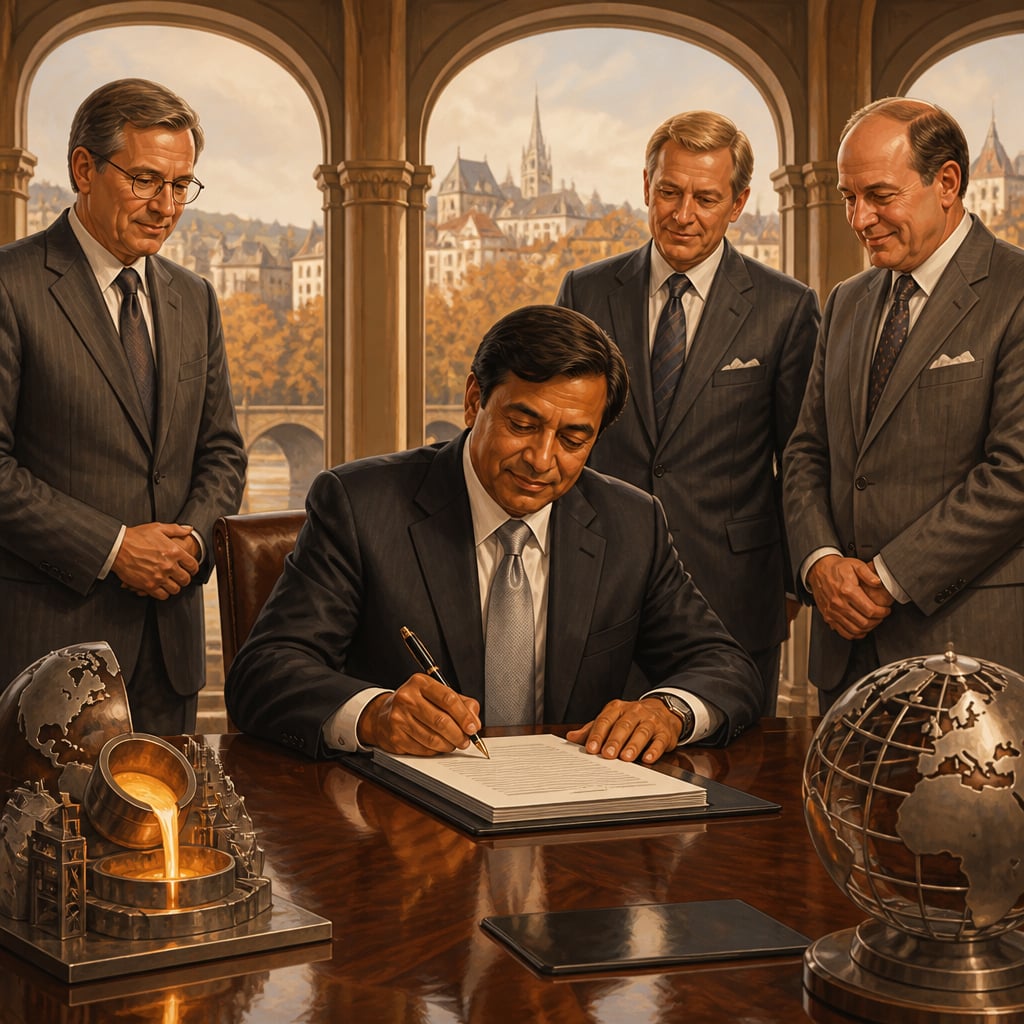
On October 25, 2006, the headlines read like fiction: 'Indian Steelmaker Wins Battle for Arcelor.' Lakshmi Mittal, a man born in Sadulpur, Rajasthan, a village with no running water, had just completed a hostile takeover of Arcelor, the world's largest steelmaker, headquartered in Luxembourg.
European executives had called the bid 'hostile,' 'unwanted,' and with barely concealed contempt, 'a monkey trying to buy a lion.' The French and Luxembourg governments had intervened to block it. The Arcelor board had called Mittal's company 'a company of Indians.'
Mittal won anyway. The combined ArcelorMittal became the world's largest steel company, and an Indian was its CEO.
This was the udyami-uday, the rise of the entrepreneur, that liberalization made possible. A generation that had survived the License Raj's restrictions now competed on global stages, buying companies that once would have been their customers.
The New Business Dharma: Wealth as Service
Indian business culture draws from dharmic traditions that frame wealth differently than Western capitalism.
The Bhagavad Gita teaches:
"योगस्थः कुरु कर्माणि सङ्गं त्यक्त्वा धनञ्जय" Yogasthah kuru karmani sangam tyaktva Dhananjaya "Established in yoga, perform actions abandoning attachment, O winner of wealth."
Krishna addresses Arjuna as 'Dhananjaya', winner of wealth, acknowledging that wealth acquisition can be dharmic. But the verse adds a crucial qualifier: act without attachment to results. Create wealth as service, not as personal accumulation.
The Arthashastra adds the practical dimension:
"अर्थस्य मूलमुद्यमः" Arthasya mulam udyamah "Enterprise is the root of wealth."
Kautilya celebrated enterprise (udyama) as the foundation of prosperity, not inheritance, not accident, but deliberate, intelligent effort. This ancient validation of entrepreneurship shaped Indian business families' self-understanding.
Portrait 1: Mukesh Ambani, The Digital Revolutionary
Mukesh Ambani inherited one of India's largest conglomerates, and transformed it.
When Dhirubhai Ambani died in 2002, Reliance was primarily a petrochemicals giant. Mukesh could have coasted on existing businesses. Instead, he bet everything on a vision that seemed fantastical: giving every Indian access to affordable digital connectivity.

Reliance Jio, launched in 2016, offered free voice calls forever and data at prices 90% below competitors. Analysts called it suicidal. How could a company give away its core product?
Ambani's logic was dharmic: create the ecosystem first, monetize later. By making data nearly free, Jio accelerated India's digital transformation by a decade. Within five years:
- India went from 155th globally in mobile data consumption to 1st
- 500 million Indians came online for the first time
- Digital payments (UPI) became ubiquitous
- The startup ecosystem exploded, built on Jio's infrastructure
The Bhagavata Purana teaches:
"यः स्वकर्मणा तमभ्यर्च्य सिद्धिं विन्दति मानवः" Yah svakarmana tam abhyarchya siddhim vindati manavah "By performing one's own work as worship, one attains perfection."
Ambani's work, connecting India, became a form of service. The wealth that followed was consequence, not goal.
Today, Reliance is India's most valuable company ($220 billion market cap). Jio has 450 million subscribers. And Mukesh Ambani is Asia's richest person. But more importantly: India is digitally transformed.
Portrait 2: Gautam Adani, The Infrastructure Builder
Gautam Adani's story is different, less about transformation, more about scale.
A college dropout who started as a diamond trader in Mumbai, Adani entered infrastructure in 1988 with a small PVC business. He saw what others missed: India's growth required ports, power, and logistics, unglamorous businesses that nobody wanted to build.

His first major break came in 1995 when he won the contract to develop Mundra Port in Gujarat. At the time, Mundra was a fishing village. Today, it's India's largest private port, handling 150 million tonnes of cargo annually.
Adani's philosophy reflects the Arthashastra's pragmatism:
"देशकालाविरुद्धेन धर्माद्यैः सिद्धिरिष्यते" Deshakalavviruddhena dharmadyaih siddhir ishyate "Success is achieved through dharma adapted to time and place."
Adani adapted to India's specific context: a country desperate for infrastructure but lacking the capacity to build it. He filled that gap, ports, airports, power plants, transmission lines, accumulating assets that are essential to India's growth.
By 2022, the Adani Group had become:
- India's largest private port operator
- Largest renewable energy producer
- Major airport operator (Mumbai, Lucknow, Ahmedabad)
- Largest private power transmission company
Critics point to his close government relationships. Supporters argue that infrastructure inherently requires government coordination. The debate reflects an ancient tension: how should enterprise relate to power?
The Global Champions: From Buyers to Acquirers
The Mittal, Ambani, and Adani stories represent a broader pattern: Indian business going global.
Pre-1991: Indian companies were mostly regional, family-owned, and focused on domestic markets. Global ambitions were impossible, the License Raj restricted everything from expansion to foreign exchange.
Post-1991: The doors opened. Indian companies could raise capital globally, acquire foreign firms, and compete internationally.
The transformation was dramatic:
| Company | Acquisition | Value | Significance |
|---|---|---|---|
| Tata Steel | Corus (UK/Dutch) | $12.2B | Indian steelmaker buys European giant |
| Tata Motors | Jaguar Land Rover | $2.3B | Indian firm acquires British icons |
| Hindalco | Novelis (US) | $6B | Birla aluminum goes global |
| Bharti Airtel | Zain Africa | $10.7B | Indian telecom expands to 17 African countries |
| ArcelorMittal | Arcelor | $38B | Largest steel company created |
These weren't just financial transactions, they were psychological transformations. The colonized became acquirers. The 'Third World' became investor.
The Dharma of Wealth: Ancient Questions, Modern Answers
Indian entrepreneurship raises fundamental questions about wealth and ethics.
The Isha Upanishad opens with a profound teaching:
"ईशावास्यमिदं सर्वं यत्किञ्च जगत्यां जगत्। तेन त्यक्तेन भुञ्जीथा मा गृधः कस्यस्विद्धनम्॥" Ishavasyam idam sarvam yat kincha jagatyam jagat, tena tyaktena bhunjitha ma gridhah kasya svid dhanam "All this, whatever exists in this changing universe, is pervaded by the Divine. Enjoy through renunciation. Do not covet anyone's wealth."
This verse contains India's distinctive approach to wealth:
- Everything belongs to the Divine, wealth is stewardship, not ownership
- Enjoy through renunciation, use wealth without being attached to it
- Do not covet, create value, don't just capture it
The great Indian business families, Tata, Birla, Godrej, have historically embodied this philosophy through philanthropy, trusts, and social institutions. The Tata Trusts own 66% of Tata Sons, meaning most of the conglomerate's profits flow to charitable purposes.
The newer entrepreneurs face the same question: what is wealth for?
- Azim Premji has pledged $21 billion to education
- Shiv Nadar has given $1 billion+ to schools and universities
- Ratan Tata donated his personal wealth to philanthropy
Mukesh Ambani and Gautam Adani are still building; their philanthropic legacies remain to be written. But the dharmic framework is clear: wealth creation is dharmic; wealth hoarding is not.
Modern Resonance: The Next Generation
The current era sees new patterns:
Startup India: A new generation of entrepreneurs, Bhavish Aggarwal (Ola), Vijay Shekhar Sharma (Paytm), Deepinder Goyal (Zomato), built companies from scratch rather than inheriting family businesses. They represent democratized entrepreneurship.
Tech Titans: Sundar Pichai (Google), Satya Nadella (Microsoft), Parag Agrawal (former Twitter), Indians lead the world's largest tech companies. The talent pipeline that began in IITs now reaches the apex of global business.
The Wealth Debate: As Indian billionaires multiply, questions sharpen. How should wealth be taxed? What obligations do billionaires have? How do we balance enterprise encouragement with inequality concerns?
These debates echo ancient ones. The Mahabharata's Shantiparva discusses the duties of the wealthy extensively: yes, create wealth, but remember that wealth brings responsibility.
Your Turn: The Entrepreneur Within
You don't need to build a billion-dollar company to be an udyami (entrepreneur).
The Arthashastra's principle, arthasya mulam udyamah (enterprise is the root of wealth), applies at every scale:
For Students: Your enterprise is skill-building. What capabilities are you developing that will create value for others?
For Professionals: Your enterprise is problem-solving. What problems can you solve that others will pay for?
For Everyone: The dharmic question isn't "how much can I earn?" but "what value can I create?" Wealth follows value; it doesn't precede it.
The Gita's wisdom applies: work without attachment to results. Focus on creating value; let wealth be the byproduct.
In the next lesson, we'll examine the crucial debate that accompanied India's growth: did liberalization benefit everyone, or did it create winners and losers? The samaaveshi vikasa (inclusive growth) question remains India's central challenge.
Peter Thiel in 'Zero to One' distinguishes companies that create new value versus those that merely capture existing value. The Gita's teaching aligns: focus on creation (karma), not capture (phala). The best companies obsess over customers (value creation), not competitors (value capture).
Indian philosophy offers a spiritual foundation for patient capitalism. If wealth is not the ultimate goal (moksha is), then entrepreneurs can take longer views. Jio's years of losses before profitability reflect this: build value first, capture later.
Reliance Jio invested Rs 3.5 lakh crore ($45 billion) before turning profitable. This patient capital approach, enabled by non-attachment to immediate returns, created $150+ billion in value.
The modern 'stakeholder capitalism' movement (championed by Klaus Schwab, Larry Fink) argues that companies serve multiple stakeholders, not just shareholders. The Isha Upanishad anticipated this by millennia: wealth serves the whole, not just the holder.
Indian business families traditionally understood wealth as trusteeship. The Tata Trusts (owning 66% of Tata Sons), the Birla temples and institutions, and modern philanthropists like Premji and Nadar reflect this: wealth cycles back to society.
Indian philanthropy has grown from $2 billion (2010) to $15 billion (2024). The top 10 Indian philanthropists have committed over $30 billion to charitable causes. The Isha Upanishad's teaching is being practiced at scale.
Key terms
- Udyami
- Entrepreneur; one who undertakes enterprise; someone who creates value through deliberate, intelligent effort
- Artha
- Wealth; material prosperity; one of the four purusharthas (life goals) in Hindu philosophy
- Dana
- Giving; charity; the practice of generosity as a spiritual and social duty
- Tyaga
- Renunciation; letting go; the practice of non-attachment to wealth and results
Key figures
Mukesh Ambani
Chairman and Managing Director, Reliance Industries
Gautam Adani
Founder and Chairman, Adani Group
Lakshmi Mittal
Executive Chairman, ArcelorMittal
Case studies
Lakshmi Mittal vs. Arcelor: When India Beat Europe
In January 2006, **Lakshmi Mittal** announced an unsolicited bid for Arcelor, the world's largest steel company. Arcelor was European-headquartered (Luxembourg), backed by European governments, and proud of its sophisticated operations. Mittal Steel, though larger by production volume, was seen as an upstart, an Indian-led company with operations in 'frontier' markets like Kazakhstan, Ukraine, and Indonesia. The reaction was fierce: - Arcelor's CEO Guy Dollé called Mittal's bid 'hostile' and compared the offer to 'a monkey trying to buy a lion' - The French government promised to block the deal - Luxembourg officials called for 'economic patriotism' - Arcelor's management sought 'white knight' alternatives Mittal responded with patient persistence. He improved his offer, addressed concerns about governance, and appealed directly to shareholders. His argument: this is about creating value, not nationality. The combined company would be the world's most efficient steel producer. Over six months, the battle played out publicly. European media portrayed it as an invasion; Indian media celebrated a native son challenging the colonial masters. The subtext was clear: could an Indian-led company really run a European industrial champion? On June 25, 2006, Arcelor's board finally recommended acceptance. The deal closed for €26.9 billion ($33.1 billion), the largest corporate takeover in the steel industry's history. ArcelorMittal was born, with Lakshmi Mittal as its CEO.
The Arcelor battle illustrates several dharmic principles: **Enterprise as Dharma (Udyama):** Mittal's persistence embodied the Arthashastra's teaching that enterprise is the root of wealth. He didn't inherit his position, he built it through decades of effort, starting from a single mill in Indonesia. **Non-Attachment to Results (Nishkama Karma):** Despite fierce opposition, Mittal maintained composure. He improved his offer, addressed concerns, and let the process unfold. His equanimity, treating success and failure equally, as the Gita counsels, was visible in his measured responses to personal attacks. **Stewardship Mindset:** Mittal's pitch wasn't 'I want to own Arcelor' but 'Together we can serve customers better.' He framed the acquisition as creating value for all stakeholders, employees, customers, shareholders, not as personal aggrandizement. **Overcoming Adharma:** The 'monkey' comment and 'economic patriotism' were forms of adharma, prejudice masquerading as principle. Mittal's response was to let performance speak: his company was better-run than Arcelor by most metrics. Merit ultimately overcame prejudice.
**Immediate Impact:** - ArcelorMittal became the world's largest steel company - Lakshmi Mittal became one of the world's richest people - The deal proved Indian companies could compete at the highest levels **Long-term Impact:** - ArcelorMittal remains a global steel leader (though with challenges from China) - Indian companies gained confidence for global acquisitions - Tata Steel's Corus acquisition, Hindalco's Novelis purchase, and others followed - The psychological barrier, 'Indians can't run global companies', was broken **Personal Legacy:** - Mittal has donated significantly to education (Cambridge, LBS) and other causes - His children work in the business, continuing the family tradition - The Sadulpur boy who became a global titan proved that enterprise transcends geography
Excellence transcends nationality. The market ultimately rewards value creation, not heritage. Mittal faced prejudice and nationalism, but shareholders chose returns over sentiment. The lesson for Indian entrepreneurs: compete on merit, maintain equanimity in the face of hostility, and let results speak.
Indian-origin CEOs now lead Google, Microsoft, IBM, Starbucks, Chanel, and dozens of Fortune 500 companies. The pattern Mittal pioneered, of Indian talent and capital competing at the highest global level and winning on merit, has become so common that it no longer makes headlines.
ArcelorMittal at acquisition (2006): 110 million tonnes of steel production. Mittal's personal net worth: $25 billion. The company that Europeans said an Indian couldn't run has been led by an Indian family for nearly two decades.
Historical context
The Age of Indian Global Enterprise (1991-present)
The License Raj had suppressed Indian enterprise for decades. Liberalization unleashed pent-up entrepreneurial energy. Business families that had survived through relationships and licenses now competed through capability. A new generation, Adani, startup founders, built from scratch without family advantages.
Chinese entrepreneurs built larger companies faster, aided by state support and a larger domestic market. Japanese conglomerates went global earlier. But Indian entrepreneurs operate in a democracy with free press and contentious politics, their success came despite constraints that their Asian peers didn't face.
Indian billionaires: 9 (1991) → 169 (2024). Combined wealth: $20 billion → $954 billion. India now has the third-largest billionaire population globally, after the US and China.
The rise of Indian enterprise matters beyond economics. It changes how India sees itself (from borrower to investor) and how the world sees India (from poor country to opportunity). The psychological transformation, believing Indians can lead global companies, enables the next generation to aim higher.
Reflection
- The Isha Upanishad teaches that all wealth is ultimately Divine, we are stewards, not owners. How does this perspective change your relationship with money and possessions? If you truly believed you were managing rather than owning your wealth, what would you do differently?
- The Arthashastra states that 'enterprise is the root of wealth.' What enterprise, what deliberate, intelligent effort, are you currently engaged in that might create wealth? If you're not actively building, what would it take to start? What's one concrete step you could take this week?