Sankat: The 1991 Balance of Payments Crisis

When India Had Fifteen Days Left

In July 1991, India's foreign reserves could cover only fifteen days of imports, the nation stood on the brink of sovereign default. This lesson explores how decades of fiscal imprudence led to crisis, and how one economist's steady hand averted catastrophe while laying the foundation for India's economic transformation.

The Gold That Flew to London
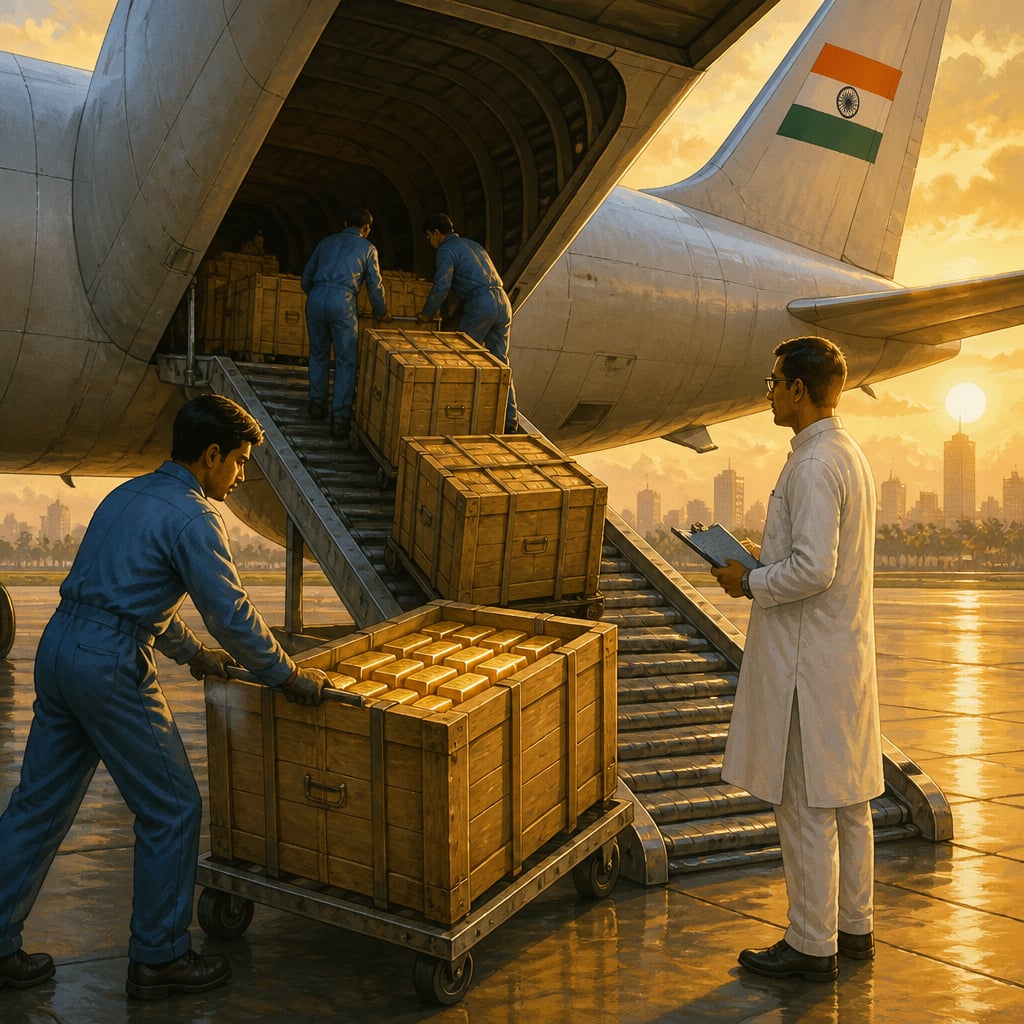
Gold loaded onto a cargo plane at Sahar Airport 1991

On July 4, 1991, a cargo plane took off from Mumbai's Sahar Airport carrying 47 tonnes of gold, India's sovereign reserve, bound for the Bank of England. The nation's finance minister, Yashwant Sinha, had just resigned. The ruling Congress government was in disarray. And India, the world's largest democracy, was about to default on its international debt obligations.

In the corridors of North Block, Manmohan Singh, a soft-spoken economist who had never contested an election, sat with a calculator, running the numbers again. Foreign exchange reserves: $1.2 billion. Import bill: $2.4 billion per month. At current levels, India had precisely fifteen days before it couldn't pay for essential imports like oil and food.

This was sankat, a Sanskrit word meaning crisis, but also carrying the deeper meaning of a 'narrowing passage.' The question wasn't whether India would face transformation; it was whether it would emerge stronger or shattered.

The Roots of Crisis: Four Decades of Fiscal Imprudence

How does the world's tenth-largest economy reach the brink of default? The answer lies in understanding kosha-niti, the ancient science of treasury management that India had abandoned.

Kautilya, writing in the 4th century BCE, was unequivocal about fiscal prudence:

"कोशमूलो हि दण्डः" Koshamulo hi dandah "The treasury is the foundation of state power."

For Kautilya, a depleted treasury wasn't merely an accounting problem, it was an existential threat. A king without reserves was a king without options, forced to accept whatever terms enemies or creditors demanded.

Post-independence India ignored this wisdom. The License Raj required government permission for everything from opening a factory to importing machinery. This bred corruption and stifled private enterprise. Worse, successive governments financed populist programs through borrowing rather than revenue.

By 1991, India's fiscal deficit had ballooned to 8.4% of GDP. The current account deficit, the gap between what India imported and exported, was 3.5% of GDP. When the Gulf War spiked oil prices and remittances from Gulf workers dried up, the fragile structure collapsed.

The Chanakya Niti had warned:

"अनागतविधाता च प्रत्युत्पन्नमतिस्तथा" Anagatvidhata cha pratyutpannamatistatha "The wise prepare for future troubles and respond skillfully when crisis arrives."

India had done neither. And now, the bill was due.

The Principle Revealed: Crisis as Teacher

When PM P.V. Narasimha Rao took office on June 21, 1991, he made an unusual choice for Finance Minister: Manmohan Singh, a career bureaucrat and economist who had never held elected office. In the Bhagavad Gita's terms, Rao was selecting his Arjuna, someone who would act decisively despite the enormity of the challenge.

Krishna's counsel to the hesitating Arjuna resonates:

"कर्मण्येवाधिकारस्ते मा फलेषु कदाचन" Karmanye vadhikaraste ma phaleshu kadachana "You have the right to action alone, not to its fruits."

Manmohan Singh's task was to act, immediately, decisively, without knowing whether the fruits would be political survival or electoral oblivion. On July 24, 1991, he rose in Parliament to deliver a budget that would change India forever.

The immediate crisis management was surgical:

But the deeper insight was philosophical. As Manmohan Singh told Parliament: "No power on earth can stop an idea whose time has come." The idea was simple: trust the Indian people more than the Indian government.

Global Perspectives on Crisis Economics

India's 1991 crisis wasn't unique. Similar debt spirals have toppled governments across the world, and economists have long debated how to respond.

Michel Camdessus (1933-2022), Managing Director of the IMF from 1987-2000, oversaw India's bailout. His institution's standard prescription, devaluation, austerity, privatization, was controversial. Critics called it "one-size-fits-all" medicine that ignored local conditions. But Camdessus argued that countries in crisis had no alternatives: "You cannot eat sovereignty."

Joseph Stiglitz (1943-present), Nobel laureate and former World Bank Chief Economist, later criticized IMF-style interventions in his book Globalization and Its Discontents. He argued that austerity during crisis deepens recession, and that countries need stimulus, not cuts. Yet even Stiglitz acknowledged that India's case was different, the reforms went beyond IMF conditions to genuinely liberalize the economy.

Dani Rodrik (1957-present), Harvard economist, offers a middle path. His research shows that successful reforms require "local ownership", they must be designed by domestic policymakers, not imposed from Washington. India's 1991 reforms worked precisely because Manmohan Singh and Narasimha Rao shaped them to Indian conditions.

Thinker Key Insight Indian Application
Michel Camdessus Crisis demands immediate action; delay is costlier than reform India's 18% devaluation was painful but necessary to restore confidence
Joseph Stiglitz Austerity can deepen crisis; protect the vulnerable India maintained food subsidies even while cutting elsewhere
Dani Rodrik Reforms work when locally owned Manmohan Singh crafted reforms to Indian conditions, not IMF templates

Modern Resonance: Sri Lanka's Warning, India's Wisdom

Thirty years later, India's neighbor provided a stark reminder of what might have been.

Empty fuel queue on a Colombo street April 2022

In April 2022, Sri Lanka defaulted on its sovereign debt, the first Asian nation to do so in decades. Protesters stormed the presidential palace. Prime Minister Mahinda Rajapaksa fled. The economy collapsed: inflation hit 70%, fuel queues stretched for miles, hospitals ran out of medicines.

The parallels to India 1991 were eerie: unsustainable borrowing, depleted reserves, a currency in freefall. But the outcomes were opposite. Why?

India's 1991 reforms had built structural resilience:

When COVID-19 struck in 2020, India faced a crisis as severe as 1991. But Finance Minister Nirmala Sitharaman responded from strength, not desperation. The government launched Atmanirbhar Bharat, a Rs 20 lakh crore ($260 billion) stimulus, without seeking IMF assistance or pledging gold reserves.

The contrast with Sri Lanka proves the Arthashastra's point: kosha (treasury) is the foundation of state power. A nation with reserves has options; a nation without reserves has only creditors.

Your Turn: Building Your Personal Kosha

You might think 1991 is ancient history. But the principle of kosha-niti applies at every scale.

Ask yourself: Do you have an emergency fund covering six months of expenses? When an unexpected bill arrives, a medical emergency, job loss, car repair, do you negotiate from strength or scramble for credit cards?

India learned in 1991 that reserves equal freedom. A nation with fifteen days of imports is a nation that accepts any terms. A nation with eleven months of reserves is a nation that walks away from bad deals.

The same applies to you. Build your personal kosha, not from fear, but from the dharmic understanding that capability enables choice.

In the next lesson, we meet the man who turned crisis into opportunity: P.V. Narasimha Rao, the reluctant reformer who changed India forever.

Foreign exchange reserves and sovereign creditworthiness

John Maynard Keynes advocated for 'liquidity preference', the value of holding cash reserves rather than fully deploying capital. Modern central banks maintain forex reserves as buffers against crisis.

The Arthashastra adds a moral dimension: reserves aren't just for bargaining power but for dharma, the ability to fulfill obligations to citizens without depending on foreign creditors. A nation that borrows to survive becomes a nation that serves its lenders.

India's forex reserves: $1.2 billion (1991) → $600+ billion (2024). Import cover: 15 days (1991) → 11+ months (2024). The 500x increase in reserves represents 30+ years of applied kosha-niti.

Decision-making under uncertainty; crisis management leadership

Herbert Simon's concept of 'bounded rationality' acknowledges that perfect information is impossible. Leaders must decide with incomplete data. The Gita's counsel predates this by millennia, act on duty, not on guaranteed outcomes.

Key terms

Kosha
Treasury; the accumulated reserves of wealth that enable state power and individual freedom
Sankat
Crisis; a narrowing passage; a moment of danger that also presents opportunity for transformation
Udarikaran
Liberalization; the opening up of an economy by reducing government controls and enabling private enterprise
Avamulyan
Devaluation; the deliberate reduction of a currency's value relative to other currencies

Key figures

Manmohan Singh

Finance Minister of India (1991-1996), later Prime Minister (2004-2014)

Narendra Modi

Prime Minister of India (2014-present)

Michel Camdessus

Managing Director of the International Monetary Fund (1987-2000)

Case studies

Sri Lanka 2022: When a Nation Ignores Kosha-Niti

In April 2022, Sri Lanka became the first Asian nation in decades to default on its sovereign debt. Foreign exchange reserves had fallen to $50 million, not enough to buy a week's worth of fuel. The rupee collapsed. Inflation hit 70%. Hospitals ran out of medicine, schools closed for lack of power, and fuel queues stretched for miles. The immediate trigger was COVID-19's impact on tourism (Sri Lanka's main forex earner). But the underlying cause was decades of fiscal imprudence: borrowing for prestigious but unproductive infrastructure (the Hambantota Port, built with Chinese loans, now leased to China for 99 years), populist tax cuts that slashed revenue, and foreign exchange controls that depleted reserves. In July 2022, protesters stormed President Gotabaya Rajapaksa's residence. He fled the country. The economy had collapsed so completely that the army had to distribute rice. An IMF bailout followed, but on terms far harsher than India had accepted in 1991.

Sri Lanka's crisis is a textbook violation of kosha-niti. The Arthashastra warns that a depleted treasury leaves the state powerless, unable to resist external pressure or fulfill obligations to citizens. Consider the contrast with India: - **1991 India**: Crisis hit when reserves fell to $1.2 billion (15 days of imports). Painful reforms followed, but sovereignty was preserved. - **2022 Sri Lanka**: Crisis hit when reserves fell to $50 million. The nation literally couldn't buy fuel. Sovereignty was compromised, Hambantota Port now belongs to China. The dharmic principle is clear: fiscal imprudence is not just bad economics, it is adharma. A government that depletes reserves to fund short-term popularity is betraying future generations. A nation that borrows for show projects while neglecting productive capacity is violating the trust of its people. India's post-1991 trajectory proves the alternative: build reserves, maintain fiscal discipline, engage the world from strength. By 2020, when COVID struck, India had $580 billion in reserves, and could launch a Rs 20 lakh crore stimulus without asking the IMF for permission.

Sri Lanka accepted an IMF bailout with harsh conditions: tax increases, spending cuts, privatization of state enterprises. The port built with Chinese loans is now Chinese territory in all but name. Recovery will take years, and a generation of Sri Lankans will bear the cost of fiscal imprudence they didn't choose. Meanwhile, India, which faced a similar crossroads in 1991, responded to COVID-19 from a position of strength. No gold pledged, no sovereignty compromised, no IMF conditions accepted. The difference? Thirty years of learning from sankat.

Kosha-niti is not abstract philosophy, it is the difference between nations that weather crises and nations that collapse. Sri Lanka 2022 is what India 1991 would have become without reform. The lesson for individuals is identical: build reserves before crisis, not during it.

Pakistan's repeated IMF bailouts (24 programs since 1958) and the debt crises in Ghana, Zambia, and Ethiopia illustrate that Sri Lanka's collapse was not unique. Nations that deplete reserves while borrowing for non-productive expenditure follow a predictable pattern that Kautilya's kosha-niti principles would have flagged early.

India's forex reserves grew from $1.2 billion (1991) to $600+ billion (2024), a 500x increase. Sri Lanka's reserves fell from $7.9 billion (2019) to $50 million (2022), a 99% collapse. The numbers tell the story of kosha-niti applied versus kosha-niti ignored.

Historical context

Post-Independence India: License Raj to Liberalization (1947-1991)

By 1991, India's economy was strangled by regulation. Starting a business required navigating dozens of permits. Import licenses created scarcity and corruption. The 'Hindu rate of growth' (3.5% annually) meant per-capita income barely rose. Meanwhile, the 'Asian Tigers' (South Korea, Taiwan, Singapore) had transformed themselves through export-oriented growth. India's crisis wasn't just about reserves, it was about a failed economic model.

India's 1991 crisis occurred during a wave of liberalizations worldwide. The Soviet Union collapsed, Eastern Europe opened to markets, China accelerated its reforms, and Latin America embraced the 'Washington Consensus.' India joined this global shift, but with distinctive features. Unlike shock therapy in Russia (which collapsed living standards), India's reforms were gradual. Unlike Latin American privatizations (often corrupt fire sales), India retained strategic sectors.

India's share of world GDP: 4.2% in 1991 → 7.3% in 2024. Per capita income: $304 in 1991 → $2,500 in 2024. The reforms triggered by crisis enabled the largest poverty reduction in human history.

Understanding 1991 is essential for understanding modern India. Every debate about economic policy, privatization, foreign investment, subsidies, fiscal deficit, traces back to the choices made during that crisis. The sankat of 1991 forced decisions that shaped the next three decades.

Reflection

More in Liberalization: The 1991 Revolution

All lessons in Liberalization: The 1991 Revolution · Viksit Bharat: India's Development Journey course