LPG: Liberalization, Privatization, Globalization

The Three Pillars of Transformation

Beyond the acronym, what did LPG actually change? This lesson unpacks the three pillars that dismantled the License Raj: liberalization freed entrepreneurs from bureaucratic control, privatization introduced competition and efficiency, and globalization connected India to world markets. Discover how these reforms transformed everyday economic life, and why debates about their scope continue today.

The Day the Inspector Stopped Mattering
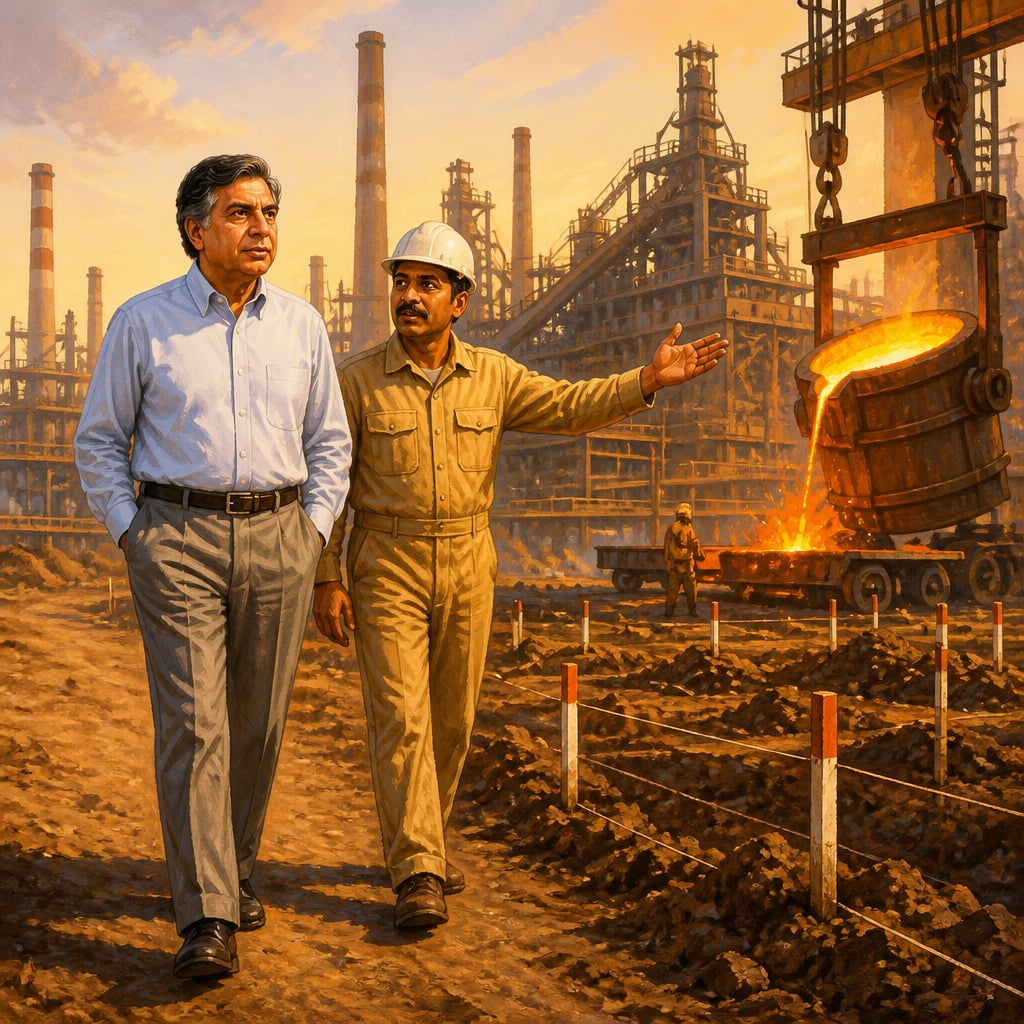
Ratan Tata at Tata Steel Jamshedpur expansion 1992

In 1990, Ratan Tata wanted to increase production at Tata Steel's Jamshedpur plant. He needed government permission. The application traveled through four ministries, required nineteen separate approvals, and took fourteen months. By the time clearance arrived, the market opportunity had vanished.

Two years later, in 1992, Tata decided to expand again. This time, he simply... did it. No inspector's permission. No ministerial clearance. No fourteen-month wait. The company analyzed the market, approved the investment internally, and began construction.

That shift, from permission-raj to decision-by-business, was the essence of the 1991 reforms. It wasn't just policy change; it was a fundamental rewiring of how India's economy functioned.

Understanding the Three Pillars

The acronym 'LPG' became shorthand for India's transformation. But what did each letter actually mean?

L: Liberalization - Setting Enterprise Free

The Panchatantra tells the story of a caged parrot who forgets how to fly. When finally released, it stays in the cage, freedom meaningless to one who no longer remembers it.

Indian business in 1991 was that parrot. The License Raj had conditioned entrepreneurs to seek permission rather than opportunity. Liberalization meant opening the cage:
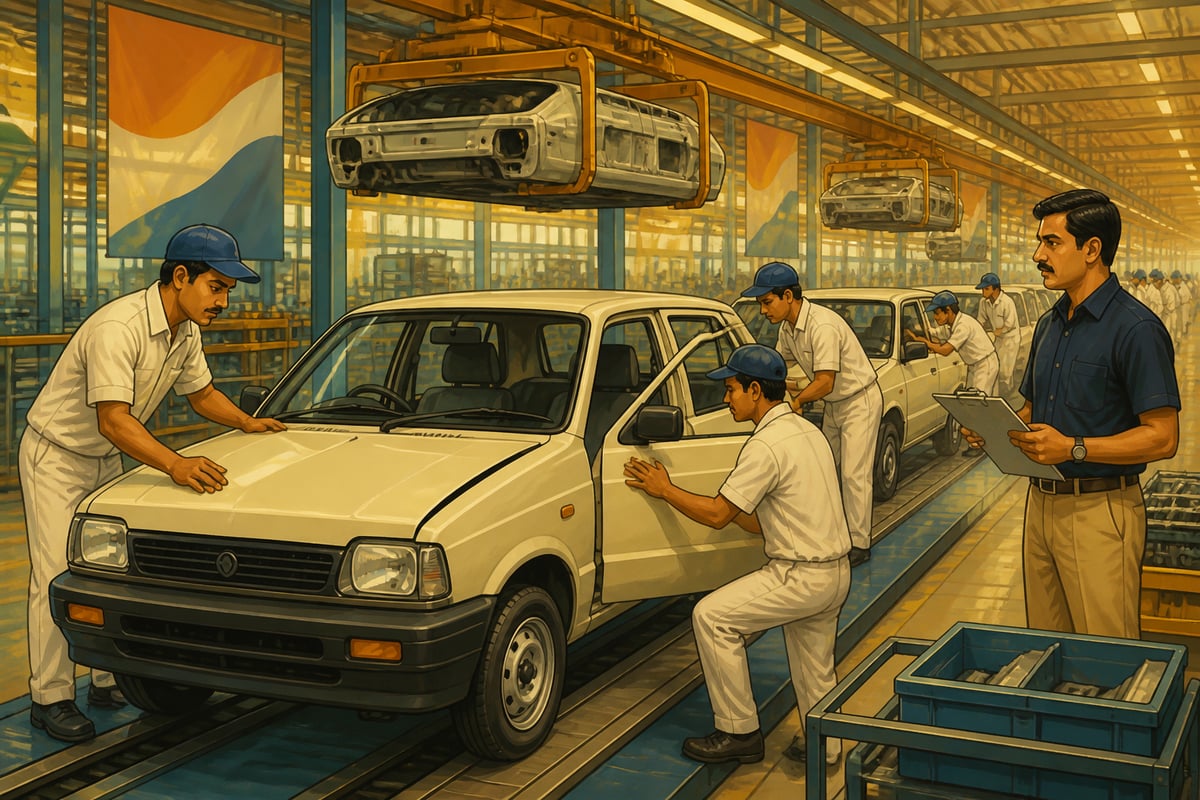
Maruti-Suzuki assembly line in Gurgaon mid-1990s

What Changed:

The Arthashastra had long recognized this principle:

"व्यापारं स्वतन्त्रं कुर्यात्" Vyapaaram svatantram kuryaat "Trade should be conducted freely."

Kautilya understood that excessive regulation strangled commerce. His regulations were targeted, quality standards, honest weights, fraud prevention, not permissions to produce. Liberalization returned India to this ancient wisdom.

P: Privatization - Introducing Competition

The Bhagavad Gita teaches that everyone has their svadharma, their own nature and calling:

"स्वधर्मे निधनं श्रेयः परधर्मो भयावहः" Svadharme nidhanam shreyah paradharmo bhayavahah "Better to die in one's own dharma than to live in another's."

Applied to economics: businesses should do what they do best. Government should govern; airlines should fly planes; steel makers should make steel. When government tried to run airlines, hotels, and bread factories, it performed none of these well, it was acting in paradharma (another's role).

Privatization (called 'disinvestment' to avoid ideological battles) meant:

What Changed:

G: Globalization - Connecting to the World

The Panchatantra also teaches: "He who stays home sees only his own courtyard; he who travels sees the world."

For four decades, India had chosen to see only its courtyard. Globalization meant:

Container ship loading at Nhava Sheva port

Trade Opening:

Foreign Investment:

Currency Convertibility:

Global Perspectives: The Intellectual Fathers

The LPG reforms didn't emerge from nowhere. They drew on two centuries of economic thinking.

Adam Smith (1723-1790), the Scottish philosopher, established the intellectual foundation in The Wealth of Nations (1776). His insight: when individuals pursue their own interest through voluntary exchange, an 'invisible hand' coordinates their actions for social benefit.

Smith wasn't against all government, he supported public goods, education, and infrastructure. But he argued that government should not direct production decisions: "It is not from the benevolence of the butcher, the brewer, or the baker that we expect our dinner, but from their regard to their own interest."

Milton Friedman (1912-2006), the American economist, updated Smith for the 20th century. His 1962 book Capitalism and Freedom argued that economic liberty and political liberty were inseparable. Friedman's influence shaped the 'Washington Consensus', the set of market-oriented policies that institutions like the IMF recommended.

Contrast with Indian Context:

Thinker Core Insight Indian Application
Adam Smith Markets coordinate better than planners License Raj's failure to allocate resources efficiently
Milton Friedman Economic freedom enables political freedom End of inspector-raj reduced corruption and increased citizen agency
Kautilya Regulate for quality, not quantity Replace production controls with consumer protection

Importantly, India didn't adopt Anglo-American capitalism wholesale. The reforms retained:

This was liberalization with Indian characteristics, market opening within a framework of social objectives.

What Actually Changed: Before and After

Aspect Pre-1991 Post-1991
Starting a business 80+ licenses, 2-3 years Registration in days (now hours online)
Importing machinery Banned or 150% tariff 10-15% tariff, freely available
Foreign investment Virtually banned Automatic approval up to 51%
Competing with PSU Illegal in reserved sectors Open competition
Exchange rate Government-fixed, multiple rates Market-determined, unified
Phone connection 10-year waitlist (BSNL monopoly) Available immediately (private operators)
Air travel Only Indian Airlines, Air India Dozens of carriers, competitive prices

The transformation wasn't instant. Growth accelerated gradually, from 3.5% ('Hindu rate') to 6% in the 1990s to 8%+ in the 2000s. But the direction was irreversible.

Modern Resonance: Completing the Reforms

By 2025, much of LPG is taken for granted. Young Indians don't remember waiting years for phone connections or needing licenses to produce biscuits. But debates continue about:

Unfinished Liberalization:

Privatization Debates:

Globalization Tensions:

Finance Minister Nirmala Sitharaman has continued the gradualist approach: pursuing reforms where politically feasible, waiting on others. The National Asset Monetization Pipeline (2021) aims to lease government assets worth Rs 6 lakh crore, a new form of privatization that avoids ownership transfer while introducing private efficiency.

Your Turn: The Freedom to Choose

The Panchatantra's caged parrot eventually learns to fly again, but only through practice.

The LPG reforms gave Indians economic freedom. But freedom is valuable only if exercised:

Kautilya's wisdom applies: "Trade should be conducted freely", but free trade requires free traders, people who understand and exercise their economic agency.

In the next lesson, we'll see how these reforms enabled India's most spectacular economic success: the IT revolution that made 'Bangalore' a global brand.

Adam Smith's concept of division of labor makes a similar point: specialization increases efficiency. Public choice economics (James Buchanan) extends this to institutions: government agencies face different incentives than businesses, making them suited for different functions.

The Gita's framing adds a moral dimension: acting outside your dharma isn't just inefficient, it's ethically problematic. Government officials running hotels aren't just inefficient, they're neglecting their actual duty (governance) while poorly performing someone else's.

Air India under government ownership: Lost Rs 70,000 crore over two decades. Under Tata (2022-present): Ordered 470 new aircraft, expanded routes, improved service. Same airline, different dharma of ownership.

David Ricardo's theory of comparative advantage (1817) makes a related point: nations should specialize in what they do relatively best. Michael Porter's competitive advantage framework (1985) extends this to companies.

The Panchatantra adds a moral dimension: claiming excellence you lack is a form of delusion (moha). Companies that prospered only through protection were living a lie. Globalization forced honesty, succeed genuinely or admit failure.

Infosys in 1991: $2 million revenue, domestic focus. Infosys in 2024: $18 billion revenue, 50+ countries. Globalization didn't destroy Indian companies, it revealed which ones had genuine excellence.

Key terms

License Raj
The system of industrial licensing that required government permission for most business activities; used pejoratively to describe bureaucratic control over economic life
Udarikaran
Liberalization; the removal of government controls on economic activity, allowing market forces to determine production and prices
Nijikarana
Privatization; the transfer of government-owned enterprises or activities to private ownership and management
Vaishvikaran
Globalization; the integration of national economies into the world economy through trade, investment, and movement of people and ideas

Key figures

Montek Singh Ahluwalia

Economic Advisor and architect of 1991 reforms

Adam Smith

Scottish philosopher and father of modern economics

Milton Friedman

American economist and Nobel laureate

Case studies

Maruti-Suzuki: How Liberalization Transformed Indian Automobiles

In 1983, Maruti Udyog Limited, a government company, entered a joint venture with Suzuki of Japan to produce small cars for India. At the time, Indian roads were dominated by the Ambassador and Premier Padmini, both based on 1950s designs unchanged for decades. The License Raj had frozen automotive innovation. The Maruti 800, launched in 1983, was revolutionary: reliable, fuel-efficient, and modern. By 1991, Maruti held 60% market share. But even Maruti was constrained: import duties made components expensive, foreign ownership was limited, and capacity expansion required government approval. The 1991 reforms changed everything: - Suzuki increased its stake from 26% to 54% (by 2013, to 56%) - Import tariffs on components dropped, enabling better technology - New competitors entered: Hyundai (1996), Honda, Toyota, Ford - Maruti could expand capacity without permission The company went from producing 100,000 cars in 1991 to over 2 million in 2024. More importantly, competition forced continuous improvement: new models, better quality, lower prices.

The Maruti story illustrates all three pillars of LPG: **Liberalization:** Before 1991, even Maruti needed government permission to expand. After 1991, business decisions were made by business managers. The company could respond to market demand rather than bureaucratic approval cycles. **Privatization:** Suzuki's increasing ownership stake aligned incentives. A government-owned Maruti might have resisted change; a Suzuki-controlled Maruti had to compete globally. The svadharma principle applied: let car companies, not bureaucrats, decide how to make cars. **Globalization:** Competition from Hyundai, Honda, and others forced Maruti to improve continuously. The Panchatantra's wisdom proved true: excellence that survives only in protection isn't genuine. Maruti had to become genuinely world-class. The dharmic insight: **competition is not cruelty, it's the discipline that produces genuine excellence**. Without Hyundai's entry in 1996, Maruti might have become another Ambassador, frozen in time, serving customers poorly while claiming success.

Maruti-Suzuki in 2024: - India's largest car manufacturer - 2+ million vehicles produced annually - Exports to 100+ countries - R&D center in India developing global platforms - Market share maintained despite intense competition The Indian automobile industry overall: - 4th largest in the world - $120 billion industry - 50 million jobs (direct and indirect) - Export hub for global manufacturers The transformation from Ambassador-era stagnation to global automotive hub took just three decades, enabled by the 1991 reforms.

Liberalization enables; competition refines; globalization tests. Maruti succeeded not despite competition but because of it. The reforms that allowed Hyundai to enter also forced Maruti to become genuinely excellent. Protection preserves mediocrity; competition creates champions.

India is now the world's third-largest automobile market and exports vehicles to over 100 countries. The Maruti-Suzuki story is a template being studied by African nations like Ethiopia and Rwanda as they attempt to build their own automotive industries through strategic joint ventures.

Maruti's productivity: 50 cars per employee in 1991 → 250 cars per employee in 2024. The same workers, the same factories, but freed from permission-raj and subjected to competitive pressure, productivity increased 5x.

Historical context

The Global Liberalization Wave (1978-2000)

The License Raj had created a peculiar economy: artificial scarcity created by regulation, 'shortage economy' psychology, and business success determined by government connections rather than customer service. The 1991 reforms fundamentally rewired incentives: businesses now succeeded by serving customers, not cultivating bureaucrats.

India's gradualist approach contrasted with Russia's 'shock therapy' (rapid, simultaneous reforms that caused economic collapse) and China's authoritarian liberalization (economic freedom without political freedom). India chose a middle path: significant reform but phased implementation, maintaining democratic accountability throughout.

Impact of LPG: GDP growth averaged 3.5% from 1950-1990 ('Hindu rate of growth'), 6% from 1990-2000, and 8%+ from 2000-2010. Per capita income: $304 (1991) → $2,500 (2024). The reforms enabled the fastest poverty reduction in Indian history.

Understanding LPG is essential because debates about its scope continue today. Every policy discussion, labor reform, agricultural markets, foreign investment, privatization, is a continuation of the 1991 conversation. Knowing what LPG actually meant helps evaluate contemporary policy debates.

Reflection

More in Liberalization: The 1991 Revolution

All lessons in Liberalization: The 1991 Revolution · Viksit Bharat: India's Development Journey course