Samaaveshi Vikasa: The Inclusive Growth Debate

Did Everyone Benefit?

India's GDP soared after 1991, but did everyone gain? As billionaires multiplied, 300 million remained poor. This lesson explores the great debate between economists who prioritize growth (Bhagwati, Panagariya) and those who emphasize distribution (Sen, Drèze), and examines India's innovative attempts, like the JAM Trinity, to make growth work for all.

The Two Indias
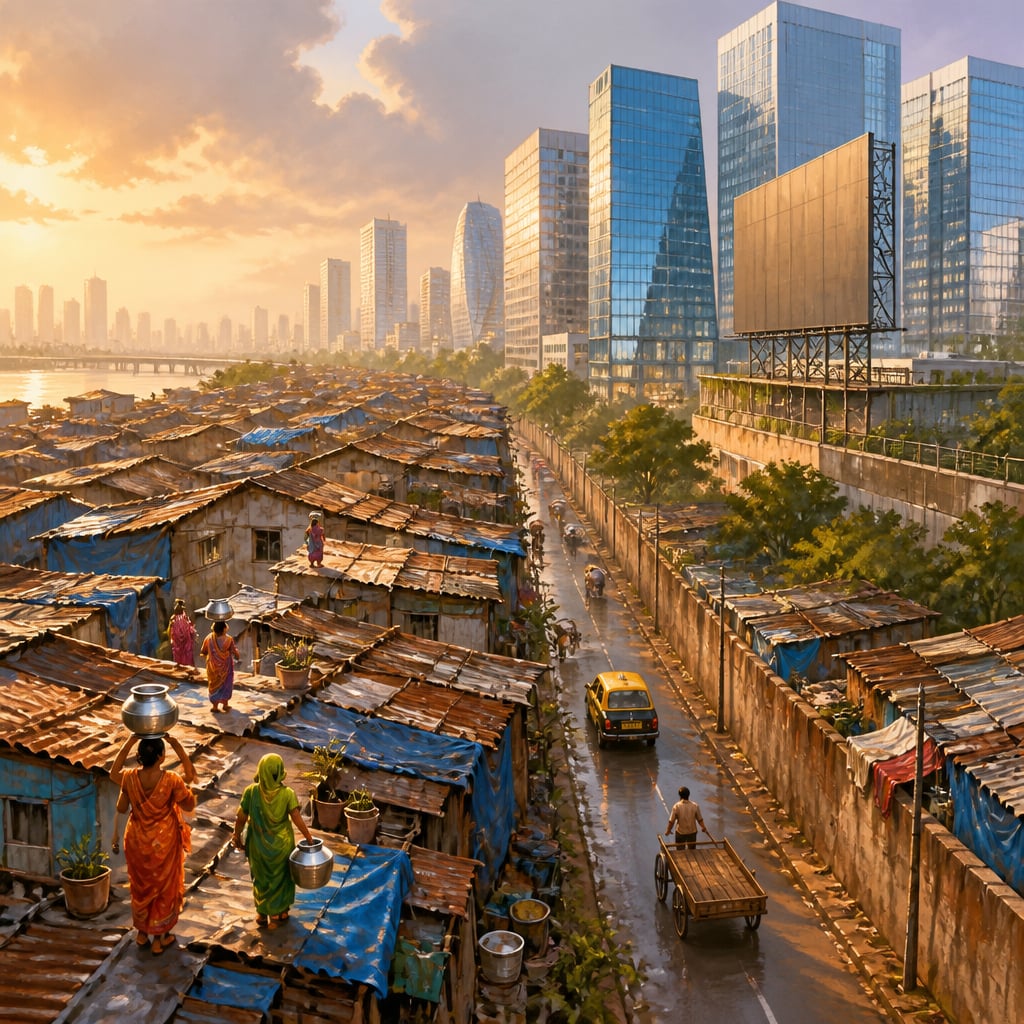
BKC office towers rising behind Dharavi rooftops in Mumbai

In 2011, two of India's most celebrated economists published competing visions for the nation's future.

Jagdish Bhagwati and Arvind Panagariya argued in Why Growth Matters that India's path to prosperity lay in accelerating market reforms. Growth, they insisted, was the only way to generate the resources needed for poverty reduction. "Redistribution of a small pie leaves everyone hungry."

Amartya Sen and Jean Drèze countered in An Uncertain Glory that growth without social investment was hollow. What good was GDP growth if half the population remained malnourished, uneducated, and excluded? India had achieved 'growth without development', impressive statistics that masked continuing human misery.

This debate, samaaveshi vikasa (inclusive growth) versus growth-first, remains India's central economic controversy. And it has deep roots in dharmic thought.

The Dharmic Framework: The King's Duty

Ancient Indian texts were clear: the ruler's primary duty was the welfare of all subjects, especially the vulnerable.

The Arthashastra states:

"प्रजासुखे सुखं राज्ञः प्रजानां च हिते हितम्" Prajaasukhe sukham raajnah prajaanaam cha hite hitam "In the happiness of the people lies the king's happiness; in their welfare, his welfare."

Kautilya didn't leave this as abstract principle. He specified that the state should maintain kosha (treasury) precisely to fund welfare: orphanages, support for the disabled, relief during famines. The strong state existed to protect the weak.

The Manusmriti reinforces this through the concept of danda (righteous governance):

"अदण्ड्यान् दण्डयेद्यो हि दण्ड्याँश्चैव न दण्डयेत्। स राजा दण्डमादाय सह तेनैव नश्यति॥" Adandyan dandayed yo hi dandyaamshchaiva na dandayet, sa raaja dandamaadaaya saha tenaiva nashyati "The king who punishes those who deserve no punishment, and fails to punish those who deserve it, brings destruction upon himself."

Extending this to economics: the state that burdens the poor while letting the wealthy escape obligations commits adharma. Taxation without corresponding welfare is exploitation, not governance.

The Bhagavad Gita adds the perspective of action for universal welfare:

"लोकसंग्रहमेवापि सम्पश्यन्कर्तुमर्हसि" Lokasangraham eva api sampashyan kartum arhasi "You should act for the welfare of the world."

Krishna counsels that the wise act not for personal benefit but for lokasangraha, the welfare of all beings. Applied to economic policy: growth that benefits only some while excluding others violates this dharmic principle.

The Great Debate: Growth vs. Distribution

The Bhagwati-Panagariya Position: Growth First

Jagdish Bhagwati (Columbia University) and Arvind Panagariya (former NITI Aayog Vice Chairman) argue that India's primary problem is insufficient growth, not maldistribution.

Their logic:

  1. You cannot redistribute what doesn't exist. India was too poor in 1991 for redistribution to matter. A bigger pie was needed.
  2. Growth creates jobs. The best anti-poverty program is employment. Market growth generates the jobs that lift people out of poverty.
  3. Growth funds welfare. Tax revenue from growth enables government spending on health, education, and infrastructure.
  4. Track record: India's poverty rate fell faster after 1991 (from 45% to 21%) than in the four decades before.

Bhagwati's famous phrase: "Growth is not a sufficient condition for poverty reduction, but it is a necessary condition."

The Sen-Drèze Position: Capabilities First

Amartya Sen (Nobel laureate, Harvard) and Jean Drèze (economist-activist) counter that growth without human development is hollow.

Their logic:

  1. Growth for whom? If growth benefits only the top 10%, it doesn't help the poor. India's growth has been relatively 'jobless', capital-intensive rather than labor-intensive.
  2. Capabilities matter more than income. What matters is not GDP but whether people can live healthy, educated, dignified lives. India's social indicators (nutrition, education, health) lag countries with lower GDP.
  3. The Bangladesh comparison: Bangladesh, with lower GDP per capita than India, has better health and education outcomes. Growth isn't everything.
  4. Public investment is essential. Markets alone won't provide education, healthcare, and nutrition to the poor. Active government intervention is needed.

Sen's capability approach: "Development is freedom, the expansion of human capabilities to live lives people have reason to value."

Aspect Bhagwati-Panagariya Sen-Drèze
Priority Economic growth Human development
Mechanism Markets create opportunity Public investment creates capability
Role of state Enable growth, reduce barriers Provide education, health, nutrition
Key metric GDP growth rate Human Development Index
Success example Gujarat's growth model Kerala's social development

What Actually Happened? The Evidence

The data tell a complex story that neither side fully captures.

Poverty Reduction: Success

Inequality: Concerning

Social Indicators: Mixed

The honest answer: both sides are partially right. Growth was necessary, without it, poverty reduction was impossible. But growth alone was insufficient, active intervention was needed to ensure benefits reached the excluded.

The Innovation: JAM Trinity

India's response to the inclusive growth challenge has been distinctively innovative: using technology to solve problems that traditional welfare couldn't.

Rural woman receiving a Direct Benefit Transfer on her phone

JAM = Jan Dhan + Aadhaar + Mobile

Jan Dhan Yojana (2014): Universal bank accounts for every Indian. 520 million accounts opened, the largest financial inclusion program in history.

Aadhaar (2009-present): Biometric identity for 1.4 billion people. Enables targeted delivery of benefits without leakage.

Mobile: 800 million smartphone users. Creates the infrastructure for digital services delivery.

The combination enables Direct Benefit Transfer (DBT): government payments go directly to beneficiaries' bank accounts, bypassing the corruption that plagued earlier welfare schemes.

Impact of JAM:

The dharmic insight: technology as an instrument of raja-dharma. What Kautilya envisioned, the state protecting the vulnerable, is now possible at scale through digital infrastructure.

Modern Resonance: The Path Forward

The inclusive growth debate has evolved:

Current Consensus:

Policy Innovations:

India is experimenting with a model that neither pure market capitalism nor traditional socialism attempted: growth-enabled, technology-delivered, universal basic services.

The Philosophical Resolution

Perhaps the debate itself reflects a false dichotomy.

The Arthashastra's vision was never growth OR distribution, it was growth FOR distribution. Kautilya wanted a strong economy precisely because only a prosperous state could fulfill its dharmic obligations to citizens.

Prajaasukhe sukham raajnah, the ruler's happiness lies in the people's happiness. This isn't welfare versus growth; it's welfare THROUGH growth, and growth FOR welfare.

The JAM Trinity embodies this synthesis: market-driven growth funds digital infrastructure that enables universal welfare delivery. Technology bridges the gap that ideology couldn't.

Your Turn: The Smallest Person Test

Mahatma Gandhi writing the talisman of the smallest person

Gandhi proposed the Talisman: whenever in doubt, recall the face of the poorest person you've seen and ask whether your action will be of any use to them.

Apply this to economic debates:

The dharmic test isn't GDP growth alone, it's whether the antya jana (last person) benefits. Inclusive growth isn't charity; it's the fulfillment of raja-dharma, the state's fundamental obligation.

In the final lesson, we'll look at how these debates apply to India's 2047 vision: what must be done to make 'Viksit Bharat' a reality for all Indians, not just some?

John Rawls' 'veil of ignorance' thought experiment leads to similar conclusions: if you didn't know your position in society, you'd design institutions that protect the worst-off. Kautilya's raja-dharma anticipates this, the ruler must act as if the poorest citizen's welfare is his own.

The dharmic framing adds motivation: serving others isn't just pragmatic but spiritually significant. Raja-dharma is a path to moksha when performed with the right attitude. This can inspire genuine commitment, not just strategic calculation.

India's political stability despite massive inequality partly reflects welfare programs that create minimum floors. Free food rations reached 800 million during COVID, an application of raja-dharma that prevented social collapse.

The concept of 'externalities' in economics captures a similar idea: actions have effects beyond the immediate parties. Policy should internalize externalities, make actors bear the full costs and benefits of their choices. Lokasangraha requires considering all effects, not just private gains.

Lokasangraha goes beyond externalities to motivation. It's not just that you should consider social effects, it's that your primary goal should be social benefit. This reframes the entire purpose of economic activity.

CSR legislation (Companies Act 2013) requires large companies to spend 2% of profits on social welfare. This is a weak institutional form of lokasangraha, mandating that business consider social benefit, not just profit.

Key terms

Samaaveshi Vikasa
Inclusive growth; economic development that benefits all sections of society, not just the already-privileged
Raja-dharma
The duties of the ruler; the moral and practical obligations of governance; the dharma specific to those who hold power
Lokasangraha
Welfare of the world; acting for universal benefit; maintaining social and cosmic order through righteous action
Antyodaya
The rise of the last person; development that prioritizes those at the very bottom of society

Key figures

Amartya Sen

नोबल पुरस्कार विजेता अर्थशास्त्री, विकास के दार्शनिक

Jagdish Bhagwati

कोलंबिया विश्वविद्यालय के अर्थशास्त्री, व्यापार के सिद्धांतकार

Jean Drèze

विकास अर्थशास्त्री और कार्यकर्ता

Arvind Panagariya

अर्थशास्त्री, नीति आयोग के पहले उपाध्यक्ष (2015-2017)

Case studies

JAM Trinity: Technology as Raja-Dharma

By 2010, India's welfare system faced a fundamental problem: benefits weren't reaching beneficiaries. The Public Distribution System (PDS) for food had 40-50% leakage, nearly half of subsidized grain disappeared before reaching the poor. Fuel subsidies mostly benefited the middle class. Scholarship programs had ghost beneficiaries. NREGA wage payments were delayed for months, with middlemen extracting cuts. The diagnosis was clear: the delivery mechanism was broken. India was spending on welfare but couldn't ensure it reached the intended recipients. The solution emerged through three separate innovations that converged: **Aadhaar (2009):** A unique biometric ID for every resident. Originally conceived for security, it became the key to solving identity fraud. With Aadhaar, you could verify that the person claiming benefits was actually the intended beneficiary. **Jan Dhan Yojana (2014):** Universal bank accounts for every Indian. In 18 months, 520 million accounts were opened, the largest financial inclusion program in history. Now everyone had somewhere to receive money. **Mobile (ongoing):** By 2024, 800 million Indians have smartphones. This created the delivery infrastructure for digital services. **JAM = Jan Dhan + Aadhaar + Mobile** The integration of these three enabled Direct Benefit Transfer (DBT): government sends money directly to beneficiaries' Aadhaar-linked bank accounts, bypassing the entire chain of intermediaries who previously extracted their cuts.

JAM represents technology in service of raja-dharma. **The Problem:** Traditional welfare systems violated Manu's danda principle. They 'punished' the poor (through leakage, delays, humiliation) while 'sparing' the corrupt (middlemen extracted without consequence). The system was adharmic. **The Solution:** DBT creates what Kautilya would recognize as good governance: direct, accountable, verifiable. The state's duty to protect the vulnerable can now be fulfilled without corruption rendering it hollow. **The Arthashastra Vision:** Kautilya specified that the state should maintain systems to support orphans, the disabled, and the destitute. He didn't have digital technology, but he understood the principle. JAM is Kautilyan welfare with 21st-century tools. **Lokasangraha:** JAM benefits all by reducing the fiscal drain of corruption. Money saved from leakage can fund additional welfare. The beneficiary receives more; the taxpayer pays less; only the corrupt lose. This is lokasangraha, universal benefit. **Critique:** Some argue JAM creates surveillance risks, excludes those without Aadhaar/phones, and replaces in-kind transfers (food) with cash that can be misused. These are valid concerns requiring ongoing refinement, dharma requires constant attention to implementation, not just intent.

**Scale:** - 520 million Jan Dhan accounts (zero-balance accounts for the unbanked) - 1.4 billion Aadhaar numbers issued (world's largest biometric database) - Rs 2.25 lakh crore ($27 billion) transferred via DBT annually - 300+ schemes now use DBT **Impact:** - Estimated Rs 2.7 lakh crore ($33 billion) saved from reduced leakage since 2014 - LPG subsidy: went from untargeted (benefiting all) to targeted (benefiting only those who need it) - NREGA wage payments: from months-delayed to direct-to-account - COVID relief: reached 800 million people within weeks, would have been impossible without JAM infrastructure **Global Recognition:** - World Bank: 'India's DBT is perhaps the world's most sophisticated social protection delivery system' - IMF: highlighted as model for other developing countries - Being studied/adapted by other nations

Technology can solve problems that ideology couldn't. The growth-vs-distribution debate assumed you had to choose. JAM showed that with proper infrastructure, you can grow the economy AND ensure benefits reach the bottom. Raja-dharma in the digital age doesn't require trade-offs, it requires innovation.

India's UPI processed over 14 billion transactions in a single month (December 2024), making it the world's most active real-time payment system. Countries from Singapore to France are adopting UPI-based models, proving that digital public infrastructure built for inclusion can leapfrog developed-world systems.

Pre-JAM leakage in PDS: 40-50%. Post-JAM (in reformed states): under 10%. The difference is the difference between a welfare system that works and one that doesn't.

Historical context

The Inclusive Growth Debate (1991-present)

India's inclusive growth challenge is uniquely severe: the largest absolute number of poor people in the world (even as poverty rates fall), massive regional variation (Kerala vs. Bihar), and persistent social exclusion (caste, gender). No other country faces this combination at India's scale.

China reduced poverty faster but with authoritarian methods. Brazil's Bolsa Familia pioneered conditional cash transfers. Nordic countries built universal welfare states. India is experimenting with a new model: universal basic services delivered through digital infrastructure in a democratic context.

India's poverty reduction: 45% (1993) → 21% (2011) → estimated 10-12% (2024). This represents 400+ million people lifted above poverty, the largest poverty reduction in human history, though hundreds of millions still remain vulnerable.

The inclusive growth debate isn't academic, it determines whether India's development benefits all citizens or creates a two-tier society. The choices made now will shape whether 'Viksit Bharat 2047' means prosperity for all or just for some.

Reflection

More in Liberalization: The 1991 Revolution

All lessons in Liberalization: The 1991 Revolution · Viksit Bharat: India's Development Journey course