IT Kranti: The Services Revolution
How India Became the World's Back Office
In 1991, India was known for snake charmers and poverty. By 2000, 'Bangalore' had become a global brand synonymous with software excellence. This lesson explores how liberalization, talent, and one calendar bug (Y2K) transformed India from agricultural backwater to IT superpower, and what this reveals about the power of knowledge in the modern economy.
The Rice Trader's Son Who Built an Empire
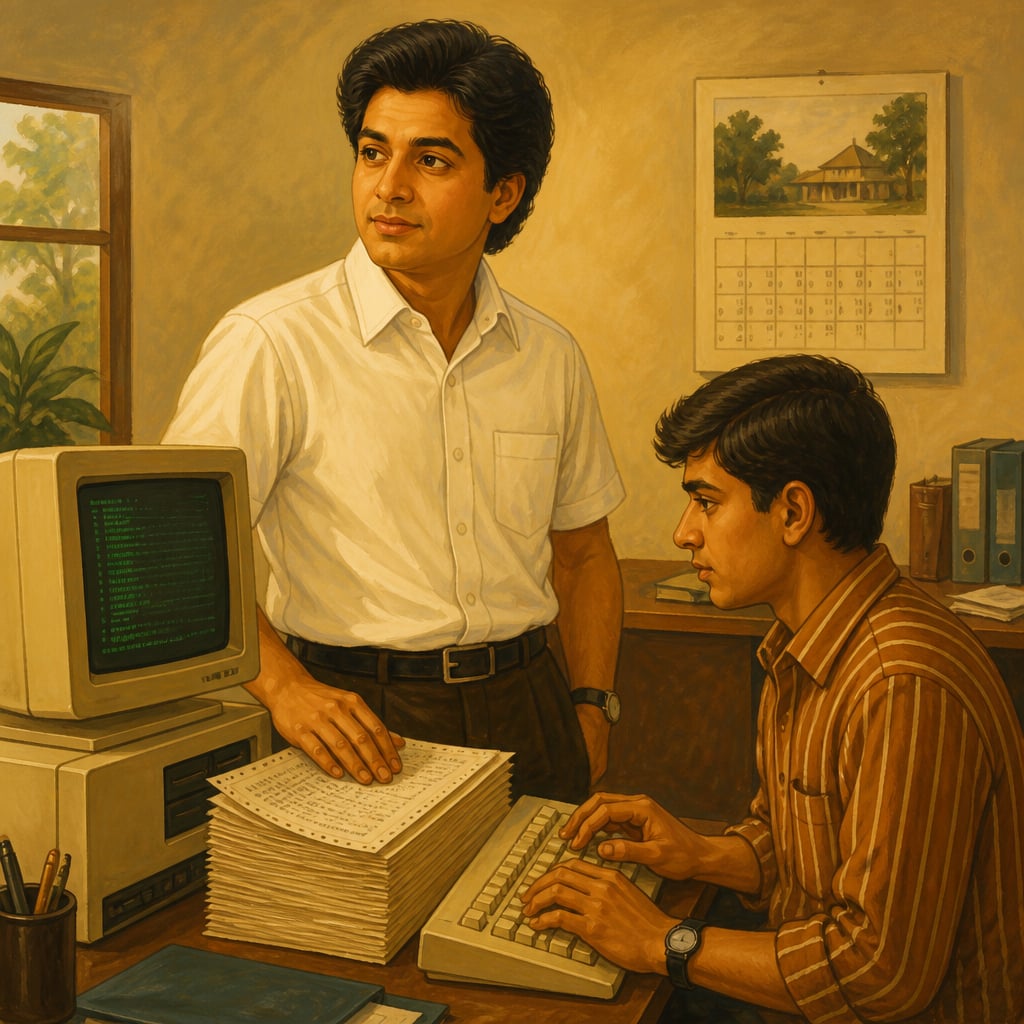
In 1966, Azim Premji was a 21-year-old engineering student at Stanford when his father died suddenly. He rushed home to Bombay to take over the family business: Western Indian Vegetable Products Limited, a cooking oil company.
It was an unlikely starting point for what would become India's third-largest IT company. But Premji saw something others missed. In the 1970s, IBM was expelled from India for refusing to dilute its stake to 40%. Most saw this as India's loss. Premji saw it as opportunity.
He pivoted his vegetable oil company into computing. The company, renamed Wipro, began making minicomputers, then software. By 1991, when liberalization opened India's doors, Premji was ready.
This is the story of IT Kranti, the knowledge revolution that transformed India's economy and global image, proving that a nation's greatest resource isn't what lies beneath its soil, but what resides between its citizens' ears.
The Foundations: Why India Was Ready
India's IT success wasn't accidental. It grew from deep roots.
Ancient Tradition of Knowledge Work
The Upanishads established knowledge as the supreme value:
"विद्या ददाति विनयम्" Vidya dadati vinayam "Knowledge gives humility."
This wasn't just philosophy, it shaped social organization. For millennia, India honored the vidvan (learned person). Brahminical tradition, whatever its flaws, created cultures of learning that persisted. When modern education arrived, Indians took to it with cultural familiarity.
The IIT System
Nehru's establishment of the Indian Institutes of Technology (1951 onwards) created a pipeline of world-class engineering talent. By 1991, India was producing more engineers annually than any country except the Soviet Union. Most couldn't find jobs matching their skills, the License Raj had no use for them.
Libalization changed this. Suddenly, these engineers had somewhere to go.
English Language Advantage
British colonialism left a bitter legacy, but also English. In a globalizing world, India's millions of English speakers became an asset. They could communicate directly with American and British clients, read technical documentation, and integrate into global teams.
Bhartrihari's ancient insight proved prescient:
"विद्या नाम नरस्य रूपमधिकं प्रच्छन्नगुप्तं धनम्" Vidya nama narasya rupam adhikam prachchhanna guptam dhanam "Knowledge is a person's greatest ornament, a hidden treasure that cannot be stolen."
India's hidden treasure, its educated workforce, was about to be discovered by the world.
The Pioneer: Shiv Nadar and the HCL Story
Shiv Nadar took a different path than Premji. A DCM engineer, he left his job in 1976 to start Microcomp with five friends and Rs 1.87 lakh borrowed from their families. They began in a cramped Delhi office, assembling calculators.
Nadar's breakthrough came from understanding a fundamental truth that Thiruvalluvar had articulated centuries earlier:
"கற்றதனால் ஆய பயன்என்கொல் வாலறிவன் நற்றாள் தொழாअर् एनिन्" Katrrathanal aaya payanenkol vaalariivan nattral thozhaar enin "What is the purpose of learning if it doesn't lead to wisdom and action?"
Nadar's learning wasn't academic, it was applied. HCL (Hindustan Computers Limited) didn't just assemble computers; it developed original products. In 1978, HCL created India's first indigenous microcomputer. In 1983, it networked India's first local area network.
By 1991, HCL was ready to pivot to software services. When liberalization opened the doors, HCL walked through them, into American banks, European manufacturers, and eventually every continent.
The Catalyst: Y2K and India's Moment

The Y2K problem was simple to explain, terrifying to contemplate, and massively expensive to fix.
In the 1960s-80s, programmers had saved memory by storing years as two digits: '85' instead of '1985.' This meant that on January 1, 2000, computers might interpret '00' as 1900, potentially crashing banking systems, power grids, and air traffic control.
Fixing Y2K required examining millions of lines of old code, written in languages like COBOL that American programmers had forgotten. The work was tedious, time-critical, and required armies of coders.
India had exactly what Y2K demanded:
- Abundant English-speaking programmers (IITs, RECs, and engineering colleges)
- Low costs (Indian salaries were 1/10th of American equivalents)
- Time zone advantage (work continued while Americans slept)
- Familiarity with legacy systems (Indian companies had maintained old codebases)
Between 1997 and 1999, Indian IT companies grew explosively. Infosys revenues jumped from $100 million to $500 million. TCS, Wipro, and HCL experienced similar growth. The Y2K crisis became India's opportunity.
More importantly, Y2K introduced Indian IT companies to global clients. Once American banks discovered that Indian programmers could handle complex systems, they kept coming back, for application development, maintenance, and eventually digital transformation.
Global Perspectives: The Knowledge Economy
Peter Drucker (1909-2005), the management theorist, had predicted this shift. In his 1959 book Landmarks of Tomorrow, Drucker coined the term 'knowledge worker.' His insight: in the emerging economy, the means of production wouldn't be factories but minds.
Drucker's prediction proved exactly right for India. The country lacked capital, infrastructure, and manufacturing capacity. But it had knowledge workers, millions of them, eager for opportunity.
Michael Porter (1947-present), Harvard's strategy professor, analyzed India's IT success through his competitive advantage framework. India's advantage wasn't cheap labor alone, China had that too. It was the cluster effect: Bangalore's concentration of IT companies, engineering colleges, and supporting services created an ecosystem that reinforced itself.
| Thinker | Key Insight | India IT Application |
|---|---|---|
| Peter Drucker | Knowledge workers are the new means of production | India's educated workforce became its competitive advantage |
| Michael Porter | Clusters create self-reinforcing competitive advantage | Bangalore became a global IT hub through agglomeration |
| Thiruvalluvar | Learning must lead to wisdom and action | Indian engineers combined theoretical knowledge with practical application |
The Transformation: From Poverty to Possibility
The IT revolution transformed more than India's economy, it transformed India's self-image.
Before IT (1980s):
- India known for: Poverty, snake charmers, spiritual mysticism
- Global perception: Third-world, backward, hopeless
- Brain drain: Best students left for the US and never returned
After IT (2000s):
- India known for: Software, IT services, technical excellence
- Global perception: Rising power, talented workforce, opportunity
- Brain circulation: Professionals moved between India and abroad
The numbers tell the story:
- IT industry revenue: $150 million (1991) → $245 billion (2024)
- IT employment: 50,000 (1991) → 5.4 million (2024)
- IT exports: Nearly zero (1991) → $199 billion (2024)
But the cultural shift mattered more than the economic statistics. For the first time since independence, young Indians could aspire to world-class careers without leaving India. The Infosys and Wipro campuses, with their gleaming buildings, international standards, and stock options, showed what Indian enterprise could achieve.
Modern Resonance: From Services to Products to AI
The IT industry continues to evolve:
Services → Products: Indian companies are moving from doing outsourced work to building original products. Zoho, Freshworks, and dozens of SaaS companies now sell globally.

IT → Digital Public Infrastructure: India Stack (Aadhaar, UPI, DigiLocker) shows Indian technology serving Indians first, then the world. UPI now processes 12 billion transactions monthly, more than all US card transactions combined.
Services → AI: The next frontier. India's IT workforce must now learn to work with AI, not compete against it. Companies like TCS and Infosys are retraining millions.
Azim Premji, now 79, has pledged 67% of his Wipro shares, worth $21 billion, to charity. Shiv Nadar has given away over $1 billion to education. The IT revolution's wealth is cycling back into the knowledge system that created it.
Your Turn: Knowledge as Capital
The IT revolution offers a personal lesson: in the knowledge economy, your mind is your means of production.
The Upanishads knew this:
"सा विद्या या विमुक्तये" Sa vidya ya vimuktaye "That is knowledge which liberates."
Knowledge liberates, from poverty, from dependence, from limited options. The millions of Indians who built IT careers weren't born with advantages. They invested in learning, developed skills, and created value.
Ask yourself:
- What knowledge are you building that others will value?
- Are you learning for credentials or for capability?
- How are you staying relevant as technology changes?
Bhartrihari's wisdom echoes: knowledge is "hidden treasure that cannot be stolen." Unlike physical assets, knowledge compounds. The more you learn, the more you can learn. The IT revolution proved this at national scale.
In the next lesson, we'll meet the entrepreneurs who rode the liberalization wave beyond IT, the Udyami-Uday, the rise of Indian business leaders who took Indian brands global.
Gary Becker's human capital theory (Nobel Prize 1992) formalized this insight: investments in education and training increase individual productivity and earnings. Becker proved empirically what Bhartrihari knew intuitively.
The Indian tradition adds a deeper dimension: knowledge isn't just economically valuable, it's spiritually liberating. This motivates learning beyond mere career advancement, creating deeper commitment to mastery.
Return on education in India: An IIT graduate's starting salary averages Rs 15-20 lakh; average graduate salary is Rs 3-4 lakh. The 'hidden treasure' of IIT education yields 4-5x returns immediately, compounding over a career.
David Kolb's 'experiential learning' theory (1984) makes a similar point: learning occurs through a cycle of experience, reflection, conceptualization, and experimentation. Thiruvalluvar anticipated this by emphasizing that learning must translate to action.
Indian engineering education combined theoretical rigor (IIT entrance exams) with practical application (industry projects, internships). This balance, neither pure theory nor mere vocational training, created versatile engineers valued globally.
India produces 1.5 million engineering graduates annually. Those from rigorous programs (IITs, NITs, top private colleges) command 5-10x salaries of others. The difference: thorough learning, not just credentials.
Key terms
- Vidya
- Knowledge; learning; the understanding that liberates and creates capability
- Suchana Praudyogiki
- Information Technology; the application of computing and telecommunications to process and transmit information
- Bahya Srota
- Outsourcing; obtaining services from external sources, typically in other countries
- Jnana Arthavyavastha
- Knowledge economy; an economy where knowledge and intellectual capability are primary sources of value creation
Key figures
Azim Premji
Chairman of Wipro (1966-2019), philanthropist
Shiv Nadar
Founder and Chairman Emeritus of HCL Technologies
Peter Drucker
Management theorist and author
Case studies
Y2K: The Bug That Made India a Superpower
In the 1960s-80s, computer memory was expensive. Programmers saved space by storing years as two digits: '85' instead of '1985.' This seemed harmless, until people realized that on January 1, 2000, computers might interpret '00' as 1900. The Y2K problem (also called the 'Millennium Bug') threatened catastrophe: banking systems might fail, power grids could crash, air traffic control might malfunction. Every large organization had millions of lines of code to examine and fix. The challenge was massive: - Billions of lines of code in COBOL, FORTRAN, and other legacy languages - Tight deadline (December 31, 1999 was non-negotiable) - Shortage of programmers who knew old languages - American programmer salaries of $50-100/hour made comprehensive fixes prohibitively expensive India had exactly what Y2K required: - Thousands of programmers trained in COBOL and legacy systems (Indian companies maintained old codebases that American firms had abandoned) - English-speaking workforce that could communicate with US clients - Rates of $15-20/hour (vs. $50-100 in the US) - 12-hour time difference enabling round-the-clock work Indian IT companies, TCS, Infosys, Wipro, HCL, mobilized armies of programmers. They combed through code, identified date-sensitive logic, and made fixes. By late 1999, India had become the world's Y2K remediation center.
Y2K illustrates several dharmic principles: **Opportunity in Crisis (Sankat as Opportunity):** What Americans saw as a problem, Indians saw as opportunity. The crisis created demand; Indian preparation (trained engineers, English capability) met it. **Knowledge as Wealth:** India lacked capital for manufacturing. But it had the 'hidden treasure' of educated workers. Y2K proved Bhartrihari's point: knowledge is wealth that cannot be stolen, but can be sold. **Thorough Learning Applied:** The engineers who fixed Y2K had learned COBOL thoroughly, even when it seemed obsolete. Thiruvalluvar's counsel, 'learn thoroughly what ought to be learned', paid off when that 'obsolete' knowledge became desperately valuable. **Service as Path to Partnership:** Indians began as 'body shops' doing tedious remediation. But Y2K built relationships. Clients who trusted Indian firms for Y2K kept coming back for application development, then digital transformation. Service became partnership.
Y2K's immediate impact: - Indian IT revenue doubled from 1997-1999 - Hundreds of Indian companies entered global markets - Tens of thousands of programmers gained international experience Y2K's lasting impact: - Established India as a credible IT destination - Built client relationships that continued for decades - Created the 'global delivery model' (work follows the sun) - Proved that knowledge work could be done anywhere January 1, 2000 passed without major incidents. The Y2K bug was fixed, largely by Indian programmers working in offices from Bangalore to Chennai to Hyderabad. India had arrived on the global IT stage.
Opportunity favors the prepared. India's IT infrastructure, IITs, engineering colleges, English education, was built for decades before Y2K created demand. When the moment came, India was ready. The lesson for individuals: build capabilities before you need them, because you never know when crisis will create opportunity.
India's IT industry now faces a similar inflection point with AI. Just as Y2K created unexpected demand for Indian programmers, the global AI talent shortage is creating new opportunities. Whether India captures this wave depends on the same factors: prepared talent, cost advantage, and willingness to seize the moment.
Y2K spending globally: $300-600 billion. India's share: estimated $5-7 billion in contract value, the seed money that launched a $245 billion industry.
Historical context
India's IT Revolution (1984-2010)
India's IT success was not inevitable. Other developing countries had engineers and low costs. India's advantage came from the combination: English language, IIT-quality education, liberalization timing, and entrepreneurs like Premji and Nadar who saw opportunity early.
China's economy grew faster than India's in manufacturing. But India carved a distinctive niche in services, IT, BPO, and later, software products. The two giants took different paths to development, proving that there is no single model for economic transformation.
India's IT industry: $150 million revenue (1991) → $245 billion (2024). Employment: 50,000 (1991) → 5.4 million direct + 20 million indirect (2024). The sector now contributes ~8% of GDP.
The IT revolution proved that knowledge-based development is possible, that a nation can transform through human capital rather than natural resources or manufacturing. This insight shapes India's approach to AI, digital public infrastructure, and education today.
Reflection
- Bhartrihari calls knowledge 'hidden treasure that cannot be stolen.' What knowledge or skills do you possess that are truly portable, valuable regardless of employer, location, or circumstance? What knowledge have you acquired that is actually dependent on your current context and might not transfer?
- Y2K created opportunity for those who had built relevant capabilities in advance. What emerging technologies or skills might create similar opportunities in the next decade? What specific learning investment would you make today to be prepared when opportunity arrives?