The 'Hindu Rate' Myth: Socialist Stagnation Explained
Correcting a Misleading Narrative
The term 'Hindu Rate of Growth' falsely implies that Hinduism caused India's economic stagnation. This lesson corrects that narrative: the slow growth was caused by socialist policies, not Hindu culture. In fact, India's dharmic economic traditions, as seen in the Arthashastra and thriving merchant communities, are distinctly pro-trade and pro-wealth. The real culprit was the Nehruvian Rate of Growth.
A Name That Libels a Civilization
In 1978, economist Raj Krishna coined a term that would shape how the world understood India's economic failure: the "Hindu Rate of Growth."
The phrase was catchy. It stuck. For decades, commentators used it to explain why India grew at a sluggish 3.5% while Asian Tigers raced ahead at 9%. The implication was clear: something about Hinduism, its fatalism, its other-worldliness, its caste system, was holding India back.
This was a lie. A well-intentioned lie, perhaps, but a lie nonetheless.
India's slow growth had nothing to do with Hinduism. It had everything to do with socialism. The policies that strangled India's economy, License Raj, import substitution, public sector monopolies, price controls, were imported from Fabian Britain and Soviet Russia. They had no roots in Hindu tradition.
In fact, India's dharmic economic traditions are distinctly pro-trade, pro-wealth, and pro-enterprise. The Arthashastra reads like a free-market manifesto. The Marwari and Gujarati merchant communities built trading empires across continents. Before socialism, India was not poor, it was the world's largest economy.
This lesson sets the record straight. The correct term is not "Hindu Rate of Growth." It is the Nehruvian Rate of Growth, or better yet, the License Raj Rate of Stagnation.
The Man Who Saw It Coming
When P.C. Mahalanobis presented his Second Five Year Plan to the Panel of Economists in 1955, nearly all endorsed it. Central planning was the consensus. Heavy industry was the future. The state would lead.
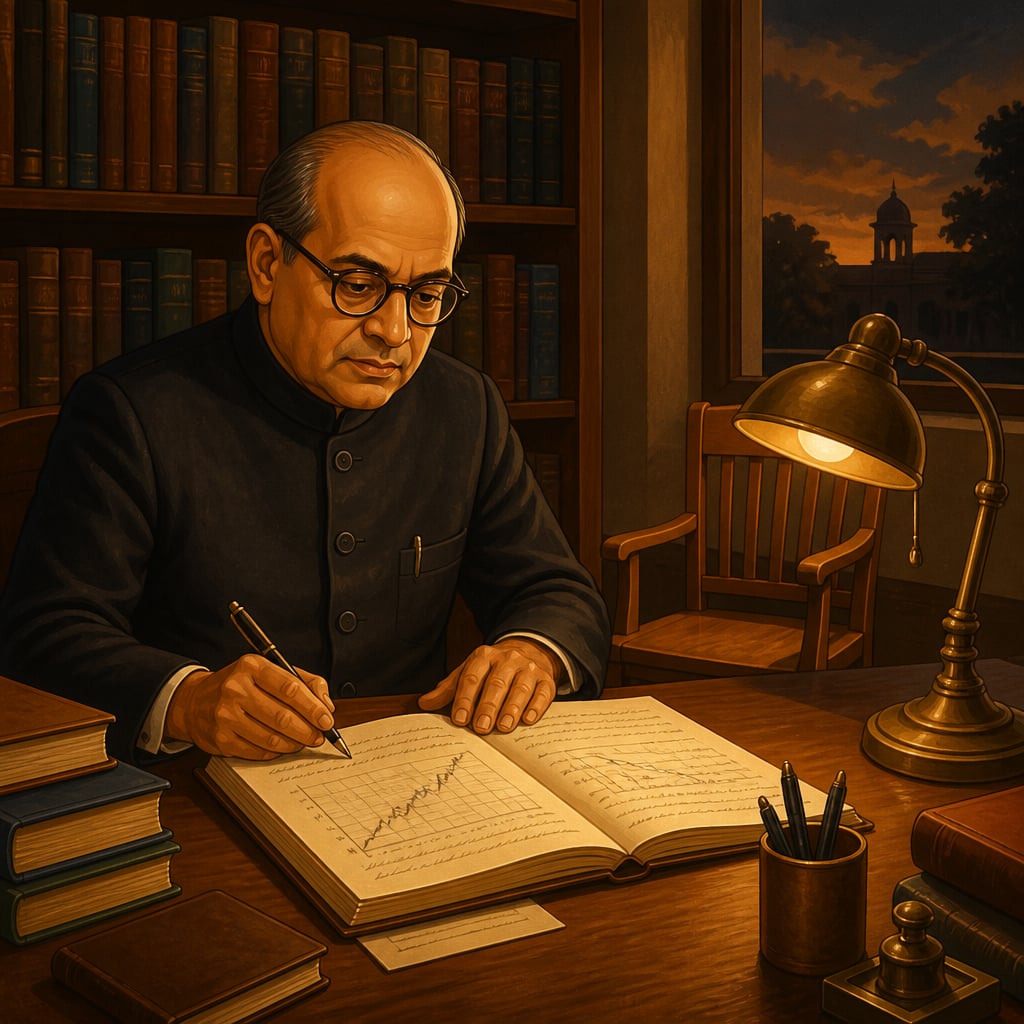
One man dissented: B.R. Shenoy.
Bengaluru Raghunath Shenoy was a professor at the University of Gujarat, trained in the Austrian School of economics. While others saw Soviet success, Shenoy saw Soviet propaganda. While others trusted planners, Shenoy trusted markets.
His dissenting note to the Second Plan was prophetic:
"The Plan will lead to inflationary pressures, balance of payments crises, and chronic shortages. Controls will breed more controls. Black markets will flourish. Growth will stagnate. The public sector will absorb resources without producing commensurate output."
Every prediction came true. Every single one.
But Shenoy was ignored. His dissent was buried in annexures. The planning establishment treated him as an eccentric, a crank, a man who didn't understand "modern economics." He died in 1978, the same year Raj Krishna coined the phrase that blamed Hinduism for what Shenoy had correctly blamed on socialism.
The Arithmetic of Stagnation
Let's be precise about what "slow growth" meant:
| Period | India GDP Growth | South Korea | Taiwan | Singapore |
|---|---|---|---|---|
| 1960-70 | 3.7% | 8.6% | 9.2% | 8.8% |
| 1970-80 | 3.0% | 9.5% | 9.7% | 8.5% |
| 1980-91 | 5.5% | 9.4% | 7.6% | 6.6% |
India's per capita income grew at barely 1% annually for three decades, just enough to match population growth. Living standards stagnated. A child born in 1960 was almost as poor at 30 as at birth.
Meanwhile, South Korea, which was poorer than India in 1960, became a developed nation. Taiwan and Singapore transformed from third-world to first-world in one generation. They did it not with planning but with trade, private enterprise, and global integration.
The difference was not culture. Koreans and Taiwanese were not "less Hindu" than Indians, they were not Hindu at all. The difference was policy. India chose socialism; they chose markets. India suffered; they prospered.
The Human Face of Shortage: Waiting for Everything
Statistics are abstract. The reality of License Raj was visceral.

The Bajaj Scooter Wait: In the 1980s, getting a Bajaj Chetak scooter required booking and waiting, often for 7 to 10 years. Families would book scooters when children were born, hoping they'd arrive by the time the child could ride. Some never came.
The Telephone Wait: Getting a landline telephone could take 15 to 20 years. Connections were so scarce that having a phone was a status symbol. Politicians used phone allocations as patronage. Businesses died waiting for dial tones.
The LPG Wait: Cooking gas cylinders required registration with the government. Waiting lists stretched for years. Millions of households cooked on kerosene stoves, inefficient, dangerous, polluting, because the planned economy couldn't produce enough gas.
The Car Lottery: There were only two cars available: the Ambassador and the Premier Padmini. Neither changed models for decades. Getting one required waiting, bribing, or knowing someone. Even government officials waited years for "official" vehicle allocations.
This was the "Hindu Rate of Growth" in practice: not a civilizational curse but a policy-induced shortage economy. Every product that required a license to produce became scarce. Every scarcity created black markets, corruption, and suffering.
The Dharmic Economic Tradition
The cruel irony of the "Hindu Rate" label is that Hindu economic tradition is the opposite of what caused stagnation.

The Arthashastra, Kautilya's treatise on statecraft from the 4th century BCE, reads like a manual for market economics:
- Private property protection: The king must protect private wealth, not confiscate it
- Trade promotion: Commerce is the source of royal revenue; the state should facilitate, not obstruct
- Limited regulation: Excessive controls burden merchants and reduce prosperity
- Competition: Multiple suppliers benefit consumers; monopolies harm them
कोशमूलो हि दण्डः। "The treasury is the foundation of the state's power.", Arthashastra 2.8.1
Kautilya understood that wealth creation, not wealth redistribution, is the basis of national strength.
The Marwari and Gujarati Traditions: India's merchant communities, Marwaris, Gujaratis, Chettiars, Sindhis, built trading empires spanning Asia, Africa, and the Middle East. They financed the British Raj's wars. They built India's first modern industries. They did this not despite Hindu values but because of them.
The concept of dharmic artha, ethical wealth creation as a life goal, sanctified commerce. The Vaishya varna was not a degraded status but a vital function. Trade was punya, meritorious.
Pre-Colonial Prosperity: India was the world's largest economy for most of recorded history, comprising 25% of global GDP in 1700. This prosperity was not despite Hinduism but under Hindu rule. The decline came with colonialism and, later, socialism.
The Real Culprit: Socialist Policies
If not Hinduism, what caused the stagnation?
1. Industrial Licensing: Starting a business required dozens of permits. Expanding production needed government approval. The capacity to produce scooters was decided not by consumer demand but by bureaucrats in Delhi.
2. Import Substitution: India tried to produce everything domestically, even when imports were cheaper and better. The result: shoddy products at inflated prices, with no incentive to improve.
3. Public Sector Monopolies: Airlines, banks, insurance, telecom, all were nationalized. Competition was illegal. Efficiency was optional. Losses were covered by taxpayers.
4. Price Controls: The government fixed prices for food, fuel, and essentials. Below-market prices meant producers had no incentive to supply. Shortages became chronic.
5. Foreign Exchange Controls: Travelling abroad required permission. Importing required licenses. The rupee was not convertible. India cut itself off from the world economy.
6. Nationalization Waves: In 1969 and 1980, banks were nationalized. In 1973, coal was nationalized. One by one, productive private enterprises were converted into loss-making public units.
These policies came from Fabian Britain, Soviet Russia, and American development economics, not from the Vedas, the Upanishads, or any Hindu text. Socialism was the foreign import; market economics is indigenous to India.
Sanjeev Sanyal: Correcting the Narrative
Sanjeev Sanyal, economist and Principal Economic Adviser to the Government of India (2017-2022), has been a leading voice in correcting the "Hindu Rate" narrative.
In books like The Indian Renaissance and The Ocean of Churn, Sanyal documents India's pre-colonial economic dynamism, the trade networks, the manufacturing prowess, the financial systems. He shows that Indian poverty is not ancient but recent and policy-induced.
"The term 'Hindu Rate of Growth' is not just inaccurate, it is a slur. It implies that our culture is the problem. In fact, our culture built one of the greatest trading civilizations in history. The problem was the specific set of policies we adopted after 1947.", Sanjeev Sanyal
Sanyal proposes alternative terms: "Nehruvian Rate of Growth" or "License Raj Stagnation." These correctly identify the cause without libeling a civilization.
The Global Perspective: W. Arthur Lewis and Development Theory
W. Arthur Lewis (1915-1991), the Nobel laureate from St. Lucia, developed the "dual economy" model that explained how poor countries could grow rapidly by shifting labor from low-productivity agriculture to high-productivity industry.
Lewis's insight: growth requires structural transformation, moving workers and capital from farms to factories. But this transformation requires markets. It requires prices that signal where resources should go. It requires entrepreneurs who respond to incentives.
India's License Raj blocked every mechanism Lewis identified. Labor couldn't move freely (rigid labor laws). Capital couldn't flow to profitable sectors (industrial licensing). Prices didn't signal scarcity (price controls). Entrepreneurs were supplicants, not decision-makers.
Lewis understood that development is not about planning, it is about liberating economic energy. India's policies did the opposite. They suppressed the very forces that produce growth.
The 2025 Reality: Breaking Free
India today grows at 6-7%, double the "Hindu Rate." What changed? Not Hinduism. Policies changed.
- Industrial licensing: Abolished (1991)
- Import restrictions: Largely removed (1991-2000s)
- Public sector monopolies: Broken (airlines, telecom, banking)
- Price controls: Reduced (except political sacred cows like fertilizer)
- Foreign exchange: Rupee partially convertible (1994)
The liberalization of 1991 proved definitively that India's growth potential was always there, it was just suppressed by socialist policies. When the policies changed, growth exploded.
Today's India has:
- Jio: Telecom revolution impossible under BSNL monopoly
- Maruti: World-class cars impossible under Ambassador protection
- UPI: Digital payments impossible under nationalized banking
- Startup ecosystem: 100+ unicorns impossible under License Raj
These achievements required no change in Hindu dharma. They required only the removal of socialist barriers.
Your Turn: Language Shapes Perception
The "Hindu Rate of Growth" is not just a historical curiosity. It shapes how people think about India and Hinduism today.
When foreigners hear the phrase, they assume something about Hindu culture is anti-growth. When Indians internalize it, they develop cultural shame. When policymakers use it, they miss the real lesson: that policies matter more than culture.
Your assignment: whenever you hear the phrase "Hindu Rate of Growth," correct it. Explain that:
- The slow growth was caused by socialist policies, not Hindu culture
- Hindu economic tradition is pro-trade and pro-wealth
- India's pre-colonial economy was the world's largest
- When policies changed in 1991, growth surged, same Hindus, different policies
The correct term is the Nehruvian Rate of Growth or License Raj Stagnation. Use it. Spread it. Correct the narrative.
Hinduism did not fail India. Socialism did.
Supply-side economics and wealth creation as the basis of national power
Adam Smith's 'Wealth of Nations' makes similar arguments: national prosperity comes from free trade and the invisible hand, not from state direction. Kautilya preceded Smith by two millennia.
The Arthashastra provides a thoroughly Indian, dharmic foundation for market economics. It shows that free trade and private property are not 'Western' imports but ancient Indian principles.
When India followed Arthashastra-style policies (pre-1947 business houses), it created world-class enterprises. When it followed socialist policies, it created shortages and stagnation.
The role of entrepreneurs and merchants in economic development
Joseph Schumpeter's 'entrepreneur as creative destroyer' and Hernando de Soto's work on property rights echo these ancient Indian insights about the merchant's role in prosperity.
Key terms
- Nehruvādi Vikās Dar
- The Nehruvian Rate of Growth - a more accurate term for India's slow growth (3.5%) during 1950-1991, correctly attributing it to Nehru's socialist policies rather than Hindu culture.
- Abhāva Arthavyavasthā
- Shortage Economy - an economic system characterized by chronic scarcities of consumer goods, long waiting lists, and black markets, typically caused by price controls and production restrictions.
- Vāṇik Patha
- The Merchant's Path - ancient trade routes and more broadly, the path of commerce as the means to national prosperity.
- Anujñā Rāj
- License Raj - the system of government permits, licenses, and approvals required for nearly all economic activity in India from 1947-1991.
Key figures
B.R. Shenoy (Bengaluru Raghunath Shenoy)
Economist, professor at Gujarat University, lone dissenter to India's Second Five Year Plan
Sanjeev Sanyal
Economist, historian, Principal Economic Adviser to Government of India (2017-2022), member of Prime Minister's Economic Advisory Council
W. Arthur Lewis
Nobel Prize-winning economist (1979), developed the 'dual economy' model of development
Case studies
Waiting for Everything: Scooter, Phone, Gas
Ramesh was born in Delhi in 1975. When he was born, his father booked a Bajaj Chetak scooter. It arrived when Ramesh was 8 years old, in 1983. The family celebrated as if they had won a lottery. The telephone was harder. Ramesh's father applied for a landline in 1970. The connection came in 1988, 18 years later. During those years, the family used a neighbor's phone for emergencies, paying them for the privilege. Having a phone number was a status symbol; neighbors knew the Sharmas had 'arrived' when they got their connection. LPG gas was slightly better, only a 3-year wait. Until then, Ramesh's mother cooked on a kerosene stove. The kitchen was blackened with soot. She developed respiratory problems. When the gas cylinder finally arrived, it felt like moving from the middle ages to the modern era. This was not poverty, Ramesh's father was a bank officer, middle class by any definition. This was **policy**: the planned economy simply could not produce enough scooters, telephones, or gas cylinders. Every one of these products was subject to industrial licensing. Production was 'planned,' not driven by demand. The plan was wrong. Meanwhile, in Seoul, Ramesh's counterpart, a boy born the same year, grew up in a household that bought a car in 1980, had a phone by 1982, and used gas from birth. Korea was poorer than India in 1960. It was richer by 1975 and vastly richer by 1990. The difference was not culture, it was policy.
The shortage economy violated dharmic principles: **Artha denied**: The four purushaarthas include artha, legitimate material prosperity. When policy makes it impossible to obtain basic goods, it blocks this life goal. **Svadharma suppressed**: Producers who could have made scooters, phones, and gas cylinders were not allowed to, they lacked licenses. Their svadharma as creators was denied. **Corruption normalized**: When goods are scarce, bribes become the allocation mechanism. The entire system became adharmic, black markets, under-the-table payments, 'knowing someone.' The 'Hindu Rate of Growth' label blames dharma for this. In fact, it was the abandonment of dharmic economics, where markets facilitate exchange and producers meet demand, that caused the suffering.
After 1991: - Bajaj now produces over 2 million two-wheelers annually; no waiting lists - India has 1.2 billion mobile phone connections; getting a SIM takes minutes - Ujjwala scheme provided 100 million LPG connections to poor households The same population, same culture, same Hinduism, but different policies. The shortage economy ended because the policies that caused it ended. This proves definitively that the stagnation was policy-induced, not culture-caused.
Never accept cultural explanations for policy failures. The 'Hindu Rate of Growth' was a convenient excuse that let policymakers escape blame. The reality: socialist policies caused shortages; liberalization ended them. Culture was constant; policies changed.
India delivered 2 billion COVID vaccine doses in under two years using the same manufacturing ecosystem that liberalization built. The contrast with the pre-1991 shortage economy is stark: a nation that once could not produce enough scooters now produces enough vaccines for the world.
Bajaj Chetak production in 1985: ~100,000 units, 7-year waiting lists. Bajaj total two-wheeler production in 2023: 3.8 million units, immediate availability. Same company, same country, different policies.
Historical context
The Stagnation Period (1965-1991)
The 1965-1991 period saw India fall behind nearly every comparable country. Pakistan, which started with similar per capita income, pulled ahead. Indonesia, Thailand, Malaysia, all grew faster. The Asian Tigers became developed nations. Only India stagnated, trapped in the License Raj.
South Korea's per capita income was lower than India's in 1960 ($155 vs $187). By 1991, Korea's was $7,523; India's was $378. This 20x difference emerged in one generation, same time period, opposite policies, opposite results.
India's share of world trade: 2.2% in 1947, 0.4% in 1991. The License Raj didn't just slow growth, it caused India to retreat from the world economy entirely.
The 'Hindu Rate' narrative matters because it shaped perceptions, and still does. Correcting it is not just historical accuracy but contemporary necessity. India's economic potential was always there; only the policies suppressed it.
Living traditions
Today's Indian billionaires disproportionately come from these trading communities. Their success is not 'crony capitalism' but the flowering of suppressed traditions. Given freedom, India's entrepreneurs built world-class companies.
- Family Economic Heritage Research: Study your own family's economic history. Were there traders, manufacturers, financiers? How did they survive License Raj? What can you learn from their resilience?
- Shekhawati Region: The ancestral homeland of the Marwari business community. The painted havelis (mansions) testify to pre-colonial merchant wealth. These families later founded Birla, Dalmia, Goenka, and other industrial houses.
- Nakaoda Market, Ahmedabad: One of India's oldest trading markets, operating continuously for centuries. The diamond and textile trades here survived socialism and flourish today.
- Chettinad: The ancestral region of the Chettiar banking community. Their palatial homes, built from wealth earned financing trade across Southeast Asia, show pre-colonial Indian commercial reach.
- Nathdwara Temple (Shrinathji): The merchant communities who built Shekhawati were also the primary patrons of Nathdwara. The temple-merchant relationship demonstrates vanik-patha (merchant path) as dharmic duty - wealth creation enabling dharmic practice.
- Mahalakshmi Temple, Kolhapur: One of the Shakti Peethas, Mahalakshmi literally embodies prosperity as divine. The temple's ancient origins and continued relevance demonstrate that wealth (Lakshmi) is worshipped, not shunned, in Hindu tradition.
Reflection
- Why do you think the 'Hindu Rate of Growth' narrative became popular? What purpose did it serve to blame culture rather than policy? Who benefited from this misdirection?
- Have you ever encountered explanations that blame Indian culture for problems that are actually caused by policy or circumstance? How can you recognize and counter such narratives?