1966 and 1991: The Crisis Points

When Crisis Becomes Catalyst

Two defining moments when India stood at the brink - the 1966 devaluation humiliation and the 1991 balance-of-payments crisis. These weren't just economic emergencies; they were karma-phala moments when decades of policy choices demanded reckoning. Understanding how crisis becomes catalyst reveals the dharmic principle of sankata as avasar - adversity as opportunity for transformation.

The Breaking Point: When Nations Must Choose

June 1991. India's foreign exchange reserves had dwindled to a mere $1.2 billion - barely enough to cover two weeks of imports. The government was forced to secretly fly 47 tonnes of gold to London as collateral for an emergency loan. A nation that had once exported gold to the world was now pawning its reserves to survive.

This wasn't India's first crisis. Twenty-five years earlier, in 1966, another emergency had forced a humiliating 57% rupee devaluation. Both moments share a pattern: the accumulated karma of economic policy choices eventually demands payment.

Ancient Wisdom on Crisis

The Arthashastra recognizes that kingdoms face periodic crises, and the mark of wise leadership is transforming danger into opportunity:

"आपदि सञ्चितार्थस्य धर्मः संरक्षणं स्मृतम्।" "In times of crisis, the dharma of accumulated wealth is its deployment for protection."

Kautilya wasn't just talking about spending reserves - he was articulating a principle about crisis response. The resources accumulated during prosperity exist precisely to navigate adversity.

The 1966 Crisis: First Warning Ignored

The Build-Up

By the mid-1960s, Nehruvian socialism was showing strain:

Resource Crunch:

Agricultural Failure:

Balance of Payments:

The Devaluation Drama

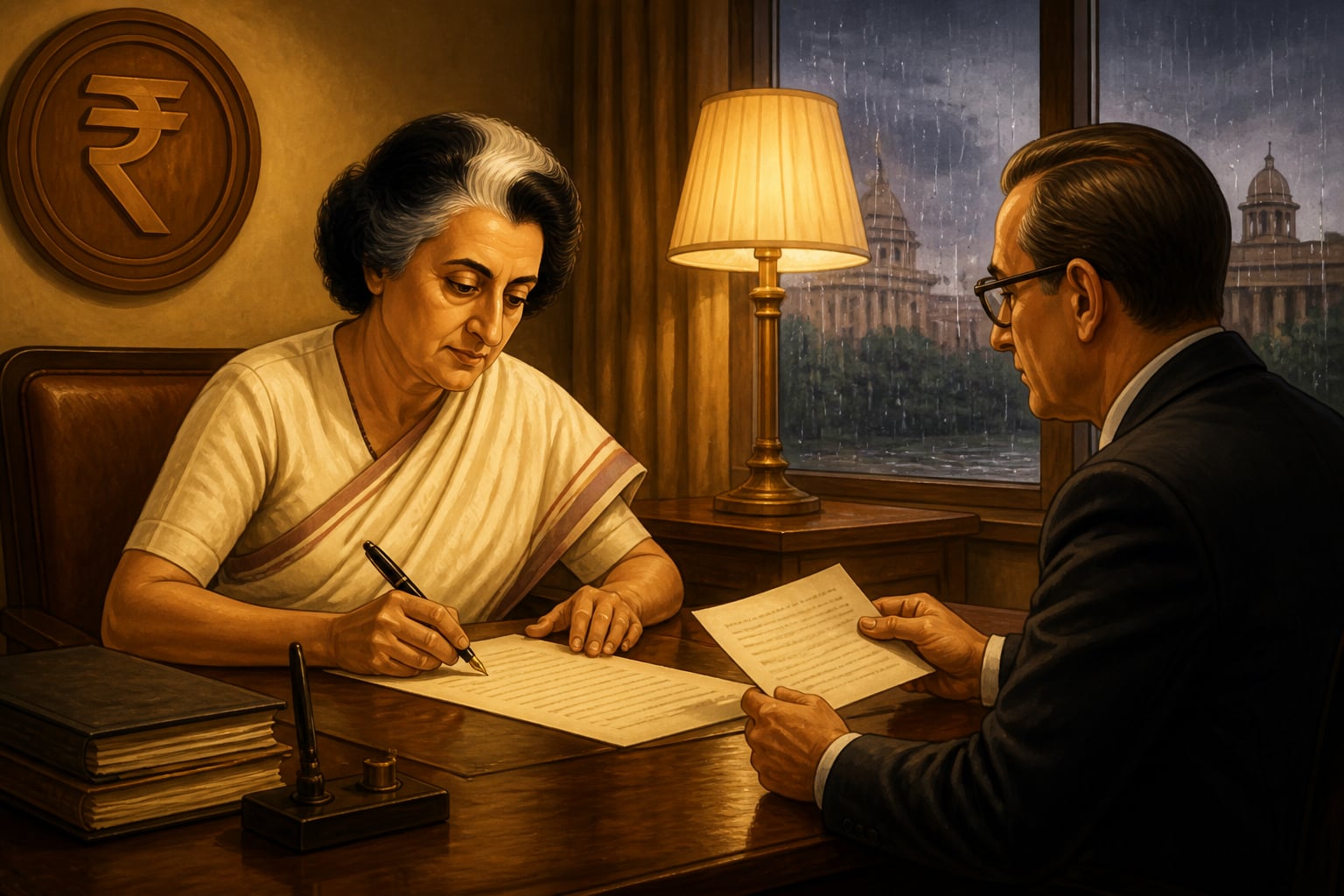
Indira Gandhi signing the 1966 devaluation order

Under pressure from the IMF and World Bank, India devalued the rupee by 57% on June 6, 1966 - from ₹4.76 to ₹7.50 per dollar.

What Was Promised:

What Actually Happened:

The Wrong Lessons

Instead of recognizing that the crisis revealed fundamental problems with the socialist model, the political establishment concluded:

  1. Foreign advice is dangerous - leading to further insularity
  2. Market reforms are politically toxic - leading to doubling down on controls
  3. Self-reliance must be absolute - leading to deeper autarky

The opportunity for reform was missed. The license-permit raj intensified. Nationalization expanded. The stage was set for an even bigger crisis.

The 1991 Crisis: No Escape This Time

The Perfect Storm

By 1991, multiple pressures converged:

Fiscal Deterioration:

External Shocks:

Political Instability:

The Credit Crunch:

The Gold Pledge: India's Darkest Hour

In June 1991, India faced a choice: default on international obligations or take emergency action. The government chose humiliation over default.

RBI officials loading gold crates onto an Air India plane at dawn

The Operation:

The Symbolism:

The Manmohan Moment

Prime Minister Narasimha Rao, with Finance Minister Manmohan Singh, chose transformation over band-aids.

Immediate Crisis Management:

Structural Reforms:

Manmohan Singh delivering the July 1991 budget speech

The Famous Budget Speech (July 24, 1991):

"Let the whole world hear it loud and clear. India is now wide awake. We shall prevail. We shall overcome."

Why 1991 Succeeded Where 1966 Failed

Different Leadership Choices

1966 Approach:

1991 Approach:

The Karma-Phala Principle

The Bhagavad Gita teaches that actions have inevitable consequences:

"कर्मण्येवाधिकारस्ते मा फलेषु कदाचन" "Your right is to action alone, never to its fruits."

But the corollary is equally true: fruits WILL come, whether you claim right to them or not.

1947-1966 Karma: Inefficient industrialization, agricultural neglect, fiscal indiscipline 1966 Phala: Devaluation crisis, food dependency

1967-1991 Karma: Deeper controls, expanded public sector, populist spending 1991 Phala: Near-bankruptcy, gold pledge, loss of economic sovereignty

Post-1991 Karma: Liberalization, competition, global integration Phala: Growth acceleration, poverty reduction, global respect

Sankata as Avasar: The Dharmic View of Crisis

The Mahabharata offers wisdom on adversity:

"विपत्तिः परीक्षा च महतां भवति।" "Crisis is the examination of the great."

Crises reveal character - of individuals and nations. They also create windows of possibility closed during normal times.

Why Reforms Happen in Crisis

Vested interests weakened: Those benefiting from status quo have less power to resist Political cover provided: "Emergency measures" become acceptable Public awakened: Complacency replaced by willingness to change New coalitions possible: Crisis scrambles old political alignments

India's Crisis-Reform Pattern

Crisis Reform Opportunity Result
1966 Industrial rationalization Missed - returned to controls
1991 Comprehensive liberalization Seized - transformed economy
2008 Financial sector reform Partially seized
2020 (COVID) Labor, agriculture reform Attempted, partially reversed

Comparative: How Other Nations Handled Crises

China 1978: Deng's Opening

Crisis: Cultural Revolution had devastated economy Response: "Reform and Opening Up" - special economic zones, foreign investment, private enterprise Result: World's fastest sustained growth

South Korea 1997: IMF Crisis

Crisis: Asian financial crisis, corporate debt collapse Response: Accepted painful IMF conditions, restructured chaebols Result: Emerged stronger, more resilient

Argentina 2001: Convertibility Collapse

Crisis: Debt default, currency board failure Response: Default, devaluation, but incomplete reform Result: Recurring crises, persistent problems

The Lesson

Crisis creates opportunity. Whether nations seize it depends on leadership quality and institutional capacity.

The Economists Behind the Moments

B.K. Nehru and L.K. Jha (1966)

These senior bureaucrats managed the 1966 crisis:

Manmohan Singh (1991)

The architect of India's transformation:

Key Insight: Singh had written about the need for reform for years. The crisis didn't change his analysis - it changed the political possibility of action.

Jeffrey Sachs: The Crisis Counselor

American economist who advised many countries on crisis response:

His Principle: Crisis moments require bold action; gradualism fails because opposition regroups.

The Debate: Was India's 1991 approach (gradual but sustained reform) better than shock therapy? India avoided Russia's chaos while achieving transformation.

The Political Economy of Crisis

Why Democracies Struggle with Preemptive Reform

Vote Bank Calculations: Every reform creates losers who vote; gains are diffuse Short Election Cycles: Politicians optimize for next election, not next generation Status Quo Bias: Change is uncertain; keeping current system is "safe"

Why Crisis Enables Reform

Status Quo Untenable: Doing nothing is clearly worse than changing Emergency Powers: Normal resistance mechanisms suspended Blame Shifting: "We had no choice" provides political cover Coalition of Necessity: Diverse groups unite against common threat

What We Almost Lost in 1991

Imagine if India had defaulted instead of reforming:

Economic Isolation: Cut off from global capital, technology, markets Political Instability: Economic collapse triggering social unrest Strategic Vulnerability: Weak economy limiting defense capability Lost Decades: Falling further behind China, Southeast Asia

The reforms of 1991 weren't just about economics - they preserved India's viability as a major power.

The Unfinished Agenda

Both 1966 and 1991 revealed structural weaknesses. Some have been addressed; others persist:

Addressed:

Still Pending:

The next crisis - whenever it comes - will likely force action on these remaining issues.

Dharmic Lessons for Personal Finance

The principles that apply to nations apply to individuals:

Build Reserves: The Arthashastra's kosha (treasury) principle applies to family savings

Avoid Debt Traps: India's borrowing spiral offers warnings for personal finance

Crisis as Opportunity: Job loss or market crash can force beneficial changes

Face Reality: Denial (like 1966's retreat to controls) makes problems worse

Your Turn: Crisis Scenarios

Personal Crisis Exercise:

  1. Identify a financial crisis you or your family faced
  2. What karma (past choices) contributed to it?
  3. Did you treat it as sankata or avasar?
  4. What reforms did it enable or force?

National Policy Exercise:

  1. What current trends might create the next crisis?
  2. What reforms are politically impossible today but crisis might enable?
  3. How can we achieve reform without crisis?

Key Takeaways

  1. Crisis is karma-phala: Policy mistakes accumulate until correction becomes unavoidable
  2. 1966 was a warning ignored: Retreating to controls after crisis set up bigger crisis later
  3. 1991 was transformation seized: Leadership used crisis window to push comprehensive reform
  4. Sankata becomes avasar through wise response: Same crisis can destroy or transform, depending on choices
  5. The reform agenda remains incomplete: Some changes still await their crisis catalyst

Looking Ahead

The pattern of crisis-and-reform continues. Understanding 1966 and 1991 helps us recognize the next breaking point when it comes - and the opportunity it will create. The question for the next generation: Can we reform proactively, or must we wait for crisis to force our hand?

India's 1991 humiliation - pawning gold for emergency loans - illustrates why reserves matter. For individuals, the lesson is maintaining 6-12 months of expenses as emergency fund. This isn't idle money; it's the kosha (treasury) that preserves sovereignty during sankata. Without reserves, you lose the freedom to make good choices when crisis strikes.

The contrast between 1966 (crisis wasted) and 1991 (crisis utilized) offers a personal template. When facing financial setback - job loss, market crash, business failure - the instinct is to return to 'normal' as quickly as possible. The wiser approach: use the disruption to make changes impossible during stable times. Review spending, restructure investments, develop new skills. Sankata becomes avasar through intentional transformation.

Key terms

Crisis/Adversity
A moment of acute difficulty or danger. In dharmic thought, sankata is not merely negative but contains the seed of transformation - adversity as opportunity. The 1991 crisis was sankata that became avasar (opportunity) for reform.
Balance of Payments (BOP)
The record of all economic transactions between a country and the rest of the world. A BOP crisis occurs when a country cannot pay for essential imports or service its debts - exactly what India faced in 1991 when reserves fell to $1.2 billion.
Mudra Avamulyaan
Deliberate reduction in the official value of a currency relative to other currencies. India devalued by 57% in 1966 and 19% in 1991. Devaluation makes exports cheaper and imports costlier, theoretically improving trade balance.
Structural Adjustment
Fundamental changes to economic policy, typically involving reduced government intervention, privatization, and trade liberalization. IMF loans often came with structural adjustment conditions. India's 1991 reforms went beyond IMF requirements.

Key figures

Manmohan Singh

1932-present

As Finance Minister in 1991, Singh was the architect of India's economic liberalization. His budget speech announced the end of the license raj, opened India to foreign investment, and initiated reforms that transformed the economy. Cambridge-educated economist who had long advocated reform but needed the crisis to create political space for implementation.

Arvind Subramanian

1959-present

Former Chief Economic Adviser (2014-2018) who has extensively analyzed India's reform journey. His research quantified how the 1991 reforms accelerated growth and identified the unfinished agenda. Author of 'India's Turn: Understanding the Economic Transformation' which provides scholarly analysis of crisis-driven reform.

Jeffrey Sachs

1954-present

American economist who became the world's foremost 'crisis doctor,' advising Bolivia, Poland, Russia, and other countries on stabilization and reform. His 'shock therapy' approach argued that crisis moments require bold, comprehensive action rather than gradualism.

Living traditions

Reflection

More in Independence to License Raj (1947-1991)

All lessons in Independence to License Raj (1947-1991) · Viksit Bharat: India's Development Journey course