Safalta: IITs, ISRO, Green Revolution

The Enduring Achievements of Nation-Building

Not everything from the Nehruvian era failed. The IITs, ISRO, atomic energy, and the Green Revolution represent genuine achievements whose benefits compound today. Explore how patient institution-building, despite economic policy failures elsewhere, created capabilities that power India's 2024 resurgence.

The Bicycle That Reached the Moon
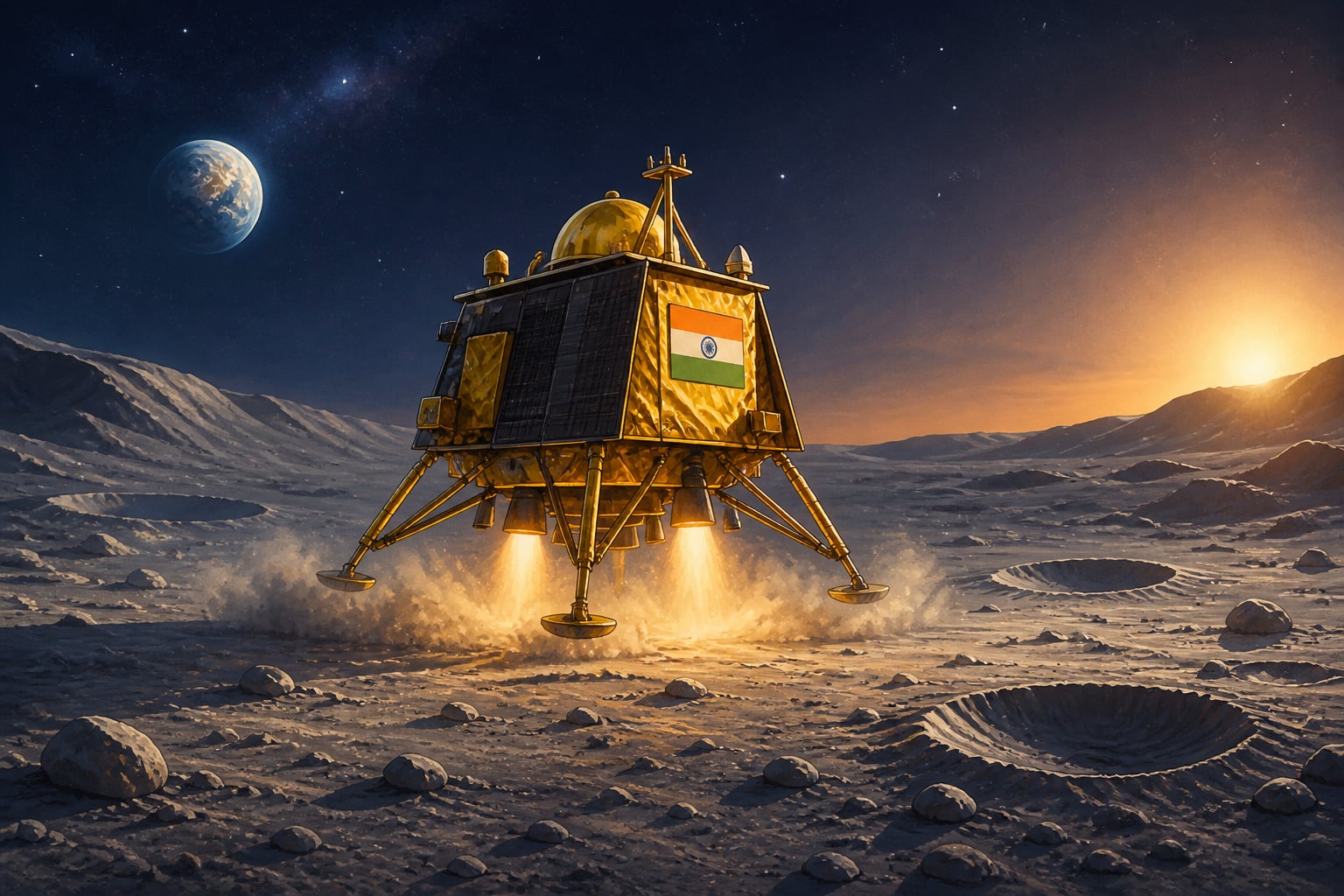
Chandrayaan-3 Vikram lander touching the lunar south pole

On August 23, 2023, as Chandrayaan-3's Vikram lander touched down on the lunar south pole, billions watched. India had become only the fourth country to soft-land on the Moon, and the first to reach the south pole.

The celebrations obscured a remarkable fact: the spacecraft that achieved this cost $75 million. NASA's Artemis program budget: $93 billion. India's space agency achieved with discipline what others could not with endless money.

But the real story began not in 2023, but in 1962. In that year, a visionary physicist named Vikram Sarabhai convinced Nehru to establish the Indian National Committee for Space Research, with an initial team of just 20 scientists working in a church building in Thumba, Kerala. They transported their first rocket on a bicycle.
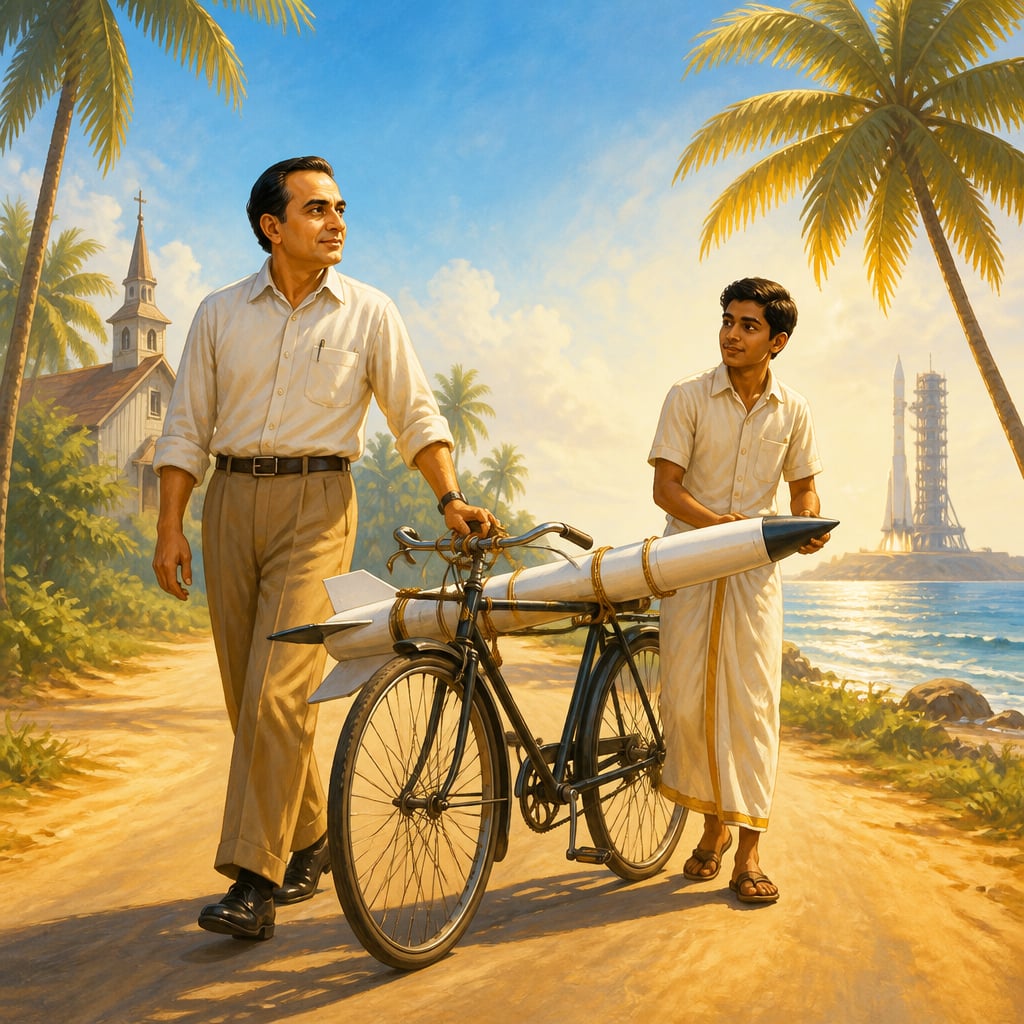
Vikram Sarabhai wheeling a sounding rocket on a bicycle to Thumba

That bicycle ride led to the Moon. The institution Sarabhai built survived policy changes, budget cuts, and decades of the "Hindu Rate of Growth." It survived because it was built on something more durable than any Five Year Plan: knowledge, vision, and discipline.

This is the story of what Nehruvian India got right.

The Science of Nation-Building

While License Raj strangled private enterprise, a parallel story unfolded in science and education. Nehru understood something that transcended his socialist economics: newly independent nations need capabilities, not just ideologies.

Three institutions exemplify this vision:

The Indian Institutes of Technology (IITs)

The first IIT opened in Kharagpur in 1951, in what had been a British detention camp for political prisoners. By 1961, five IITs existed, modeled on MIT but adapted for Indian needs. Foreign faculty from multiple countries helped establish rigorous standards.

The numbers speak: Today, IIT alumni lead Google (Sundar Pichai, IIT Kharagpur), Adobe (Shantanu Narayen, IIT Madras), and have built companies worth hundreds of billions. India's tech workforce, the world's largest, was seeded in these institutions.

Atomic Energy and ISRO

Homi Jehangir Bhabha, the architect of India's nuclear and space programs, convinced Nehru that science was the only path to true sovereignty. In 1944, Bhabha wrote to Tata seeking support for nuclear research: "When nuclear energy has been successfully applied for power production, in say a couple of decades from now, India will not have to look abroad for its experts."

He was right. India's nuclear program, whatever one thinks of its military applications, gave India energy security and technological self-reliance. ISRO, which emerged from the atomic energy ecosystem, now launches satellites for countries that once refused to share technology with India.

The Green Revolution

In the early 1960s, India faced famine. American wheat shipments kept millions alive, but under humiliating conditions (the PL-480 program came with political strings). Food security was not just economic; it was a matter of national sovereignty.

Swaminathan examining dwarf wheat with a Punjabi farmer

M.S. Swaminathan, working with international partners like Norman Borlaug, introduced high-yield dwarf wheat and rice varieties. Combined with irrigation from Five Year Plan dams, India's food production doubled between 1965 and 1985. By 1980, India was food self-sufficient. Today, it exports rice and wheat.

The Visionary: Homi Bhabha

To understand why some Nehruvian projects succeeded while others failed, study Homi Jehangir Bhabha (1909-1966).

Bhabha was no socialist ideologue. Educated at Cambridge, trained in the most competitive scientific environments of Europe, he understood that excellence cannot be decreed, it must be cultivated. His institutions reflected this:

"Science is the only basis for democratic progress, and unless we train hundreds and thousands of our most talented young people in the methods of science, we will never be able to modernize our country.", Homi Bhabha, 1948

Bhabha died in a 1966 plane crash over Mont Blanc, the same year as Nehru's successor Shastri. But the institutions he built survived both deaths. They survived because they were designed to outlast any individual.

Global Perspectives: The State-Science Partnership

India's success in science and technology reflected a global model.

Vannevar Bush (1890-1974), American engineer and science administrator, established the template in his 1945 report "Science: The Endless Frontier." Bush argued that basic research, funded by the state but conducted with autonomy, was the foundation of national power. The National Science Foundation, the modern American research university, and the internet itself trace to Bush's vision.

Nehru read Bush. More importantly, Bhabha understood him. The atomic energy and space programs were built on the Bush model: state funding, institutional autonomy, merit-based selection, long-term patience.

Wernher von Braun (1912-1977) built America's space program from German rocket technology. His approach was different: massive budgets, military urgency, public spectacle. India could not compete with Apollo. But ISRO proved you didn't need to: steady, frugal progress could eventually reach the same destination.

Approach Bush/Bhabha Von Braun/Apollo
Funding Moderate, sustained Massive, politically driven
Timeline Decades Years
Goal Capability building Spectacular achievements
Sustainability High Boom-bust cycles

India followed the Bush/Bhabha model. It took 60 years, but India landed on the Moon at 1/1000th the cost of America's current program.

The Dharmic Framework: Vidya, Drishti, Tapasya

The success of IITs, ISRO, and the Green Revolution reflects dharmic principles that Nehruvian economics often violated.

Vidya: Knowledge as True Wealth

The Upanishads repeatedly emphasize that knowledge (vidya) is the supreme wealth, more valuable than gold, more durable than empires.

विद्या ददाति विनयं विनयाद् याति पात्रताम्। पात्रत्वाद्धनमाप्नोति धनाद्धर्मं ततः सुखम्॥

"Knowledge gives humility; humility gives character; character attracts wealth; wealth enables dharma; dharma brings happiness.", Hitopadesha

The IITs represent vidya: India invested in knowledge when it could barely afford food. That knowledge compounded. Today, it generates billions in economic value.

Drishti: Long-Term Vision

Drishti means vision, the ability to see beyond the immediate. Bhabha planned atomic energy for 50 years. Sarabhai planned space for generations. The Green Revolution scientists worked for a decade before results appeared.

This contrasts with the Five Year Plan approach: set targets, check boxes, move on. Real capability cannot be built in five years. It requires the drishti to plant trees whose shade you will never enjoy.

Tapasya: Disciplined Austerity

ISRO's frugality is not poverty, it is tapasya, the disciplined austerity that produces excellence. The scientists who launched rockets on bicycles were not victims of underfunding. They were practitioners of tapasya: doing more with less, eliminating waste, focusing on essentials.

तपसा ब्रह्म विजिज्ञासस्व। "Through tapasya, seek to know Brahman.", Taittiriya Upanishad

The Moon landing was tapasya in action: $75 million, 60 years of patient work, and the discipline to refuse shortcuts.

The 2025 Echo: Legacy in Action

The institutions Nehru and Bhabha built are the engines of Modi's India:

ISRO in 2024:

IITs in 2024:

Green Revolution Legacy:

S. Somanath, ISRO's current chairman who oversaw Chandrayaan-3, embodies this legacy. He joined ISRO in 1985, inheriting the institution Sarabhai built. His success is not individual genius but institutional capability accumulated over generations.

What Made the Difference?

Why did IITs succeed while License Raj failed? Why did ISRO flourish while public sector enterprises stagnated?

The differences are instructive:

Factor Successful Institutions Failed Policies
Selection Merit-based, competitive Political, quota-based
Autonomy Protected from bureaucracy Captured by bureaucracy
Accountability Results measured globally Targets set politically
Timeline Decades Five-year cycles
Culture Excellence expected Compliance sufficient

The lesson is not that all state intervention fails, IITs and ISRO are state creations. The lesson is that how the state intervenes matters more than whether it intervenes. Autonomy, merit, long-term thinking, and global benchmarks produce success. Bureaucratic control, political interference, and short-term targets produce stagnation.

Your Turn: The Institutional Test

As you evaluate institutions, educational, corporate, governmental, apply the dharmic test:

The IITs, ISRO, and the Green Revolution passed this test. Much of Nehruvian policy did not. The distinction matters as India builds the next generation of institutions for Viksit Bharat 2047.

Nehru's economic philosophy may have failed, but his faith in science and education did not. The knowledge India built in the 1950s and 60s is compounding today. The lesson: invest in what endures. Policies change, governments fall, ideologies fade. Knowledge remains.

Human capital investment and compounding returns on education

Gary Becker's human capital theory (Nobel 1992) argues that education is an investment with returns. Paul Romer's endogenous growth theory shows how knowledge accumulation drives long-term growth.

The dharmic framework goes beyond economics: vidya is not just profitable but intrinsically valuable. This creates motivation beyond financial returns, the IIT founders were not seeking ROI but building national capability.

IIT alumni have founded companies worth $500+ billion (Google, Adobe, Infosys, etc.). The original investment in 5 IITs in the 1950s-60s was under $50 million. ROI: immeasurable.

Frugal innovation, resource efficiency, and constraint-driven creativity

Clayton Christensen's 'disruptive innovation' shows how resource constraints force different approaches that eventually outcompete incumbents. Toyota's lean manufacturing achieved more with less through disciplined waste elimination.

Key terms

Vidyā
Knowledge, learning, education - particularly knowledge that leads to wisdom and liberation, as opposed to mere information or skill.
Dṛṣṭi
Vision, sight, perspective - the ability to see beyond immediate circumstances to long-term possibilities and consequences.
Tapasyā
Disciplined austerity, focused practice, voluntary hardship undertaken for a higher purpose. From 'tap' (to heat/burn).
Sāphalya
Success, fruitfulness, achievement of purpose - the positive outcomes that result from dharmic action and patient effort.

Key figures

Homi Jehangir Bhabha

Physicist, founder of India's atomic energy and space programs, creator of institutional frameworks for Indian science

S. Somanath

Chairman of ISRO (2022-present), oversaw Chandrayaan-3 Moon landing success

Vannevar Bush

American engineer and science administrator; architect of the modern American research system

Case studies

Chandrayaan-3: Sixty Years from Bicycle to Moon

On August 23, 2023, at 6:04 PM IST, Chandrayaan-3's Vikram lander touched down on the lunar south pole. India became the fourth country to soft-land on the Moon, and the first to reach the scientifically valuable south pole region, where water ice may enable future human habitation. The mission cost $75 million, less than many Hollywood movies. NASA's Artemis program to return Americans to the Moon has a budget of $93 billion. Russia's Luna-25, which crashed days before Chandrayaan-3's success, cost $200 million. But the real story began in 1962, when Vikram Sarabhai established the Indian National Committee for Space Research with 20 scientists. Their first sounding rocket was transported to the launch site on a bicycle. They worked in a church building. Their budget was negligible. Sixty-one years of patient institution-building, through political changes, budget constraints, the Hindu Rate of Growth, and competing national priorities, led to this moment. The capability was not bought or borrowed; it was built, layer by layer, decade by decade.

Chandrayaan-3 exemplifies all three dharmic principles: **Vidya**: ISRO built genuine knowledge over six decades. The scientists who landed Vikram inherited capabilities from predecessors who never saw the Moon landing. Knowledge compounded. **Drishti**: Sarabhai in 1962 could not have imagined 2023's success, but he built for it anyway. His long-term vision planted trees whose shade he would never enjoy. **Tapasya**: The frugal approach was not poverty but discipline. Constraint forced innovation: ISRO developed techniques NASA didn't need to discover because they had unlimited budgets. Limitation became advantage. The contrast with License Raj is instructive: while the Planning Commission set five-year targets and declared victory regardless of results, ISRO built for decades and measured success against global competitors. Autonomy, merit, and global standards, Bhabha's institutional principles, made the difference.

Chandrayaan-3's Pragyan rover operated for 14 days, analyzing lunar soil and transmitting data on elemental composition. The mission confirmed water ice in the south pole region, information that may prove crucial for future Moon bases. More importantly, the success validated six decades of institution-building. PM Modi declared India's space program a model for the world. Private space companies are emerging (Skyroot, Agnikul) building on ISRO's ecosystem. India now offers commercial launch services at globally competitive rates. The bicycle has reached the Moon. And it got there not through sprint but through marathon, patient, disciplined, sustained.

Capability cannot be purchased; it must be built. Chandrayaan-3 succeeded not because of 2023's budget but because of 60 years of accumulated vidya, drishti, and tapasya. The lesson for Viksit Bharat: institution-building is slow, unglamorous, and essential. There are no shortcuts.

ISRO's cost-effective model is now being replicated by India's private space sector. Companies like Skyroot Aerospace and Agnikul Cosmos are building on ISRO's six decades of accumulated knowledge, proving that patient public investment in capability eventually seeds private innovation.

Cost comparison: Chandrayaan-3 ($75M) vs NASA Artemis ($93B) = ISRO achieved for 0.08% of NASA's budget. India's space program employs 17,000 people and generates $2.5B annually in launch services and satellite applications.

Historical context

Building Scientific Capability (1944-2023)

India's scientific institution-building occurred despite economic policy failures elsewhere. The same Nehru who created License Raj also created IITs and supported Bhabha's autonomy. The difference: scientific institutions were protected from the bureaucratic control that strangled everything else.

China pursued a similar path with different timing. Started later (1970s reforms) but with more resources, China has now surpassed India in many scientific metrics. The comparison shows both the power of institution-building and the cost of India's 'lost decades' of slower growth.

ISRO's total budget from 1969-2023: approximately $15 billion. NASA's budget for 2023 alone: $25.4 billion. India built a Moon-landing capability for less than one year of NASA's operating expenses.

The success of IITs, ISRO, and the Green Revolution proves that Nehruvian failures were not inevitable. Where institutions had autonomy, merit-based selection, and long-term vision, they succeeded. This suggests that India's economic trajectory was not destiny but choice, and different choices could have produced different outcomes.

Living traditions

Today's 23 IITs, expanding ISRO capabilities, and agricultural research network trace directly to 1950s-60s investments. The lesson: patient institution-building creates capabilities that compound for generations.

Reflection

More in Independence to License Raj (1947-1991)

All lessons in Independence to License Raj (1947-1991) · Viksit Bharat: India's Development Journey course