Pancha-Varshiya Yojana: Five Year Plans
The Grand Experiment in Planned Development
Explore India's Five Year Plans, the ambitious attempt to engineer economic development through central planning. Understand how P.C. Mahalanobis designed the framework, what it achieved in heavy industry and institutions, and why it ultimately fell short of its promises.
The Statistician Who Would Plan a Nation
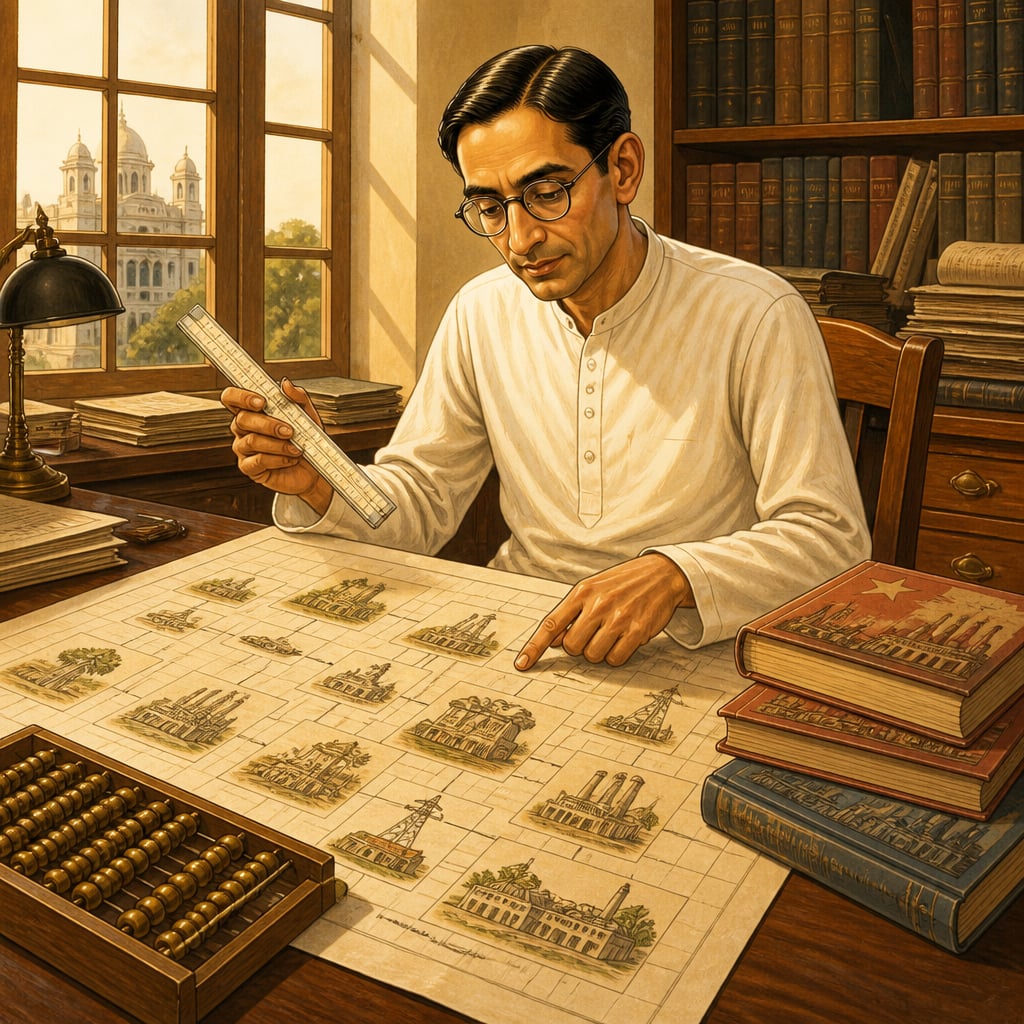
In 1954, a lanky Bengali physicist-turned-statistician walked the corridors of Moscow, studying the machinery of Soviet planning. Prasanta Chandra Mahalanobis, founder of the Indian Statistical Institute, inventor of the Mahalanobis Distance used worldwide, had been given an extraordinary task: design the mathematical framework that would lift 360 million Indians from poverty.
Nehru trusted Mahalanobis completely. "The Professor," as he was known, combined scientific prestige with ideological conviction. He believed that economics could be solved like a physics problem, measure the variables, build the equations, optimize the solution. The chaos of millions of individual decisions could be replaced by the precision of statistical planning.
The result would be the most ambitious social engineering project outside the Communist bloc: India's Five Year Plans.
The Architecture of Planning
The First Five Year Plan (1951-1956) was modest, focused on agriculture and irrigation, recovering from Partition's disruption. It exceeded its targets, boosting confidence in planning.
The Second Five Year Plan (1956-1961) was Mahalanobis's masterpiece. Called the "Mahalanobis Model," it was based on a striking insight: to grow faster later, you must invest in heavy industry now. Consumer goods can wait. Steel, power, machinery, these create the capacity to produce everything else.
The model was elegant:
- Prioritize heavy industry (Department I in Soviet terminology)
- Import capital goods, export nothing (import substitution)
- Protect domestic industry from foreign competition
- Let the Planning Commission allocate investment
- Accept short-term sacrifice for long-term growth
"We cannot develop as a modern nation without a base of heavy industry. Steel is the foundation. From steel comes everything else.", P.C. Mahalanobis, 1955
The Planning Commission became India's economic nerve center. Every significant investment, public or private, required its approval. The Commission set targets for steel production, power generation, food grains, and textile output. The market was not trusted to allocate resources; experts would do it better.
What the Plans Built
The achievements were real. By the end of the Third Plan (1966), India had:
Heavy Industry:
- Steel production grew from 1.5 million tons (1951) to 6.5 million tons (1966)
- Bhilai, Durgapur, and Rourkela steel plants, built with Soviet, British, and German help
- Heavy Electricals India Limited (BHEL), India's own turbine and generator maker
- Hindustan Machine Tools (HMT), from watches to machine tools

Infrastructure:
- Bhakra-Nangal Dam (Punjab), Nehru's "Temple of Modern India"
- Damodar Valley Corporation, India's TVA (Tennessee Valley Authority)
- Railway expansion and electrification
- National Highway network foundations
Institutions:
- Indian Institutes of Technology (IITs), five by 1966
- Indian Institutes of Management (IIMs)
- Atomic Energy Commission and Bhabha Atomic Research Centre
- ISRO's precursor, the Indian National Committee for Space Research
These were genuine achievements. India, which could barely make a bicycle at independence, was producing steel, generating power, building dams. The foundational capabilities that power India's 2024 economy were laid in the 1950s and 60s.
The Soviet Model: Gosplan's Shadow
Mahalanobis did not invent planning from scratch. His model explicitly borrowed from Gosplan, the USSR's State Planning Committee that had operated since 1921.
Gosplan's appeal was undeniable. In three decades, the Soviet Union had transformed from an agrarian backwater to an industrial superpower that defeated Nazi Germany. Soviet growth rates in the 1950s, officially 10%+ annually, dazzled the developing world. When Mahalanobis visited Moscow, he saw what seemed like economic magic.
But Gosplan had features Mahalanobis overlooked:
- Coercion: Soviet industrialization was funded by starving peasants, the Ukrainian famine of 1932-33 killed millions
- Falsified data: Soviet statistics were propaganda, not economics
- Military priority: Much "civilian" industry served the arms race
- Zero feedback: Planners ignored signals that their plans weren't working
India, thankfully, was a democracy. Nehru would not, could not, replicate Soviet brutality. But this meant Indian planning lacked the coercive power that made Gosplan "work." Plans depended on voluntary compliance, and when targets weren't met, nothing happened.
Global Perspectives on Development Planning
Walt Whitman Rostow (1916-2003), American economist and national security advisor, offered a competing vision in The Stages of Economic Growth (1960), subtitled "A Non-Communist Manifesto." Rostow argued that all societies pass through five stages: traditional, preconditions for takeoff, takeoff, drive to maturity, and high mass consumption.
Rostow's insight: the "takeoff" requires massive investment, but it needn't come from the state. Foreign investment, trade, and private enterprise could provide capital. His model influenced US aid policy and offered an alternative to Mahalanobis.
W. Arthur Lewis (1915-1991), Nobel laureate from St. Lucia, developed the "dual economy" model, showing how surplus labor from agriculture could fuel industrial growth. Lewis respected planning but emphasized that eventually labor surplus ends and market wages must rise.
Milton Friedman (1912-2006) visited India in 1955 and submitted a memo to the Finance Ministry. His verdict was blunt: India's controls would strangle growth. Let prices work. Free the rupee. Trust the market. The memo was ignored; Friedman's predictions proved accurate.
| Thinker | Core Insight | Indian Parallel |
|---|---|---|
| Rostow | Takeoff requires investment, not state control | India's heavy industry phase |
| Lewis | Dual economy can fund industrialization | India's agricultural surplus (when it worked) |
| Friedman | Controls distort prices and strangle growth | License Raj's stagnation |
The Dharmic Lens: Yajna, Karma-Phala, and Balance
From a dharmic perspective, the Five Year Plans present a profound moral dilemma.
The Yajna Question: Vedic tradition understands that great achievements require sacrifice, yajna. Villages were flooded for dams. People were displaced for steel plants. Forests were cleared for mines. Was this dharmic sacrifice for the greater good, or adharmic imposition on the powerless?

Nehru called Bhakra Dam a "Temple." But temples are built by willing devotees. The villages submerged by Bhakra's reservoir had no choice. The tribal communities displaced by Hirakud Dam received no adequate compensation. The "sacrifice" was not offered, it was extracted.
श्रेयान्द्रव्यमयाद्यज्ञाज्ज्ञानयज्ञः परन्तप। सर्वं कर्माखिलं पार्थ ज्ञाने परिसमाप्यते॥
"Better than the sacrifice of material things is the sacrifice of knowledge, O Arjuna. All actions in their entirety culminate in knowledge.", Bhagavad Gita 4.33
The Gita suggests that true yajna involves willing participation and wisdom, not just material extraction. The Planning Commission claimed to "know" what was best, but did it truly understand the lives it disrupted?
The Karma-Phala Paradox: The Five Year Plans produced both intended and unintended consequences. Heavy industry grew, as intended. But so did corruption, black markets, and bureaucratic sclerosis, unintended karma-phala.
Every license requirement created a bribe opportunity. Every import restriction created a smuggling incentive. Every price control created a black market. The planners did not intend these outcomes, but actions have consequences beyond intentions.
The Dharmic Balance: A dharmic approach to historical judgment avoids both hagiography and condemnation. The Plans built IITs and steel plants, genuine achievements that serve India today. They also created License Raj and Hindu Rate of Growth, genuine failures that held India back for decades.
Honesty requires acknowledging both. Nehru was neither savior nor villain. Mahalanobis was neither genius nor fool. They were humans working with limited knowledge, shaped by their times, producing mixed results.
The 2025 Echo: From Planned to Market
India formally abandoned Five Year Plans in 2017, replacing the Planning Commission with NITI Aayog (National Institution for Transforming India). The change was more than symbolic.
NITI Aayog does not allocate resources. It does not give licenses. It is a "think tank" that advises, not commands. The states, not Delhi, now drive development. The market, not the Commission, allocates capital.
Arvind Panagariya, NITI Aayog's first Vice-Chairman (2015-2017), represented this transformation. A Columbia economist, Panagariya had critiqued Indian planning for decades. His appointment signaled that the Mahalanobis era was definitively over.
In 2024, India's economic planning focuses on:
- PLI schemes (Production-Linked Incentives), targeted support, not command planning
- PM Gati Shakti, infrastructure coordination without central control
- Aspirational Districts, state-led, data-driven development
- JAM Trinity, direct benefit transfers, bypassing bureaucracy
The achievements of the First and Second Plans, IITs, steel capacity, atomic energy, remain. The methods have been abandoned. India learned that building capability requires investment; allocating it efficiently requires markets.
Your Turn: The Planner's Dilemma
Imagine you are Mahalanobis in 1954. You have a newly independent nation, desperately poor, with no industrial base. The Soviet model seems to be working. Western capitalism is associated with colonialism. What would you do differently?
This is the honest dilemma. Central planning failed, but was there a realistic alternative that India's leadership could have accepted in 1954? The Asian Tigers (South Korea, Taiwan, Singapore) would show another path in the 1960s-70s, but their lessons were not available to Mahalanobis.
The takeaway is not that planning was evil, it was a reasonable response to the knowledge and constraints of its time. The takeaway is that good ideas must be tested against reality, and when they fail, we must have the courage to change course. India took too long to change, that is the tragedy. But it did change, that is the hope.
As you plan your own life, education, career, investments, remember: plans are essential, but flexibility is more essential. The world changes. Knowledge grows. What seemed optimal yesterday may be suboptimal today. The dharmic approach is to plan wisely, act decisively, and adapt continuously.
Opportunity cost and distributional impact of development
Utilitarian ethics (Bentham, Mill) would justify costs if total welfare increases. Rawlsian justice asks whether the worst-off benefit. Libertarians question any involuntary taking. Each framework yields different conclusions about development displacement.
The dharmic framework asks not just 'what are the costs and benefits?' but 'was the sacrifice willing and informed?' This adds a dimension missing from purely utilitarian calculations.
Bhakra Dam displaced ~36,000 people. Hirakud Dam displaced ~150,000. Many received inadequate compensation and were never resettled properly.
Robert Merton's 'law of unintended consequences' formalizes this. Hayek's knowledge problem explains why: planners cannot possess all relevant information. Good intentions + incomplete knowledge = unexpected results.
The karma-phala concept integrates unintended consequences into the moral framework. It's not just that plans fail, it's that action always produces unexpected fruits, and we remain responsible for them.
Key terms
- Pañca Vārṣika Yojana
- Five Year Plan - the framework for India's planned economic development from 1951-2017, setting targets for production, investment, and growth.
- Yajña
- Sacrifice, offering - in Vedic tradition, a ritual offering to the gods; more broadly, any act of selfless service or contribution to a greater good.
- Bhārī Udyoga
- Heavy Industry - industries producing capital goods like steel, machinery, and power generation equipment, as opposed to consumer goods.
- Karma-phala
- Fruits of action - the consequences that flow from actions, both intended and unintended. A core concept in Hindu philosophy emphasizing that actions have inescapable results.
Key figures
Prasanta Chandra Mahalanobis
Statistician, architect of India's Second Five Year Plan, founder of the Indian Statistical Institute
Arvind Panagariya
Economist, first Vice-Chairman of NITI Aayog (2015-2017), Professor at Columbia University
Gosplan (State Planning Committee, USSR)
The Soviet central planning agency that served as the model for India's Planning Commission
Case studies
Bhakra-Nangal: Temple or Tragedy?
In 1963, Jawaharlal Nehru inaugurated the Bhakra Dam on the Sutlej River in Punjab. It was the highest straight gravity dam in the world at the time, 226 meters of concrete holding back the waters that would irrigate Punjab and Haryana, generate 1,325 MW of power, and transform the agricultural economy. Nehru called it a 'Temple of Resurgent India.' The dam delivered. The Green Revolution that fed India in the 1970s-80s was watered by Bhakra. Punjab became India's breadbasket. The power generated lit millions of homes. But temples have sacrifices. The dam's reservoir flooded 21,000 hectares, submerging 404 villages, displacing approximately 36,000 people. Many were from scheduled tribes with little political voice. Compensation was inadequate. Resettlement was haphazard. Families who had lived on that land for generations were scattered to urban slums and marginal farms. The environmental costs accumulated too: siltation reduced the dam's capacity, downstream ecosystems were disrupted, and the Sutlej's natural flood cycles, which had deposited fertile soil for millennia, were permanently altered.
Was Bhakra dharmic? The question forces us to confront competing values. From a utilitarian standpoint, the calculus seems positive: millions fed and lit versus thousands displaced. But dharma asks more than 'what is the net benefit?' The yajna (sacrifice) was not willing. The displaced villages had no meaningful voice in the decision. They did not offer themselves for the greater good, they were taken. The karma-phala included benefits (irrigation, power) and costs (displacement, environmental damage) that continue to unfold. The planners focused on the benefits; the costs fell on those with no power to resist. A dharmic approach would have: (1) sought genuine consent where possible, (2) provided full and fair compensation, (3) treated the displaced as participants in a national yajna, not as obstacles to be removed. This did not happen.
Bhakra Dam remains operational, generating power and irrigating 4 million hectares. Punjab's agricultural transformation is real. But so is the trauma of displacement. Studies show that many oustees never recovered their pre-dam living standards. Their children and grandchildren still carry the memory of lost lands. The dam itself faces challenges: siltation has reduced capacity by an estimated 15%. The reservoir, designed to last 88 years, may have a shorter lifespan. The 'Temple' requires constant maintenance against nature's reclaiming force.
Development achievements are real but so are their costs. Dharmic evaluation asks not just 'what was built?' but 'who paid and did they consent?' Bhakra fed millions, but the 36,000 displaced deserve acknowledgment, not erasure from the story of India's progress.
India's 2013 Land Acquisition Act now requires consent from 70-80% of affected families and mandates rehabilitation before displacement. The Three Gorges Dam in China displaced 1.3 million people with minimal consent, highlighting that the question of development versus displacement remains unresolved globally.
Between 1947 and 2000, an estimated 50 million Indians were displaced by development projects (dams, mines, factories). Most received inadequate compensation. This is among the largest involuntary population movements in history.
Historical context
India's Planned Development Era (1951-1991)
India's planning era coincided with the Cold War. Both superpowers offered aid and models. India took Soviet planning methodology but American food aid (PL-480). This balancing act allowed some independence but also created dependencies.
South Korea launched its first Five Year Plan in 1962, but with crucial differences: export orientation, private enterprise leadership, and flexibility to change course. Korea grew at 9%+ while India stagnated at 3.5%. The contrast would become a textbook case.
India's average GDP growth: First Plan 3.6%, Second Plan 4.1%, Third Plan 2.8% (disrupted by wars and droughts). The target of 5%+ was rarely achieved. Meanwhile, Japan averaged 9.4% growth in the 1960s.
Understanding the planning era helps us appreciate both the genuine constraints faced by policymakers and the opportunity costs of their choices. India was not uniquely foolish, many countries chose planning. But some chose better.
Living traditions
The planned cities of the 1950s-60s have held up better than the planned economy. Chandigarh is consistently rated India's best-planned city. The lesson: physical planning has more durable success than economic planning.
- Planned vs Organic City Comparison: Compare Chandigarh (planned 1950s) with Gurugram (organic 1990s-2000s growth). Both are cities near Delhi. Which approach worked better? Why?
- Bhakra Dam: The 'Temple of Modern India.' View the dam, the reservoir, and, if you can find them, the resettlement colonies where displaced families were moved.
- Chandigarh: Le Corbusier's planned city, India's first modernist urban experiment. The Capitol Complex, Rock Garden, and sector grid show utopian planning in action.
- Indian Statistical Institute: Mahalanobis's institution, where the Second Plan was designed. The campus includes his personal library and working papers.
- Somnath Temple: Rebuilt multiple times after destructions, Somnath embodies the dharmic response to crisis - patient reconstruction rather than imposed planning. The temple's revival was driven by voluntary contributions, not state mandates.
- Vaishno Devi Shrine: The Shrine Board manages one of India's largest pilgrimages - 8 million visitors annually - using modern logistics while preserving the traditional yatra experience, showing planning that serves rather than displaces communities.
Reflection
- When development benefits millions but displaces thousands, how should we evaluate it? Can aggregate welfare gains justify individual suffering? What does dharmic ethics say about sacrificing the few for the many?
- Think of a major plan you have made, for education, career, or life. What unintended consequences (karma-phala) emerged? How might you design future plans to be more adaptive to unexpected results?