Nehruvian Socialism: Vision and Choices
The Idealism That Shaped Post-Independence India
Explore how Jawaharlal Nehru's vision of democratic socialism, shaped by Fabian thinkers like Harold Laski and the Soviet model, determined India's economic trajectory for four decades. Understand the idealism, the constraints, and the unintended consequences of centralized planning.
The Midnight Gamble
On August 15, 1947, as the clock struck midnight and India awoke to freedom, a newly independent nation faced an impossible question: How do you build an economy from the ruins of colonial extraction?
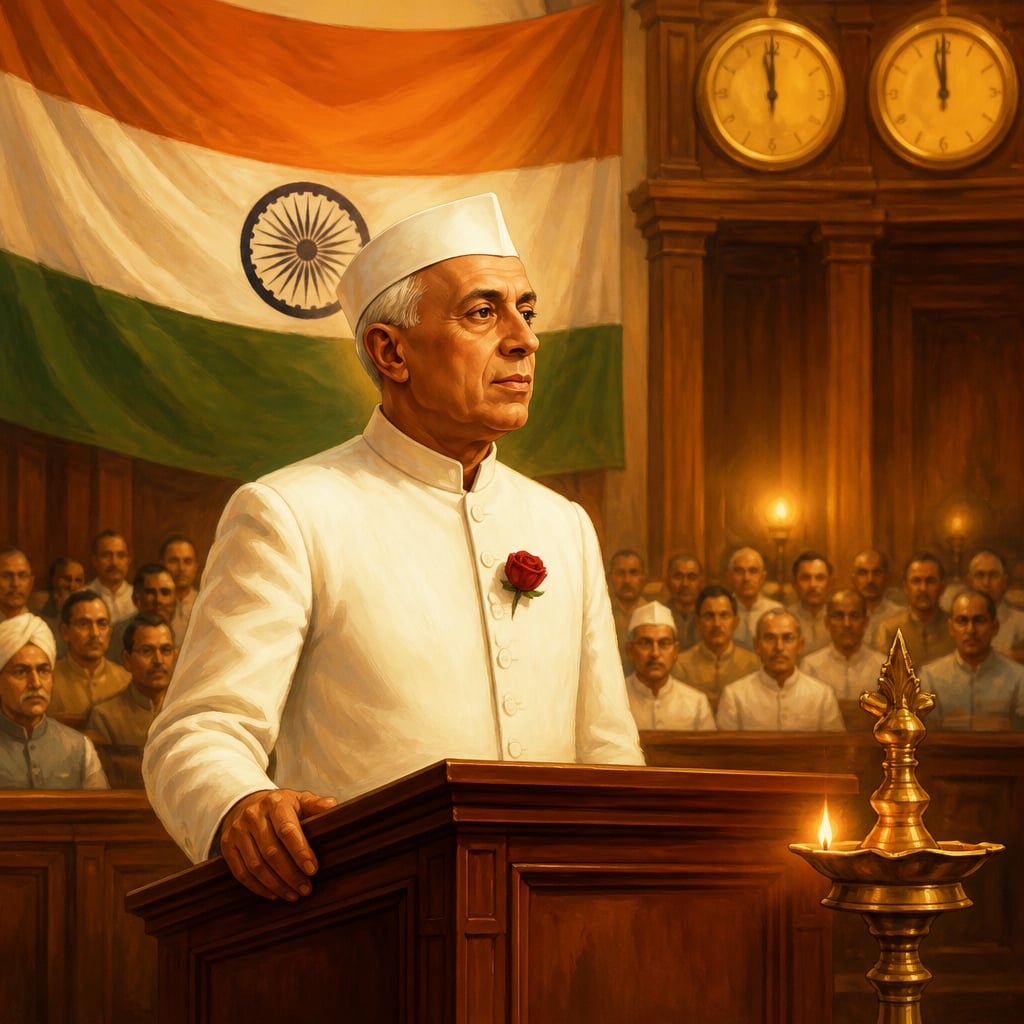
Jawaharlal Nehru stood before the Constituent Assembly that night, his famous "Tryst with Destiny" speech still echoing. But behind the soaring rhetoric lay an urgent practical problem. India's per capita income was among the lowest in the world, just ₹265 annually. The country had virtually no heavy industry. Literacy stood at 12%. The British had left behind a deliberately deindustrialized colony, its wealth systematically drained over two centuries.
Nehru had a plan. A vision. And it would shape India for the next forty-four years, for better and for worse.
The Making of an Economic Worldview
To understand Nehruvian socialism, you must first understand the man who shaped it. Nehru was not born a socialist. He was born into Allahabad's anglicized elite, educated at Harrow and Cambridge, trained as a barrister at the Inner Temple. His economic awakening came later.
Three influences proved decisive:
First, the Fabian Society. During his time in England, Nehru encountered the Fabian socialists, Sidney Webb, Beatrice Webb, and crucially, Harold Laski at the London School of Economics. The Fabians believed in gradual, democratic socialism: state ownership of key industries, scientific planning, and technocratic governance. Unlike revolutionary Marxists, they sought to "permeate" existing institutions rather than destroy them.
Nehru absorbed this worldview deeply. As he wrote in 1936: "I am convinced that the only key to the solution of the world's problems and of India's problems lies in socialism."
Second, the Soviet experiment. Nehru visited the USSR in 1927, just a decade after the Russian Revolution. He was dazzled by what he saw, or what he was shown. The Five Year Plans, the rapid industrialization, the transformation of a backward agrarian society into an industrial power. The Soviet model seemed to offer a shortcut that capitalism, with its messy markets and exploitation, could not.
"There is no way of escaping the conclusion that planning and development in India today must be socialistic... I see no way of ending the poverty and the vast unemployment that exists, except through a large measure of socialist planning.", Jawaharlal Nehru, 1958
Third, colonial trauma. India's experience under British rule convinced Nehru that unfettered capitalism was synonymous with exploitation. The East India Company had arrived as traders and ended as rulers. Private profit had meant public plunder. For Nehru, the free market was not a neutral mechanism, it was the weapon of the colonizer.
The Philosophy of the "Commanding Heights"
Nehru's economic vision crystallized in a phrase borrowed from Lenin: the state must control the "commanding heights" of the economy. This meant:
- Heavy industry (steel, coal, machinery, power) would be exclusively state-owned
- Mixed economy with public sector "in command" and private sector permitted but controlled
- Central planning through Five Year Plans, with the Planning Commission setting targets
- Import substitution to reduce dependence on foreign goods
- Industrial licensing to direct private investment according to national priorities
The Industrial Policy Resolution of 1956 formalized this vision. Industry was divided into three categories: Schedule A (state monopoly), Schedule B (state-led with private participation), and Schedule C (private sector, but heavily regulated).
This was not communism, Nehru explicitly rejected Soviet-style authoritarianism. He called it "democratic socialism," a third way between American capitalism and Soviet communism. The state would own, the experts would plan, and democracy would legitimize.
Global Perspectives on Central Planning
Nehru was not alone in his faith in planning. The mid-20th century was the high tide of technocratic optimism.
Gunnar Myrdal (1898-1987), the Swedish economist and Nobel laureate, championed state-led development for Asian economies. His influential book Asian Drama (1968) argued that development required strong state intervention to overcome "soft state" tendencies. Myrdal advised India directly and reinforced Nehru's convictions.
John Maynard Keynes (1883-1946), though no socialist, had legitimized government intervention in the economy. His ideas about managing aggregate demand and countercyclical spending gave intellectual cover to planning.
Friedrich Hayek (1899-1992), however, offered a devastating counter-argument. In The Road to Serfdom (1944), Hayek warned that central planning inevitably leads to authoritarianism. Without price signals from free markets, planners cannot allocate resources efficiently. They must resort to coercion. "The curious task of economics," Hayek wrote, "is to demonstrate to men how little they really know about what they imagine they can design."
| Thinker | Key Insight | Nehruvian Parallel |
|---|---|---|
| Myrdal | Strong state needed for development | Planning Commission as development engine |
| Keynes | Government can manage demand | State investment in heavy industry |
| Hayek | Planners lack knowledge; prices coordinate | India's price distortions and shortages |
Nehru read Hayek but dismissed him. The urgency of nation-building, he believed, demanded planning. Markets could not be trusted to serve the poor.
The Dharmic Critique: Svadharma and Swadeshi
From a dharmic perspective, Nehruvian socialism presents a profound tension.
The Bhagavad Gita teaches svadharma, that each person has their own nature, calling, and path. To suppress this for imposed uniformity is adharmic:
श्रेयान्स्वधर्मो विगुणः परधर्मात्स्वनुष्ठितात्। स्वधर्मे निधनं श्रेयः परधर्मो भयावहः॥
"Better is one's own dharma, though imperfectly performed, than the dharma of another well performed. Better is death in one's own dharma; the dharma of another is fraught with danger.", Bhagavad Gita 3.35

The entrepreneurial svadharma of the merchant, the craftsman, the innovator was systematically suppressed under License Raj. The Marwari who wanted to start a factory, the Gujarati who wished to export textiles, the Tamil engineer with a new invention, all had to seek permission from bureaucrats in Delhi. Their svadharma required state sanction.

Mahatma Gandhi had offered a different vision: Grama Swarajya, village self-governance, decentralized production, each community meeting its own needs. Gandhi famously said: "India lives in her villages." He envisioned an economy of self-reliant village republics, not centralized factories.
Nehru chose the opposite path. He called village economics "backward" and Gandhi's charkha (spinning wheel) a "symbol of our backwardness." Modernization meant urbanization, industrialization, central planning. In this, Nehru broke decisively with Gandhian economics.
The 2025 Echo: Lessons for Viksit Bharat
Seventy-seven years after independence, India stands transformed, but largely because of policies that reversed Nehruvian socialism.
The 1991 liberalization, which we'll explore in Lesson 6, dismantled much of the License Raj. Today, PM Modi's "minimum government, maximum governance" explicitly rejects Nehruvian statism. The slogan "Viksit Bharat 2047" envisions a developed India by the centenary of independence, an implicit acknowledgment that the first five decades took a wrong turn.
In 2024, India's industrial production is led by private conglomerates: Tata, Reliance, Adani, Mahindra. The companies Nehru feared have become engines of growth. The license requirements he mandated have been abolished. The import substitution he championed has given way to "Make in India" for exports.
Yet Nehru's legacy is not entirely negative. The institutions he built, IITs, IIMs, ISRO, atomic energy, created capabilities that power India today. His insistence on heavy industry, however inefficient, gave India a steel and power base. His democratic commitment ensured that when socialism failed, it could be democratically rejected.
Your Turn: The Idealist's Dilemma
Here is the honest question every student of economics must face: Was Nehru wrong, or was he wrong for his time?
In 1947, India had just witnessed the Bengal Famine of 1943, where British free-market policies let three million starve while food was exported. Capitalism, to Indians of that generation, meant the East India Company. The market meant exploitation.
Can you blame Nehru for distrusting the market? Can you blame him for looking to the Soviet model, which seemed to be working? Can you blame him for believing that experts could plan better than the chaos of individual choices?
The lesson is not that Nehru was evil, he was idealistic, well-intentioned, and working with the knowledge of his time. The lesson is that good intentions are not enough. Economic systems have consequences that idealism cannot wish away. The road to stagnation, as Hayek warned, is paved with the best of intentions.
As you consider your own economic choices, what to study, where to work, how to invest, remember: svadharma matters. Your unique calling, your individual path, your entrepreneurial instinct, these are not to be suppressed by systems, however well-meaning. Wealth creation, as the Vedas teach, is a purushartha, a legitimate life goal. No bureaucrat in Delhi, or anywhere else, should have the power to deny it.
Comparative advantage and specialization in economics
Adam Smith's division of labor and David Ricardo's comparative advantage echo svadharma, let each do what they do best. Hayek's 'knowledge problem' shows why central planners cannot know each person's svadharma.
The dharmic framework adds a moral dimension: suppressing svadharma is not just economically inefficient but ethically wrong. It denies human flourishing.
Under License Raj, starting a business in India required 80+ government approvals. By 2024, Ease of Doing Business rank improved from 142nd (2014) to 63rd.
Max Weber's 'Protestant Ethic' saw wealth-creation as a sign of divine favor. Marxism condemned it as exploitation. Indian thought takes a middle path: wealth is legitimate when earned ethically.
Unlike both Protestant guilt-driven capitalism and socialist wealth-suspicion, the purushartha framework integrates wealth into spiritual life. Artha supports dharma and enables kama, while moksha keeps perspective.
Key terms
- Samājavāda
- Socialism - the economic system advocating collective or state ownership of the means of production and distribution.
- Ādeśa Arthavyavasthā
- Command Economy - an economic system where the government, rather than market forces, determines what goods should be produced, how much, and at what price.
- Svadharma
- One's own dharma - the unique calling, nature, and duty appropriate to an individual based on their inherent qualities and circumstances.
- Puruṣārtha
- The four goals of human life in Hindu philosophy: dharma (righteousness), artha (wealth), kama (pleasure), and moksha (liberation).
Key figures
Jawaharlal Nehru
First Prime Minister of India; chief architect of India's socialist economic policies
Bibek Debroy
Economist, Chairman of the Economic Advisory Council to the PM (2017-present); translator of Sanskrit texts
Harold Laski
British political theorist and economist at the London School of Economics; leading Fabian socialist
Case studies
Ambassador vs. Maruti: A Tale of Two Cars
For three decades, the Hindustan Ambassador was the only car available to most Indians. Produced by the state-protected Hindustan Motors, it remained virtually unchanged from 1957 to 1990, the same 1948 Morris Oxford design, the same inefficiency, the same lack of innovation. Why improve when you had a guaranteed market and no competition? Meanwhile, across Asia, Japan and Korea were building automotive giants. Toyota, Honda, Hyundai, companies that would become world leaders, were competing, innovating, and exporting. India's protected industry fell further behind each year. In 1983, a joint venture between the Indian government and Suzuki of Japan produced the Maruti 800. It was smaller, cheaper, more fuel-efficient, and, crucially, it was built with competition in mind. Within a decade, Maruti outsold Ambassador. By 2014, Hindustan Motors shut down Ambassador production entirely. The plant that once symbolized Nehruvian self-reliance had become a monument to its failure.
The Ambassador story illustrates what happens when svadharma is suppressed. The engineers at Hindustan Motors had no incentive to innovate, their svadharma as creators was irrelevant in a system that rewarded compliance over creativity. The bureaucrats who granted licenses had no automotive expertise, they were following paradharma, someone else's path. Maruti succeeded because it introduced competition (legitimate 'conflict' in the market sense) and allowed consumer choice. The svadharma of consumers, to choose what suits them, was finally respected. The dharmic lesson: protection breeds stagnation; competition drives excellence.
Maruti Suzuki is today India's largest carmaker with 40%+ market share. It has spawned a components ecosystem employing millions. The Ambassador became a museum piece. When PM Modi launched 'Make in India' in 2014, he did not point to Hindustan Motors as a model but to competitive private sector manufacturing. India now exports cars to 80+ countries, something unthinkable under the Ambassador-era model.
Protection from competition does not build capability, it destroys it. The Ambassador was not killed by liberalization; it was already dead, preserved artificially by a system that punished innovation. True strength comes from facing the market, not hiding from it.
India's automotive industry now exports over $15 billion annually and is the world's third-largest car market. The transformation from the Ambassador's monopoly to a globally competitive industry is cited in development economics as a textbook case of how liberalization unleashes suppressed capability.
Ambassador production peak: 24,000 units/year. Maruti production in 2023: 1.5 million units. The difference is not just quantity but quality, exports, employment, and technological capability.
Historical context
Post-Independence India (1947-1964)
India in 1947 was among the poorest countries in the world after two centuries of colonial extraction. Life expectancy was 32 years. Literacy was 12%. Industry was negligible outside textiles. The choice of socialism was driven by this context: markets had failed India under colonialism; could the state do better?
While India chose central planning, post-war Japan and Germany pursued market-oriented rebuilding with spectacular results. Japan's GDP grew at 10% annually in the 1960s; India's at 3.5%. By 1990, Japan was the world's second-largest economy; India remained among the poorest.
India's share of world GDP: 25% in 1700, 4.2% in 1950, 3.1% in 1991, 7.5% in 2024. The colonial drain and socialist stagnation are visible in these numbers.
Understanding the context of 1947 helps us evaluate Nehru fairly. He was not malicious but mistaken. The same contextual understanding should make us cautious about today's economic certainties, they too may prove wrong.
Living traditions
The contrast between Bhilai and Bengaluru is the visual story of this chapter. Bhilai was planned from above; Bengaluru grew from below. Both are 'Made in India', but only one model scaled.
- Comparative Urban Development Study: Compare the two cities: Bhilai's planned township with its Soviet-style apartment blocks vs. Bengaluru's organic growth. Which model produced more prosperity?
- Bhilai Steel Plant: One of the largest steel plants in Asia, built with Soviet assistance. A monument to Nehruvian heavy industry, still functioning but no longer the engine of growth it was meant to be.
- Nehru Memorial Museum: Nehru's residence as PM, now a museum. Contains his personal papers and captures the idealism of the era.
- Infosys Campus, Bengaluru: The gleaming campus of Infosys, built entirely after liberalization, represents everything the License Raj could not produce: global competitiveness, innovation, and private sector dynamism.
- Tirumala Tirupati Devasthanams (TTD): TTD's modern management systems - online darshan booking, queue management, prasadam distribution logistics - demonstrate how traditional institutions can adopt efficient organizational practices while preserving spiritual essence.
- Akshardham Temple: Built in 2005 using traditional construction methods with modern project management, Akshardham represents the synthesis Nehru sought but through private initiative - world-class infrastructure without government planning.
Reflection
- Nehru genuinely believed he was helping India's poor. Yet his policies may have kept hundreds of millions in poverty for decades longer than necessary. How do we evaluate leaders whose good intentions produced bad outcomes? Is intention or result more important in judging economic policy?
- Where in your own life or career have you seen 'License Raj' dynamics, systems that require permission, create gatekeepers, and suppress initiative? How might you work to reduce such barriers for yourself and others?