License-Permit Raj: The Bureaucratic Stranglehold

How Red Tape Crushed Enterprise

Explore the mechanics of License Raj, the system of permits, approvals, and controls that required entrepreneurs to beg bureaucrats for permission to produce, expand, or even close. Understand how some navigated it (Dhirubhai Ambani) while others were crushed, and why the system created both corruption and inefficiency by its very design.

The Permit That Took Seven Years
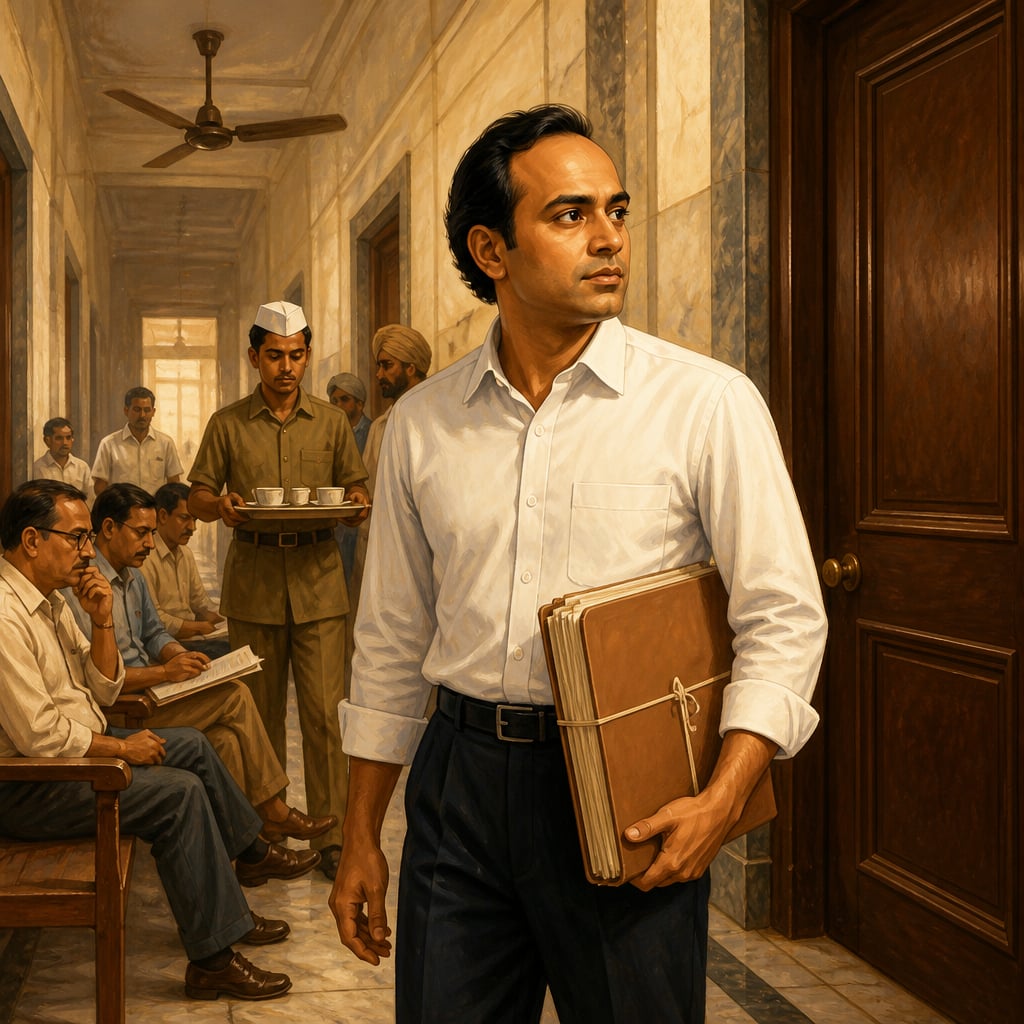
Dhirubhai Ambani in an Udyog Bhavan corridor with license applications

In 1966, a young entrepreneur named Dhirubhai Ambani applied for a license to manufacture polyester yarn. He had already built a successful textile trading business. He saw the future: synthetic fabrics would transform Indian clothing. All he needed was government permission.

Seven years passed.

Seven years of applications, rejections, appeals, meetings, connections, and, inevitably, payments to expedite files. In 1973, he finally received his license. By then, foreign competitors had leaped ahead. Indian consumers had learned to smuggle polyester from abroad. Billions in economic value had evaporated in bureaucratic waiting rooms.

This was License Raj: governance by permission slip.

The Anatomy of Control

To understand why License Raj failed, you must understand how it worked.

The Industrial (Development and Regulation) Act of 1951 established the framework. No industrial undertaking could be established or expanded without a license from the Central Government. The license specified:

Over time, additional controls proliferated:

MRTP Act (1969): The Monopolies and Restrictive Trade Practices Act prevented "large" companies from expanding. If you were successful, you were punished with more restrictions. The Tatas, Birlas, and other established houses found it nearly impossible to grow.

FERA (1973): The Foreign Exchange Regulation Act controlled every rupee that crossed borders. Importing machinery required permission. Traveling abroad required permission. Holding foreign currency was nearly criminal.

Capital Issues Control Act: Companies couldn't issue shares without government approval. The price, timing, and quantity of equity issues were regulated.

Essential Commodities Act: The government controlled prices of food, fuel, and other "essentials", ensuring chronic shortages.
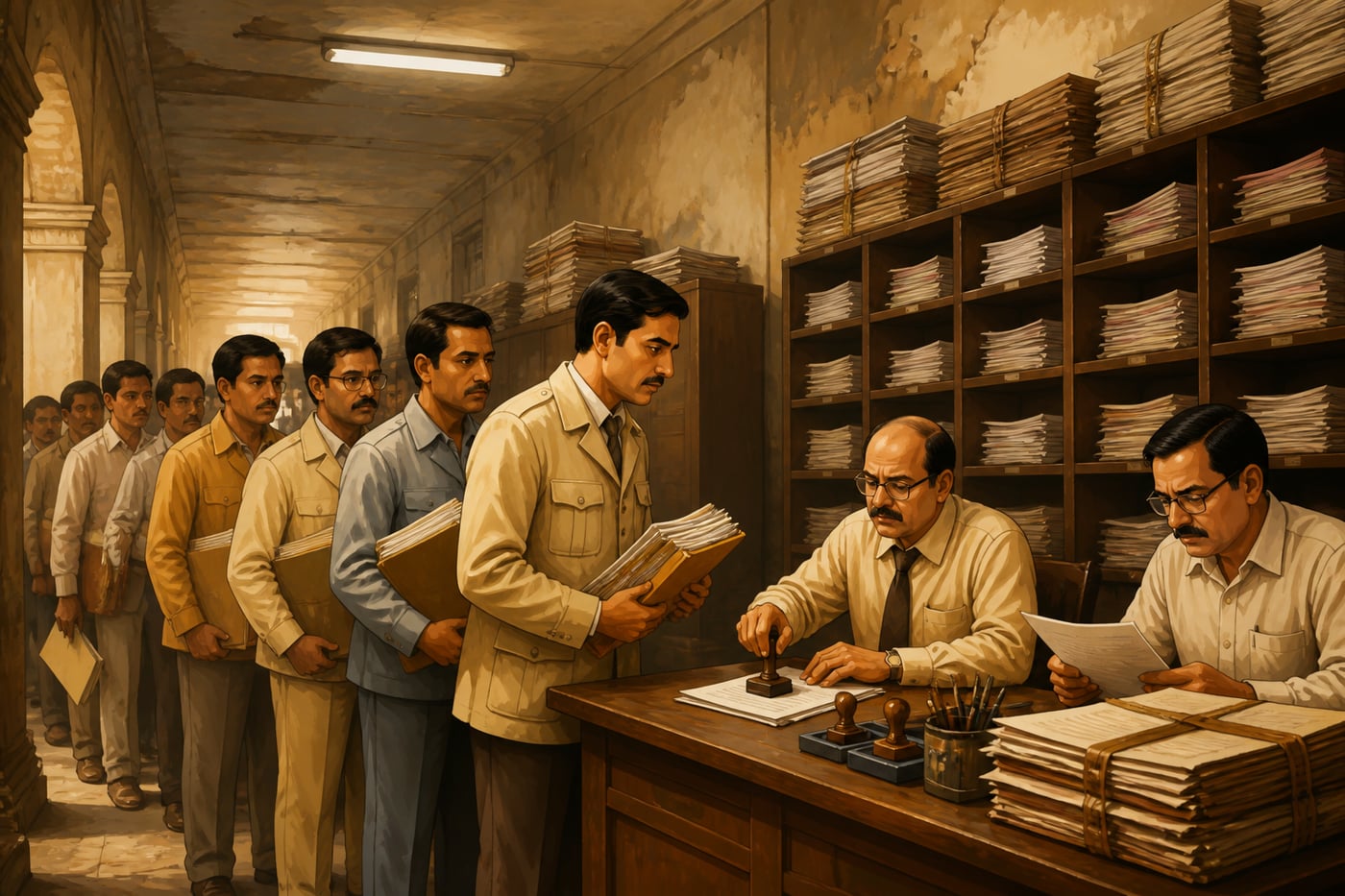
1975 North Block corridor crowded with entrepreneurs and clerks

The result: 80+ approvals were required to start a manufacturing business in India. Each approval involved a different ministry, different forms, different officials, different bribes.

The License Raj Labyrinth

Here is what an entrepreneur faced:

  1. Industrial License Application: Submit to the Directorate General of Technical Development. Wait 1-3 years.

  2. Capital Goods Import License: If approved, submit to the Chief Controller of Imports and Exports. Wait 6-12 months.

  3. Foreign Collaboration Approval: If technology was needed from abroad, submit to the Foreign Investment Board. Wait 1-2 years.

  4. MRTP Clearance: If the company was "large," submit to the MRTP Commission. Wait 1-2 years.

  5. Land Acquisition: Submit to state government. Navigate local politics. Wait indefinitely.

  6. Pollution Control: Submit to the Pollution Control Board. Wait 6-12 months.

  7. Power Connection: Apply to the State Electricity Board. Wait 1-3 years.

  8. Financing: Approach government-controlled banks. Demonstrate licenses. Wait 6-12 months.

Each step created opportunities for corruption. Each delay compounded. A project planned for 1975 might start in 1983, if at all.

"The License Raj was not just inefficient, it was designed to fail. Every bottleneck created rent-seeking opportunity. Every permission was a toll booth. The system enriched gatekeepers while impoverishing the nation.", Raghuram Rajan

The Players: Those Who Navigated and Those Who Drowned

Dhirubhai Ambani became the master of License Raj navigation. He understood that the system rewarded connections, not merit. He built relationships with bureaucrats and politicians. He obtained licenses that competitors couldn't get. He used the system's complexity as a moat, if you couldn't navigate, you couldn't compete.

Was this ethical? That depends on your framework. Dhirubhai didn't create License Raj, he survived it. In a system where permission was required for everything, those who could obtain permission won. Those who couldn't, lost, regardless of their capability or character.

The Bombay Dyeing Story shows the other side. Nusli Wadia's family business, established in 1879, was trapped by the MRTP Act. As a "large" company, Bombay Dyeing couldn't expand. When Reliance entered textiles with fresh licenses, Bombay Dyeing was at a disadvantage not because of inferior products but because of inferior political connections.

Reliance polyester loom running while Bombay Dyeing sits idle

The "Polyester Wars" of the 1980s pitted Reliance against Bombay Dyeing. Both sought licenses, quotas, and favorable policies. The competition occurred not in the marketplace but in Delhi's corridors. The winner was determined not by consumers but by bureaucrats.

The Informal Economy: Hernando de Soto's Insight

Hernando de Soto, the Peruvian economist, studied how regulatory burdens force businesses underground. His research, documented in The Mystery of Capital and The Other Path, showed that when formal systems are too costly, entrepreneurs create informal systems.

India's License Raj produced exactly this outcome:

De Soto's key insight: Property rights and easy business formation create prosperity. India's system did the opposite, it made formal business so difficult that informality became rational.

"In India, the cost of being legal was so high that illegality became the sensible choice. This wasn't moral failure, it was rational response to an irrational system.", Hernando de Soto

The Dharmic Critique: Adharma Institutionalized

From a dharmic perspective, License Raj was adharmic by design, it systematically violated principles that Indian tradition upholds.

Violation of Svadharma: Every entrepreneur has a calling, to create, to produce, to serve customers. License Raj required them to abandon this svadharma and become supplicants. The businessman became a beggar. The creator became a petitioner.

Corruption as Compulsion: The Gita repeatedly condemns bribery and corruption. Yet License Raj made corruption mandatory for survival. A system that forces good people to do bad things is itself bad.

अनृतं च प्रियं ब्रूयात् न ब्रूयात् सत्यमप्रियम्।

"One should not speak pleasant untruth, nor should one speak unpleasant truth.", Manusmriti

But what if the only way to get your file moving is to lie about your capacity? What if speaking truth means your application is rejected? License Raj created moral impossibilities, situations where no ethical path existed.

Arbitrary Power: Dharmic governance, as described in texts from Manusmriti to Arthashastra, requires that the king (state) follow known rules. Arbitrary power, where outcomes depend on bureaucratic whim, is condemned as tyranny.

License Raj officers had near-absolute discretion. Two identical applications might receive opposite outcomes based on mood, connection, or payment. This was not rule of law but rule of officials.

Raghuram Rajan: The Crony Capitalism Connection

Raghuram Rajan, former RBI Governor and IMF Chief Economist, has extensively analyzed how License Raj created "crony capitalism", a system where business success depends on political connections rather than market performance.

In his book Saving Capitalism from the Capitalists (co-authored with Luigi Zingales), Rajan shows how:

  1. Barriers to entry protect incumbents: When licenses are required, those who have them are protected from competition. New entrants can't challenge old players.

  2. Connections become capital: In License Raj, political relationships were more valuable than factories or technology. Businesses invested in lobbying rather than innovation.

  3. Reform becomes difficult: Those who benefit from the system, big businesses with licenses, bureaucrats with power, politicians with patronage, resist change.

"License Raj created a coalition of incumbents who had every incentive to maintain barriers. The tragedy is that even many victims supported the system because they hoped someday to become beneficiaries.", Raghuram Rajan

Rajan argues that India's post-1991 growth came precisely from dismantling these connections. When licenses were abolished, competition increased. When competition increased, consumers won.

The 2025 Reality: The Unfinished Liberation

Industrial licensing was largely abolished in 1991. But License Raj's ghost lingers:

Land acquisition still requires navigating multiple authorities. The 2013 Land Acquisition Act made it harder, not easier, to assemble land for projects.

Labor laws remain from the License Raj era. The Industrial Disputes Act (1947) makes it nearly impossible to close factories or retrench workers, so companies don't hire in the first place.

Environmental clearances have become the new bottleneck. A single project may require forest clearance, environmental clearance, coastal regulation clearance, and wildlife clearance, each from different authorities.

Compliance burden remains crushing for small businesses. GST simplification helped but compliance costs are still significant.

Progress made:

Work remaining:

Your Turn: Recognizing Modern License Raj

License Raj is not just history, versions of it exist everywhere.

In education: To start a school or college, you need university affiliation, AICTE approval, UGC recognition, state government permission... The parallel economy of "coaching centers" exists because formal education is too regulated.

In healthcare: Medical practice requires degrees, registrations, licenses from state medical councils. Many competent practitioners operate informally because formal compliance is impossible.

In housing: Urban development authorities, building permissions, occupancy certificates, property registration... Millions live in "unauthorized" colonies because authorized housing is unaffordable due to regulatory costs.

The dharmic response is not to abandon all regulation but to ask:

Every unnecessary permission is a toll booth. Every toll booth is an opportunity for extraction. The path to Viksit Bharat requires dismantling toll booths, not building new ones.

Ease of doing business as measure of governance quality

The World Bank's Ease of Doing Business index measures exactly this: how much 'sankata' (distress) do regulations cause? Good governance minimizes bureaucratic burden.

This dharmic principle predates modern economics by millennia. India's tradition always understood that commerce requires enabling governance, not obstructing bureaucracy.

India's Ease of Doing Business rank: 142nd in 2014, 63rd in 2019. The improvement came from reducing 'sankata' (distress) for merchants through reforms.

Institutional economics and how rules shape behavior

Douglass North's institutional economics shows that 'the rules of the game' determine economic outcomes. Bad rules produce bad behavior, even from good people.

Key terms

Audyogik Anujñā
Industrial License - the government permit required to establish, expand, or modify any industrial undertaking under the Industries (Development and Regulation) Act, 1951.
Ekādhikāra
Monopoly - exclusive control over a commodity or service. The MRTP Act (1969) was designed to prevent monopolies but ended up protecting incumbents from competition.
Kālābāzār
Black Market - informal markets where goods are traded outside legal channels, typically at prices above official rates. Created by price controls and licensing restrictions.
Nirīkṣak Rāj
Inspector Raj - the system where government inspectors had power to enter, inspect, and penalize businesses, often using this power for extortion.

Key figures

Dhirubhai Ambani

Founder of Reliance Industries; master navigator of the License Raj system

Raghuram Rajan

Economist, former RBI Governor (2013-2016), former IMF Chief Economist; critic of crony capitalism

Hernando de Soto

Peruvian economist; expert on property rights and the informal economy

Case studies

The Polyester Wars: Reliance vs Bombay Dyeing

In the 1980s, India's textile industry became a battlefield, not of products and prices, but of licenses and connections. **Reliance Industries**, founded by Dhirubhai Ambani, had risen from textile trading to manufacturing. By 1985, it was seeking licenses to expand polyester capacity massively. Dhirubhai cultivated political connections across parties. He understood that in License Raj, the real competition was in Delhi, not the marketplace. **Bombay Dyeing**, run by Nusli Wadia, was an old-economy company, established 1879, impeccable reputation, but classified as a 'large house' under MRTP. Every expansion required MRTP clearance, which was slow and uncertain. Wadia played by rules that Ambani was rewriting. The battle played out in: - **License applications**: Both sought capacity licenses. Reliance got approvals; Bombay Dyeing faced delays. - **Import quotas**: When raw materials were rationed, Reliance received larger allocations. - **Policy changes**: When polyester import duties changed, the changes seemed to favor Reliance's integrated model. - **Media wars**: Both sides planted stories. The business press became a battleground. The conflict culminated in criminal complaints, parliamentary questions, and mutual accusations of impropriety. The actual products, polyester fabrics, were almost irrelevant. The war was about capturing the regulatory apparatus.

The Polyester Wars illustrate how License Raj **perverted competition**: **Corruption compelled**: Both sides were forced into political manipulation. In a system where licenses determined survival, not cultivating connections was suicidal. The system made adharma rational. **Consumer irrelevant**: Nowhere in this story do consumers appear. Their preferences didn't matter. What mattered was what bureaucrats approved. This is the opposite of market dharma, where the customer is sovereign. **Zero-sum thinking**: In a license-limited world, every approval for one company was denial to another. This created bitter rivalry instead of expanding-pie cooperation. The dharmic economy allows competition in the marketplace, may the best product win. License Raj forced competition in the bureaucracy, may the best-connected win. This is not dharma; it is distortion.

Reliance won the Polyester Wars, not definitively, but cumulatively. By 1991, it was India's largest private company. Bombay Dyeing survived but never caught up. But the real outcome came after 1991. When licenses were abolished: - Both companies had to compete on products, not permissions - New competitors entered (imports, new domestic players) - Consumers finally had choice - Polyester prices fell; quality improved; variety exploded The market resolved in years what the bureaucracy couldn't resolve in decades. The Polyester Wars showed that License Raj didn't prevent monopoly, it just determined who the monopolist would be.

When government controls allocation, competition moves from marketplace to bureaucracy. Resources spent on lobbying, connections, and manipulation are resources not spent on innovation, quality, and service. The most talented entrepreneurs become the best navigators of red tape, a tragic waste of human potential.

Lobbying and regulatory capture remain central concerns in modern economies. From Big Tech's influence on regulation to pharma industry lobbying in the US, the pattern of competition shifting from the marketplace to the halls of power persists wherever governments control market access.

Reliance market cap in 1985: ~₹600 crore. Reliance market cap in 2024: ~₹19 lakh crore. But most of this growth came after 1991, when licenses ended and market competition began.

Historical context

The License Raj Period (1951-1991)

License Raj reached peak absurdity in the 1970s-80s. The Emergency (1975-77) showed how controls could be used for political ends. The 1980s 'liberalization by stealth' began easing some controls but the core system remained until 1991's crisis forced change.

While India's bureaucracy processed license applications, East Asian economies were building export industries. South Korea's Hyundai, Taiwan's TSMC, Singapore's ports, all emerged during India's License Raj years. The comparison is stark: what India could have been versus what it became.

Processing time for industrial license in 1985: average 3-5 years. Number of forms required: 80+. Compare with Singapore: company registration in 1 day, minimal approvals needed.

Understanding License Raj mechanics helps recognize similar systems today. Whenever approval is required, queues form, bribes flow, and productive energy is wasted. The lesson applies beyond India to any regulatory system.

Living traditions

The business houses that survived License Raj had to develop political skills alongside commercial ones. This dual capability, market competition plus regulatory navigation, remains valuable in India where bureaucracy still matters.

Reflection

More in Independence to License Raj (1947-1991)

All lessons in Independence to License Raj (1947-1991) · Viksit Bharat: India's Development Journey course