Sindhi-Vanijya: Trading Traditions of Indus Valley

Merchants Without a Homeland

How Sindhi traders, inheritors of 5,000 years of Indus Valley commerce, lost everything in Partition yet rebuilt global empires within a generation - demonstrating that trading acumen transcends territory.

The Merchant Who Became King
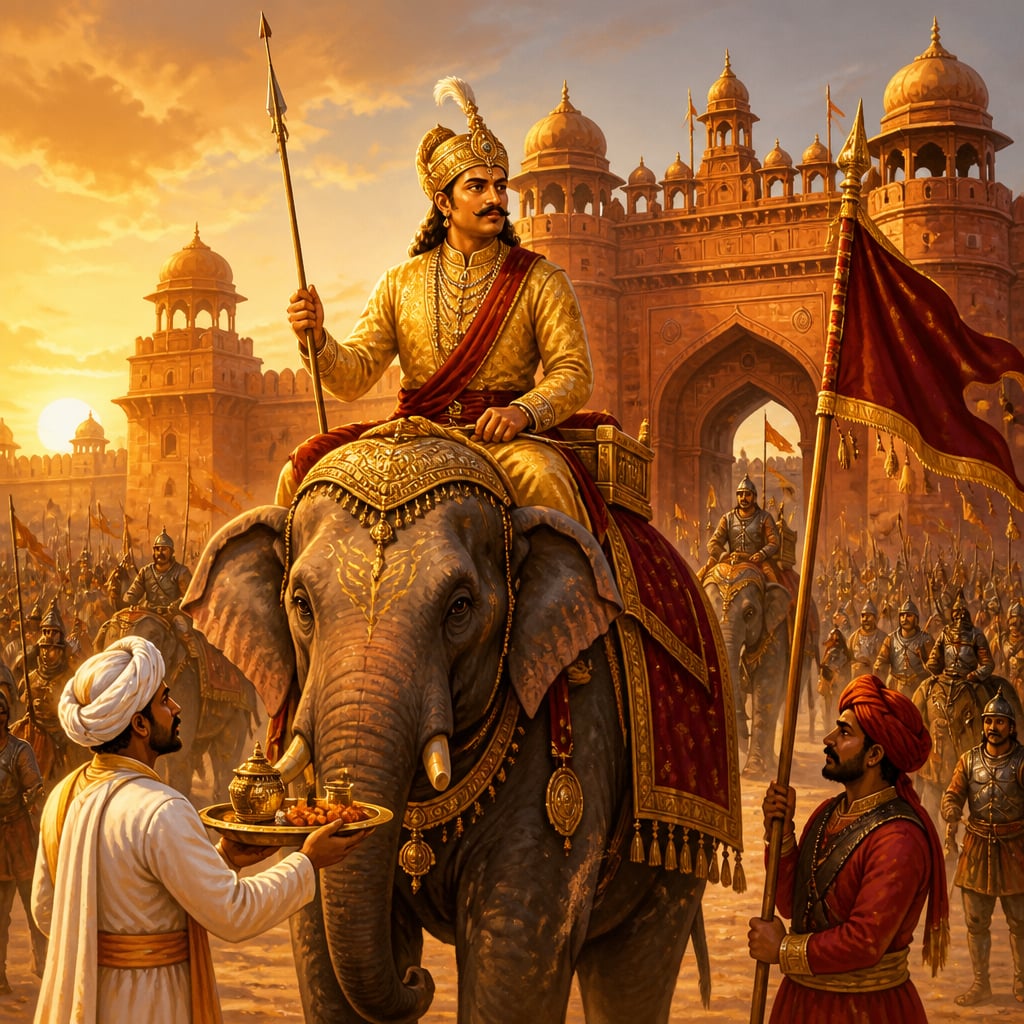
Hemu on his war elephant before the gates of Delhi in 1556

In 1556, a grain merchant's son stood before the gates of Delhi. Hemu - born Hemchandra Vikramaditya in a Sindhi trading family - had risen from selling grains in the markets of Rewari to commanding the largest army in Hindustan.

Just weeks earlier, he had defeated the Mughal forces in battle after battle. Now, on October 7, 1556, he would fight for the throne of Delhi itself at the Second Battle of Panipat.

Hemu's army numbered 1,500 war elephants and 100,000 soldiers. He rode his favorite elephant, Hawai, at the front. For a moment, it seemed a Sindhi merchant's son would rule India.

An arrow struck his eye. He fell. The battle was lost.

But Hemu's story captures something essential about Sindhi identity: traders who could become warriors, merchants who could become kings. The Sindhis had been trading since the Indus Valley Civilization - 5,000 years of commerce flowing through their land. When Partition came in 1947, they would need every ounce of that ancestral resilience.

The Land at the Crossroads

Sindh - the land of the Sindhu (Indus) River - was blessed and cursed by geography. The Indus created fertile agricultural land. More importantly, it created the crossroads of Asia.

From Mohenjo-daro (2600-1900 BCE), Sindhi merchants traded with Mesopotamia, Persia, and Central Asia. The Indus Valley Civilization's standardized weights and measures - found across thousands of kilometers - suggest sophisticated trading networks.

"Sindhi ghar ghar mein vyapari" - Every Sindhi home has a trader

This wasn't metaphor. Sindhi culture sacralized commerce more completely than perhaps any other Indian community. While Brahmins elsewhere looked down on trade, Sindhi Brahmins often combined priesthood with business. The amil (administrator-merchant) class handled both governance and commerce.

By the 19th century, Sindhi traders had networks spanning:

Then came 1947.

The Great Uprooting

Partition created millions of refugees on both sides. But Sindhi Hindus faced a unique catastrophe: almost the entire community had to leave.

Unlike Punjab, where populations moved in both directions, Sindh was 75% Muslim. There was no equivalent incoming population. Sindhi Hindus left wholesale - an estimated 1.2 million people abandoning homes, businesses, and communities built over generations.

They arrived in India with nothing. Literally nothing.

A Sindhi refugee family at the Ulhasnagar barracks in 1947

Refugee camps: Ulhasnagar near Bombay. Adipur in Gujarat. Scattered colonies across India.

No networks: Unlike Marwaris or Gujaratis who had established communities across India, Sindhis had concentrated in Sindh. Their trading partners were now in Pakistan.

No language recognition: Sindhi wasn't even recognized as an official language of India until 1967.

A community that had been trading for 5,000 years had to start from absolute zero.

The Sindhi Rebuilding: Four Pillars

1. Punarjanma: The Rebirth Mentality

Sindhis didn't mourn what was lost. They treated 1947 as punarjanma - rebirth. The past was gone. Only the future mattered.

This wasn't stoicism but strategy. Refugee camps became classrooms for business. Elders taught trading skills to youth. The question wasn't "What did we lose?" but "What can we build?"

2. Saheli-Saathi: Rebuilding Networks

Without established networks, Sindhis created new ones. The saheli-saathi (friend-companion) system worked like this:

"Sindhi nu Sindhi sahara" - A Sindhi is a Sindhi's support

Within a decade, these networks spanned India. Within two decades, they were global again.

3. Jugaad: Adaptive Innovation

Sindhis perfected jugaad - the art of creative problem-solving with limited resources. When you have nothing, innovation isn't optional.

Examples:

4. Vyapaar-Vidya: 5,000 Years of Trading DNA

Sindhis carried something no partition could take: trading knowledge encoded over millennia.

These skills, refined since Mohenjo-daro, proved more valuable than any physical inventory.

Global Perspectives on Refugee Entrepreneurship

The Sindhi experience parallels history's great refugee rebuildings:

The Sephardic Jewish Diaspora (post-1492) offers the closest parallel. When Ferdinand and Isabella expelled Jews from Spain, a community that had thrived for centuries scattered across the Mediterranean, Netherlands, and Ottoman Empire.

Like Sindhis, Sephardic Jews:

The Sephardic network eventually dominated the diamond trade from Amsterdam to Antwerp to New York - much as Sindhis would come to dominate certain trading niches in India.

The Huguenot exodus (1685) similarly scattered French Protestant merchants across Europe. They brought textile skills that transformed British manufacturing and banking expertise that built German commerce.

Diaspora Key Strength Post-Exile Success
Sephardic Jews Trading networks + diamond expertise Dominated global diamond trade
Huguenots Textile + banking skills Built British/German industries
Vietnamese refugees Adaptability + education focus US business success within one generation
Sindhis Trading DNA + network rebuilding Manufacturing, retail, global trade

The common thread: communities that treat knowledge as their primary asset can survive losing everything else.

Modern Resonance: The Hinduja Phenomenon

In 1947, Parmanand Deepchand Hinduja was a successful merchant in Sindh with trading interests across Iran and Iraq. Partition destroyed his Indian base. He had to choose: retreat or expand.

He chose expansion.

The four Hinduja brothers reviewing their global operations in London

Sending his four sons - Srichand, Gopichand, Prakash, and Ashok - to different global locations, Parmanand rebuilt the Hinduja network using classic Sindhi strategies:

Saheli-Saathi: Each brother became a node in a global network. London, Geneva, Mumbai, Los Angeles - family members providing local knowledge and trustworthy partnership.

Jugaad: Without capital for major investments, they became intermediaries - connecting Iranian oil with European buyers, facilitating trade others couldn't.

Vyapaar-Vidya: Deep understanding of markets, currencies, and cross-cultural negotiation - trading knowledge refined over generations.

By 2024, the Hinduja Group:

The family motto? "My dharma is to work so that I can give." Classic Sindhi integration of commerce and service.

The Ulhasnagar Miracle

Perhaps nowhere demonstrates Sindhi resilience better than Ulhasnagar - a name that means "city of joy" but was given to what began as a refugee transit camp.

In 1947, the Kalyan military barracks near Bombay became a temporary shelter for Sindhi refugees. "Temporary" meant tents and uncertainty.

By 2024, Ulhasnagar is:

The transformation followed classic Sindhi patterns:

  1. Start with nothing: Literally tents and refugee rations
  2. Find any trading opportunity: Sindhis began trading goods between refugee camps
  3. Build manufacturing: When trading wasn't enough, they made goods themselves with improvised machinery
  4. Scale through networks: Success stories spread through the community, bringing more entrepreneurs
  5. Dominate niches: Ulhasnagar became the default source for certain products because Sindhis optimized relentlessly

Your Turn: The Sindhi Mirror

The Sindhi story isn't about trauma - it's about transcendence. Their principles apply whether or not you've lost everything:

From Mohenjo-daro to Mumbai, from Hemu's empire to Hinduja's, Sindhi success proves that trading communities carry their wealth in their heads, not their warehouses.

In the next lesson, we'll examine what these legendary communities share - the common patterns that made Marwaris, Chettiars, Gujaratis, and Sindhis successful across such different circumstances.

Sunk cost fallacy avoidance; forward-looking decision making; psychological resilience as economic advantage

Behavioral economists study the 'sunk cost fallacy' - the tendency to continue investing in losing propositions because of past investment. Sindhi punarjanma thinking naturally avoids this trap by treating each day as a fresh start.

The Hindu concept of rebirth, internalized into business thinking, provides philosophical grounding for what economists call 'rational' forward-looking behavior. Treating business cycles as births and deaths removes emotional attachment to past investments.

Studies of refugee entrepreneurs consistently show higher business formation rates than native populations. The 'nothing to lose' mentality, combined with necessity, drives action that comfortable populations avoid.

Frugal innovation; resource constraints as innovation drivers; bootstrapping

Harvard Business School now teaches 'frugal innovation' - developing solutions under resource constraints. Indian examples like the Tata Nano and Jaipur Foot prosthetic are celebrated cases. Sindhi traders practiced frugal innovation for millennia before it became a business school concept.

Key terms

Punarjanma
Rebirth; in Sindhi business context, the mentality of treating major losses as opportunities for complete reinvention rather than permanent defeat
Jugaad
Creative improvisation; the art of achieving goals through unconventional means when standard resources aren't available
Vyapaar-Vidya
Trading knowledge; the accumulated wisdom of commerce passed down through generations, covering everything from market reading to negotiation to risk assessment
Amil
A Sindhi caste that combined administrative and commercial functions; administrator-merchants who managed both governance and trade

Key figures

Hemu (Hemchandra Vikramaditya)

1501-1556

The Hinduja Brothers

1935-present

The Sephardic Jewish Diaspora

1492-present

Case studies

Ulhasnagar: From Refugee Tents to Manufacturing Powerhouse

In August 1947, the Kalyan Military Transit Camp near Bombay became a refuge for thousands of Sindhi families fleeing Partition. Rows of army tents housed people who had been prosperous merchants, landowners, and professionals just weeks before. The camp was meant to be temporary - refugees would be 'resettled' elsewhere. Instead, Sindhis made it permanent. The camp was renamed 'Ulhasnagar' (City of Joy) in 1949, though there was little joyful about the initial conditions. Refugees lived on government rations. There were no jobs, no infrastructure, no future visible. But Sindhi trading instincts couldn't be suppressed. Within months: **Trading began**: Refugees started trading goods between camps, exploiting price differences for basic commodities **Manufacturing emerged**: Unable to afford inventory, Sindhis began making goods themselves - starting with basic textiles using improvised equipment **Networks formed**: Information about successful ventures spread through the Sindhi community, attracting more entrepreneurs to promising sectors **Niches were captured**: Ulhasnagar became known for specific products - jeans, leather goods, electronics - where Sindhi manufacturers achieved unbeatable cost positions through jugaad innovations

Through dharmic economics, Ulhasnagar demonstrates several principles: **Punarjanma in Action**: Refugees treated 1947 as a rebirth, not an ending. Rather than waiting for government resettlement, they created their own futures. **Karma Yoga**: Work itself became the path forward. Not waiting for perfect conditions, but acting with what was available. The Gita's teaching - 'focus on action, not results' - enabled action even when results seemed impossible. **Saheli-Saathi Networks**: The community supported itself. Credit flowed between Sindhi traders when banks wouldn't lend to refugees. Information about opportunities spread through community channels. **Seva through Commerce**: Ulhasnagar's manufacturers didn't just create wealth - they provided affordable goods to India's masses. The dharmic principle of business as service found expression in products that lower-income Indians could afford. Conventional economic analysis would predict that refugees without capital, infrastructure, or networks would remain dependent on aid. Sindhi commercial culture overrode this prediction.

By 2024, Ulhasnagar has transformed from tented refugee camp to: - **City of 700,000+ residents** - almost all descendants of 1947 refugees - **Major manufacturing hub** for textiles, leather, and consumer goods - **Annual production value in thousands of crores** across various industries - **Supplier to India and export markets** with goods reaching across Asia and Africa The city remains predominantly Sindhi and retains the trading culture that created it. Second and third generation Sindhis have diversified into services, professions, and technology - while manufacturing continues as the economic base. Critically, this transformation happened without significant government support or external investment. Sindhi community capital, recycled through the saheli-saathi network, funded successive waves of business creation.

Communities with strong trading cultures can rebuild from complete destruction within a generation. The critical assets aren't financial but cultural: trading knowledge, mutual support networks, willingness to start from nothing, and the punarjanma mentality that treats setbacks as new beginnings.

Refugee entrepreneurship remains one of the most under-studied phenomena in economics. From Vietnamese boat people building nail salon empires in the US to Syrian refugees launching businesses across Turkey and Germany, the Ulhasnagar pattern repeats globally. Communities with embedded trading culture rebuild faster because their real capital is knowledge and trust networks, not physical assets.

Ulhasnagar's jeans manufacturing industry alone produces an estimated 50 million pairs annually - built from a refugee camp with no textile tradition, no machinery, and no capital in 1947.

Historical context

2600 BCE - Present

Sindh's position on the Indus River made it the crossroads of subcontinental trade for 5,000 years. The region connected maritime trade from the Arabian Sea with overland routes to Central Asia, Persia, and beyond. Unlike other Indian trading communities that operated within Hindu social frameworks, Sindhi Hindus developed unique adaptations to living under Muslim-majority rule for centuries - including pragmatic attitudes toward inter-religious business and distinctive cultural practices that survived Partition.

The Sindhi Partition experience most closely parallels the Sephardic Jewish expulsion from Spain (1492) and subsequent diaspora. Both communities had traded for millennia; both faced sudden complete displacement; both carried 'portable' trading knowledge; both rebuilt networks across multiple countries; both came to dominate particular trading niches. The Vietnamese boat people (post-1975) represent a more recent parallel, with similar patterns of rapid entrepreneurial success in host countries.

Sindhi Hindus went from approximately 1.2 million refugees in 1947 to being among India's most successful business communities by 1970 - a transformation achieved in a single generation despite starting with no assets, no networks, and no government support.

The Sindhi experience proves that trading cultures can survive the complete loss of territory, assets, and networks. This has profound implications for understanding entrepreneurship, refugee policy, and the relative importance of financial versus human capital. The lesson: invest in education and community bonds - they're the only assets that can't be confiscated.

Reflection

More in Legendary Trading Communities of India

All lessons in Legendary Trading Communities of India ยท Vaishya Dharma: The Art of Ethical Commerce course