Samudaya-Safalta: Why These Communities Succeeded

Decoding the Common Patterns

What do Marwaris, Chettiars, Gujaratis, and Sindhis share that made them legendary traders? This synthesis lesson decodes the seven common factors of samudaya-safalta - community success - and examines why some communities with similar advantages didn't achieve similar results.

The Puzzle of Selective Success
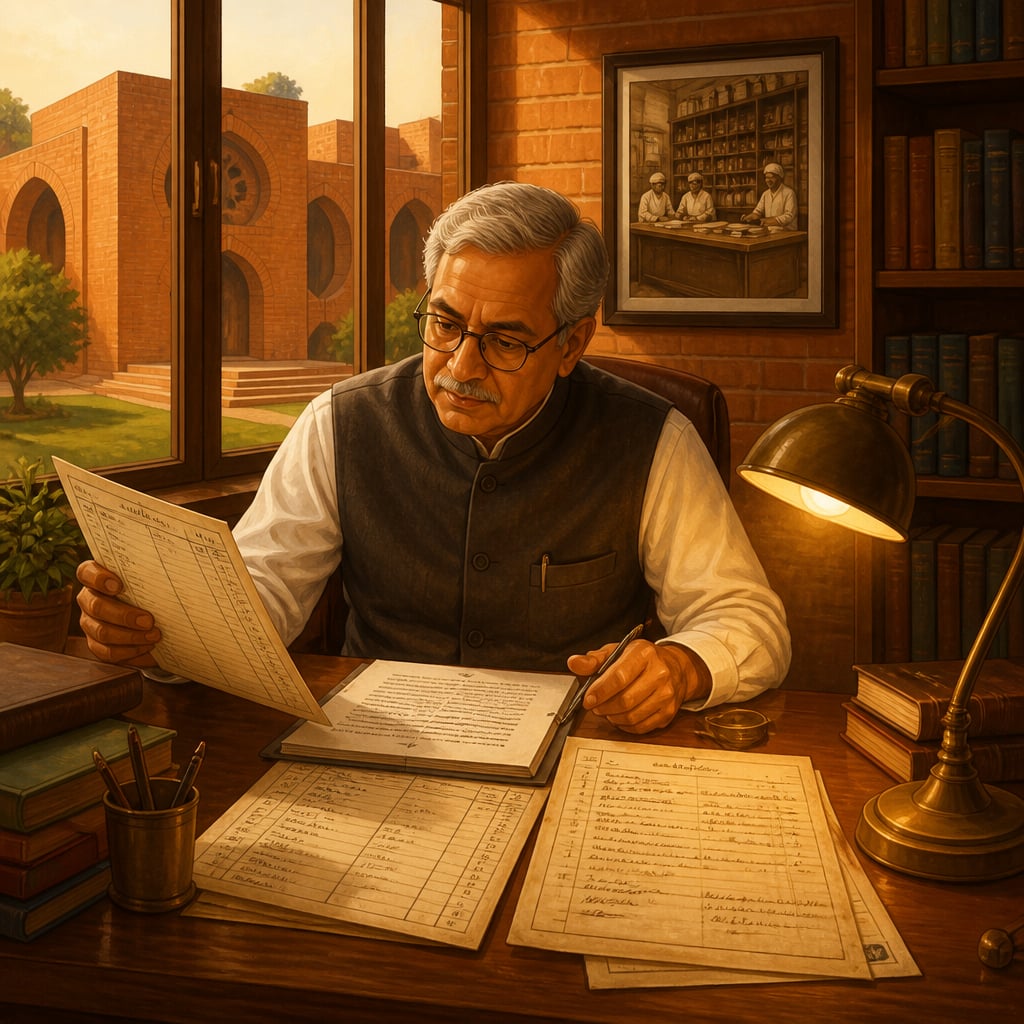
Dwijendra Tripathi comparing trading-community records at his IIM Ahmedabad desk

Consider the puzzle: India has hundreds of distinct communities. Many had access to trade routes. Many practiced commerce for centuries. Many had strong family structures. Yet only a handful became legendary trading communities with disproportionate economic power.

Marwaris from Rajasthan's desert control an estimated 60% of India's industrial assets despite comprising less than 1% of population.

Chettiars from 74 Tamil villages financed the development of Southeast Asia.

Gujaratis own 60%+ of American hotels and cut 90% of the world's diamonds.

Sindhis rebuilt from refugee camps to become among India's most successful entrepreneurs.

Why these communities and not others? What did they share that created such extraordinary success?

In 1978, economist Thomas Timberg published his landmark study of Marwari business, attempting to answer this question. Business historian Dwijendra Tripathi spent decades documenting Indian trading communities at IIM Ahmedabad. Their research, combined with the evidence we've examined, reveals seven common factors.

The Seven Pillars of Samudaya-Safalta

1. Vishwasa-Tantra: The Trust System

All four communities developed sophisticated trust systems that enabled commerce without legal infrastructure:

The pattern: Each community created mechanisms to punish defection (breaking trust) and reward cooperation (honoring commitments). This reduced transaction costs dramatically compared to relying on courts and contracts.

2. Kanjusi-Dharma: Sacred Frugality

All four communities practiced extreme frugality - not as poverty but as discipline:

The pattern: Wealth was for compounding, not consuming. Personal frugality freed capital for business growth. Visible simplicity prevented social pressure for wasteful display.

3. Pravas-Niti: Strategic Migration

All four communities treated migration as business strategy:

The pattern: Migration wasn't exile but opportunity hunting. Family members in different locations created information advantages, arbitrage opportunities, and fallback options.

4. Vidya-Prem: Investment in Education

All four communities invested heavily in education - not as luxury but as portable capital:

The pattern: Education created skills that could move - the ultimate hedge against loss of physical assets.

5. Kutumbaka-Bandhan: Family Structure

All four communities used the joint family as economic unit:

The pattern: The family provided patient capital, built-in training, trust relationships, and multi-generational continuity that individual entrepreneurs couldn't match.

6. Vibhajana-Yukti: Diversification Strategy

All four communities avoided concentration risk:

The pattern: No single monsoon, customer, or government could destroy a diversified family. This survival strategy from adverse origins became competitive advantage.

7. Kasht-Labh: The Advantage of Adversity

Perhaps most counterintuitively, all four communities emerged from adverse conditions:

The pattern: Adversity forced innovation. Communities with comfortable agricultural bases had less pressure to develop trading expertise. Necessity created capability.

The Contrast: Why Others Didn't Succeed Similarly

The seven factors become clearer when we examine communities that had some advantages but didn't achieve similar trading dominance:

The Bengal Paradox

A genteel Bengali bhadralok household reading law in late-19th-century Calcutta

Bengali bhadralok (genteel class) had access to British education, colonial capital, and Calcutta's position as commercial capital. Yet Bengalis didn't become a dominant trading community. Why?

Bengalis excelled in professions (law, medicine, civil service) and culture (literature, arts) but not in trading community formation.

The Kerala Question

Keralites have among India's highest education levels, significant diaspora (Gulf migration), and historical trading connections (spice trade). Yet they didn't form trading community networks like Gujaratis or Marwaris.

Kerala produced excellent professionals and workers but not trading dynasties.

The Agricultural Prosperity Trap

Communities in fertile agricultural regions - Punjab's Jat farmers, UP's agrarian castes - often didn't develop trading cultures despite wealth:

The kasht-labh (advantage of adversity) factor explains much: communities forced to trade by circumstance developed capabilities that comfortable communities didn't need.

New Trading Communities Emerging

The patterns aren't locked in history. New communities are applying the seven factors today:

The Patidar Phenomenon

Patidars (Patels) from Gujarat have emerged as a distinct trading force in recent decades:

Patidars are essentially applying the Gujarati playbook with community-specific adaptation.

The Gounder Rise

Kongu Vellalar Gounders from Tamil Nadu's Coimbatore region have built significant industrial presence:

Gounders demonstrate that the seven factors can be replicated outside traditional trading communities.

Global Perspectives: Middleman Minorities

Economist Thomas Sowell studied what he calls "middleman minorities" worldwide - ethnic groups that dominate commerce in their host societies:

Sowell's analysis confirms the seven factors aren't India-specific but universal patterns of trading community success:

Factor Indian Communities Global Parallels
Trust Systems Sangam, naam, saheli-saathi Jewish kehilla, Chinese guilds
Frugality Kanjusi-dharma Protestant ethic, Confucian thrift
Migration Pardesi journeys Jewish diaspora, Chinese overseas
Education Community schools, universities Yeshivas, Chinese examination tradition
Family Structure HUF, kutumbaka Extended family businesses, clan structures
Diversification Multi-industry families Portfolio trading patterns
Adversity Origins Desert, rocky land, Partition Persecution, minority status

The striking conclusion: successful trading communities worldwide share remarkably similar characteristics, suggesting these factors represent universal requirements for community commercial success, not cultural accidents.

The Ratan Tata Synthesis

Ratan Tata reviewing a strategic acquisition file at Bombay House

Ratan Tata represents a unique synthesis of trading community wisdom. Though Parsi (a separate trading community with its own traditions), Tata learned from and integrated practices across communities:

From Marwaris: Long-term investment orientation; patience through cycles From Gujaratis: Partnership structures; willingness to enter new industries From Parsi Tradition: Integration of business with national service; the Tata ethos of "earning public trust" Modern Adaptation: Professional management, global expansion, strategic acquisitions

Tata's leadership of Tata Group (1991-2012) showed that the seven factors can be consciously applied, not just inherited. His transformation of Tata from a diversified conglomerate to a globally competitive group demonstrates that community business wisdom can be learned and adapted.

Your Turn: The Samudaya Mirror

The seven factors aren't genetic inheritance - they're practices that can be adopted:

The trading communities didn't succeed because of birth - they succeeded because of practices refined over generations. Those practices are learnable.

In our final lesson, we'll bring these insights into 2026 and beyond - asking how these ancient patterns apply to the AI age, the global economy, and your specific circumstances.

Cultural transmission; institutional economics; path dependence vs. deliberate design

Management consulting sells frameworks for organizational success. The seven pillars are a framework for community/network success - applicable to any group seeking collective prosperity, whether defined by ethnicity, profession, or purpose.

India's trading community traditions provide living laboratories for studying these factors. Unlike historical cases (Venetian merchants, Hanseatic League), Indian communities remain active and observable. This enables ongoing learning and adaptation.

Communities that have consciously adopted trading community practices - like Patidars in American hospitality or Gounders in Coimbatore manufacturing - show similar success patterns within 1-2 generations, suggesting the factors are indeed transferable.

Antifragility; post-traumatic growth; selection effects; necessity as innovation driver

Nassim Taleb's 'antifragility' concept - systems that gain from disorder - parallels kasht-labh. The innovation literature shows that constraints drive creativity more than abundance does. Trading communities embodied antifragility before Taleb named it.

Key terms

Samudaya-Safalta
Community success; the phenomenon of entire communities achieving economic dominance through shared practices, values, and institutions
Kasht-Labh
Advantage from adversity; the phenomenon where difficult origins or circumstances create capabilities that become competitive advantages
Madhyastha-Jati
Middleman minority; an ethnic group that specializes in commerce and intermediation in societies where they are a minority
Sapta-Stambha
The seven pillars; the seven common factors underlying trading community success identified in this analysis

Key figures

Dwijendra Tripathi

1935-present

Ratan Tata

1937-present

Thomas Sowell

1930-present

Case studies

The Contrast: Why Bengal and Kerala Didn't Produce Trading Dynasties

Bengal and Kerala both had apparent advantages for trading community formation: **Bengal**: - Calcutta was British India's commercial capital - Early access to English education - Historical trading traditions (medieval Bengal was wealthy) - Intellectual and cultural leadership **Kerala**: - Ancient spice trade connections (Roman, Arab, Chinese trade) - India's highest literacy and education levels - Significant diaspora (Gulf migration) - Port cities with trading history Yet neither produced trading dynasties comparable to Marwaris, Gujaratis, or Chettiars. Why? **The Bengali Case**: The bhadralok (genteel) class that dominated Bengal society valued government service, professions, and culture over commerce. Trade was associated with lower status. Education focused on liberal arts and law rather than business. Early adoption of nuclear family patterns reduced the joint family capital pooling advantage. Community enforcement mechanisms were weaker - individual reputation mattered more than community sanction. The result: Bengal produced world-class intellectuals, lawyers, and administrators, but not trading dynasties. **The Kerala Case**: Religious and caste fragmentation (Hindu, Muslim, Christian communities with distinct practices) prevented the unified community networks that trading communities require. Migration was individual/family rather than community-coordinated. The economic model emphasized remittances (sending wages home) rather than business building abroad. Matrilineal traditions in some communities created different inheritance patterns. The result: Kerala produced excellent professionals and workers worldwide, but not trading networks.

The contrast illuminates which of the seven factors are most essential: **Trust Systems (Factor 1)**: Bengal lacked strong community enforcement; Kerala had fragmented communities. Both missing the unified trust infrastructure that enables credit and coordination. **Status of Commerce**: In Bengal, trade carried lower status than professions. This inverted the trading community pattern where commerce was dharma, not stigma. **Family Structure (Factor 5)**: Earlier nuclear family adoption in Bengal reduced joint family advantages. Different inheritance traditions in Kerala created different incentive structures. **Migration Pattern (Factor 3)**: Both regions had migration, but not the coordinated community network-building that trading communities practiced. Individual success didn't create community infrastructure. The dharmic insight: samudaya-safalta requires all seven factors working together. Excellence in some (education in both regions, migration in Kerala) cannot compensate for weakness in others (trust systems, family structure, commercial status).

The contrast produces clear lessons: **What Bengal achieved instead**: Literary and intellectual leadership (Tagore, Ray, Sen); professional excellence (law, medicine, civil service); cultural production. Bengali success came in fields where individual talent matters more than community network. **What Kerala achieved instead**: Human development indices (health, education, gender equality); professional diaspora success; model of social development without trading wealth. **What both missed**: The compound returns of community commercial networks; the multi-generational wealth accumulation; the infrastructure of trust that enables scaling. By 2024, the patterns persist: Marwaris and Gujaratis continue dominating Indian commerce; Bengali and Keralite success remains concentrated in professions and individual achievement rather than trading community formation.

Commercial community success requires all seven factors aligned. Excellence in education or individual achievement doesn't substitute for trust networks, family structure, and commercial culture. The factors are interdependent - you can't choose three or four and expect the same results.

The 'Bengal paradox' has a direct modern parallel in regions with strong academic output but weak commercial ecosystems. Many countries invest heavily in education but fail to produce entrepreneurial clusters because they neglect the complementary factors: trust networks, family capital structures, and cultural respect for commerce. Silicon Valley's dominance, for instance, rests on network effects that mirror traditional trading community dynamics.

Despite producing more Nobel laureates (Tagore, Sen, Raman) than any Indian region, Bengal's share of India's commercial wealth has declined relative to Gujarat and Rajasthan over the past century.

New Communities Rising: Patidars and Gounders

The seven factors aren't historical artifacts - they're being applied by new communities today: **The Patidar (Patel) Phenomenon**: Patidars from Gujarat's Kheda, Mehsana, and surrounding districts have emerged as a distinct trading force since the 1970s: - **Trust Systems**: The Patidar Samaj (community organization) coordinates information, resolves disputes, and enforces standards. Patel directories enable global community connections. - **Frugality**: Known for extreme cost management - the motel business model relies on family labor and minimal overhead. - **Migration**: Systematic waves to East Africa, UK, and especially USA. Community networks in each destination help newcomers establish. - **Education**: Heavy investment in professional education - engineering, medicine, business. - **Family Structure**: Joint family businesses remain common; siblings often operate connected enterprises. - **Diversification**: From farming to motels to real estate to medicine to technology. **The Gounder Rise**: Kongu Vellalar Gounders from Tamil Nadu's Coimbatore region have built significant industrial presence: - **Trust Networks**: Strong community institutions coordinating business information and credit. - **Frugality**: Legendary cost-consciousness in manufacturing operations. - **Education**: Investment in technical education; Coimbatore has numerous engineering colleges. - **Industry Clustering**: Textile machinery, pumps, auto components - cluster effects like Surat diamonds. - **Family Structure**: Extended family businesses spanning multiple units.

The Patidar and Gounder cases demonstrate that the seven factors remain applicable: **Deliberate Application**: Neither community had historical trading traditions like Marwaris or Chettiars. Their commercial success emerged from deliberate adoption of trading community practices within living memory. **Adaptation Not Copying**: Each community adapted the factors to their context. Patidars didn't become Marwaris - they developed Patidar-specific versions of the seven factors. **Speed of Results**: Both communities achieved significant commercial presence within 2-3 generations - faster than the centuries it took traditional trading communities. Deliberate application accelerates. **Kasht-Labh Present**: Both communities faced challenges - Patidars moved from agriculture facing land fragmentation; Gounders industrialized from agrarian backgrounds. Adversity drove innovation in both cases. The dharmic insight: the sapta-stambha (seven pillars) are like the ashtanga (eight limbs) of yoga - a practice that can be adopted by anyone who commits to the discipline. Community background provides head start but isn't prerequisite.

**Patidar Results by 2024**: - 60%+ of American hotels owned by Patels (predominantly Patidars) - AAHOA represents $150+ billion in hotel property - Second generation diversifying into luxury hospitality, real estate development, technology - Political influence in both India and USA **Gounder Results by 2024**: - Coimbatore is major industrial center for pumps, motors, auto components - Gounder-owned companies include major brands in engineering sectors - Significant wealth concentration in the community - Expansion beyond Tamil Nadu into national and global markets Both demonstrate that the seven factors work when consciously applied - you don't need centuries of trading tradition to build trading community success.

The seven factors are transferable and can be adopted by any community within 1-2 generations. The key requirements: explicit understanding of the factors, community coordination in applying them, and willingness to adapt rather than copy.

The Patel hotel phenomenon is being replicated by Indian diaspora communities in new sectors: Gujaratis in diamond trading across Antwerp and Dubai, Telugu professionals in American tech, and Punjabis in Canadian trucking and logistics. Each follows the same seven-factor pattern. Understanding these dynamics helps communities consciously accelerate their commercial development rather than waiting for organic evolution.

Patidars went from minimal presence in American hospitality in 1970 to owning 60%+ of US hotels by 2024 - demonstrating that the seven factors can produce samudaya-safalta within two generations.

Historical context

Cross-historical synthesis

India's unique caste/community structure created the conditions for trading community specialization. Unlike societies where commerce was open to all, the jati (community) system channeled certain groups toward trade across generations, enabling the accumulation and transmission of commercial knowledge and practices. The HUF legal framework provided institutional support unavailable elsewhere. Even as caste rigidity has reduced, community networks remain significant in Indian commerce.

Thomas Sowell's research documents similar patterns globally: Jews in Europe, Chinese in Southeast Asia, Lebanese in West Africa, Armenians in Middle East, Indians in East Africa. This global convergence suggests the seven factors represent universal requirements for pre-modern commercial success. Modern economies may have reduced their necessity (through contract law, credit bureaus, etc.) but haven't eliminated their advantages.

Across all documented 'middleman minorities' globally, researchers find the same patterns: disproportionate commercial representation relative to population, similar internal practices (trust networks, frugality, education emphasis, family structure), and similar historical trajectories (initial entry as minorities, commercial success, sometimes backlash).

Understanding why specific communities succeeded - and why others with apparent advantages didn't - provides actionable insight. The seven factors aren't cultural decoration but functional requirements. Anyone seeking community or network-based success can apply them deliberately rather than waiting for historical accident.

Reflection

More in Legendary Trading Communities of India

All lessons in Legendary Trading Communities of India ยท Vaishya Dharma: The Art of Ethical Commerce course