Kutumbaka-Udyama: Joint Family Business Models
The Family as Enterprise
How Indian trading communities transformed the joint family (HUF) into a wealth-building engine - pooling capital, distributing risk, training successors, and creating multi-generational dynasties that outperform Western corporate models.
The Ledger That Bound Generations
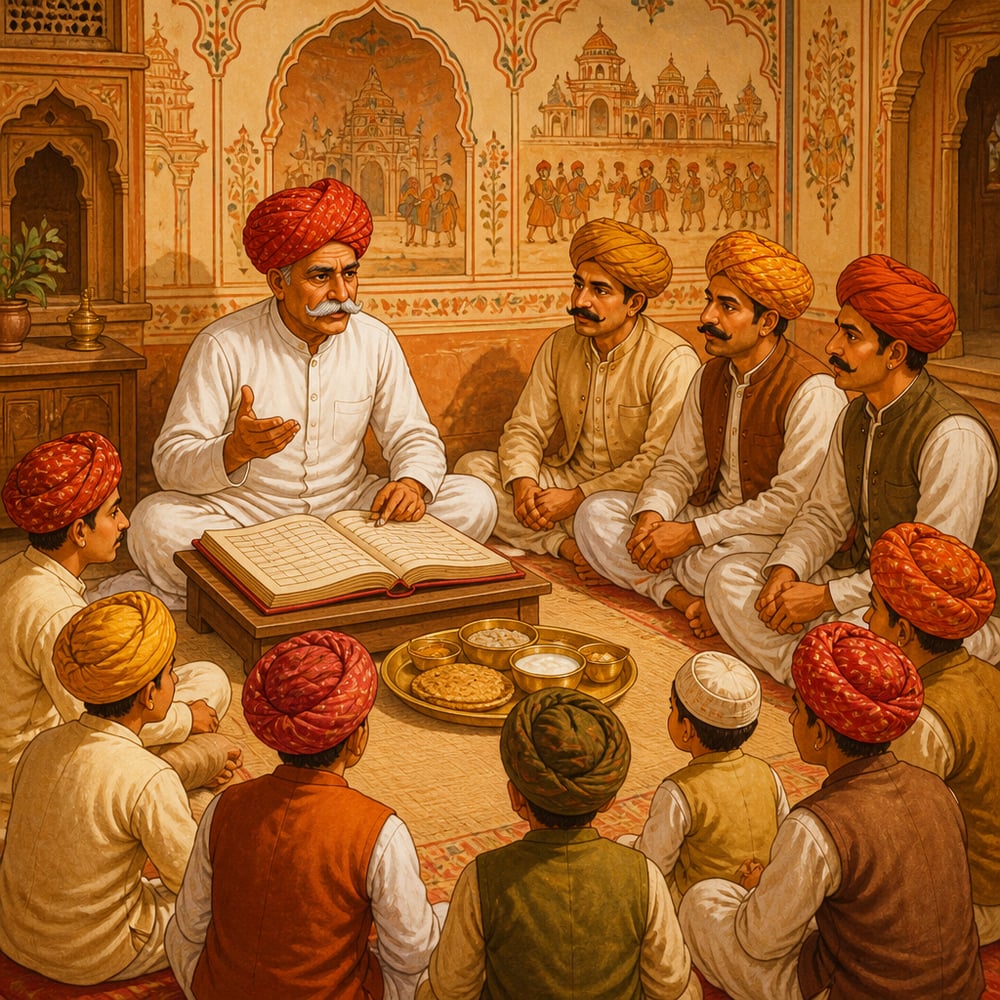
In 1857, a young merchant named Shiv Narain Birla sat in a cramped room in Pilani, Rajasthan, reviewing a ledger. It wasn't his ledger - it belonged to his grandfather, documenting three generations of Birla family transactions. Every entry carried weight: debts owed, debts collected, partnerships honored, promises kept.
Shiv Narain made a decision that would shape Indian business for the next 170 years. Rather than divide the family wealth among his sons, he would formalize what Marwari families had practiced informally: the Hindu Undivided Family (HUF) as a business structure.
All income would flow into the family pool. All decisions would be made by the karta (family head). Sons would apprentice in the family business before receiving responsibility. Daughters would receive their share as stridhan at marriage. The family would operate as one economic unit across generations.
By 2024, the Birla family - now in its fifth generation - controls assets worth over Rs. 3 lakh crore across textiles, cement, telecom, and financial services. The joint family structure that Shiv Narain formalized has survived world wars, independence, liberalization, and the digital revolution.
This is the power of kutumbaka-udyama - the family as enterprise.
The Joint Family: India's Original Corporation
Long before limited liability companies, India had the Hindu Undivided Family (HUF) - a legal entity that treated the family as a business unit.
The key features:
Coparcenary Rights
All male members (and after 2005, female members) born into the family automatically become coparceners - co-owners of family property. This creates:
- Automatic succession: No need for complex inheritance planning
- Pooled capital: Family wealth compounds across generations without fragmentation
- Shared liability: The family collectively backs each member's ventures
The Karta System
The eldest male (traditionally) serves as karta - the family manager with authority to:
- Make business decisions on behalf of the family
- Enter contracts binding on the HUF
- Manage family property and investments
- Allocate resources among family members
"Karta ka faisla, sabka faisla" - The karta's decision is everyone's decision
Joint but Separate
HUF members can have personal income and property separate from the HUF. This creates flexibility: individual entrepreneurship within collective security.
Why Joint Families Outperform
Why did Indian trading communities build such enduring dynasties when Western business families often fragment within three generations? Several structural advantages:
1. Patient Capital
Joint family capital doesn't demand quarterly returns. When the Birlas invested in cement in the 1920s, they could wait decades for returns. When Reliance built Jamnagar refinery, the Ambanis could deploy family resources without external shareholder pressure.
Western contrast: Public company CEOs face constant pressure for short-term performance. Family businesses can think in generations.
2. Built-In Training
Sons (and increasingly daughters) grew up in the business. By the time they took responsibility, they had:
- Years of observation and informal apprenticeship
- Relationships with key partners and customers
- Deep understanding of family values and practices
- Tested judgment through graduated responsibilities
Western contrast: Professional managers join companies as adults, requiring years to understand culture and relationships.
3. Trust Networks
Family relationships provided what contracts couldn't: absolute trust. When a Birla guaranteed a deal, the family's century of reputation backed it. When a Chettiar extended credit, the entire community's honor was at stake.
Western contrast: Contractual relationships require lawyers, enforcement mechanisms, and monitoring costs.
4. Diversification Without Bureaucracy
A joint family could deploy different members to different industries without creating separate companies. One brother handles textiles, another cement, a third finance - all under one family umbrella.
Western contrast: Conglomerates require complex corporate structures, transfer pricing, and regulatory compliance.
The Karta: CEO for Life (With Obligations)

The karta is often misunderstood as an autocrat. In practice, the role carried massive obligations:
Duty to Maintain: The karta must ensure every family member's needs are met - education, marriage, healthcare, housing. A karta who enriched himself while family members suffered would lose legitimacy.
Duty to Consult: While the karta had final authority, effective kartas built consensus. The Birla family's baithak (family meeting) tradition ensured all voices were heard before major decisions.
Duty to Preserve: The karta was custodian, not owner. His job was to grow the patrimony for future generations, not consume it. The Marwari tradition of kanjusi (frugality) restrained even powerful kartas from personal extravagance.
Duty to Educate: The karta was responsible for training successors. This wasn't optional - a karta who failed to develop the next generation failed his primary duty.
Global Perspectives on Business Dynasties
Samsung's Lee Family provides the most instructive comparison. Founder Lee Byung-chul built Samsung from a trading company into Korea's largest conglomerate using methods strikingly similar to Indian joint families:
Family Control: Despite Samsung being publicly traded, the Lee family maintains control through complex cross-shareholdings and family offices.
Generational Training: Lee Kun-hee, the son, spent years in various Samsung divisions before assuming leadership. His son, Lee Jae-yong, followed the same path.
Long-Term Orientation: Samsung could invest billions in semiconductors for years before profitability because family control insulated management from short-term pressure.
Succession Challenges: Like Indian families, Samsung faced succession crises. Lee Kun-hee's 2008 resignation over a slush fund scandal, and ongoing legal issues for Lee Jae-yong, show that family businesses worldwide struggle with governance.
| Feature | Indian HUF | Korean Chaebol | Western Public Company |
|---|---|---|---|
| Ownership | Family coparcenary | Family through cross-holdings | Dispersed shareholders |
| Management | Family karta | Family chairman | Professional CEO |
| Time horizon | Generational | Generational | Quarterly |
| Succession | Trained within | Trained within | External hire common |
| Accountability | Family reputation | National reputation | Stock price |
The key difference: Indian HUF law provided legal structure for family business that Korean chaebols had to construct through financial engineering. The HUF was designed for this purpose; chaebols improvised.
Modern Resonance: The Godrej Model
The Godrej family - now in their fifth generation - represents the evolution of Indian family business from informal HUF to formalized family governance.
Founded by Ardeshir Godrej in 1897, the company began with locks and safes. Today, Godrej Group spans consumer goods, real estate, appliances, and agribusiness with revenues exceeding Rs. 40,000 crore.

What makes Godrej distinctive is their Family Constitution - a formal document governing:
Entry and Exit: How family members join the business (qualifications required), what happens if they want to leave (exit mechanisms), and how those outside the business receive benefits.
Roles and Compensation: Clear distinction between ownership returns (dividends) and management compensation (salary). Family members working in the business are paid market rates; those who don't still receive ownership benefits.
Decision Making: Which decisions require family consensus, which the operating executives can make independently, and how disputes are resolved.
Succession Planning: Explicit criteria for who can lead operating companies versus hold ownership positions. Professional capability, not just bloodline, determines management roles.
This formalization transformed the HUF's informal flexibility into structured governance - keeping family advantages while adding professional discipline.
The Succession Challenge
The greatest threat to joint family businesses isn't external competition - it's internal succession. Studies show:
- Only 30% of family businesses survive to the second generation
- Only 12% survive to the third generation
- Only 3% make it to the fourth generation
Indian business families have beaten these odds through specific practices:
Graduated Responsibility
Heirs don't inherit control - they earn it. The typical progression:
- Observation (childhood): Attending family meetings, visiting businesses
- Apprenticeship (teens/twenties): Working in various family operations
- Responsibility (thirties): Running a division or subsidiary
- Preparation (forties): Shadowing the karta, handling major decisions
- Succession (fifties+): Assuming full leadership
Structured Separation
When families grow too large for unified management, structured separation prevents destructive conflict. The Bajaj family model:
- Different branches control different companies (Bajaj Auto vs. Bajaj Finserv)
- Cross-shareholdings maintain family alignment
- Regular family meetings preserve relationships
- Clear boundaries prevent interference
The Family Office
Modern Indian business families increasingly use family offices - professional organizations managing family wealth, governance, and next-generation development. These provide:
- Independent advice (not from business employees)
- Conflict resolution mechanisms
- Wealth management across generations
- Philanthropy coordination
Your Turn: The Kutumbaka Mirror
Even if you're not from a business family, kutumbaka principles apply:
Think Like a Karta: What are you building that will outlast you? What obligations come with your current privileges? Who are you training to succeed you?
Create Your Coparcenary: Who are your 'family' in the economic sense - people whose success is tied to yours? Have you formalized mutual obligations?
Plan Your Succession: Whether in career or life, what happens after you? Kutumbaka thinking means considering the next generation, not just the current one.
Balance Control and Professional Input: Even strong kartas took advice. Where do you need outside perspective? What decisions shouldn't you make alone?
From the Birlas' first ledger to Godrej's family constitution, Indian business families have continuously evolved the kutumbaka model - keeping what works while adding modern governance. The lesson: tradition and modernity aren't opposites; the best family businesses integrate both.
In the next lesson, we'll ask the ultimate question: why did these specific communities - Marwaris, Chettiars, Gujaratis, Sindhis - succeed while others didn't? What patterns unite them?
Stewardship theory; servant leadership; principal-agent alignment in family firms
Modern leadership theory rediscovers 'servant leadership' - the idea that leaders serve those they lead. The karta model embodied this for centuries. CEO compensation debates (how much is too much?) don't arise when the karta's consumption is constrained by family norms.
The karta system solved agency problems that plague Western corporations. A karta who depleted family resources for personal benefit would lose moral authority and family cooperation. Reputation within the family enforced behavior that external auditors cannot.
Studies of Indian business families show that kartas who visibly maintained family welfare - funding education, arranging marriages, resolving disputes fairly - retained authority into old age. Those who extracted personal benefit faced family fragmentation.
Formal vs. informal institutions; contract theory; governance costs
Western corporations rely entirely on formal governance - contracts, bylaws, regulations. Indian family businesses traditionally relied on informal governance - shared values, reputation, family pressure. The family constitution synthesizes both: formal documentation of informal expectations.
Key terms
- Karta
- The head/manager of a Hindu Undivided Family, with authority to make decisions binding on all members and manage joint family property
- Coparcener
- A member of a Hindu Undivided Family who has a birthright to joint family property; one who shares equally in inheritance
- Kutumbaka-Udyama
- Family enterprise; the model of treating the joint family as a unified business entity with collective ownership, governance, and inter-generational continuity
- Parivar-Samvidhan
- Family constitution; a formal document governing family business relationships, roles, succession, and dispute resolution
Key figures
The Birla Family (Shiv Narain to Present)
1857-present
The Godrej Family (5th Generation)
1897-present
Samsung's Lee Family
1938-present
Case studies
The Godrej Family Constitution: Formalizing Five Generations of Wisdom
By the early 2000s, the Godrej Group faced a challenge familiar to successful family businesses: success itself. Founded in 1897, the group had grown to include consumer products, real estate, appliances, and agribusiness. The family had expanded to include dozens of members across multiple branches. Potential conflicts loomed: **Who could work in the business?** Some family members had professional qualifications; others didn't. Some wanted management roles; others preferred passive ownership. **How would decisions be made?** With multiple operating companies and family branches, who had authority over what? **What about succession?** The current generation was aging. How would leadership transition? **How to handle disagreements?** When family members disagreed, who would resolve disputes? Rather than wait for these issues to create conflict - as had happened in the Ambani family and others - the Godrej family proactively developed a **Family Constitution** with the help of professional advisors. The process took several years and involved: - Interviews with all family members about expectations and concerns - Study of other family constitutions (European aristocratic families, American business families) - Multiple drafts reviewed by legal, tax, and governance experts - Family retreats to discuss and refine provisions - Final adoption by all family members
The Godrej constitution process demonstrates several dharmic principles: **Vimarsha (Deliberation)**: Rather than imposing rules top-down, the family engaged in genuine consultation. Every voice was heard before decisions were made - the karta tradition of building consensus adapted to modern practice. **Nyaya (Justice)**: The constitution sought fair treatment across generations and branches. Non-working family members receive ownership benefits; working members receive additional compensation. Merit determines management roles, but family membership guarantees ownership rights. **Vyavastha (Order)**: By creating explicit structures, the family prevented the disorder that destroys business families. Structure wasn't constraint but enablement - freeing family members to focus on business rather than political maneuvering. **Santati (Continuity)**: The constitution explicitly addresses succession - not as a problem to be avoided but as a natural transition to be planned. This aligns with the dharmic view that generations are connected, not separate. The Western approach would be a legal shareholders' agreement. The purely traditional approach would be informal family understanding. Godrej synthesized both: a legally binding document rooted in family values.
The Godrej Family Constitution has proven effective across several tests: **Succession**: Leadership transitioned smoothly as the founding generation stepped back. Clear criteria meant successors were known years in advance. **Business Performance**: Without family political distractions, operating companies could focus on markets. Godrej Consumer Products, Godrej Properties, and other units have outperformed peers. **Family Harmony**: Unlike the Ambani split (2005), Birla separations, and other high-profile family disputes, Godrej has managed disagreements through constitutional mechanisms rather than public conflict. **Next Generation Integration**: Younger family members understand their options - work in the business (if qualified) or benefit as owners without management burden. Clear paths prevent resentment. By 2024, the Godrej Group continues growing under family leadership, now valued at over Rs. 40,000 crore. The constitution is periodically reviewed and updated as circumstances change.
Family businesses can formalize governance without losing family character. The key is involving all stakeholders in creating the constitution, grounding formal rules in family values, and building mechanisms for evolution as circumstances change.
As India's startup ecosystem matures, first-generation founders face succession questions their families never encountered. The Godrej constitution model offers a middle path between selling to private equity and hoping the next generation figures it out. Family governance advisory is now one of the fastest-growing consulting niches in India, driven by exactly this need.
Godrej has maintained family control and family harmony through five generations - far exceeding the three-generation average for family business survival - while growing to Rs. 40,000+ crore valuation.
Historical context
Ancient - Present
The Hindu Undivided Family isn't just a business structure - it's a legal entity unique to Indian law, with roots in ancient dharmashastra. The HUF can own property, operate businesses, and receive income separate from its individual members. This created a legal framework for joint family enterprise that no other legal system provides. Even modern Indian tax law treats HUF as a separate taxable entity with its own exemptions. The joint family system was reinforced by social practices: multi-generational households, arranged marriages creating family alliances, and cultural emphasis on family loyalty over individual achievement.
No other legal system provides an equivalent to the HUF. Korean chaebols, European family businesses, and American dynasties must construct complex corporate structures to achieve what the HUF provides by default. This legal advantage enabled Indian business families to maintain control across generations more easily than counterparts elsewhere. The family trust (Western) and the family holding company (European) are attempts to replicate HUF features without the statutory framework.
Estimates suggest HUFs control approximately 40-50% of India's private business assets, making the joint family structure perhaps the single most important organizational form in the Indian economy.
Understanding kutumbaka-udyama explains why Indian business is structured the way it is. Family control isn't an archaic remnant but a deliberate governance choice with proven advantages in long-term wealth creation. Modern debates about family business succession, governance, and professionalization build on this foundation.
Reflection
- The karta role combines authority with absolute obligation - leadership is earned through service, not claimed through position. In your own life, where do you have authority? For each area of authority, identify the corresponding obligations. Are you fulfilling those obligations fully, or has authority become disconnected from service?
- Whether or not you're in a family business, you have implicit 'constitutions' governing your important relationships - unwritten expectations about roles, decisions, and conflicts. Choose one important relationship (business partner, spouse, close collaborator) and draft a simple 'constitution': Who decides what? How are disagreements resolved? What happens if circumstances change? Share this draft with the other party as a conversation starter.