Gujarati-Udyamita: Entrepreneurship from Ports to Diaspora

From Surat to Silicon Valley

How Gujarat's maritime traders built 4,000 years of commercial success through partnership culture, value-consciousness, and diaspora networks - from the ancient port of Lothal to owning half of America's motels.

The Stepwell Builder
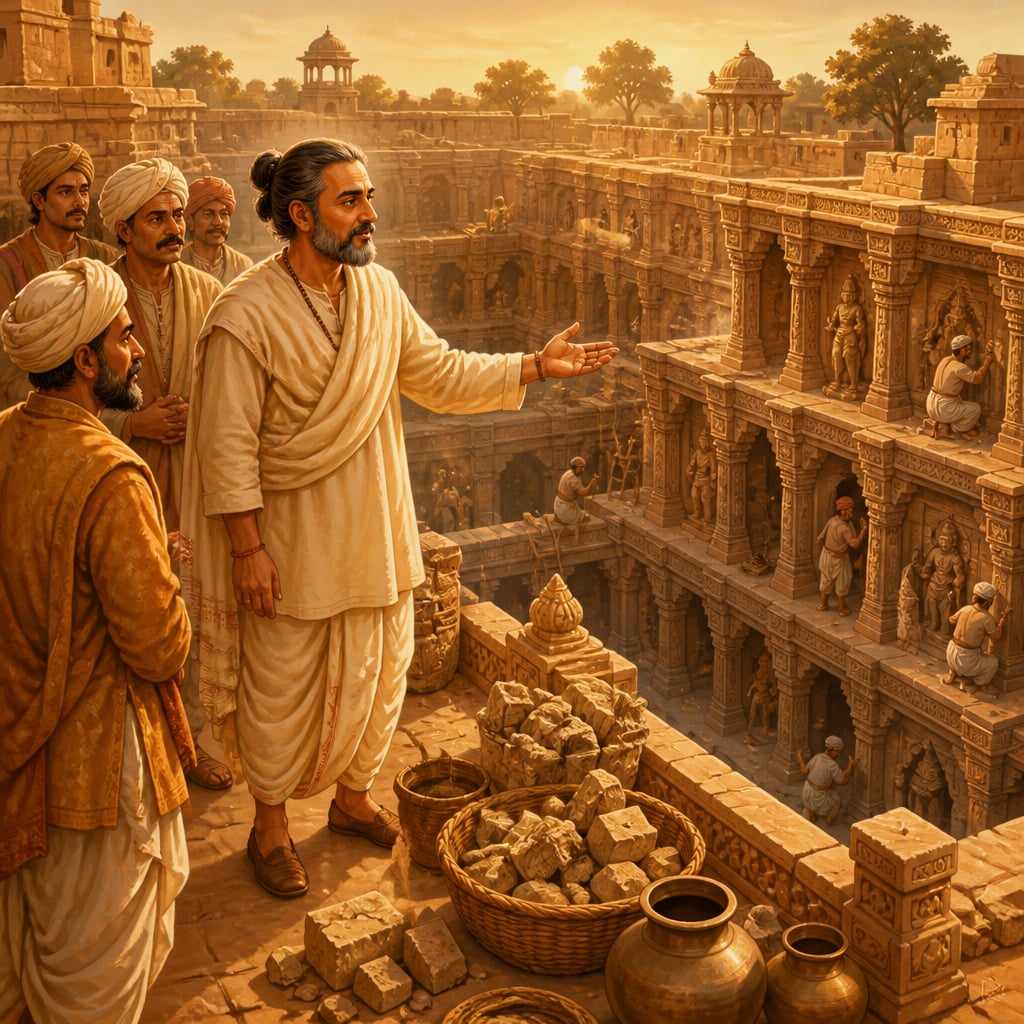
Jagdu Shah overseeing the construction of Rani ki Vav in 14th-century Patan

In 1304, the city of Patan in Gujarat faced a crisis. The monsoons had failed. Wells ran dry. Animals died. People began to migrate.

One man decided to do something about it. Jagdu Shah, a Jain merchant who had built his fortune in the textile trade, announced he would construct a stepped reservoir - but not just any reservoir. He would build the most magnificent vav (stepwell) ever seen, capable of providing water through the worst droughts.

His fellow merchants thought he was mad. The estimated cost would consume most of his fortune. "Why not just build a simple tank?" they asked.

Jagdu Shah's response has echoed through seven centuries of Gujarati business:

"A simple tank would serve my generation. But a great vav will serve a hundred generations. The profit is not in the water - it is in the naam (reputation) that makes people trust my descendants."

The Rani ki Vav (Queen's Stepwell) that Jagdu Shah helped finance - now a UNESCO World Heritage site - still stands. So does the Gujarati principle it embodied: invest in infrastructure that outlasts you.

The Land That Made Merchants

Gujarat's geography designed it for trade. With the longest coastline of any Indian state (1,600 km), natural harbors at Bharuch, Surat, and Cambay, and position at the crossroads of land routes to Central Asia and sea routes to Arabia and Africa, Gujarat was trading when most civilizations were still farming.

The ancient port of Lothal (2400 BCE) in Gujarat is the world's oldest known dockyard - evidence that Gujaratis were engaged in maritime commerce when Egypt was building pyramids.

"Vyapaar ma dharam, dharam ma vyapaar" - Business is in religion, religion is in business

This Gujarati saying captures how commerce and spirituality intertwined. Jain merchants saw ethical business as religious practice. Hindu traders built temples with profits. Muslim Bohras and Memons integrated charity into commercial networks. Unlike cultures where trade was considered inferior, Gujarat sacralized it.

By the 16th-17th centuries, Surat was among the world's great ports, with trading networks reaching Japan, Indonesia, East Africa, and the Middle East. The English, Dutch, and Portuguese all established factories here - not conquering Surat, but seeking permission to trade from Gujarati merchants who controlled the Indian Ocean trade.

The Gujarati System: Four Pillars of Enterprise

1. Bhagidari: The Partnership Culture

Gujarati business runs on bhagidari (partnership). Rather than single ownership with hired labor, Gujaratis share both investment and profit. A typical textile unit might have:

Each takes risk. Each shares reward. This structure allows rapid scaling without debt and spreads risk across the community.

2. Paisa Vasool: Sacred Frugality

Paisa vasool (value for money) isn't stinginess - it's optimization. Gujaratis ask of every expense: "Can we get the same result cheaper? Can we get more result for the same cost?"

This produced:

"Ek rupiya na sau karega" - Make one rupee do the work of hundred

3. Nyati-Mandal: Cluster Networks

Gujaratis don't just enter industries - they dominate them through clustering. When one Gujarati succeeds in a sector, the community follows:

Clusters provide: shared suppliers, shared knowledge, community financing, and market power.

4. Pravas-Udyam: The Migration Business Model

Gujaratis treat migration as business strategy. Send the first wave, establish beachhead, pull the network. This pattern - visible in East Africa in the 1890s, UK in the 1960s, US in the 1970s - creates global opportunity networks.

Global Perspectives on Trading City-States

Gujarat's commercial culture finds its closest parallel in Venice (697-1797 CE).

The Venetian Model built a trading empire from a lagoon with no natural resources. Like Surat merchants, Venetians:

The Venetian Colleganza (trading partnership) remarkably resembles Gujarati bhagidari: one partner provides capital (the stans), another sails with the goods (the procertans), profits split 75-25. This allowed risk distribution across voyages.

Marco Polo's family used this structure for their famous Asian journeys - just as Gujarati merchant families financed expeditions to Southeast Asia and East Africa.

Feature Venice Gujarat
Geographic advantage Control of Adriatic Control of Arabian Sea
Partnership model Colleganza Bhagidari
Risk distribution Multiple small investments Family/community pooling
Infrastructure investment Docks, Arsenal Stepwells, dharamshalas
Commercial neutrality Traded with Christians & Muslims Traded with all religions

The key difference: Venice declined when trade routes shifted. Gujarat adapted - from maritime trade to textiles to diamonds to pharmaceuticals to IT services. Gujarati commercial culture proved more portable than Venetian institutions.

Modern Resonance: The Patel Motel Phenomenon

A Gujarati Patel family welcoming guests at their 1980s California motel

In 1942, Kanjibhai Desai arrived in San Francisco from Gujarat. By the 1970s, Gujarati Patels (predominantly from Kheda and Surat districts) had discovered an unlikely opportunity: roadside motels.

The pattern that followed demonstrates every Gujarati business principle:

Bhagidari: Multiple families pooled resources to buy first properties. Returns were reinvested to fund the next family's acquisition.

Paisa Vasool: By using family labor (no staff costs), living on-site (no separate housing), and maintaining properties themselves, Patels could profit where others couldn't.

Cluster Networks: Information about motel opportunities spread through community networks. A listing in California would reach cousins in Texas within days.

Diaspora Pull: Each established family sponsored relatives' immigration, who then joined the business before launching their own.

By 2024, the Asian American Hotel Owners Association (AAHOA) - founded by and predominantly composed of Gujarati Patels - represents owners of over 60% of American hotels, accounting for $150 billion in property value.

The community's market power is now so significant that hotel chains court AAHOA directly. Gujaratis haven't just entered an industry - they've reshaped it.

The Surat Diamond Miracle

Young cutters polishing diamonds at a modern Surat workshop

Perhaps no industry better illustrates Gujarati commercial genius than diamond cutting.

In the 1960s, the global diamond cutting industry was centered in Antwerp, Belgium, and Tel Aviv, Israel. Cutting required expensive machinery, trained craftsmen, and established relationships with De Beers.

Gujarati entrepreneurs saw opportunity. They began with small, low-value diamonds that Antwerp considered unprofitable. Using family labor, lower wages, and obsessive cost optimization, Surat cutters could process diamonds profitably that Europeans couldn't.

By 2024:

The transformation took 40 years and followed the classic Gujarati pattern: enter at the bottom, optimize relentlessly, scale through networks, eventually dominate.

Your Turn: The Gujarati Mirror

Gujarati success isn't genetic - it's systematic. You can apply these principles:

From Jagdu Shah's stepwell to Surat's diamond bourse, Gujarati success follows a pattern: create value, share risk, optimize costs, build networks, invest in infrastructure that outlasts you.

In the next lesson, we'll meet the Sindhi traders - merchants who lost everything in Partition but rebuilt global networks from nothing.

Risk distribution; comparative advantage in partnerships; stakeholder alignment

Modern partnership law and private equity structures attempt what Gujarati bhagidari achieves naturally: aligning incentives by making everyone a stakeholder. The rise of co-founder equity splits in startups reflects rediscovery of these principles.

Gujarati bhagidari operates on trust rather than contract, reducing transaction costs. Where Western partnerships require lawyers and detailed agreements, Gujarati partnerships often operate on handshakes backed by community enforcement.

Studies of Surat diamond businesses show that 70%+ operate as bhagidari partnerships rather than sole proprietorships, distributing both risk and reward across community members.

Industrial clusters; agglomeration effects; network externalities

Economist Michael Porter's 'cluster theory' won business strategy fame explaining why industries concentrate geographically (Silicon Valley for tech, Hollywood for film). Gujarati merchants practiced cluster strategy for centuries before Porter named it.

Key terms

Bhagidari
Partnership; the Gujarati system of shared ownership, risk, and profit in business ventures
Paisa Vasool
Literally 'getting one's money's worth'; the Gujarati philosophy of extracting maximum value from every expenditure
Nyati-Mandal
Community circle; the caste/community networks that facilitate business information sharing, financing, and opportunity distribution
Vav
Stepwell; the underground water reservoirs built by Gujarati merchants as philanthropic infrastructure investments

Key figures

Jagdu Shah

14th Century

The Patel Motel Phenomenon

1970s-present

The Venetian Merchants

697-1797 CE

Case studies

Surat: How a Gujarati City Captured 90% of World Diamond Cutting

In the 1960s, diamond cutting was dominated by Antwerp (Belgium) and Tel Aviv (Israel) - cities with centuries of tradition, skilled craftsmen, and established relationships with De Beers. India had no diamond mines and no cutting tradition. Gujarati entrepreneurs saw opportunity in the economics. Diamond cutting requires labor-intensive precision work. European labor costs made small, low-value diamonds unprofitable to cut. These 'small goods' were essentially waste. The first Gujarati diamond workshops opened in Surat and Mumbai, focusing exclusively on these small diamonds. Using family labor, lower wages, and obsessive cost optimization, they could profit where Europeans couldn't. The initial entry point was deliberately low-status - 'chips and small goods' that established players ignored. But entry created learning. Learning improved quality. Improved quality enabled moving up to larger stones. Moving up attracted more entrants from the community. The cluster grew through classic Gujarati mechanisms: - **Bhagidari partnerships** spread risk and capital - **Nyati-mandal networks** shared information and opportunities - **Paisa vasool optimization** kept cutting quality while slashing costs - **Diaspora connections** linked Surat to Antwerp buyers

Through a dharmic economics lens, Surat's diamond success illustrates several principles: **Seva through Value Creation**: Gujarati cutters created value by making 'waste' diamonds valuable. This wasn't extraction but creation - adding to the world's store of beauty and utility. **Aparigraha (Non-Grasping)**: Rather than trying to capture the whole industry immediately, Surat started with the lowest segment. Humility about starting position enabled eventually reaching the top. **Sahakara (Cooperation)**: The cluster succeeded because firms cooperated on supply chains, training, and infrastructure while competing on quality and price. Competition and cooperation coexisted. **Santoshi (Contentment with Gradual Progress)**: The transformation took 40 years. No get-rich-quick schemes - just steady improvement, generation after generation. Western business strategy would recommend either competing directly (challenging Antwerp head-on) or differentiating (finding a niche). The Gujarati approach was neither: enter at the bottom, optimize relentlessly, and let the industry come to you.

By 2024, Surat's transformation is complete: - **90%** of world's diamonds by volume are cut in Surat - **800,000+** workers employed in the industry - **Bharat Diamond Bourse** in Mumbai is world's largest diamond trading center - Even Antwerp's remaining operations increasingly source from Surat The industry has created significant wealth broadly distributed across Gujarat's trading communities. The second generation is now moving into upstream (diamond sourcing) and downstream (retail) segments. The 2023 Russia sanctions on diamond exports paradoxically strengthened Surat's position, as the industry had already diversified sourcing beyond Russian supply.

Industry domination doesn't require starting at the top. The Gujarati approach - enter at the bottom, optimize relentlessly, scale through networks, move up gradually - transforms apparent disadvantages (no tradition, no mines) into advantages (no legacy costs, fresh perspectives).

As lab-grown diamonds disrupt the natural diamond industry, Surat is pivoting into lab-grown production using the same cluster advantages that won the natural diamond market. The city already produces 75% of the world's lab-grown diamonds. This adaptability demonstrates that network-based industrial clusters can absorb technological disruption better than vertically integrated corporations.

Surat processes 90% of world's diamonds by pieces, from near-zero market share 60 years ago - one of the most complete industry transformations in global business history.

Historical context

2400 BCE - Present

Gujarat's 1,600 km coastline - India's longest - positioned it as the subcontinent's window to the Arabian Sea and beyond. Major ports at Bharuch, Cambay, and Surat connected India to Arabia, East Africa, and Southeast Asia for millennia. The state's internal geography - with textile-producing regions, agricultural zones, and trading cities - created integrated commercial systems. Jain merchant communities, particularly in Ahmedabad and Patan, developed sophisticated business ethics that treated commerce as religious practice.

Gujarat's commercial continuity (4,400+ years) exceeds almost any other trading culture. Venice lasted roughly 1,100 years. The Hanseatic League operated for about 400 years. Only Phoenician/Lebanese commercial traditions rival Gujarat's longevity. Unlike these parallels, Gujarat's commercial culture proved portable - adapting from maritime trade to textiles to diamonds to pharmaceuticals to services, and relocating to East Africa, UK, and USA while maintaining essential characteristics.

By one estimate, the Gujarati diaspora controls business assets worth over $500 billion globally, including 60%+ of American hotels, significant portions of UK retail, and substantial pharmaceutical and diamond operations.

Gujarat demonstrates that commercial culture - the combination of partnership norms, value-consciousness, network effects, and willingness to migrate - can be more durable than any particular industry or location. Understanding how Gujarati business principles work allows applying them regardless of one's ethnic background.

Reflection

More in Legendary Trading Communities of India

All lessons in Legendary Trading Communities of India ยท Vaishya Dharma: The Art of Ethical Commerce course