Chettiar-Kula: Banking Networks Across Southeast Asia

Financiers of Southeast Asia

How the Nattukottai Chettiars from Tamil Nadu built the financial infrastructure of Burma, Malaya, and Indonesia through revolutionary trust-based lending and fortress-like homes that still stand as monuments to their wealth.

The Banker Without a Bank
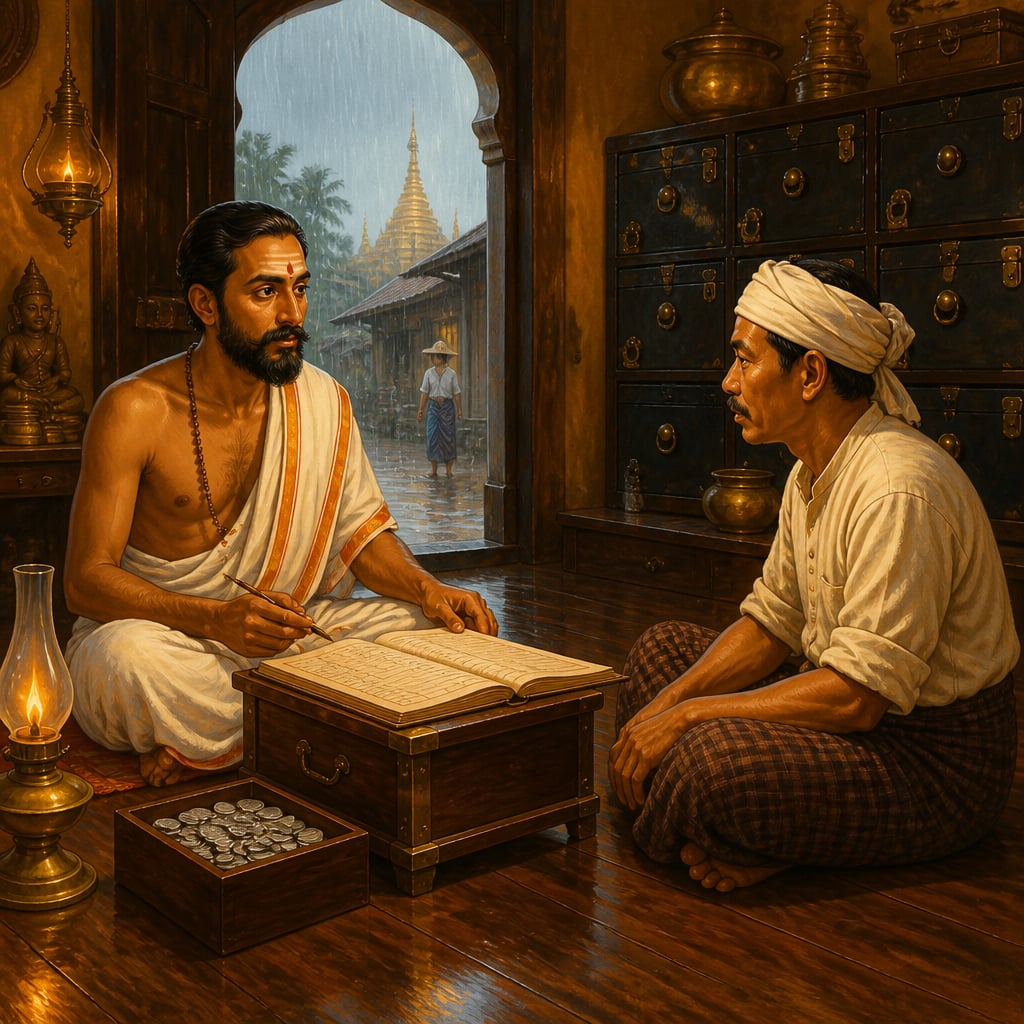
Ramanathan Chettiar lending to a Burmese rice farmer in his Rangoon shophouse

In 1885, Ramanathan Chettiar sat on the wooden floor of a modest shophouse in Rangoon, Burma. Before him knelt a Burmese rice farmer, nervously clutching his hat. The farmer needed 500 rupees to buy seed and hire labor for the coming planting season. He had no land deed to offer as collateral - the land belonged to the village. He had no credit history. He had only his word and the recommendation of another farmer who had borrowed from Ramanathan the previous year.

Ramanathan asked three questions: "Who is your father? Who will vouch for you? Will you repay at harvest?"

The farmer answered. Ramanathan counted out 500 rupees from a cloth bag.

No papers were signed. No interest rate was quoted on a document. No lawyers were consulted. Yet both parties knew exactly what would happen: the farmer would repay the principal plus 12% at harvest, or his reputation - and that of his guarantor - would be destroyed in every Chettiar counting house from Rangoon to Singapore.

This was adaikkalam - lending on trust alone. And with this simple system, the Nattukottai Chettiars from a cluster of villages in Tamil Nadu's Sivaganga district would finance the development of an entire region.

The Land That Grew Bankers

The Chettinad region of Tamil Nadu - comprising 74 villages in what is now Sivaganga and Pudukottai districts - seems an unlikely birthplace for international bankers. Dry, rocky, with minimal agriculture, the land forced its inhabitants to look outward.

From at least the 13th century, Chettiars traded across the Bay of Bengal. But their transformation from traders to bankers accelerated dramatically in the 19th century when the British opened Burma, Malaya, and the Straits Settlements to development.

"Kayiru illama kattudal" - Binding without rope

This Chettiar proverb describes their lending philosophy: create obligations without legal documentation. The "rope" was community reputation, far stronger than any contract.

By 1930, Chettiars had lent an estimated 750 crore rupees across Southeast Asia - equivalent to perhaps $60-70 billion today. They financed:

All without a single formal bank.

The Chettiar System: Four Pillars of Trust

1. Adaikkalam: The Collateral-Free Revolution

Unlike Western banking that required physical collateral, Chettiars lent primarily on character assessment. The adaikkalam system worked because:

2. Sangam: The Community Assembly

Every Chettiar community abroad maintained a sangam - an assembly that met regularly to resolve disputes, share information about borrowers, and coordinate lending practices. The Rangoon Sangam could communicate a defaulter's name to Singapore within weeks, destroying credit across the entire network.

"Sangathil solliyathai thirumba sollathe" - Don't repeat what was said in the Sangam

This confidentiality code protected both business intelligence and community solidarity.

3. Nattu-Kottai: Fortress Homes of Pride

Despite operating across Southeast Asia, Chettiars invested their wealth primarily in their home villages. The famous nattu-kottai (fortress homes) of Chettinad - massive mansions with Italian marble, Belgian chandeliers, and teak from Burma - were built not to live in, but to demonstrate family honor.

A grand Chettinad nattu-kottai mansion with women arranging brass lamps

A Chettiar might spend 350 days a year in Rangoon but would build a 40-room mansion in his ancestral village. This wasn't irrationality - it was brilliant strategy:

4. Pulli-Pennukkodi: The Women's Ledger

Uniquely among Indian trading communities, Chettiar women managed significant wealth. The pennukkodi (woman's property) included jewelry, home management, and often parallel lending operations. When men were abroad, women ran the home economy and made local investment decisions.

Global Perspectives on Banking Networks

The Chettiar model finds remarkable parallels in global banking history:

The Medici Family (1397-1494) built the most powerful bank in Renaissance Europe using strikingly similar principles. Like Chettiars, the Medicis:

Cosimo de' Medici's famous observation - "A man can do much damage with only a little capital if he has many friends" - could have been spoken by any Chettiar banker.

The Rothschild Network (19th century) similarly placed five brothers across European capitals, enabling rapid information flow and coordinated lending. Their carrier pigeon network for transmitting bond prices mirrors how Chettiars used the sangam system to share credit information.

HSBC's founding (1865) in Hong Kong to finance Asian trade occurred precisely when Chettiars dominated Southeast Asian lending. The bank's founders explicitly studied informal Asian credit networks.

Banking Model Key Innovation Limitation
Medici Reputation-based credit Tied to political power
Rothschild Information network Required capital concentration
HSBC Formal structure Depended on colonial protection
Chettiar Community enforcement Vulnerable to political change

The Chettiar advantage was decentralization. No single family failure could collapse the system. Their weakness was dependence on stable political conditions.

Modern Resonance: The Fall and Legacy

The Chettiar empire collapsed between 1930-1962. The Great Depression devastated borrowers. Burmese nationalism targeted foreign moneylenders. The Land Alienation Act of 1948 in independent Burma effectively confiscated Chettiar-held land - an estimated 2.5 million acres.

Yet the Chettiar legacy endures:

Indian Bank, founded by Annamalai Chettiar in 1907, remains a major public sector bank. Its founding principle - banking for the "common man" - reflected Chettiar experience lending to farmers and small traders.

The Murugappa Group, founded in 1900 by Dewan Bahadur A.M. Murugappa Chettiar, is now a Rs. 45,000 crore conglomerate spanning engineering, finance, and plantations. The family has successfully transitioned through five generations while maintaining community values.

A modern Indian credit rating agency assessing a borrower's character

CRISIL, India's leading credit rating agency, essentially formalizes what Chettiars did informally - assessing creditworthiness through reputation and track record rather than just asset collateral.

In 2024, the Reserve Bank of India's push for "account aggregators" and alternative credit scoring - using payment history, utility bills, and peer references - echoes the Chettiar insight that character data matters more than collateral.

Your Turn: The Chettiar Mirror

The Chettiars teach us that trust is a bankable asset - perhaps the most valuable one. Consider:

The Chettiars lost their Southeast Asian empire to political change. But the principles that built it - trust networks, community enforcement, visible credibility, and graduated relationship-building - remain as powerful today as in Ramanathan Chettiar's Rangoon shophouse.

In the next lesson, we'll travel west to Gujarat, where maritime traders built networks from Surat to East Africa - and eventually to Silicon Valley.

Information asymmetry; network effects; trust networks as competitive advantage

Modern venture capital operates similarly - VCs share deal information, due diligence, and founder assessments through informal networks. Y Combinator's partner meetings function much like Chettiar sangams.

The Chettiar sangam combined functions that Western finance separates: credit bureau, arbitration court, trade association, and professional network. This integration reduced transaction costs and enabled faster decision-making.

The Rangoon Sangam reportedly processed credit inquiries and dispute resolutions within days, while colonial courts took months or years. This speed advantage was worth significant basis points in lending margins.

Asset diversification; political risk hedging; signaling theory

Modern wealth advisors recommend geographic diversification - 'don't keep all assets in one jurisdiction.' The Chettiars practiced this before portfolio theory existed, using home-country anchoring to hedge foreign political risk.

Key terms

Adaikkalam
Refuge, shelter; in Chettiar banking, lending based purely on trust without physical collateral
Nattu-Kottai
Literally 'country fortress'; the massive ancestral mansions built by Chettiars in their home villages
Sangam
Assembly, gathering; the Chettiar community councils that governed business practices abroad
Pennukkodi
Women's wealth/property; assets controlled independently by Chettiar women, including jewelry and household management

Key figures

Ramanathan Chettiar

1851-1930

CRISIL Founders (Pradip Shah & Team)

1987-present

Cosimo de' Medici

1389-1464

Case studies

Murugappa Group: Five Generations of Family Business

In 1900, Dewan Bahadur A.M. Murugappa Chettiar founded a small money-lending business in Burma. Today, the Murugappa Group is a Rs. 45,000 crore conglomerate with interests in engineering (Tube Investments, Carborundum Universal), finance (Cholamandalam), agricultural inputs, and more. What makes Murugappa remarkable isn't just longevity - it's how they've managed succession across five generations while most Indian family businesses fail by the third generation. Their methods directly reflect Chettiar traditions: **Family Constitution**: In 1998, anticipating succession challenges, the family drafted a formal constitution governing roles, compensation, entry criteria for next generations, and exit mechanisms. This formalized what sangams did informally. **Professional Management**: Unlike many Indian family businesses, Murugappa brought in professional CEOs early. Family members must prove competence before joining the business - the gaddi-munim apprenticeship formalized. **Separation of Ownership and Management**: Shareholders (family) and operators (professionals + qualified family) have distinct roles. This prevents the conflicts that destroy most family businesses. **Community Engagement**: The family still maintains Chettiar traditions - supporting temples, community events, and educational institutions in Chettinad.

The Murugappa model shows Chettiar principles scaled to modern corporate governance: **Sangam → Family Constitution**: The informal community assembly that governed Chettiar behavior becomes a formal document governing family behavior. **Adaikkalam → Trust-Based Hiring**: Just as Chettiars lent on character, Murugappa promotes based on demonstrated competence, not just bloodline. **Nattu-Kottai → Legacy Investments**: The family continues supporting Chettinad heritage, temples, and education - visible commitments that anchor identity. **Pennukkodi → Women's Participation**: Unlike many traditional businesses, Murugappa has increasingly included women in leadership - extending the Chettiar tradition of women's economic agency. Conventional business wisdom says family businesses should professionalize completely or remain traditional. Murugappa found a third way: formal structures protecting informal values.

The Murugappa Group has successfully transitioned through five generations with minimal public conflict - unusual for any family business, extraordinary for India where family disputes frequently destroy value. The 2019-2021 dispute with a family member (Valli Arunachalam) over board representation, while painful, was resolved through the constitutional mechanisms established earlier - the system worked even under stress. By 2024, the group maintained leadership in multiple industries (Tube Investments is India's largest cycle manufacturer; Cholamandalam is a leading NBFC), proving that Chettiar-style long-term thinking can compete in modern markets.

Family businesses can survive across generations if they formalize community wisdom into governance structures. The Murugappas translated sangam principles into a constitution, adaikkalam trust into competency requirements, and nattu-kottai anchoring into continued community engagement.

McKinsey estimates that family businesses generate 70% of global GDP, yet most lack formal governance structures. The Murugappa family constitution model is now taught at INSEAD and ISB as a benchmark. As first-generation Indian startup founders begin thinking about succession, the Chettiars' five-generation playbook offers a tested alternative to the 'hire a professional CEO' default.

Only 12% of Indian family businesses survive to the third generation; the Murugappa Group is thriving in its fifth generation with Rs. 45,000+ crore revenue.

Historical context

17th Century - 1962

The Chettinad region of Tamil Nadu - 74 villages in Sivaganga and Pudukottai districts - produced a unique banking culture. With minimal agricultural potential, families had traded across the Bay of Bengal since the Chola period. The distinctive nattu-kottai mansions, many now UNESCO-protected, were built with wealth earned abroad. Even today, the region has the highest concentration of heritage architecture in South India, though many houses stand empty as families have dispersed.

The Chettiar banking network was contemporary with and comparable to major Western banking systems. While the Rothschilds financed European governments, Chettiars financed Asian agriculture. At their peak (1930), Chettiar lending in Southeast Asia exceeded the formal banking sector in the region.

At their peak around 1930, Nattukottai Chettiars had approximately 750 crore rupees outstanding in loans across Southeast Asia - making them collectively one of the largest banking operations in Asia, all without a single formal bank building.

The Chettiar story shows both the power and vulnerability of trust-based systems. The same community bonds that enabled rapid credit expansion also concentrated political risk. When nationalism rose, Chettiars were identified as 'foreign exploiters' despite having financed development for decades. Modern businesses must balance community-based trust with institutional resilience.

Reflection

More in Legendary Trading Communities of India

All lessons in Legendary Trading Communities of India · Vaishya Dharma: The Art of Ethical Commerce course