Sandhi-Kala: Negotiation Wisdom from Epics

The Art of the Deal

Ancient Indian epics and niti-shastras contain sophisticated negotiation frameworks - knowing when to push, when to yield, and how to create outcomes where both parties gain.

Krishna the Negotiator
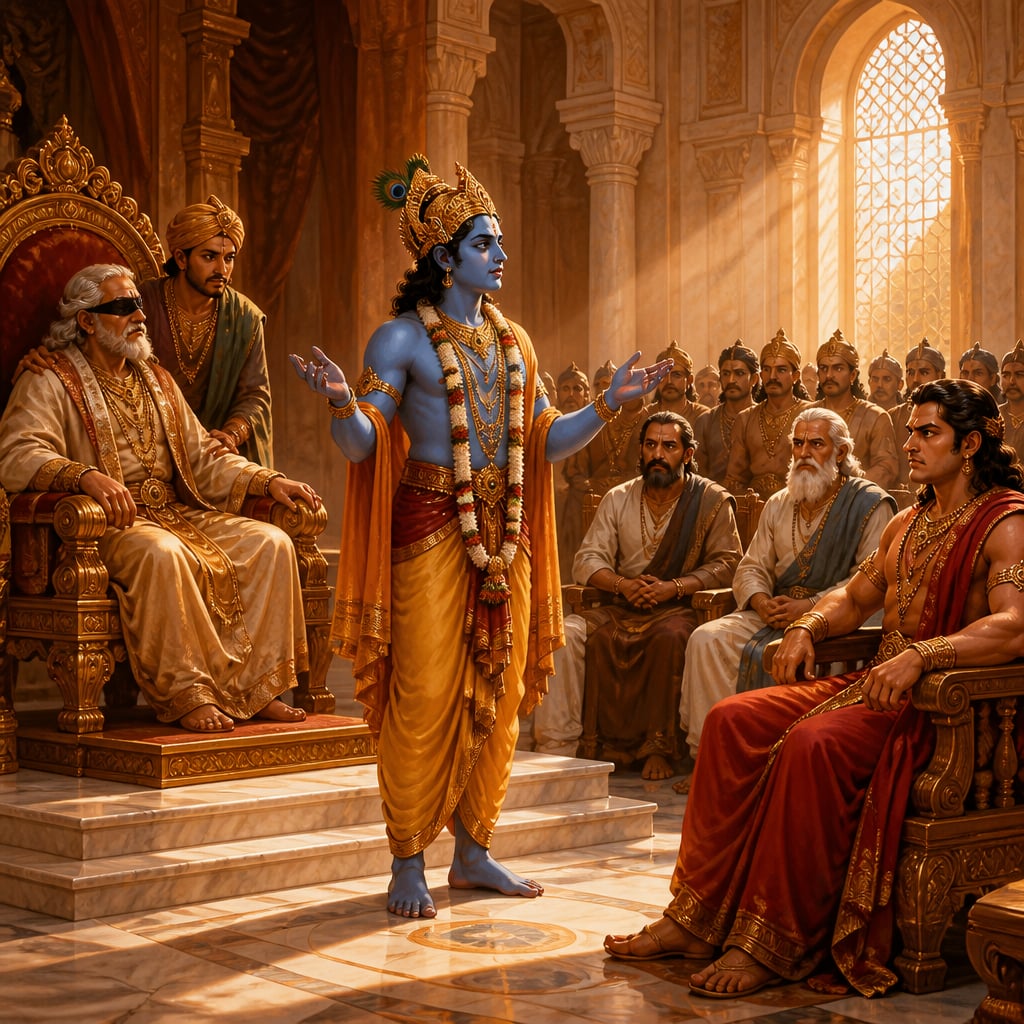
Krishna addressing the Kaurava court at Hastinapura on his peace mission

Before the Mahabharata war, Lord Krishna went to Hastinapura on a peace mission. The Pandavas had been cheated, exiled, and humiliated. They wanted justice - their kingdom back.

Krishna's negotiation is a masterclass in strategic dealing:

Opening position: Return the full kingdom to the Pandavas.

First concession: If not the whole kingdom, give them their five villages.

Final minimum: If not five villages, just five houses - one for each brother.

Duryodhana refused even the final offer: "I will not give them land enough to stick a needle in."

Krishna's negotiation failed - or did it? By offering progressively reasonable terms that Duryodhana rejected, Krishna established moral legitimacy for the Pandavas' war. The negotiation was about more than the immediate deal; it was about the narrative.

"Śamo damas tapaḥ śaucaṁ kṣāntir ārjavam eva ca" "Peace, self-control, austerity, purity, patience, and uprightness..."

Krishna demonstrated all these in negotiation while preparing for the alternative.

The Four Upayas: Complete Negotiation Framework

The Arthashastra and Nitishastra traditions outline four approaches to achieving objectives:

Upaya Sanskrit Meaning When to Use
Sama साम Conciliation, persuasion When interests align
Dana दान Gifts, compensation When goodwill needs building
Bheda भेद Division, differentiation When opponents can be separated
Danda दण्ड Force, punishment When all else fails

The sophisticated point: all four are legitimate tools. The wise negotiator knows which to deploy when.

Sama: The Power of Alignment

From the Mahabharata's Shanti Parva:

"Sāmnaiva prathamaṁ yatnaḥ kartavyo buddhimat-tamaiḥ" "The wisest should first try conciliation."

Sama means finding common ground, emphasizing shared interests, and persuading through reason. This isn't weakness - it's efficiency. Deals achieved through sama require no enforcement costs.

Modern application: In salary negotiations, sama means understanding your employer's constraints and aligning your ask with their interests. "I want a raise" is dana-seeking. "Here's how investing in my development serves the company's goals" is sama.

Infosys co-founder Nandan Nilekani exemplified sama in building Aadhaar. Rather than mandating adoption, he persuaded ministries by showing how the unique ID served their individual interests - welfare departments wanted better targeting, banks wanted KYC simplification. Sama made adoption easier than resistance.

Dana: Strategic Generosity

Dana in negotiation isn't bribery - it's creating obligation and goodwill. The Hitopadesha explains:

"Dānena tulyaṁ na hi kiṁcid asti" "Nothing equals giving in its power."

Strategic giving creates psychological reciprocity. When you give first, the other party feels obligated to reciprocate.

Modern application: Reliance's free Jio service was dana at scale. By giving away connectivity, Jio created millions of grateful customers who felt obligated to stay when paid services began. The 'gift' of free service was actually a negotiating tool.

Bheda: Intelligent Division

Bheda means understanding that opponents are rarely monolithic. They have factions, interests, and divisions that can be leveraged.

Vibhishana arriving at Rama's camp by the southern sea

In the Ramayana, when Vibhishana defected from Lanka to join Rama, this was bheda - separating a reasonable faction from Ravana's hardliners.

"Bhedayet sādhvasādhūnāṁ madhye prajñā-balena tu" "Through wisdom, separate the reasonable from the unreasonable."

Modern application: In corporate negotiations, bheda means understanding that 'the company' isn't one entity. Finance, legal, operations, and leadership may have different interests. A deal rejected by legal might be approved if you first win support from operations.

Danda: When All Else Fails

Danda - force or punishment - is the last resort, used only when sama, dana, and bheda have failed. But it must remain credible.

The Arthashastra is clear:

"Daṇḍa eva hi śāstā syāt sarveṣāṁ dharma-rakṣakaḥ" "Punishment alone is the protector of all and guardian of dharma."

The point isn't to use danda but to have it available. A negotiator without danda capability isn't taken seriously.

Modern application: TATA Steel's acquisition of Corus (2007) succeeded partly because Tata could credibly threaten to walk away. Their dana (generous offer) worked because competitors provided bheda (CSN's competing bid) and danda (ability to withdraw) remained credible.

Sandhi: The Art of Agreement

The term sandhi means 'joining' or 'peace-making.' It's the culmination of successful negotiation - an agreement that both parties can honor.

The Mahabharata distinguishes types of sandhi:

Type Description Example
Kapala Sandhi Equal terms 50-50 joint ventures
Upahara Sandhi Tribute/payment for peace Licensing fees, royalties
Parikraya Sandhi Buying peace Acquisition premium
Sangata Sandhi Alliance of equals Strategic partnerships

Critical insight: The best sandhi serves both parties' interests. A deal that humiliates one party won't hold.

ZOPA and BATNA: Ancient Concepts

Modern negotiation theory uses ZOPA (Zone of Possible Agreement) and BATNA (Best Alternative to Negotiated Agreement). Both concepts appear in ancient texts:

ZOPA in the Arthashastra:

"Sandhivigraha-kāraṇaṁ vikṣya kurvīta buddhimān" "The wise person examines the causes for peace or war before acting."

This means: understand where agreement is possible before negotiating.

BATNA in the Mahabharata: Krishna's peace mission worked because the Pandavas had a strong BATNA - they were ready for war. Duryodhana's refusal to negotiate came from overestimating his BATNA and underestimating theirs.

The Psychology of Negotiation

The Vidura Niti (from the Mahabharata) contains sophisticated negotiation psychology:

"Krodhena dahyamāno'pi sāntim eva samāśrayet" "Even when burning with anger, one should take refuge in peace."

Emotional regulation is essential. The angry negotiator makes bad deals.

"Bahv-āśī svalpasantuṣṭo jāgartvy-arthī ca yo naraḥ" "He who eats much, is easily satisfied, and wakeful for his interests..."

This describes the ideal negotiator: patient ('eats much' - can wait), reasonable ('easily satisfied' with fair terms), and vigilant ('wakeful for his interests').

Failed Negotiations as Strategic Moves

Sometimes the best negotiation outcome is no deal - but with the right narrative.

Krishna's failed peace mission wasn't actually a failure. It:

  1. Established Pandava moral legitimacy
  2. Revealed Duryodhana's unreasonableness
  3. Unified wavering allies behind the Pandavas
  4. Created documentation of genuine peace attempts

Modern parallel: When Tata walked away from Singur (2008 Nano factory dispute), the 'failed negotiation' actually demonstrated strength and attracted better opportunities (Gujarat offered superior terms).

Global Perspectives on Negotiation

The Indian upāya framework has parallels in Western negotiation theory, though few traditions achieved Sanskrit texts' systematic integration of ethics with strategy.

Roger Fisher and William Ury (Harvard Negotiation Project) developed 'Getting to Yes' (1981), the most influential Western negotiation framework. Their 'principled negotiation' closely parallels sama - focus on interests rather than positions, invent options for mutual gain, use objective criteria. Fisher and Ury's insight that 'the relationship matters' echoes the Mahabharata's teaching that negotiation shapes narratives beyond the immediate deal.

Chris Voss (FBI Hostage Negotiation) brought tactical empathy to high-stakes negotiation. His 'Never Split the Difference' (2016) emphasizes emotional intelligence - understanding the other party's feelings to influence their decisions. This parallels Vidura's teaching on emotional regulation: knowing the other's emotional state while controlling your own is decisive advantage.

Herb Cohen ('You Can Negotiate Anything') popularized negotiation as life skill in the 1980s. His emphasis on information, time, and power as negotiation fundamentals echoes the Arthashastra's analysis of strength assessment (bala). Cohen's dictum 'care, but not that much' captures danda credibility - you must genuinely be willing to walk away.

Tradition Key Framework Upāya Parallel
Harvard (Fisher/Ury) Principled Negotiation Sama (interest-based alignment)
FBI (Chris Voss) Tactical Empathy Vidura Niti (emotional intelligence)
Cohen School Information/Time/Power Arthashastra bala analysis
Cialdini (Influence) Reciprocity Principle Dana (strategic generosity)

The Indian advantage: these Western frameworks are relatively recent (1980s onward) and fragmented across different schools. The Sanskrit tradition integrated negotiation wisdom millennia earlier into a coherent system where sama, dana, bheda, and danda form a complete escalation ladder. Western business schools teach Fisher and Ury; they rarely teach the comprehensive framework that the Mahabharata provides.

Your Turn

Every business interaction is a negotiation - for resources, for attention, for cooperation. The ancient frameworks aren't just theory; they're practical tools.

The four upayas should become instinctive:

And always remember Krishna's example: the process of negotiation shapes narratives beyond the immediate deal. How you negotiate matters as much as what you negotiate for.

Escalation Ladder and Transaction Cost Minimization

Roger Fisher's 'Getting to Yes' emphasizes interest-based negotiation (sama). Robert Cialdini's 'Influence' documents reciprocity (dana) and coalition-building. Game theory models coalition dynamics (bheda) and credible threats (danda). The Indian framework integrates all four.

Western negotiation literature often treats tactics in isolation. The Indian upaya framework is sequential and integrated: start cheap (sama), escalate as needed (dana, bheda), with danda as credible backstop. This minimizes transaction costs while maintaining full strategic capability.

Studies show that negotiations beginning with collaborative framing (sama) achieve better outcomes for both parties than those beginning with positional bargaining. The 'integrative negotiation' research confirms what the Mahabharata taught millennia ago.

Daniel Goleman's Emotional Intelligence research shows that self-regulation predicts negotiation success better than IQ. The 'amygdala hijack' - when emotions override reason - explains why skilled negotiators lose deals when angered.

The Vidura Niti framework goes beyond recognizing emotion to prescribing response: 'samāśrayet' (take refuge in) peace. This isn't suppressing emotion but actively choosing an alternative mental state. The distinction between recognizing anger and being controlled by it is crucial.

Key terms

Sandhi
Peace, treaty, alliance; the joining together of parties through negotiated agreement
Upāya
Strategic means or expedient; the four upāyas (sama, dana, bheda, danda) form a complete negotiation toolkit
Vigraha
Hostility, war; the opposite of sandhi, used when negotiation fails
Kūṭanīti
Diplomacy, strategic policy; the art of conducting negotiations and managing relationships between parties through skillful means

Verses

सामैव प्रथमं यत्नः कर्तव्यो बुद्धिमत्तमैः। सामसाध्ये रिपौ राजन्न दानभेददण्डनाः॥

sāmaiva prathamaṁ yatnaḥ kartavyo buddhimat-tamaiḥ | sāma-sādhye ripau rājan na dāna-bheda-daṇḍanāḥ ||

The wisest make conciliation their first move; when peace can work, why war approve? No gifts, division, force are needed when gentle words have succeeded.

This establishes the efficiency argument for peaceful negotiation. Sama (conciliation) costs least in resources, time, and relationship damage. Dana, bheda, and danda each have escalating costs. Wise business leaders minimize transaction costs by starting with alignment. The aggressive negotiator who jumps to threats is not strong but wasteful.

Mahabharata, Shanti Parva, Rajadharmanushasana Parva (K.M. Ganguli translation)

षाड्गुण्यमित्याचार्याः सन्धिविग्रहयानासनद्वैधीभावसंश्रयाः॥

ṣāḍguṇyam ity ācāryāḥ sandhi-vigraha-yānāsana-dvaidhībhāva-saṁśrayāḥ ||

Six policies the masters teach: make peace, make war, advance, or halt; play both sides, or seek a refuge vault.

This expands negotiation beyond binary deal/no-deal to six strategic postures. Sometimes 'yāna' (advance) means aggressive expansion; 'āsana' (halting) means consolidating position; 'dvaidhībhāva' (dual policy) means maintaining relationships with competing parties; 'saṁśraya' (seeking protection) means partnering with a stronger player. Modern M&A strategy uses all six: acquire (yāna), defend (āsana), hedge (dvaidhībhāva), or sell to a larger player (saṁśraya).

Arthashastra, Book 7, Chapter 1 (R. Shamasastry translation)

क्रोधेन दह्यमानोऽपि शान्तिमेव समाश्रयेत्। क्रोधमूलो विनाशः स्यात्तस्माच्छान्तिः समाश्रिता॥

krodhena dahyamāno'pi śāntim eva samāśrayet | krodha-mūlo vināśaḥ syāt tasmāc chāntiḥ samāśritā ||

Even when anger burns within, let peace remain your chosen path; destruction springs from anger's root - embrace calm, escape its wrath.

This is the ancient statement of what Daniel Goleman calls 'emotional intelligence.' The angry negotiator makes bad deals - accepting too little to spite the other party, or demanding too much and breaking negotiations. 'Krodha-mūlaḥ vināśaḥ' (anger-rooted destruction) describes countless failed business deals where ego overrode economics. The disciplined negotiator maintains śānti (peace/calm) regardless of provocation.

Vidura Niti, Mahabharata, Udyoga Parva (K.M. Ganguli translation)

Key figures

Lord Krishna

Mahabharata period (traditional dating varies widely)

Nandan Nilekani

1955-present

Roger Fisher

1922-2012

Historical context

Epic and Classical Period (c. 500 BCE - 500 CE)

Classical India developed sophisticated diplomatic and negotiation traditions out of necessity. Multiple kingdoms, diverse cultures, and extensive trade required systematic approaches to alliance-building, conflict resolution, and commercial dealing. The epics and shastras codified accumulated wisdom.

While Sun Tzu's Art of War (c. 500 BCE) emphasized deception in conflict, and Machiavelli's The Prince (1513 CE) advocated amoral realpolitik, Indian traditions like the Mahabharata integrated strategic thinking with ethical frameworks. The four upāyas are amoral tools, but their deployment follows dharmic guidelines.

The Arthashastra describes 18 types of treaties and 6 forms of inter-state policy - a level of diplomatic sophistication that Europe wouldn't match for another millennium.

Modern negotiation theory often treats ethics as external constraint on strategic action. The Indian tradition integrates ethics into strategy: sama (peaceful alignment) comes first not just because it's efficient but because it's right. This integration offers an alternative to the 'anything goes' approach that characterizes some business negotiation.

Living traditions

Indian diplomacy and business negotiation reflect upāya heritage. India's Non-Aligned Movement was dvaidhībhāva (dual policy) at geopolitical scale. Indian IT companies' emphasis on 'partnership' over 'vendor relationship' is sama in practice. The tradition of patient, relationship-based negotiation that frustrates some Western counterparts comes from these ancient frameworks. Understanding the upāyas helps decode what often seems like 'inefficient' Indian business culture.

Reflection

More in Business Wisdom from Ancient Stories

All lessons in Business Wisdom from Ancient Stories · Vaishya Dharma: The Art of Ethical Commerce course