Jataka-Vanijya: Buddha's Stories of Ethical Trade

Commerce on the Path to Enlightenment

The Jataka tales reveal the Buddha in his merchant lives - demonstrating that ethical commerce and spiritual development can reinforce each other when practiced with wisdom.

The Buddha Was a Businessman

Before Siddhartha Gautama became the Buddha, he lived 547 previous lives - and in dozens of them, he was a merchant.

The Jataka tales, stories of the Buddha's previous births, form one of Buddhism's oldest and most beloved collections. What's remarkable for our purposes: the Bodhisattva (Buddha-to-be) repeatedly incarnates as a shrewd, successful, and ethical businessman.

This isn't coincidental. In Buddhist cosmology, the path to enlightenment requires developing paramitas (perfections) - wisdom, generosity, ethical conduct, patience, and effort. Commerce, when practiced dharmically, develops all of these.

The Merchant as Spiritual Exemplar

The Jatakas present several types of merchant protagonists:

Jataka Type Business Archetype Spiritual Lesson
Sea-trading Jatakas Venture capitalist Calculated risk, team leadership
Caravan Jatakas Supply chain manager Resource management, protection
Market Jatakas Retail/trading entrepreneur Fair dealing, customer relations
Treasure Jatakas Wealth manager Stewardship, generosity

In each type, the Bodhisattva demonstrates that business success and spiritual development are compatible - indeed, they can support each other.

The Wise Merchant of Benares: Fair Pricing
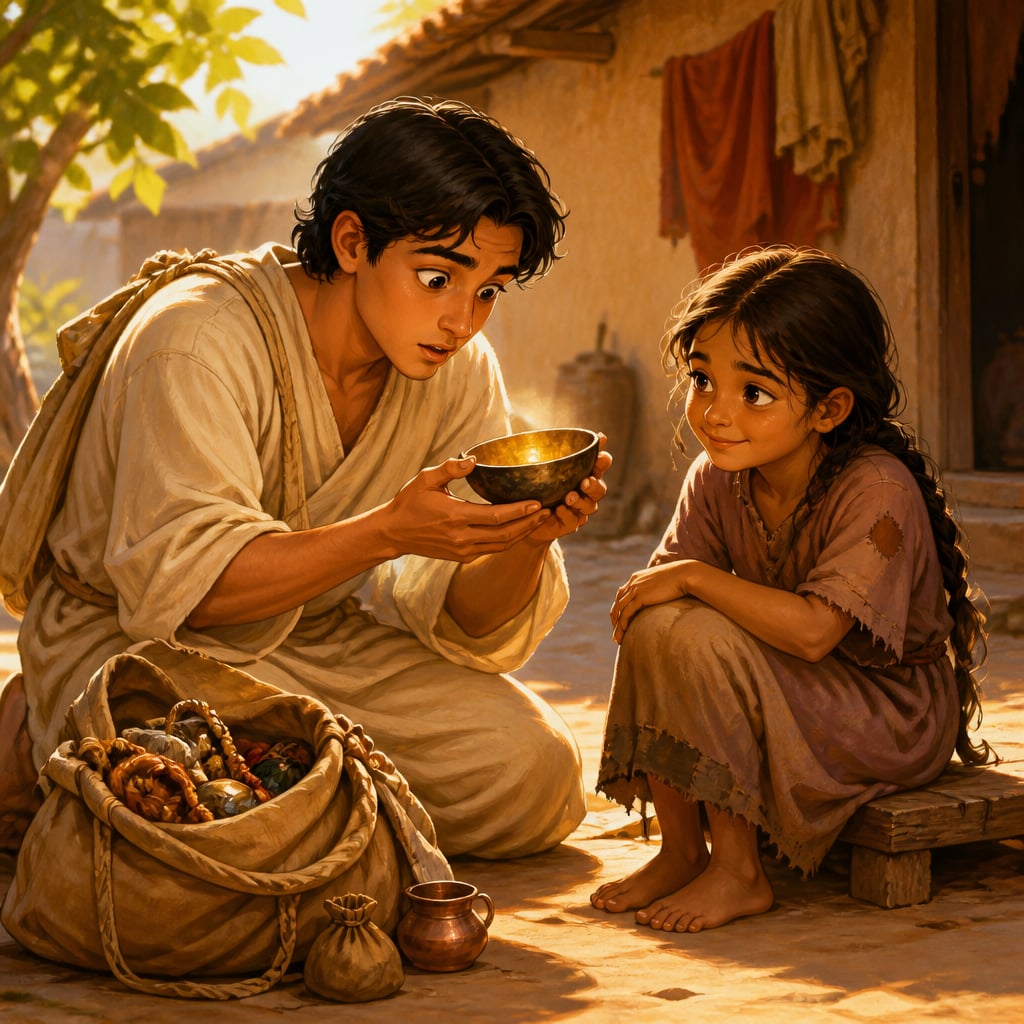
The Bodhisattva merchant Seriva discovering a golden bowl in a poor home

In the Seriva Jataka (No. 3), two merchants work the same trade route between villages. The first merchant, greedy and short-sighted, cheats a poor woman, claiming her grandmother's golden bowl is worthless brass. He offers her pennies.

The Bodhisattva, arriving after, recognizes the bowl's true value. He tells the woman honestly: this is pure gold, worth more than everything he carries. He offers her his entire stock in fair exchange. She accepts.

The greedy merchant, discovering he'd missed a fortune through his own dishonesty, dies of grief-induced heart failure.

"Satyena labhate yaso; satyena vindati priyam" "Through truth one gains honor; through truth one finds what is dear."

The business principle: Fair pricing builds sustainable relationships. The greedy merchant's attempt to exploit information asymmetry backfired catastrophically. The Bodhisattva's honesty earned him both the golden bowl and the woman's lasting gratitude and future business.

This maps directly to modern business ethics debates. When companies discover their product is worth more than customers know, what should they do? The Jataka answer: fair dealing creates more long-term value than exploitation.

The Caravan Leader: Crisis Management

The Apannaka Jataka (No. 1) - the very first story in the collection - features the Bodhisattva as a caravan leader crossing a demon-haunted desert.

A caravan leader halting his train at a false desert oasis

A demon creates an illusion of an oasis ahead. The caravan's lesser leader urges dumping water supplies to travel faster toward the mirage. The Bodhisattva refuses:

"Na passāmi purato disā yato udakam āgaccheyya" "I see no direction ahead from which water could come."

He trusts his preparation over apparent opportunity. The caravan survives; others who followed the mirage perished.

The business application: Trust your due diligence over apparent opportunities. When something looks too good to be true - a can't-miss investment, a guaranteed return, a shortcut to success - maintain discipline. The 'oasis' might be a mirage created by those who want your resources.

The Monkey King: Servant Leadership

A monkey king stretching as a living bridge for his troop

In the Mahakapi Jataka (No. 407), the Bodhisattva is born as a monkey king whose troop lives on a massive fig tree overhanging a river. When the king of Benares comes to claim the fruit, the monkey king creates a bridge with his own body so his followers can escape - sacrificing himself.

The human king, moved by this sacrifice, asks:

"What was their relation to you, that you gave your life for them?"

The Bodhisattva replies:

"Te mayham bhariya asuṁ; ahaṁ tesaṁ adhipati" "They were my responsibility; I was their leader."

This is servant leadership encoded in ancient story. The leader's role is not to extract value from followers but to create value for them - even at personal cost.

Ratan Tata exemplified this during the 2008 Mumbai attacks. When terrorists struck the Taj Mahal Palace Hotel, Tata employees stayed to protect guests. Later, Tata provided unprecedented support to affected families, including those of competitors' employees. When asked why, Tata representatives echoed the monkey king: they were our responsibility.

Honest Weights: Market Integrity

The Takkala Jataka features a merchant who discovers his competitor uses dishonest scales. The Bodhisattva must decide: expose the fraud and benefit from the competitor's downfall, or stay silent?

He exposes the fraud - not for competitive advantage but because:

"Tulam hi dhammam vinassati vināya santam" "When weights are corrupted, dharma itself is destroyed."

Market integrity matters more than any single transaction. Honest scales benefit everyone, including future competitors. By protecting the system, the Bodhisattva serves more than his own interests.

This principle underlies modern arguments for market regulation. When India's SEBI (Securities regulator) enforces honest disclosure, it's performing the Jataka function: ensuring the scales aren't corrupted.

Buddhism and Wealth: A Nuanced View

Buddhism is often misunderstood as anti-wealth. The Jatakas reveal a more nuanced position:

Wealth itself is neutral - neither good nor evil. The Bodhisattva accumulates significant wealth in many tales.

How wealth is earned matters - ethical commerce that creates real value is praised; exploitation and fraud are condemned.

How wealth is used matters more - the Bodhisattva consistently uses wealth for generosity (dana), supporting others, and creating conditions for their flourishing.

This framework anticipates modern 'conscious capitalism' - the idea that business can and should serve purposes beyond shareholder returns.

Global Perspectives on Ethical Commerce

The Jataka integration of spirituality and commerce has parallels across cultures, though few achieved Buddhism's systematic approach.

The Quaker Business Tradition (17th-19th century) represents the closest Western parallel. Quaker families, Cadbury, Rowntree, Barclays, Lloyd's, built empires on religious principles: honest weights, fair prices, employee welfare. Like Buddhist merchants practicing sammā ājīva (right livelihood), Quakers saw commerce as spiritual practice. George Cadbury built Bournville village for workers; the Rowntrees pioneered corporate pensions. This wasn't charity, it was the Seriva Jataka principle that fair dealing creates long-term value.

Yvon Chouinard (1938-present), founder of Patagonia, embodies the Mahakapi Jataka's servant leadership in modern form. In 2022, he gave away his $3 billion company to fight climate change, declaring 'Earth is now our only shareholder.' Like the monkey king sacrificing himself for his troop, Chouinard sacrificed personal wealth for collective welfare. His famous statement 'I never wanted to be a businessman' echoes Buddhist ambivalence about wealth, valuable only when used for dana (generosity).

John Mackey (1953-present), Whole Foods co-founder, coined 'Conscious Capitalism' and wrote the book defining it. Mackey's framework, purpose beyond profit, stakeholder orientation, conscious leadership, conscious culture, directly parallels Jataka business ethics. His insistence that 'business is good because it creates value' echoes the Buddhist position that ethical commerce is dharmic.

Anita Roddick (1942-2007), founder of The Body Shop, pioneered fair trade sourcing before it was fashionable. Her 'Trade Not Aid' philosophy, paying fair prices to artisan communities, mirrors the Seriva Jataka's golden bowl lesson: honest dealing creates sustainable relationships. Roddick's statement 'If you think you're too small to have an impact, try going to bed with a mosquito' captures Buddhist teaching on the power of right action.

Tradition Key Figure/Movement Core Principle Jataka Parallel
Quaker Cadbury, Rowntree Religious commerce Sammā ājīva (right livelihood)
Environmental Yvon Chouinard Earth stewardship Mahakapi (servant leadership)
Conscious Capitalism John Mackey Stakeholder value Bodhisattva as merchant
Fair Trade Anita Roddick Artisan partnerships Seriva (fair dealing)

The common thread: all these traditions recognize that sustainable business requires ethical foundation. The Jatakas systematized this insight 2,500 years before 'ESG' became a buzzword.

The Southeast Asian Commercial Buddhism

The Jatakas became especially influential in Southeast Asian Buddhism. Thai, Burmese, Sri Lankan, and Khmer cultures developed rich traditions of merchant-oriented Buddhism.

The result: a commercial culture where business success was seen as evidence of good karma from past lives, and ethical business practice was a path to good karma in future lives. This created strong incentives for fair dealing - not from external regulation but from internalized religious belief.

Practical Business Wisdom from the Jatakas

Distilling across many tales:

  1. Fair dealing creates more value than exploitation - information asymmetry is a temptation, not an opportunity
  2. Preparation beats apparent opportunity - don't abandon discipline for mirages
  3. Leadership means service - your success depends on your team's success
  4. Market integrity benefits all - protecting the system serves long-term self-interest
  5. Wealth is for use, not hoarding - circulation creates prosperity

These aren't abstract principles but practical guidance encoded in memorable stories that spread across Asia with Buddhism itself.

Your Turn

The Jatakas suggest that how you do business is spiritual practice. Every transaction is an opportunity for ethical development or ethical regression.

This challenges both the cynical view that business is inherently corrupt and the naive view that good intentions are sufficient. The Bodhisattva is shrewdly successful and deeply ethical. The Jatakas teach that this combination isn't just possible - it's the highest path.

Economics recognizes information asymmetry as a market problem. George Akerlof's 'Market for Lemons' shows how information imbalance can destroy markets. The Seriva Jataka addresses this: ethical behavior by informed parties preserves market function.

The Jataka goes beyond economics to connect fair dealing with personal flourishing (yaso - honor, reputation). The dishonest merchant didn't just lose the deal - he died of grief. Western economics treats ethics as external constraint; the Jataka internalizes ethics as self-interest rightly understood.

Edelman Trust Barometer 2023 shows 'business' is more trusted than government and media in India. Companies that maintain trust through fair dealing outperform: Tata Group's brand value ($24B) demonstrates the 'yaso' (honor/value) that comes from sustained ethical practice.

Behavioral finance documents 'irrational exuberance' and 'FOMO' (Fear Of Missing Out) that drive investors toward speculative bubbles. The Apannaka Jataka teaches exactly this: verify before trusting.

The Jataka adds a spiritual dimension: the mirage is created by a 'demon' - in psychological terms, our own greed and impatience create the illusions we chase. Self-awareness about our vulnerabilities is part of due diligence.

India lost an estimated $1 billion+ to crypto and Ponzi schemes in 2022-2023 (various reports). Victims were chasing 'mirages' - guaranteed high returns that seemed too good to verify. The Apannaka principle would have saved them.

Key terms

Bodhisattva
A being destined for enlightenment; in Jataka context, the Buddha in his previous lives while still accumulating merit and wisdom
Dāna
Generosity, giving; one of the primary Buddhist virtues and a key practice for accumulating merit
Sammā Ājīva
Right Livelihood - one of the steps on the Buddhist Eightfold Path, referring to earning a living through ethical means
Sīla
Ethical conduct, moral discipline, virtue; the foundation of Buddhist practice and essential to right livelihood in commerce

Verses

सच्चेन लभते यसो सच्चेन विन्दति प्रियम्। सच्चाय तप्पते पुच्छो दुच्छिन्नो सब्बकम्मुना॥

saccena labhate yaso saccena vindati priyaṁ | saccāya tappate pucchaṁ ducchinnno sabba-kammunā ||

Through truth one gains true honor, through truth finds what is dear; who abandons truth is tormented, cut off from good deeds here.

This is the ancient statement of 'honesty is the best policy' - but with economic reasoning. The verse connects truth (sacca) directly to reputation (yaso) and obtaining value (vindati priyam). Dishonesty doesn't just feel bad - it cuts you off from 'sabba-kammuna' (all good outcomes). This is reputation economics: truth-telling is economically rational over time.

Jataka Tales, Seriva Jataka (No. 3) (E.B. Cowell translation)

अपण्णकं ठानमेके निस्सयं गच्छन्ति मोहिता। सपण्णकं ठानमेके धीरा गच्छन्ति निब्बुता॥

apaṇṇakaṁ ṭhānam eke nissayaṁ gacchanti mohitā | sapaṇṇakaṁ ṭhānam eke dhīrā gacchanti nibbuta ||

The deluded chase uncertain ground, while the wise stand on what's sure and sound.

This is investment wisdom: distinguish between 'apaṇṇaka' (speculative, unproven) and 'sapaṇṇaka' (sound, verified) opportunities. The 'dhīra' (wise person) doesn't chase mirages. Modern translation: due diligence before investment. When an opportunity seems too good to verify, verify harder - or walk away.

Jataka Tales, Apannaka Jataka (No. 1) (E.B. Cowell translation)

अहं हि तेसं इस्सरो तेभ्यो च पालको अहम्। तेसं अत्थाय मे जीवितं वज्झे आरोग्यपच्चया॥

ahaṁ hi tesaṁ issaro tebhyo ca pālako ahaṁ | tesaṁ atthāya me jīvitaṁ vajjhe ārogya-paccayā ||

I am their lord, their guardian true; for their sake my life I'd give to ensure their welfare through.

This is the clearest ancient statement of servant leadership. The 'issaro' (leader) role means being 'pālako' (protector/guardian) whose purpose is 'tesam atthāya' (for their benefit). This inverts extractive leadership models. Modern parallel: leaders who forgo bonuses during layoffs, CEOs who take pay cuts during crises, founders who ensure employee equity. The monkey king's model creates loyalty that no contract can compel.

Jataka Tales, Mahakapi Jataka (No. 407) (E.B. Cowell translation)

Key figures

The Buddha (Siddhartha Gautama)

c. 563-483 BCE (traditional dating) or c. 480-400 BCE (scholarly dating)

Ratan Tata

1937-2024

John Mackey

1953-present

Historical context

Ancient India to Medieval Southeast Asia (c. 500 BCE - 1500 CE)

The Jatakas emerged when India was experiencing rapid urbanization and commercial expansion. Merchants were gaining social power, and questions of ethical commerce were pressing. Buddhism provided a framework that validated commercial success while guiding it toward ethical ends.

While Greek philosophy debated commerce's morality (Aristotle was suspicious of traders) and Abrahamic religions had complex attitudes toward money-lending, Buddhism in the Jatakas offered practical guidance for ethical business. This made Buddhist regions particularly commercially sophisticated.

Of the 547 Jataka tales, approximately 50+ feature the Bodhisattva as a merchant or trader - more than any other single profession except royalty. This reflects commerce's importance in Buddhist moral imagination.

The Jatakas demonstrate that ancient India had sophisticated business ethics integrated into religious practice. This heritage offers alternatives to both the 'business is inherently corrupt' cynicism and the 'anything for profit' amorality of some modern business cultures.

Living traditions

The Jataka model of ethical commerce continues in modern form. Mindful business movements, conscious capitalism, and B-Corp certifications all echo Jataka themes: business success compatible with ethical conduct, leadership as service, wealth meaningful through use not accumulation. Indian companies like Tata Group, built on values that parallel Jataka principles, demonstrate this tradition's commercial viability in the modern world.

Reflection

More in Business Wisdom from Ancient Stories

All lessons in Business Wisdom from Ancient Stories · Vaishya Dharma: The Art of Ethical Commerce course