Hitopadesha: Practical Business Wisdom

The Merchant's Manual

The Hitopadesha refines Panchatantra wisdom into direct, actionable business advice - covering customer relations, employee management, and wealth preservation with remarkable clarity.

The King Who Needed Different Advice
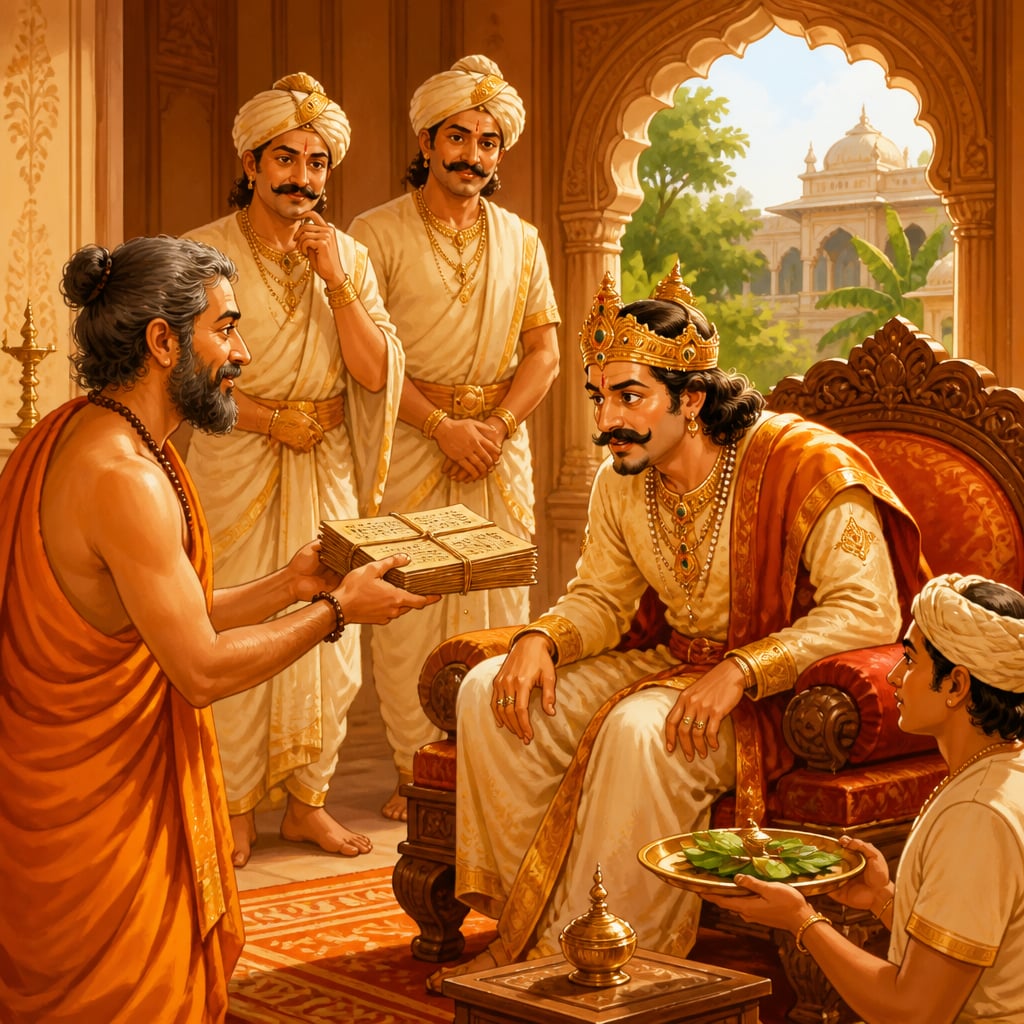
Scholar Narayana presenting his treatise to King Dhavalachandra of Bengal

Around 1100 CE, King Dhavalachandra of Bengal faced a problem. The Panchatantra was brilliant, but his young sons found its nested stories confusing. They needed something simpler - wisdom distilled into memorable maxims they could apply immediately.

The scholar Narayana took up the challenge. He extracted the Panchatantra's essence, added verses from the Nitishastra tradition, and created the Hitopadesha - literally 'Beneficial Instruction.' Where the Panchatantra was a labyrinth of stories-within-stories, the Hitopadesha was a straight path to wisdom.

The result? A text that became even more popular than its predecessor, precisely because it spoke directly to the merchant, the administrator, the practical person who needed answers, not entertainment.

The Four Books: A Business Curriculum

The Hitopadesha organizes its wisdom into four practical sections:

Book Sanskrit Name Business Focus
1 Mitralabha (Gaining Friends) Networking, alliance-building, first impressions
2 Suhridbheda (Separation of Friends) Managing conflict, protecting partnerships
3 Vigraha (War/Conflict) Competitive strategy, market battles
4 Sandhi (Peace/Resolution) Negotiation, deal-making, reconciliation

Notice the progression: first build relationships, then protect them, then compete wisely, then make peace. This is a complete business lifecycle in four books.

The Merchant and the Traveler: First Impressions
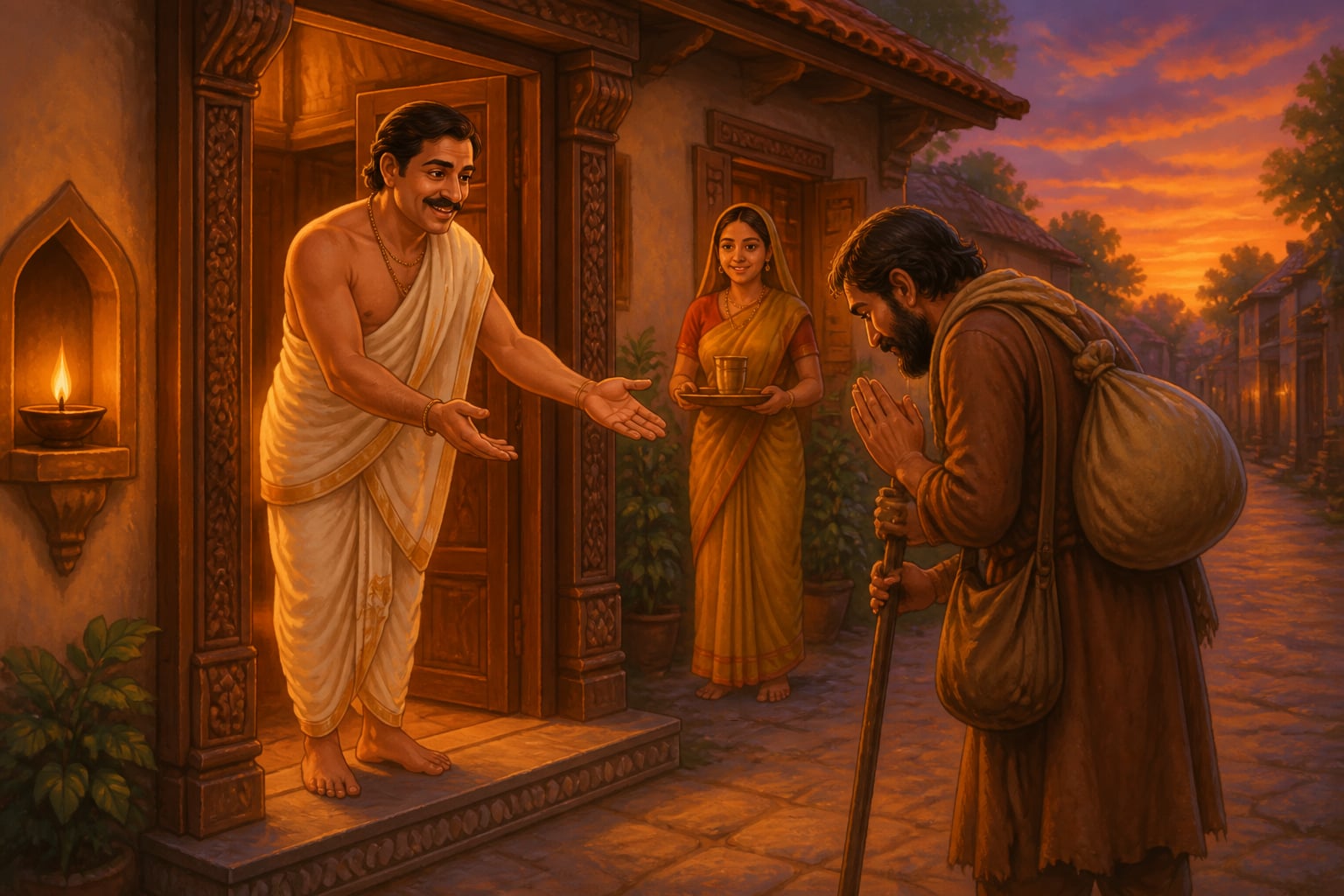
A merchant welcoming a weary traveler at his home threshold

From Mitralabha comes this famous teaching: A merchant extends hospitality to a weary traveler. Over time, the traveler proves invaluable - his knowledge of distant markets opens new trade routes for the merchant.

The embedded principle:

"Ajnātakulashīlasya vaaso deyo na kasyacit" "One whose family and character are unknown should not be given shelter."

But wait - didn't the merchant shelter a stranger? Yes, but first he observed the traveler's behavior: how he spoke, how he ate, how he treated servants. Character reveals itself through action.

The business application: Due diligence isn't just paperwork - it's behavioral observation. Modern investors call this 'pattern recognition.' The best VCs watch how founders treat waiters, how they handle rejection, how they speak of former partners. Character leaks through behavior.

Customer Wisdom: The Crocodile's Mistake

A crocodile befriends a monkey, then betrays him by trying to eat him. The monkey escapes, but the crocodile loses a reliable source of fruit forever.

"Mitram pratāpya kim phalam?" "What is gained by cheating a friend?"

This story directly addresses customer relationships. The crocodile gained nothing and lost a steady supply. Modern translation: don't exploit customers for short-term gain.

In 2015, Maggi noodles were banned in India over lead content concerns. Nestlé could have fought legally and slowly. Instead, they recalled 38,000 tons of product at massive cost, then rebuilt trust through transparency. By 2017, Maggi had recovered 60% market share. The crocodile would have fought the ban; Nestlé chose the monkey's wisdom - preserve the relationship.

Employee Management: The Jackal's Counsel

A lion king has a wise jackal minister who advises:

"Sevakam prabhum āśritya na śokam kartum arhati" "A servant who has taken refuge with a master should not be made to grieve."

This is ancient HR advice: treat employees well or lose their loyalty. But the Hitopadesha goes further:

"Alpasyāpi pravriddhasya kāryasyānubandhakaḥ" "Even small matters, if handled well, compound into great results."

Small courtesies, consistent fairness, timely appreciation - these 'small matters' compound into employee loyalty that no salary can buy.

Infosys founder Narayana Murthy built India's first truly employee-centric IT company on exactly this principle. ESOP programs made employees millionaires. The result? Industry-low attrition during India's IT boom when competitors were losing staff constantly.

Wealth Preservation: The Snake and the Frog

An old snake reclining among frogs at a pond's edge

An old snake, too weak to hunt, convinces frogs that he's reformed. He carries them on his back as transportation, eating one occasionally as 'payment.' Eventually, he runs out of frogs.

"Yathā hyaṅganayā śūnyā yathā rātrir anagnikā। tathā dāridryam icchanti ye narā durbalāḥ sadā॥" "As a woman without adornment, as a night without fire, so is poverty - always wished upon weak men."

The snake's mistake was consuming capital instead of income. He ate the frogs (principal) instead of finding sustainable food (interest/returns).

This principle explains why traditional Indian business families insist on never touching capital. The Tata Trusts, holding 66% of Tata Sons, have existed for over 100 years because they spend dividends, not principal. Contrast with founders who sell equity at every opportunity - they're eating frogs.

The Hitopadesha Advantage

Why did the Hitopadesha spread even faster than the Panchatantra? Three reasons:

  1. Shorter maxims - Verses can be memorized and applied quickly
  2. Direct advice - Less allegory, more prescription
  3. Practical focus - Stories chosen for business relevance, not literary elegance

The Hitopadesha sacrificed artistic complexity for accessibility. Vishnu Sharma was a poet; Narayana was a consultant.

Global Perspectives on Practical Wisdom

The Hitopadesha's approach, distilling complex wisdom into memorable, actionable maxims, has parallels across cultures, though few achieved its systematic depth.

Benjamin Franklin (1706-1790) created Poor Richard's Almanack, which shares the Hitopadesha's format: pithy maxims for practical life. 'A penny saved is a penny earned' and 'Early to bed, early to rise' echo the Hitopadesha's memorable brevity. But Franklin's maxims focus primarily on individual discipline, while Narayana addresses relationships, negotiations, and strategic thinking, a broader scope.

Dale Carnegie (1888-1955) wrote How to Win Friends and Influence People (1936), which directly parallels the Hitopadesha's first two books (Mitralabha and Suhridbheda). Carnegie's 'become genuinely interested in other people' and 'remember that a person's name is the sweetest sound' echo Narayana's relationship wisdom. However, Carnegie lacks the Hitopadesha's realism about conflict and strategic retreat.

Warren Buffett (1930-present) represents modern practical wisdom. His annual letters contain Hitopadesha-style maxims: 'Be fearful when others are greedy,' 'Our favorite holding period is forever.' Buffett's emphasis on long-term relationships over short-term transactions directly echoes the crocodile lesson.

Thinker Key Work Focus Hitopadesha Parallel
Franklin Poor Richard's Almanack Personal discipline Individual maxims (narrower scope)
Carnegie How to Win Friends Relationship building Mitralabha (gaining friends)
Buffett Annual Letters Long-term value Crocodile lesson (relationship preservation)

The Hitopadesha's advantage: it covers the complete lifecycle, building relationships, protecting them, handling conflict, and making peace, in one integrated system. Western wisdom tends toward single-domain advice.

Modern Resonance: 2025 and Beyond

The Hitopadesha's principles continue to shape Indian business in 2025. Aman Gupta's boAt, now India's largest audio brand, grew from nothing to ₹3,000+ crore revenue through pure utsaha and relationship-first commerce. When the audio market seemed dominated by global giants like JBL and Sony, boAt's persistent customer engagement and influencer relationships created a community-driven brand. By Q3 2024, boAt held 32% of India's earwear market.

From Bengal to Boardrooms

The Hitopadesha reached Europe before the Panchatantra did. Charles Wilkins translated it to English in 1787, and it became required reading for British East India Company officers trying to understand Indian commercial culture.

The irony: colonizers studied Indian business wisdom to exploit India better. The opportunity: we can reclaim this wisdom for India's 21st-century economic renaissance.

Your Turn

The Hitopadesha assumes you're busy. It doesn't ask you to contemplate nested allegories - it delivers actionable wisdom in memorable verses.

Here's a test: Can you remember three principles from this lesson? The crocodile's customer wisdom. The jackal's employee advice. The snake's capital preservation. If you can recall these stories, you've internalized wisdom that took Narayana months to compile.

That's the Hitopadesha's genius - and why, 900 years later, it remains the merchant's manual.

Thomas Edison's '1% inspiration, 99% perspiration.' Angela Duckworth's 'Grit' research shows perseverance predicts success better than talent. The startup mantra 'ideas are cheap, execution is everything.'

The Indian framework distinguishes 'utsaha' (active striving) from 'asha' (passive hope). Many cultures praise optimism; the Hitopadesha praises sustained effort. This prevents the trap of 'positive thinking' without action.

CB Insights analysis of startup failures shows 'ran out of cash/couldn't raise funding' (38%) and 'no market need' (35%) as top causes - both ultimately failures of sustained effort to adapt and persist.

Sunk Cost Fallacy; Stop-Loss Strategy; Pivot Decisions

Behavioral economics documents sunk cost fallacy extensively. Investment rules mandate stop-losses. Eric Ries's 'Lean Startup' methodology requires 'pivot or persevere' decisions.

The Hitopadesha frames this as wisdom (pandita), not failure. Western discourse often stigmatizes 'giving up.' The Indian frame honors strategic retreat - knowing when to let go is itself intelligence.

Key terms

Utsāha
Enthusiasm, energy, active striving - the inner drive that powers all achievement
Hitopadeśa
Beneficial instruction; friendly advice; wisdom given for the recipient's welfare
Paṇḍita
A wise person; one who has both learning and practical judgment to apply knowledge effectively
Sandhi
Peace-making, alliance, treaty, or reconciliation; the final and most sophisticated stage of the Hitopadesha's four-part business lifecycle

Verses

उत्साहो बलवानार्य नास्त्युत्साहात्परं बलम्। सोत्साहस्य च लोकेषु न किञ्चिदपि दुर्लभम्॥

utsāho balavān ārya nāsty utsāhāt paraṁ balam | sotsāhasya ca lokeṣu na kiñcid api durlabham ||

Enthusiasm is strength, O noble one - no power surpasses drive; for those who burn with purpose true, nothing's hard to derive.

This is the ancient version of 'execution beats strategy.' Many businesses fail not from bad plans but from lack of sustained energy to implement. The verse doesn't praise blind optimism - it specifically uses 'utsaha' (active striving) not 'asha' (passive hope). The entrepreneur's advantage is often simply refusing to quit.

Hitopadesha, Mitralabha (Book I) (M.R. Kale edition)

सर्वनाशे समुत्पन्ने अर्धं त्यजति पण्डितः। अर्धेन कुरुते कार्यं सर्वनाशो हि दुःसहः॥

sarvanāśe samutpanne ardhaṁ tyajati paṇḍitaḥ | ardhena kurute kāryaṁ sarvanāśo hi duḥsahaḥ ||

When ruin looms, the wise let go of half to save the rest; with what remains they carry on - total loss is worst.

This is the 'stop loss' principle predating modern finance by centuries. Indian traders understood that emotional attachment to failing ventures is the real enemy. The specific fraction 'half' may be negotiable, but the principle isn't: sometimes you must lose some to save the rest. Nokia's failure to abandon its OS for Android is a modern example of ignoring this wisdom.

Hitopadesha, Suhridbheda (Book II) (M.R. Kale edition)

अर्थार्थी जीवलोकोऽयं श्मशानमपि सेवते। त्यजन्ति मित्राणि धनैर्विहीनं पुत्राः पितरमप्यसमर्थम्॥

arthārthī jīvaloko'yaṁ śmaśānam api sevate | tyajanti mitrāṇi dhanaivihīnaṁ putrāḥ pitaram apy asamartham ||

For wealth, men haunt even burning grounds; friends flee the man whose fortune drowns; sons leave the father stripped of power - such is the world in its darkest hour.

The Hitopadesha isn't naive about human nature. This verse explains why wealth-building is dharmic: without resources, even family obligations collapse. It's not cynicism but motivation - build wealth because you'll need it, and don't expect gratitude from those you can't help. Modern translation: 'Build your emergency fund before expecting loyalty.'

Hitopadesha, Sandhi (Book IV) (M.R. Kale edition)

Key figures

Narayana

c. 1100 CE (traditional dating)

Narayana Murthy

1946-present

Benjamin Franklin

1706-1790

Case studies

boAt: Building India's Audio Empire Through Utsaha

In 2016, Aman Gupta and Sameer Mehta launched boAt with a simple observation: Indians were destroying expensive earphone cables within months. The audio market was dominated by global giants, JBL, Sony, Bose, with massive R&D and marketing budgets. Gupta, after multiple failed ventures (including a shoe brand), had every reason to quit. Instead, he applied relentless utsaha: starting with just indestructible cables, then earphones, then speakers, then smartwatches. Rather than compete on technology, boAt competed on relationships, building India's first 'audio community' through aggressive influencer partnerships, cricket sponsorships, and social media engagement. When asked about his strategy, Gupta quoted the Hitopadesha principle: 'Enthusiasm beats everything.'

boAt embodies all three Hitopadesha principles from this lesson. **Utsaha (enthusiasm)**: Gupta's previous failures would have stopped most founders. His sustained drive, pivoting from cables to audio to wearables, demonstrates that enthusiasm outlasts strategy. **Half-loss principle**: When boAt's smartwatch division initially struggled, they cut losses quickly and refocused on core audio products before expanding again with better market knowledge. **Customer relationships**: Unlike competitors who sold products, boAt built a community. Their 'boAtheads' identity created customer loyalty that no discount could match, the crocodile lesson in action.

By 2024, boAt achieved ₹3,500+ crore revenue, captured 32% of India's earwear market, and became the world's 5th largest wearables brand. The company filed for a ₹2,000 crore IPO in 2025. More remarkably: boAt achieved this with minimal advertising spend compared to competitors, relying instead on community-driven word-of-mouth, the Hitopadesha's relationship wisdom monetized at scale.

boAt proves that the Hitopadesha's principles work in the smartphone age. Sustained enthusiasm (utsaha) beats superior resources. Customer communities outlast customer transactions. Strategic retreat from failing products preserves capital for winning ones. Narayana's 900-year-old wisdom built India's largest audio brand.

The creator economy and community-led growth strategies dominating marketing today are exactly what boAt built years ago. Brands spending heavily on influencer campaigns often miss the deeper lesson: communities form around shared identity, not promotional discounts. boAt's 'boAtheads' anticipated what every D2C brand now tries to manufacture through Discord servers and loyalty programs.

boAt spends approximately 3% of revenue on marketing vs 15-20% industry average. Their 'boAthead' community of 3+ million followers generates organic reach that paid advertising cannot match, relationship economics operationalized.

Historical context

Medieval India (c. 1100-1500 CE)

Medieval Bengal was a major center of trade, connecting Central Asia to Southeast Asia through both land and river routes. Merchants needed systematic wisdom for managing complex multi-cultural commerce. The Hitopadesha served as a practical manual in this environment.

Europe's medieval business education was dominated by Church teachings suspicious of commerce. No equivalent practical business wisdom text existed until much later. The Hitopadesha gave Indian merchants a systematic framework their European competitors lacked.

The Hitopadesha was translated into more than 25 languages by 1900, including multiple European languages, Persian, Arabic, and several Southeast Asian languages - evidence of its perceived practical value across cultures.

Understanding the Hitopadesha reveals that Indian business wisdom isn't abstract philosophy but intensely practical guidance. When modern Indian entrepreneurs speak of relationship-based commerce or long-term thinking, they're drawing on centuries of Hitopadesha-shaped culture.

Living traditions

Every Indian business that prioritizes customer retention over customer acquisition is channeling Hitopadesha. Every founder who treats employees as partners practices its teachings. The text's influence is so embedded that most Indian businesspeople embody its principles without knowing the source. Startup India's emphasis on ethical entrepreneurship, SEBI's stakeholder governance requirements, and corporate India's CSR practices all echo medieval Bengal's beneficial instruction.

Reflection

More in Business Wisdom from Ancient Stories

All lessons in Business Wisdom from Ancient Stories · Vaishya Dharma: The Art of Ethical Commerce course