Kathasaritsagara: The Merchant Tales
Adventures in the Ocean of Story
The Kathasaritsagara's merchant adventures reveal the psychology of risk, the economics of trust across cultures, and why reputation was ancient India's most valuable currency.
The Poet Who Captured Commerce
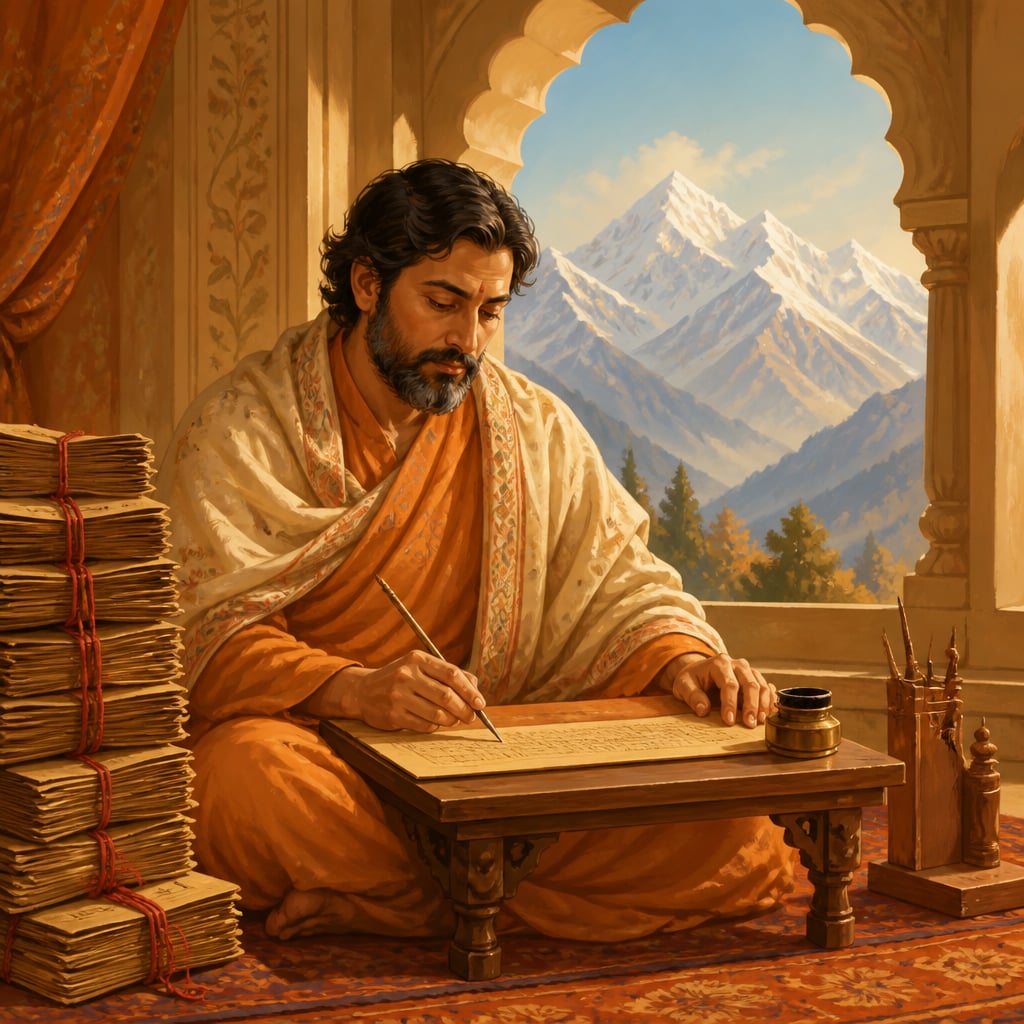
In 11th century Kashmir, the court poet Somadeva faced an unusual assignment. Queen Suryavati, wife of King Anantadeva, suffered from insomnia. Her physician prescribed not medicine but stories - tales so engrossing that they would occupy her restless mind until sleep came.
Somadeva compiled 18,000 verses over two decades, creating the Kathasaritsagara - the 'Ocean of Story.' But unlike the Panchatantra's animal fables, these were tales of human adventure: merchants sailing to golden islands, traders navigating treacherous markets, entrepreneurs building fortunes against impossible odds.
What emerged wasn't just literature. It was the most detailed portrait of medieval Indian commercial life ever recorded - and a business education disguised as bedtime stories.
Merchant Heroes, Not Side Characters
In most ancient literatures, merchants appear as supporting characters - providers of goods for heroes, financiers of wars, background figures. The Kathasaritsagara is different: merchants are heroes.
Consider the categories of protagonists:
| Story Type | Protagonist | Business Theme |
|---|---|---|
| Sea Voyages | Merchant captains | Risk management, diversification |
| Caravan Tales | Overland traders | Supply chain, security, partnerships |
| City Stories | Urban entrepreneurs | Competition, market entry, reputation |
| Magic Tales | Merchants gaining supernatural aid | The role of luck in business |
These aren't stories about merchants who happen to have adventures. They're stories about commerce itself as adventure.
The Golden Island: Calculated Risk
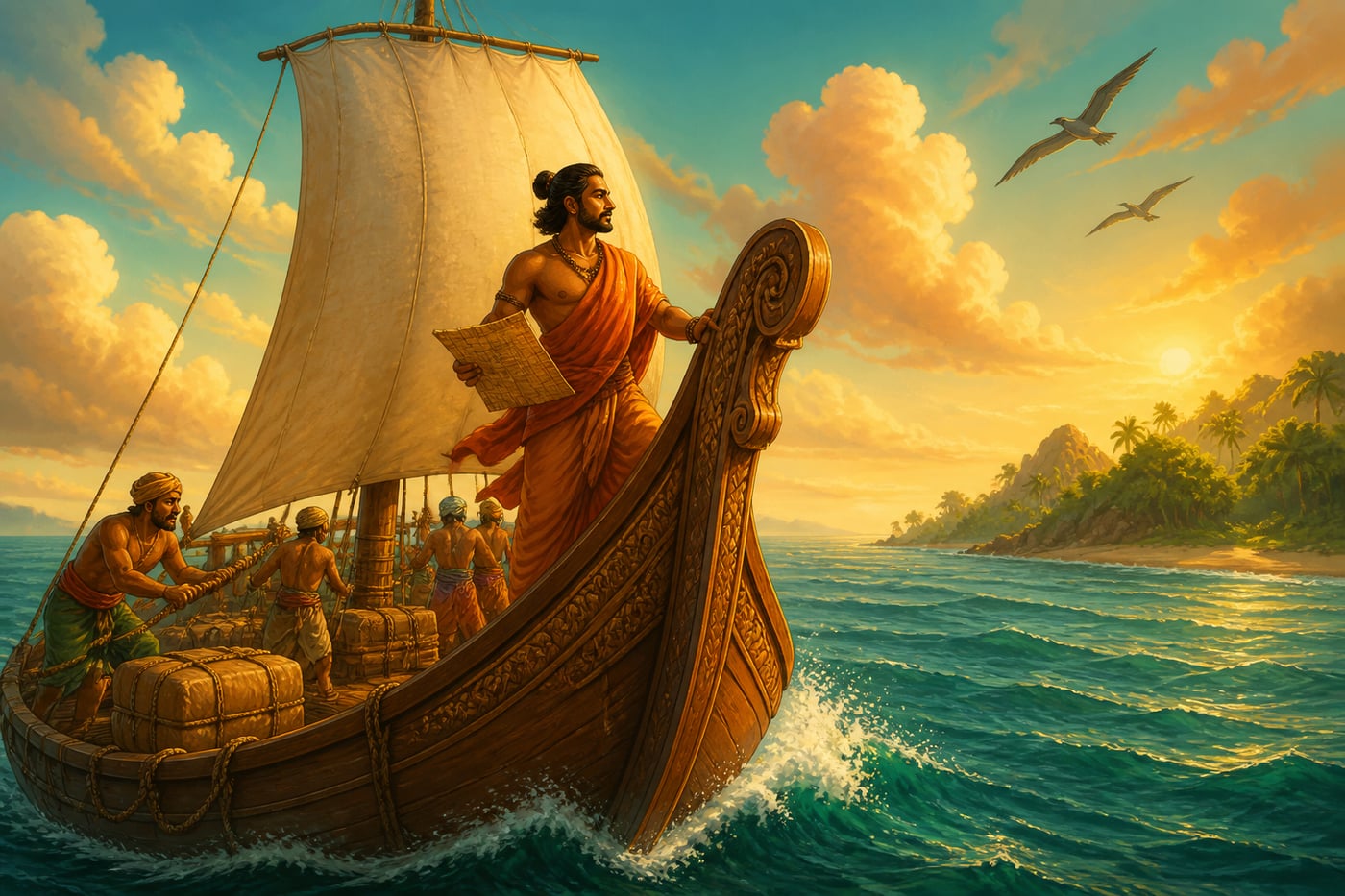
One famous tale follows Saktideva, a merchant's son who hears of Suvarnadvipa - the Golden Island (likely Sumatra or Java). The journey is perilous: storms, pirates, monsters. But the potential return is astronomical.
Saktideva calculates:
"Yatra prabruyate labho na tatra bhaya karanam" "Where great profit is spoken of, fear should not be the determining factor."
But crucially, he doesn't rush blindly. He:
- Researches thoroughly - talking to returned sailors, mapping routes
- Builds the right team - experienced captain, loyal crew
- Diversifies cargo - not everything in one ship
- Sets a stop-loss - if certain signs appear, turn back
This is venture capital methodology from the 11th century. The story validates risk-taking while teaching risk management.
In 2023, Zepto's founders Aadit Palicha and Kaivalya Vohra dropped out of Stanford to launch 10-minute grocery delivery in India. The 'Golden Island' skeptics said it was impossible. But like Saktideva, they did the research, built the team, and managed risk carefully. By 2025, Zepto reached $1 billion valuation at ages 21 and 20.
The Honest Merchant's Paradox
The tale of Chandrasvamin presents a dilemma every business person faces. A merchant in a foreign port, he discovers his local competitor is defrauding customers with false weights. Exposing the fraud would help customers but also eliminate his competitor. Staying silent protects the competitor but harms innocents.
The story's resolution: Chandrasvamin exposes the fraud but refuses to benefit from it. He doesn't take over the cheater's customers or celebrate his downfall. He simply corrects the injustice and continues his own honest practice.
The embedded principle:
"Na pareṣām apakāreṇa svaśreyaḥ sampādayet" "Do not achieve your own benefit through harm to others."
This isn't naive idealism - it's reputation economics. In a world without consumer protection laws, your reputation was your only brand. Chandrasvamin's restraint builds the reputation that brings him long-term success.
Women in Commerce

Remarkably for its era, the Kathasaritsagara features women as commercial agents. The merchant's wife Devasmita, in one famous tale, runs her husband's business while he trades abroad. When competitors try to seduce her to gain business intelligence, she outsmarts them all, protecting both her honor and her husband's trade secrets.
The story recognizes that:
- Women managed family finances and business affairs
- Commercial intelligence was valuable and worth stealing
- Women could be shrewd business operators in their own right
This challenges the stereotype of women confined to domestic roles. In medieval India's commercial households, business was a family affair.
The Psychology of Wealth
The Kathasaritsagara contains sophisticated observations about wealth psychology:
On Sudden Wealth:
"Akasmāl labdham arthaṁ ca vinashyati api akasmāt" "Wealth gained suddenly is lost suddenly."
This describes what modern economists call the 'windfall curse' - lottery winners who go bankrupt, inheritance squanderers. The stories teach that sustainable wealth requires sustainable practices.
On Poverty's Psychology: Several tales show how poverty creates a 'scarcity mindset' that sabotages opportunity. A poor merchant offered credit refuses it - his poverty has made him unable to think in terms of investment and return.
On Wealth and Character:
"Arthāgame na mattaḥ syāt arthāṁs tyaktvā na ca mlānaḥ" "Don't become intoxicated when wealth comes, nor dejected when it goes."
This is Stoic economics - what Nassim Taleb calls being 'antifragile.' The stories teach emotional regulation for entrepreneurs.
Trust Across Cultures
Many Kathasaritsagara merchants trade internationally - in China, Southeast Asia, the Middle East. The stories address a crucial question: how do you build trust with people from completely different cultures?
The answer: rituals of trust. Shared meals, gift exchanges, honoring each other's religious customs, keeping small promises before large ones. These ritualized trust-building practices created the 'social infrastructure' for the Silk Road and Indian Ocean trade.
When TCS or Infosys opened offices in America, they faced the same challenge. Their solution - emphasizing relationship-building, cultural respect, incremental trust - echoes Kathasaritsagara merchants navigating foreign ports.
Global Perspectives on Merchant Adventure Literature
The Kathasaritsagara's celebration of merchant-heroes has parallels across civilizations, though none achieved its combination of commercial realism and narrative sophistication.
Marco Polo (1254-1324) dictated The Travels of Marco Polo, documenting his 24-year journey along the Silk Road. Like Kathasaritsagara merchants, Polo sailed to golden lands (China, not Suvarnadvipa) seeking fortune. But Polo's account is autobiography, not wisdom literature - he tells what happened, not what lessons to draw. The Kathasaritsagara embeds commercial wisdom; Polo provides commercial description.
Sinbad the Sailor from One Thousand and One Nights (c. 800-900 CE) represents Arab merchant adventure literature. Sinbad's seven voyages closely parallel Kathasaritsagara sea stories - both traditions feature merchants facing monsters, pirates, and exotic lands. Scholars debate whether Indian stories influenced Arabian ones through trade route transmission, or whether maritime merchants across cultures faced similar challenges and created similar narratives.
Joseph Campbell (1904-1987) identified the 'Hero's Journey' structure in world mythology. The Kathasaritsagara merchant tales follow this pattern: departure from the known, trials in the unknown, return with treasure/wisdom. Campbell's insight: these stories aren't just entertainment - they're psychological preparation for life's entrepreneurial challenges.
| Tradition | Key Work | Focus | Kathasaritsagara Parallel |
|---|---|---|---|
| Venetian | Travels of Marco Polo | Documentary travelogue | Descriptive vs prescriptive |
| Arabian | Sinbad the Sailor | Adventure fantasy | Similar maritime merchant archetypes |
| Comparative Mythology | The Hero with a Thousand Faces | Narrative structure | Merchant as hero archetype |
The Kathasaritsagara's uniqueness: it combines adventure entertainment with systematic commercial education. Sinbad entertains; Marco Polo informs; Somadeva instructs.
From Kashmir to Everywhere
Somadeva's tales spread throughout South and Southeast Asia. They influenced Persian literature, reached Arabian storytelling traditions, and may have contributed to European fairy tales through trade route transmission.
The commercial content spread because it was useful. Merchants from different cultures found recognizable challenges and applicable wisdom. A trader in 12th century Java reading about Chandrasvamin's dilemma faced similar situations in his own port.
Your Turn
The Kathasaritsagara teaches that commerce is adventure - not just in the metaphorical sense but literally. Trade required physical courage, psychological resilience, and social intelligence.
Modern entrepreneurship sanitizes this. We talk about 'disruption' and 'growth hacking' from comfortable offices. But the underlying reality is the same: business is venturing into uncertainty with calculated risk, hoping skill and fortune align.
Somadeva's merchant heroes didn't have venture capital or legal systems. They had their wits, their reputations, and their courage. The fundamentals haven't changed - only the context.
Finance theory distinguishes 'systematic risk' (market-wide) from 'idiosyncratic risk' (venture-specific). Entrepreneurial returns come from bearing idiosyncratic risk that can't be diversified away. Warren Buffett: 'Risk comes from not knowing what you're doing.'
The Kathasaritsagara adds the psychological dimension Western finance often ignores. Sahasa isn't just willingness to accept risk - it's the courage to act despite fear. Risk tolerance can be calculated; courage must be cultivated.
India's startup ecosystem grew from $10B funding in 2020 to $38B in 2021 (NASSCOM). The entrepreneurs who took risks during COVID uncertainty - like Zepto launching in lockdown - captured disproportionate value.
This anticipates signaling theory in economics. Michael Spence's work on job market signaling (Nobel Prize 2001) shows how credentials (reputation) reduce information asymmetry and enable transactions. The verse recognized this dynamic a millennium earlier.
The Indian framework is bidirectional where Western theory often emphasizes one direction. Reputation isn't just a signal to others - it's an asset that generates returns directly. Traditional Indian business communities understood reputation as infrastructure for commerce.
Tata brand value is estimated at $24 billion (Brand Finance 2023). This 'reputation capital' enables Tata companies to enter new markets, attract talent, and command premium pricing - exactly the 'greater wealth from reputation' the verse describes.
Key terms
- Suvarṇadvīpa
- The 'Golden Island' - ancient Indian name for gold-rich islands of Southeast Asia, likely Sumatra or the Malay Peninsula
- Sāhasa
- Enterprise, courage, bold initiative - specifically the willingness to take calculated risks for potential reward
- Kathāsaritsāgara
- Literally 'Ocean of the Streams of Story' - the medieval collection of tales compiled by Somadeva in Kashmir
- Yaśas
- Fame, glory, reputation - the public recognition that follows righteous wealth creation and becomes itself a source of further prosperity
Verses
साहसेन विना लक्ष्मीर्न शक्या प्राप्तुमीप्सिता। न विना वारिसङ्क्षोभं रत्नान्युत्पद्यते समुद्रे॥
sāhasena vinā lakṣmīr na śakyā prāptum īpsitā | na vinā vāri-saṅkṣobhaṁ ratnāny utpadyate samudre ||
Without courage, desired fortune can't be won; as ocean gems emerge only when waters are churned and spun.
This is the ancient statement of 'no risk, no return.' The ocean metaphor is precise: the gems (wealth) exist within the ocean (market), but accessing them requires churning (entrepreneurial action). Passive participation in markets yields market returns; excess returns require active risk-taking. The verse also suggests that disruption is natural and necessary - a very modern insight.
Kathasaritsagara, Lambaka 6, Taranga 2 (C.H. Tawney translation)
यश आयाति धनेभ्यो धनं यशसः परम्। अतो यशोर्थिना पूर्वं यत्नः कार्यो धनार्जने॥
yaśa āyāti dhanebhyo dhanaṁ yaśasaḥ param | ato yaśorthināṁ pūrvaṁ yatnaḥ kāryo dhanārjane ||
From wealth comes fame, from fame comes wealth more great; so he who seeks renown must first accumulate.
This describes what economists call 'reputation as capital.' Initial wealth enables visibility, which builds reputation, which enables greater wealth. The verse recognizes both directions of causation. Modern parallel: startups must raise money to build products that build reputation that raises more money. The virtuous cycle starts with 'dhana-arjane' (wealth generation), not reputation-seeking.
Kathasaritsagara, Lambaka 4, Taranga 1 (C.H. Tawney translation)
परदेशे च विज्ञेयो मित्रं भ्राता पिता गुरुः। एकाकी भ्रमति यस्तु स नश्यत्यचिरादिव॥
paradeśe ca vijñeyo mitraṁ bhrātā pitā guruḥ | ekākī bhramati yas tu sa naśyaty acirād iva ||
In foreign lands, find friend as brother, father, guide; who wanders there alone will soon meet his fate and die.
This is ancient networking advice for international business. The verse doesn't say 'make friends' - it says treat friends as 'brother, father, teacher.' This depth of relationship was necessary when operating without legal protections. Modern internationalization still requires local partnerships, but we've forgotten how existentially critical they once were. Companies expanding internationally without strong local partners still 'perish' - not physically, but commercially.
Kathasaritsagara, Lambaka 12, Taranga 5 (C.H. Tawney translation)
Key figures
Somadeva
c. 1070-1100 CE
Aadit Palicha and Kaivalya Vohra
2002-present and 2003-present
Marco Polo
1254-1324
Case studies
Freshworks: From Chennai to NASDAQ Through Calculated Sahasa
In 2010, Girish Mathrubootham was working at Zoho in Chennai when a frustrating customer service experience with a laptop company inspired him to build better help-desk software. He quit his job and founded Freshdesk (later Freshworks) with co-founder Shan Krishnasamy. The 'Suvarnadvipa' they targeted was the American SaaS market, dominated by giants like Salesforce and Zendesk with massive resources and established relationships. Mathrubootham had no Silicon Valley connections, no US education, and limited capital. What he had was sahasa (entrepreneurial courage) and the Kathasaritsagara merchant's toolkit: meticulous research, the right team, and systematic trust-building with foreign customers.
Freshworks exemplifies all three Kathasaritsagara principles from this lesson. **Calculated risk (Suvarnadvipa)**: Rather than competing head-on with Zendesk's enterprise customers, Freshworks targeted underserved SMBs with simpler, cheaper solutions, researching the market gap thoroughly before committing. **Reputation spiral**: By obsessing over customer service (ironic for a customer service company), they built word-of-mouth reputation that attracted larger customers, exactly as the 'wealth creates fame, fame creates wealth' verse describes. **Foreign land networks**: Mathrubootham invested heavily in US relationships, eventually relocating to Silicon Valley, treating American partners and investors as 'brother, father, teacher.'
In September 2021, Freshworks became the first Indian SaaS company to IPO on NASDAQ, valued at $10 billion. By 2024, it serves 67,000+ customers across 120 countries. Mathrubootham's journey from Chennai to the NASDAQ trading floor mirrors Saktideva's voyage to Suvarnadvipa, calculated risk, systematic preparation, and courage rewarded with fortune.
Freshworks proves that Indian entrepreneurs can conquer 'golden islands' in the 21st century just as Kathasaritsagara merchants did a millennium ago. The journey requires the same ingredients: sahasa (courage), research (knowing the market), team (building the right crew), and reputation (systematic trust-building). Somadeva's merchant tales aren't history, they're a playbook.
Indian SaaS companies now generate over $12 billion in annual revenue, with dozens following the Freshworks playbook of solving global problems from Indian bases. The 'sahasa' (calculated daring) framework applies directly to founders today evaluating whether to build for Indian markets alone or compete globally from day one. Freshworks proved that Indian founders can own global categories, not just serve them.
Freshworks grew from $0 to $100M ARR in 7 years while competing against Zendesk ($1.3B revenue) and Salesforce ($26B revenue). Their customer retention rate of 93%+ reflects the 'reputation spiral' in action, happy customers become brand ambassadors.
Historical context
Medieval Kashmir (11th century CE)
11th century Kashmir was a sophisticated commercial center at the crossroads of multiple trade routes. The royal court was cosmopolitan, familiar with goods and ideas from across Asia. Somadeva's tales reflect this environment - merchants trading in China, Southeast Asia, and beyond.
The Kathasaritsagara's merchant tales predate European commercial literature by centuries. The Hanseatic League (1200s) and Italian merchant banking families (1400s) developed similar commercial wisdom, but much later. India's trading traditions were already ancient when Europe was beginning to systematize commerce.
The Kathasaritsagara contains approximately 350 distinct stories, of which over 100 feature merchants or commercial themes - evidence of how central business was to the medieval Indian imagination.
These aren't just old stories. They document how Indian merchants thought about risk, reputation, and relationships centuries before modern business theory. Understanding this heritage reveals that Indian commercial wisdom isn't borrowed from the West - it's indigenous and ancient.
Living traditions
Every Indian entrepreneur who takes calculated risks, builds international networks, and treats reputation as capital is living the Kathasaritsagara tradition. The specific stories may be forgotten, but the commercial culture they shaped persists. India's $250 billion IT services industry, $75 billion startup ecosystem, and expanding global business presence all reflect the sahasa (courage) and networks Somadeva documented a millennium ago.
- Family Business Lore: Traditional merchant families still transmit business wisdom through stories of ancestors' adventures - modern versions of Kathasaritsagara tales
- Startup Founder Stories: Indian startup culture celebrates founder stories with the same narrative energy as ancient merchant tales - risk, adventure, triumph against odds
- Srinagar's Old City Markets, Kashmir: Walk where Somadeva walked; the traditional markets still reflect the commercial culture that produced the Kathasaritsagara
- National Museum, New Delhi: Houses manuscripts of the Kathasaritsagara and artifacts from India's medieval trading culture
- Shankaracharya Temple: Ancient temple overlooking Srinagar, contemporary to the Kathasaritsagara's composition. Merchants would have sought blessings here before undertaking the long voyages to Suvarnadvipa described in the tales.
- Martand Sun Temple (Ruins): Massive 8th century temple, now in ruins, that demonstrates the wealth of medieval Kashmir that enabled both commerce and the literary culture producing the Kathasaritsagara.
Reflection
- The Kathasaritsagara teaches that great fortune requires 'sahasa' (courageous enterprise). What 'Suvarnadvipa' opportunity have you avoided because the journey seemed too risky, and what would thorough research and preparation look like for that voyage?
- Think of a professional relationship you currently treat as transactional. Following the Kathasaritsagara's advice for foreign lands, what would it look like to treat this person as 'brother, father, teacher' - and would deeper investment in this relationship yield returns?