Panchatantra-Niti: Commercial Lessons from Animal Tales
Strategy Through Stories
The Panchatantra's animal fables encode sophisticated business wisdom - from partnership dynamics to risk management - that has shaped Indian commercial thinking for 2,000 years.
The Merchant's Son Who Wouldn't Listen
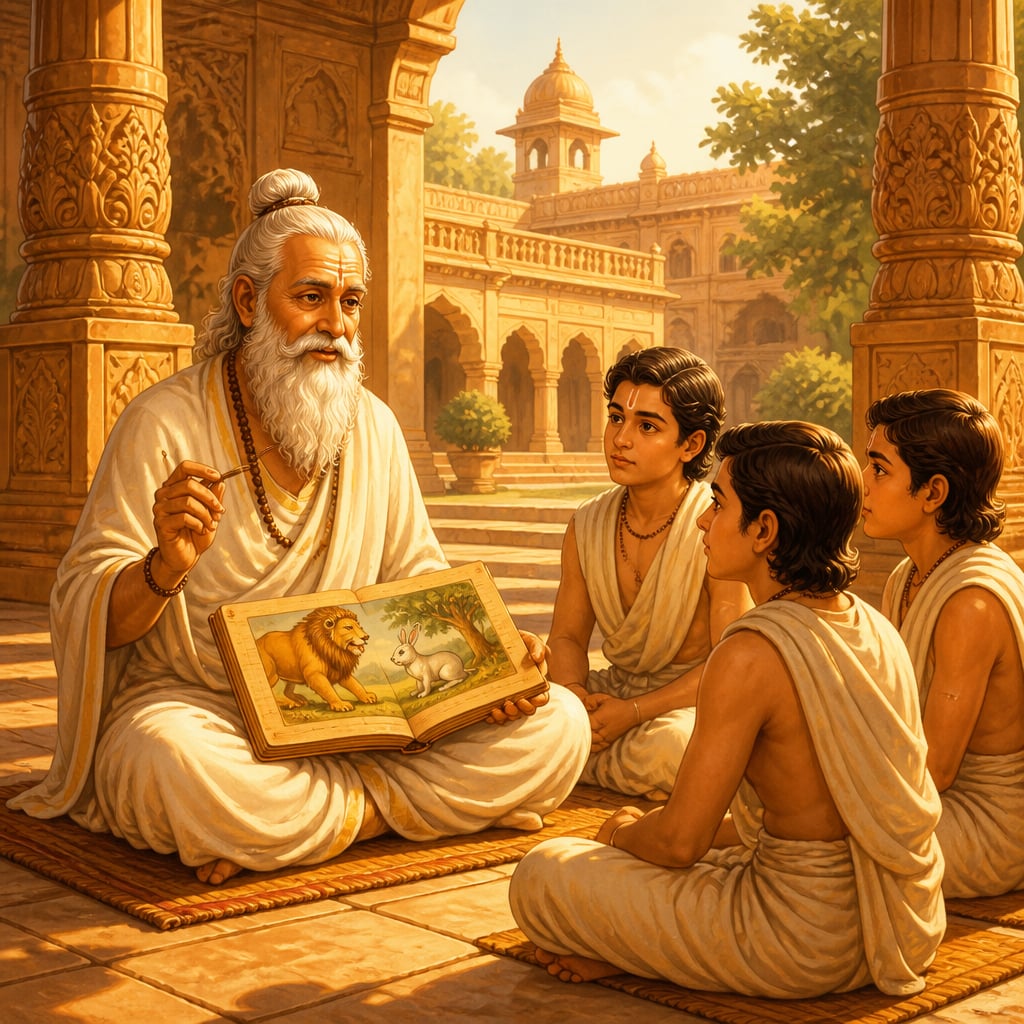
In the court of King Amarashakti of Mahilaropya, three Brahmin princes were failing miserably at their studies. Their father, the king's minister, was desperate. Every tutor had given up. Then an 80-year-old scholar named Vishnu Sharma made a bold promise: give me six months, and I will make your sons masters of niti - the science of wise conduct.
The king scoffed. Six months to achieve what years had failed? But Vishnu Sharma had a secret weapon: stories. Not dry lectures, but tales of jackals and crows, merchants and thieves, lions and mice. Stories so compelling that the princes wouldn't realize they were learning.
This is how the Panchatantra was born around 300 BCE - and why, 2,300 years later, it remains the most influential collection of business wisdom in human history.
The Five Tantras: A Business School in Fables
The name Panchatantra means 'Five Treatises,' each addressing a core aspect of strategic thinking:
| Tantra | Sanskrit Name | Business Application |
|---|---|---|
| 1 | Mitra-bheda (Loss of Friends) | Partnership dynamics and trust |
| 2 | Mitra-samprapti (Gaining Friends) | Alliance building and networking |
| 3 | Kakolukiyam (Of Crows and Owls) | Competitive strategy and espionage |
| 4 | Labdhapranasam (Loss of Gains) | Risk management and wealth preservation |
| 5 | Aparikshitakarakam (Hasty Action) | Due diligence and decision-making |
These aren't just moral tales. They're strategic frameworks disguised as entertainment.
The Lion and the Rabbit: Asymmetric Competition

Consider the famous story from Kakolukiyam: A powerful lion terrorizes a forest. The animals agree to send one creature daily as tribute. When it's the rabbit's turn, he arrives late, claiming another lion delayed him. The furious lion demands to see this rival. The rabbit leads him to a well, where the lion sees his own reflection and leaps to attack - drowning himself.
The business principle encoded here is asymmetric competition:
"Buddhir yasya balam tasya, nirbuddhes tu kuto balam" "He who has intelligence has strength; what strength has the fool?"
A small competitor (the rabbit/startup) cannot defeat a larger one (the lion/corporate giant) through direct confrontation. But by using intelligence, timing, and the competitor's own aggression against them, victory becomes possible.
In 2016, Reliance Jio executed exactly this strategy. Rather than compete on traditional terms with Airtel and Vodafone, Jio offered free services for months, using the incumbents' own network investments against them. The 'lion' couldn't resist responding - and in doing so, depleted its resources fighting a war of Jio's choosing.
The Merchant's Scale: Partnership Ethics

In Mitra-bheda, we meet two merchant friends whose partnership dissolves through a crooked weighing scale. One partner, Dharmabuddhi (righteous-minded), and the other, Papabuddhi (wicked-minded), buried their joint profits for safekeeping. Papabuddhi secretly dug up the treasure and accused Dharmabuddhi of theft.
The case went to court. Papabuddhi claimed a tree witnessed Dharmabuddhi taking the money. He had hidden his father inside the hollow tree to 'testify.' But Dharmabuddhi, suspecting treachery, set fire to the tree's base. The father emerged, confessing everything.
The embedded principle:
"Satyam eva jayate nanritam" "Truth alone triumphs, not falsehood."
But the practical wisdom is deeper: in partnerships, the dishonest party eventually overreaches. Papabuddhi's scheme failed not because of divine justice but because lies require increasingly elaborate deceptions that eventually collapse under their own complexity.
This is why traditional Indian business communities like Marwaris built empires on vishwasa (trust). The cost of maintaining elaborate lies exceeds the short-term gains from dishonesty.
The Weaver's Wife: Knowing Your Competence
A weaver wished to fight in wars like a soldier. He got a horse and armor, joined a battle, and was immediately killed. The story concludes:
"Svakarmani niratah siddhim labhate naro" "A man attains success by being devoted to his own work."
This isn't about social immobility, it's about core competency. The weaver was excellent at weaving. His failure came from abandoning proven strengths for untested ambitions.
Modern application: Companies that over-diversify often fail. The Tata Group succeeds because each company stays focused on core competencies while the group provides strategic capital. When Kingfisher Airlines collapsed, it was partly because Vijay Mallya, excellent at beverages, strayed into aviation without relevant expertise.
Vishnu Sharma's Teaching Method
What makes the Panchatantra revolutionary isn't just its content but its pedagogy. Vishnu Sharma understood that:
- Stories bypass resistance - We remember narratives, not lectures
- Animals remove ego - We accept criticism of a foolish crow more easily than of ourselves
- Nested stories create depth - One story inside another inside another mirrors business complexity
- Humor aids retention - The tales are often funny, making them memorable
This is why the Panchatantra traveled further than any other text in history. It became Kalila wa Dimna in Arabic, Fables of Bidpai in Persia, influenced La Fontaine's works, and even modern business books.
Global Perspectives on Strategic Wisdom
The Panchatantra's genius wasn't unique to India, but its systematic approach was unmatched. Consider the global landscape of strategic wisdom literature:
Aesop (c. 620-564 BCE) composed Greek fables around the same era, using animals to teach morals. But Aesop's fables are simpler, single lessons like 'slow and steady wins the race.' The Panchatantra's nested structure and strategic depth far exceeds Aesop's moral instruction.
Niccolò Machiavelli (1469-1527) wrote The Prince two millennia after Vishnu Sharma. Machiavelli's advice, appearing virtuous while acting ruthlessly, reads as cynical realism. The Panchatantra is equally pragmatic but embeds strategy within dharma. The rabbit defeats the lion cleverly, but not immorally.
Robert Greene (1959-present), author of The 48 Laws of Power, represents modern strategic wisdom. Greene explicitly draws from the Panchatantra tradition, acknowledging its influence. His 'Law 3: Conceal Your Intentions' echoes the rabbit's misdirection; 'Law 4: Always Say Less Than Necessary' mirrors the Panchatantra's teaching on strategic silence.
| Thinker | Key Work | Core Approach | Panchatantra Parallel |
|---|---|---|---|
| Aesop | Fables | Single moral lessons | Multi-layered strategic frameworks |
| Machiavelli | The Prince | Amoral power politics | Dharmic strategy within ethical bounds |
| Greene | 48 Laws of Power | Modern power dynamics | Explicitly influenced by Indian wisdom |
The comparison reveals the Panchatantra's unique achievement: strategic sophistication without abandoning ethical foundations. Where Machiavelli separates morality from strategy, Vishnu Sharma integrates them.
Modern Resonance: 2025 and Beyond
In 2016, Reliance Jio executed the rabbit-and-lion strategy at industrial scale. But the Panchatantra's principles continue shaping Indian business in 2025. Nithin Kamath's Zerodha, now India's largest stockbroker with over 7 million active clients, grew without a single advertisement, relying purely on vishwasa (trust) built through transparent practices. When SEBI tightened F&O regulations in late 2024, Zerodha's trust-based model proved more resilient than competitors who'd prioritized aggressive growth over compliance.
Your Turn
Every Indian who does business carries Panchatantra wisdom in their cultural DNA - often without knowing its source. When your grandmother warned against 'putting all eggs in one basket,' she was echoing Labdhapranasam. When your father advised choosing business partners carefully, he channeled Mitra-bheda.
The question isn't whether this wisdom is relevant - it clearly is. The question is whether you'll engage with it consciously or remain an unwitting beneficiary.
Next, we explore the Hitopadesha - Panchatantra's younger sibling, which refined these lessons with even more practical precision.
David Yoffie's 'Judo Strategy' (2001) describes using opponent's strength against them. Clay Christensen's 'Innovator's Dilemma' shows how small entrants disrupt established players. Both concepts are present in the Panchatantra 2,000 years earlier.
The Panchatantra framework is more complete - it addresses not just competitive strategy but the psychological dimension. The lion's 'intoxication with pride' (mada) is the vulnerability. Indian strategic thinking targets the opponent's mental state, not just market position.
Jio acquired 100 million subscribers in 170 days - faster than any telecom in history. Within 3 years, it became India's largest telecom while two major competitors (Aircel, Reliance Communications) went bankrupt.
Oliver Williamson's Transaction Cost Economics shows that mistrust increases costs (monitoring, contracts, litigation). Francis Fukuyama's 'Trust' (1995) argues high-trust societies outperform low-trust ones economically.
Traditional Indian business communities operationalized trust before Western economists theorized it. Marwari networks function on verbal commitments across continents. The 'hundi' system moved money on reputation alone. This isn't naivety - it's efficient economics.
India's contract enforcement costs average 31% of claim value vs 9% in Singapore (World Bank 2020). Businesses that can operate on trust save significantly on legal and monitoring costs.
Key terms
- Nīti
- The science of wise conduct; strategic wisdom that guides behavior in politics, business, and life
- Upāya
- Strategic means or method; a clever approach to achieving an objective, especially when direct action is impossible
- Viśvāsa
- Trust, confidence; the foundation of all sustainable business relationships in Indian commercial tradition
- Tantra
- A systematic framework, doctrine, or treatise; in the Panchatantra context, each 'tantra' is a complete strategic system addressing one aspect of wise conduct
Verses
बुद्धिर्यस्य बलं तस्य निर्बुद्धेस्तु कुतो बलम्। वने सिंहो मदोन्मत्तः शशकेन निपातितः॥
buddhir yasya balaṁ tasya nirbuddhes tu kuto balam | vane siṁho madonmattaḥ śaśakena nipātitaḥ ||
Intelligence is strength - the fool has none at all; a forest lion, drunk with pride, fell to a rabbit small.
This principle underlies all asymmetric competition. Startups cannot outspend incumbents, but can outthink them. The lion's 'strength' (market dominance) became his weakness (overconfidence). The rabbit's 'weakness' (size) became his strength (agility, innovation). Jio vs telecom incumbents, Amazon vs traditional retail - the pattern repeats.
Panchatantra, Introduction (Kathamukha) (Patrick Olivelle translation)
अर्थनाशं मनस्तापं गृहिण्याश्चरितानि च। नीचैर्विवादं कुलजैः पण्डितो न प्रकाशयेत्॥
arthanāśaṁ manastāpaṁ gṛhiṇyāścaritāni ca | nīcair vivādaṁ kulajaiḥ paṇḍito na prakāśayet ||
A wise man never reveals: his fortune's fall, his heart's dismay, his household's private ways, disputes with those beneath his say.
This is ancient advice on information asymmetry in business. Revealing financial distress attracts predatory competitors. Showing family disputes signals management instability. Smart businesses maintain strategic opacity while projecting strength. Modern equivalent: Why companies don't announce layoffs until legally required.
Panchatantra, Mitra-bheda (Book I) (Rajan translation)
उपायेन हि यच्छक्यं न तच्छक्यं पराक्रमैः। कार्यं वान्येन शक्तेन कर्तुं नैव हि शक्यते॥
upāyena hi yac chakyaṁ na tac chakyaṁ parākramaiḥ | kāryaṁ vānyena śaktena kartuṁ naiva hi śakyate ||
What strategy achieves, mere might cannot; nor can another's strength accomplish what your wit alone has sought.
Strategy beats scale. This principle explains why well-funded startups fail while bootstrapped ones succeed - throwing money (might) at problems rarely works as well as clever solutions (strategy). It also warns against over-reliance on consultants: 'another's power' cannot substitute for your own strategic thinking.
Panchatantra, Kakolukiyam (Book III) (Chandra Rajan translation)
Key figures
Vishnu Sharma
c. 300 BCE - 200 CE (traditional dating varies)
Mukesh Ambani
1957-present
Robert Greene
1959-present
Case studies
DMart: The Panchatantra Retailer
In 2002, when Radhakishan Damani opened the first DMart store in Mumbai's Powai, the Indian retail landscape was dominated by glitzy malls and aspirational brands. Reliance Retail, Big Bazaar, and later Amazon poured billions into rapid expansion, celebrity endorsements, and technology. Damani, a former stock market investor with no retail experience, chose a radically different path. He focused exclusively on middle-class neighborhoods, stocked only essentials (no fashion, no electronics), owned his stores instead of leasing, and paid suppliers within 11 days when the industry standard was 30-60 days. Competitors mocked his 'boring' approach. By 2024, DMart's market capitalization exceeded ₹3 lakh crore, making Damani one of India's richest individuals.
DMart embodies all three Panchatantra principles from this lesson. **Asymmetric competition**: Rather than fighting giants on their terms (technology, marketing, expansion speed), Damani competed on supplier relationships and operational efficiency, using competitors' own high costs against them. **Vishwasa (trust)**: By paying suppliers faster than anyone, DMart built loyalty that translated into better prices, which translated into customer loyalty. The virtuous cycle of trust. **Svadharma (core competency)**: While competitors diversified into fashion, electronics, and e-commerce, DMart stuck to groceries and essentials. The weaver stayed at his loom.
As of 2025, DMart operates 365+ stores with the highest sales per square foot in Indian retail. Its EBITDA margins (8-9%) exceed most global retailers. More tellingly: when Future Retail collapsed under ₃1,000 crore debt and Big Bazaar stores shuttered, DMart continued expanding profitably. The 'boring' approach proved more durable than the flashy one. Damani's net worth crossed $20 billion without a single TV advertisement or celebrity endorsement.
The rabbit doesn't need to become a lion. DMart's success demonstrates that Panchatantra strategy isn't ancient philosophy, it's operational excellence. Trust with suppliers, focus on strengths, and asymmetric positioning beat capital-intensive competition.
Quick commerce players like Blinkit and Zepto burn billions chasing growth, while DMart quietly generates India's highest retail margins through disciplined operations. In an era where venture-funded speed is worshipped, DMart proves that paying suppliers fast, expanding slowly, and focusing on unit economics creates more durable value than rapid scaling ever can.
DMart pays suppliers within 11 days; industry average is 30-60 days. This single practice, vishwasa operationalized, creates a 3-5% cost advantage that compounds into market dominance.
Historical context
Mauryan to Gupta Period (c. 300 BCE - 500 CE)
The Panchatantra emerged when India dominated global trade. Merchant guilds (shrenis) needed systematic wisdom for managing complex partnerships, supply chains, and competitive dynamics. The text filled this educational need, becoming a standard part of commercial education.
Aesop's Fables (Greece, c. 600 BCE) also used animal stories for moral instruction, but lacked the Panchatantra's systematic strategic framework. The Chinese 'Thirty-Six Stratagems' (unknown date) focuses on military tactics. Only the Panchatantra provides comprehensive business strategy through narrative.
The Panchatantra has been translated into more than 50 languages, making it one of the most translated texts in human history after religious scriptures.
This isn't ancient history - it's foundational business education that shaped how Indians think about commerce. Understanding the Panchatantra helps you understand both traditional Indian business practices and your own inherited commercial intuitions.
Living traditions
IIM Ahmedabad and other top business schools include sessions on Panchatantra strategy. Companies like Infosys and Tata reference these stories in leadership training. The 2016 'Make in India' campaign used the lion symbol, echoing Panchatantra imagery. When Indian business leaders speak of 'building trust networks' or 'strategic patience,' they're often unconsciously channeling Vishnu Sharma's 2,300-year-old wisdom.
- Grandmother's Stories (Nani ki Kahani): Traditional practice of elders telling Panchatantra stories to children, transmitting business wisdom across generations without formal instruction
- Amar Chitra Katha Publications: Comic book adaptations that have introduced millions of Indian children to Panchatantra stories since 1967
- Nalanda University Ruins, Bihar: Ancient university where texts like the Panchatantra were studied and transmitted across Asia
- India International Centre, New Delhi: Hosts lectures on traditional wisdom and its modern applications, including Panchatantra-based management workshops
- Vishnu Temple at Nalanda: Near the ancient university where Vishnu Sharma's Panchatantra was studied, temples dedicated to Vishnu (the preserver) reminded scholars that wisdom serves to sustain society and commerce.
- Mahabodhi Temple: The site of Buddha's enlightenment, historically patronized by merchant communities who understood that wisdom traditions supported ethical commerce.
Reflection
- The rabbit defeated the lion not through strength but through strategic intelligence. In your current situation - whether as student, employee, or entrepreneur - where are you trying to 'out-lion' competitors instead of finding your 'rabbit' strategy?
- The Papabuddhi-Dharmabuddhi story shows how dishonesty creates fragile structures. Can you identify a situation in your professional life where cutting ethical corners now might create future vulnerabilities?