Bhagidari-Niti: Partnership Lessons from Literature

The Art of Choosing Allies

Ancient Indian literature provides sophisticated frameworks for selecting business partners - evaluating character, capability, and complementarity before commitment.

The Partnership That Built an Empire
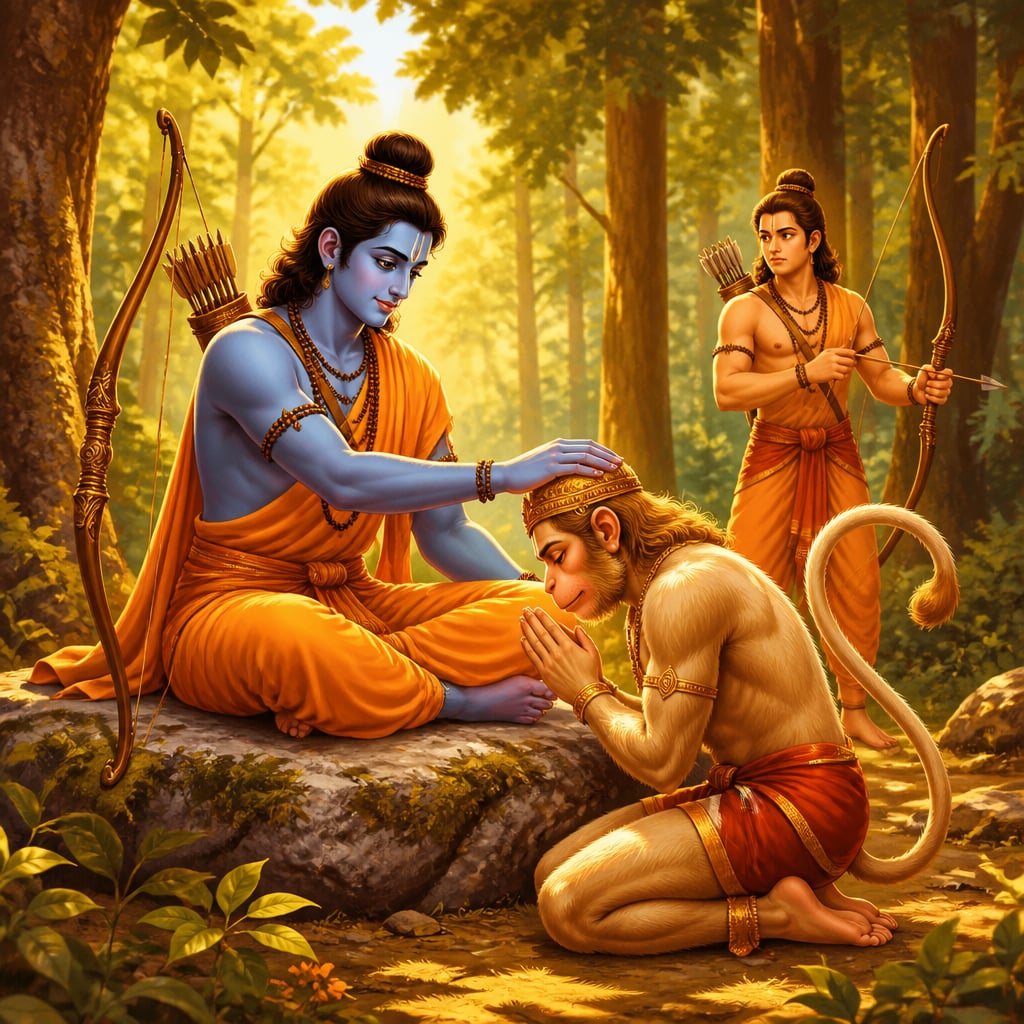
Rama placing his hand upon kneeling Hanuman in a forest clearing

Ram-Hanuman. Krishna-Arjuna. Chanakya-Chandragupta. Indian literature's greatest achievements aren't solo acts but partnerships.

Look closer: these aren't partnerships of equals. They're partnerships of complementarity - where each party brings what the other lacks.

Ram had royal authority but needed the vanara army's strength and local knowledge. Arjuna had martial prowess but needed Krishna's wisdom and strategy. Chandragupta had ambition but needed Chanakya's political genius.

The pattern: Successful partnerships combine different capabilities serving a shared purpose.

Dharmabuddhi and Papabuddhi: The Partnership Warning

From the Panchatantra comes history's clearest partnership warning. Two merchants, Dharmabuddhi (righteous-minded) and Papabuddhi (wicked-minded), partner on a trading venture. They agree to bury their joint profits for safekeeping.

Papabuddhi secretly digs up the treasure and accuses Dharmabuddhi of theft. When the case goes to court, Papabuddhi claims a tree witnessed the theft - having hidden his father inside to 'testify.'
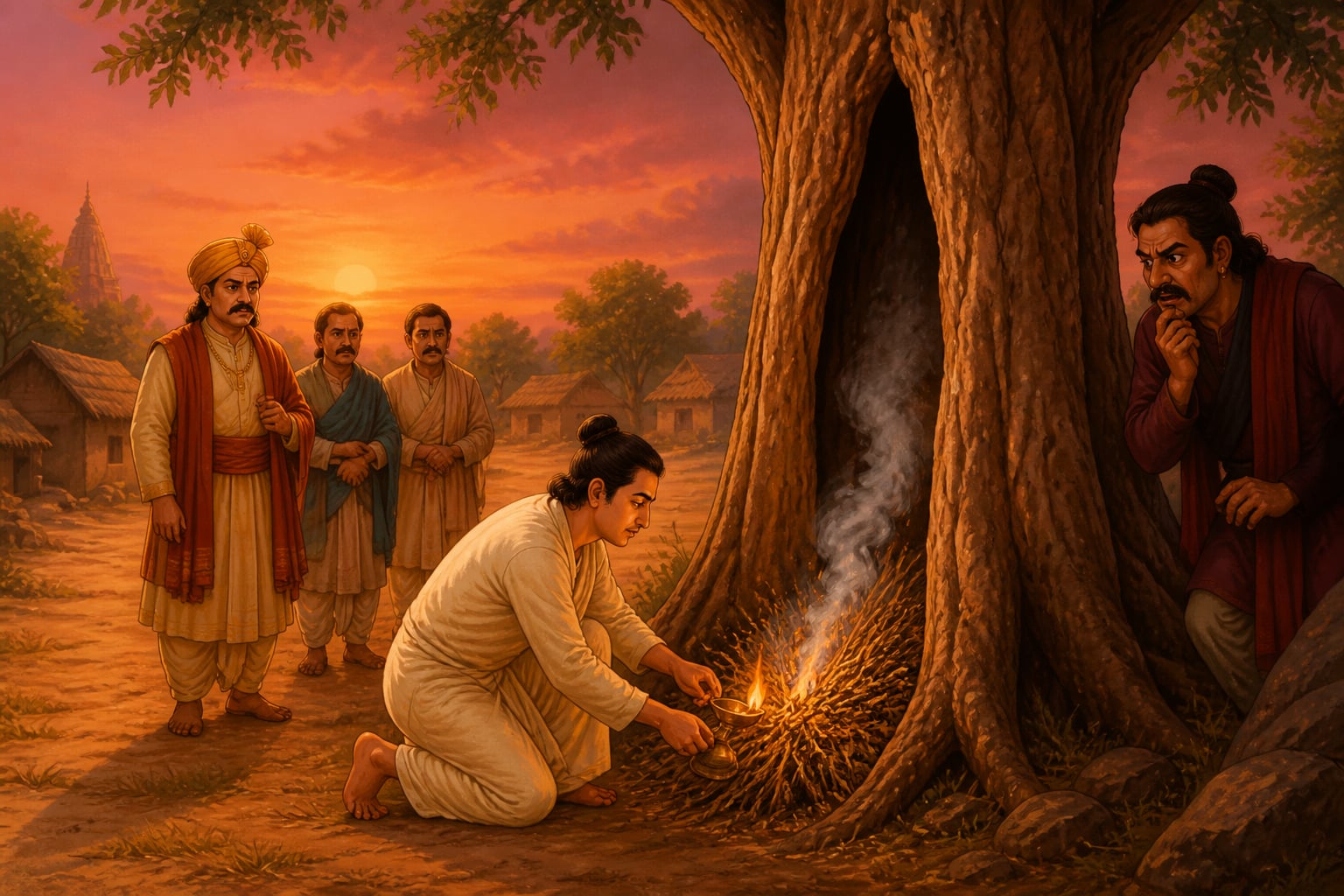
Dharmabuddhi lighting fire at the base of the hollow tree

Dharmabuddhi, suspecting treachery, sets fire to the tree's base. Papabuddhi's father emerges, confessing everything.

The embedded principles:

"Svabhāvo duratikramah" "Character is hard to overcome."

Papabuddhi's treachery wasn't accidental - it was character expressing itself. The story warns: partnership selection is primarily about character assessment. Skills can be taught; character rarely changes.

The Four Tests of Partnership Worthiness

Across Indian literature, four criteria consistently appear for evaluating potential partners:

Test Sanskrit What to Evaluate Warning Sign
Character शील (Śīla) Integrity, values, past behavior Inconsistency between words and actions
Capability सामर्थ्य (Sāmarthya) Skills, resources, competence Over-promising, vague about specifics
Commitment निष्ठा (Niṣṭhā) Dedication, follow-through History of abandoned ventures
Compatibility अनुकूलता (Anukūlatā) Shared vision, working style Immediate friction on small matters

A strong partner satisfies all four. Missing even one creates vulnerability.

Rama's Alliance Building: Strategic Partnership

When Rama needed to rescue Sita from Lanka, he didn't rush in alone. He systematically built alliances:

Sugriva: Offered the vanara kingdom's military strength in exchange for Rama helping reclaim Sugriva's throne. This was parikraya sandhi (mutually beneficial exchange) - each party gets something essential.

Vibhishana: Lanka's defector provided crucial intelligence about Ravana's defenses. This was bheda applied ethically - separating a dharmic individual from an adharmic camp.

Hanuman: The perfect lieutenant, combining extraordinary capability with absolute loyalty. Hanuman's test wasn't just competence but commitment - would he serve without seeking glory?

Rama's alliance-building demonstrates the sequencing of partnership: first find complementary capabilities, then establish clear exchange terms, then test commitment through smaller challenges.

The Merchant Partnership Verses

The Sukraniti (a medieval nitishastra) provides explicit guidance for merchant partnerships:

"Vyavahāre sthirā buddhir maitra kāryeṣu sangatā" "In business, let wisdom be stable; in friendly matters, let there be agreement."

This verse distinguishes business judgment (stable, consistent principles) from relationship management (flexible, agreeable). The best partners maintain both: reliable in principles, pleasant in interaction.

"Yatra vidyā ca śīlaṁ ca tatra lakṣmīr upāgate" "Where knowledge and character unite, there prosperity arrives."

Partnership selection prioritizes the combination of competence (vidyā) and integrity (śīla). Either alone is insufficient.

The Joint Venture Structures

Ancient Indian commerce developed sophisticated partnership structures:

Structure Description Modern Equivalent
Naigama Trade guild membership Industry association
Shreni Professional guild with joint liability Partnership firm
Pūga Mixed occupational association Holding company
Gana Equal-share association Cooperative

Members of a Mauryan-era shreni guild meeting in a trade hall

The shreni is particularly relevant: a guild where members shared both profits and liabilities. Your reputation depended on your partners' behavior. This created mutual accountability - members had strong incentives to monitor each other's conduct.

Modern startups with co-founder equity arrangements face similar dynamics. When your partner's failure becomes your failure, selection becomes critical.

Due Diligence: Ancient Style

The Arthashastra recommends specific due diligence for potential partners:

  1. Observe behavior with inferiors - How do they treat servants, suppliers, those who can't hurt them?
  2. Check past partnerships - How did previous relationships end? Why?
  3. Test with small stakes - Before major commitment, collaborate on smaller projects
  4. Assess under pressure - Character reveals itself when things go wrong

"Āpadsu mitram jānīyāt" "Know a friend in adversity."

This doesn't mean manufacture crises - it means observe how potential partners behave when natural challenges arise.

Modern Partnership Failures Through Ancient Lens

Consider partnership failures through the four-test framework:

Jet-Etihad (2013-2019): Airline partnership that failed. The character/commitment test revealed problems: Etihad's progressive distancing as Jet faced trouble showed commitment was conditional. The Dharmabuddhi-Papabuddhi lesson applies - when pressure increased, true character emerged.

Tata-DoCoMo (2009-2017): The telecom JV struggled partly due to compatibility issues - Japanese and Indian business cultures clashed on decision-making speed. Capability and character were present; anukūlatā (compatibility) was lacking.

Infosys Founders (1981-2014): Successful 30+ year partnership. All four tests were satisfied: shared values (character), complementary skills (capability), sustained effort through crises (commitment), and aligned vision (compatibility). The partnership survived because the foundation was comprehensive.

The Exit Wisdom

Indian literature also teaches when to end partnerships:

"Pāpena pāpaṁ nāśayati" "Through wickedness, wickedness is destroyed."

This warns against staying in corrupt partnerships hoping to change them from within. The Vibhishana lesson: sometimes the only dharmic choice is exit.

The Hitopadesha's half-loss principle applies to partnerships too: when a partnership is clearly failing, preserving half (your reputation, remaining resources) through early exit beats total loss through stubborn persistence.

Building Partnership Capability

The stories teach that partnership is a skill that can be developed:

  1. Start small - Build partnership track record with low-stakes collaborations
  2. Document agreements - The tree-witness story shows why clarity matters
  3. Regular check-ins - Don't let problems accumulate unaddressed
  4. Plan the exit - Even good partnerships end; discuss terms before crises
  5. Maintain alternatives - Don't become so dependent that you can't leave

Global Perspectives on Partnership

The Indian four-test framework (śīla, sāmarthya, niṣṭhā, anukūlatā) has parallels in Western partnership thinking, though few traditions achieved the same systematic integration.

Warren Buffett and Charlie Munger represent perhaps the West's most celebrated business partnership, 60+ years of collaboration at Berkshire Hathaway. Their partnership embodies all four tests: deep integrity alignment (śīla), complementary skills, Buffett's deal-making with Munger's broader intellectual framework (sāmarthya), unwavering commitment through market crashes and personal challenges (niṣṭhā), and genuine friendship enabling frank disagreement (anukūlatā). Buffett's rule 'I only work with people I like' is anukūlatā as selection criterion.

Bill Hewlett and David Packard founded HP in 1939 and built a partnership that lasted until their deaths. The 'HP Way', emphasizing trust, respect, and employee partnership, became a template for Silicon Valley culture. Their garage startup, funded by $538, grew into a company worth billions because two partners with complementary skills maintained alignment across decades.

Ben Horowitz (co-founder of Andreessen Horowitz) writes extensively about co-founder dynamics in venture capital. His insight that 'the hard thing about hard things' is often partner conflict echoes the āpadi mitra-parīkṣā principle, you don't know your partner until crisis hits. Horowitz advises testing partnerships through adversity before major commitment.

Partnership Duration Key to Success Four-Test Analysis
Buffett-Munger 60+ years Value alignment Perfect śīla match, complementary sāmarthya
Hewlett-Packard 60 years Trust culture Strong niṣṭhā, 'HP Way' as anukūlatā
Jobs-Wozniak 12 years (ended) Creative tension High sāmarthya, weak anukūlatā led to exit
Gates-Allen 17 years (ended) Vision alignment Śīla intact, health forced niṣṭhā test

The pattern: long-lasting partnerships satisfy all four tests. Failed partnerships typically have one weak dimension that eventually breaks the relationship. The Indian framework's insistence on comprehensive assessment, not just 'can we work together?' but all four dimensions, predicts partnership durability better than intuition.

Your Turn

Every business relationship is a form of partnership - with co-founders, employers, clients, suppliers. The ancient frameworks help evaluate all of them.

Before your next significant business commitment, run the four tests:

Papabuddhi seemed like a good partner until he wasn't. The stories exist precisely because partnership selection is difficult - and mistakes are costly.

Modern venture capital evaluates 'team' primarily on track record and skills. Partnership literature (like 'The Partnership Charter') adds relationship dynamics. The Indian framework is more comprehensive, adding character assessment as primary criterion.

The Indian framework places character (śīla) first - before capability. This counters the common error of partnering with capable but unethical people. 'Brilliant jerk' culture, common in Western tech, is rejected by this framework.

Harvard Business School research shows 65% of startups fail due to co-founder conflict, not market or product issues. The ancient emphasis on partner selection as primary success factor is validated.

Behavioral economics recognizes 'moral hazard' - people acting badly when they can get away with it. The Panchatantra is more pessimistic: bad character will express itself regardless of safeguards. Warren Buffett echoes this: 'When a manager with a reputation for brilliance takes on a business with a reputation for bad economics, the reputation of the business remains intact.'

The Indian framework doesn't expect character change. This prevents the common trap of 'I can fix them' or 'They'll grow.' Instead, it recommends better selection upfront. The dog's tail metaphor is memorable and accurate.

Studies on corporate fraud show that perpetrators typically had warning signs in past behavior. The 'first-time offender' is rare - character patterns persist. The Panchatantra's warning is empirically validated.

Key terms

Bhāgīdārī
Partnership, profit-sharing arrangement; the formal sharing of business outcomes between parties
Śreṇī
Professional guild or trade association where members shared both profits and liabilities
Niṣṭhā
Steadfast devotion, commitment; the quality of maintaining allegiance through difficulties
Viśvāsa
Trust, confidence, faith; the foundation of all partnership relationships, built through demonstrated character over time

Verses

स्वभावो दुरतिक्रमः। शुनः पुच्छमिव व्यर्थं जन्मप्रभृति वक्रगम्॥

svabhāvo duratikramaḥ | śunaḥ puccham iva vyarthaṁ janma-prabhṛti vakragam ||

One's nature is hard to overcome - like a dog's tail, from birth it bends; no matter how you straighten it, it always crooked wends.

This is the ancient statement against over-optimistic partnership selection. Hope that someone will 'change' or 'grow into' good character is usually misplaced. Character (svabhava) is the most stable predictor of partnership behavior. Modern due diligence focuses on financials; the Panchatantra prioritizes character assessment. Both are necessary, but character comes first.

Panchatantra, Mitra-bheda (Book I) (Patrick Olivelle translation)

यत्र विद्या च शीलं च तत्र लक्ष्मीरुपागता। विद्याहीनं शीलहीनं न च तद्गृहमश्नुते॥

yatra vidyā ca śīlaṁ ca tatra lakṣmīr upāgatā | vidyā-hīnaṁ śīla-hīnaṁ na ca tad gṛham aśnute ||

Where skill and character combine, there prosperity makes its home; lacking either one, it will elsewhere roam.

This anticipates modern debates about 'brilliant jerks' in business. The verse is clear: vidyā (skill) without śīla (character) doesn't attract lasting prosperity. The skilled but unethical may gain temporarily, but lakṣmī (prosperity) doesn't stay. This applies to partnership selection: don't partner with the capable but corrupt, or the virtuous but incompetent.

Nitisara of Kamandaki, Chapter 6, Partnership (Various editions)

आपदि मित्रपरीक्षा शूरपरीक्षा रणाङ्गणे भवति। विनये वंशपरीक्षा शीलपरीक्षा धनक्षये भवति॥

āpadi mitra-parīkṣā śūra-parīkṣā raṇāṅgaṇe bhavati | vinaye vaṁśa-parīkṣā śīla-parīkṣā dhana-kṣaye bhavati ||

Friends are tested in adversity, heroes tested in war's call; breeding shows in humble bearing, character when riches fall.

This is the ancient version of 'stress testing' partnerships. The verse identifies four testing conditions: adversity (mitra-parīkṣā), conflict (śūra-parīkṣā), power dynamics (vaṁśa-parīkṣā), and financial pressure (śīla-parīkṣā). Modern due diligence should include these stress tests: How did the potential partner behave in past crises? During conflicts? When they had power over others? When they faced financial pressure?

Subhashita Ratna Bhandagara, Verses on Friendship/Partnership (Traditional compilations)

Key figures

Hanuman

Ramayana period (traditional dating varies widely)

Azim Premji and Wipro Leadership

1945-present

Warren Buffett

1930-present

Historical context

Ancient to Medieval India (c. 500 BCE - 1500 CE)

Ancient India developed sophisticated partnership frameworks out of commercial necessity. Without modern contract enforcement, partners needed reliable methods for assessing trustworthiness. The emphasis on character (śīla) over capability reflects this reality - capability could be verified, but character required deeper assessment.

European commercial partnerships developed much later (Italian banking families in the 13th-14th centuries, joint-stock companies in the 17th century). Indian partnership structures predated these by centuries and were arguably more sophisticated in their assessment frameworks.

The shreni (guild) system's longevity - functioning for over a millennium with relatively stable structures - suggests the partnership assessment frameworks were effective. Guilds that couldn't maintain trust didn't survive.

Modern startup co-founder conflicts, joint venture failures, and partnership breakdowns often trace to inadequate initial assessment. The ancient frameworks provide systematic approaches that remain relevant. Understanding that Indian commerce developed sophisticated partnership wisdom helps reclaim indigenous business knowledge.

Living traditions

India's family business groups (Tata, Birla, Ambani, etc.) maintain partnership cultures rooted in these traditions. The emphasis on long-term relationships over transactional deals, the extensive reference-checking within business communities, and the weight given to family reputation all reflect ancient bhagidari-niti principles. Modern Indian startups increasingly rediscover these frameworks as co-founder conflicts prove the cost of inadequate partner selection.

Reflection

More in Business Wisdom from Ancient Stories

All lessons in Business Wisdom from Ancient Stories · Vaishya Dharma: The Art of Ethical Commerce course