Samudra-Vanijya-Jokhim: Maritime Trade Risk Management
How Ancient Merchants Conquered the Ocean's Uncertainty
How ancient Indian merchants invented proto-insurance mechanisms, risk pooling, bottomry loans, and guild guarantees, to tame the terrifying uncertainty of sea trade, creating frameworks that Lloyd's of London would echo fifteen centuries later.
The Last Glimpse of Bharuch
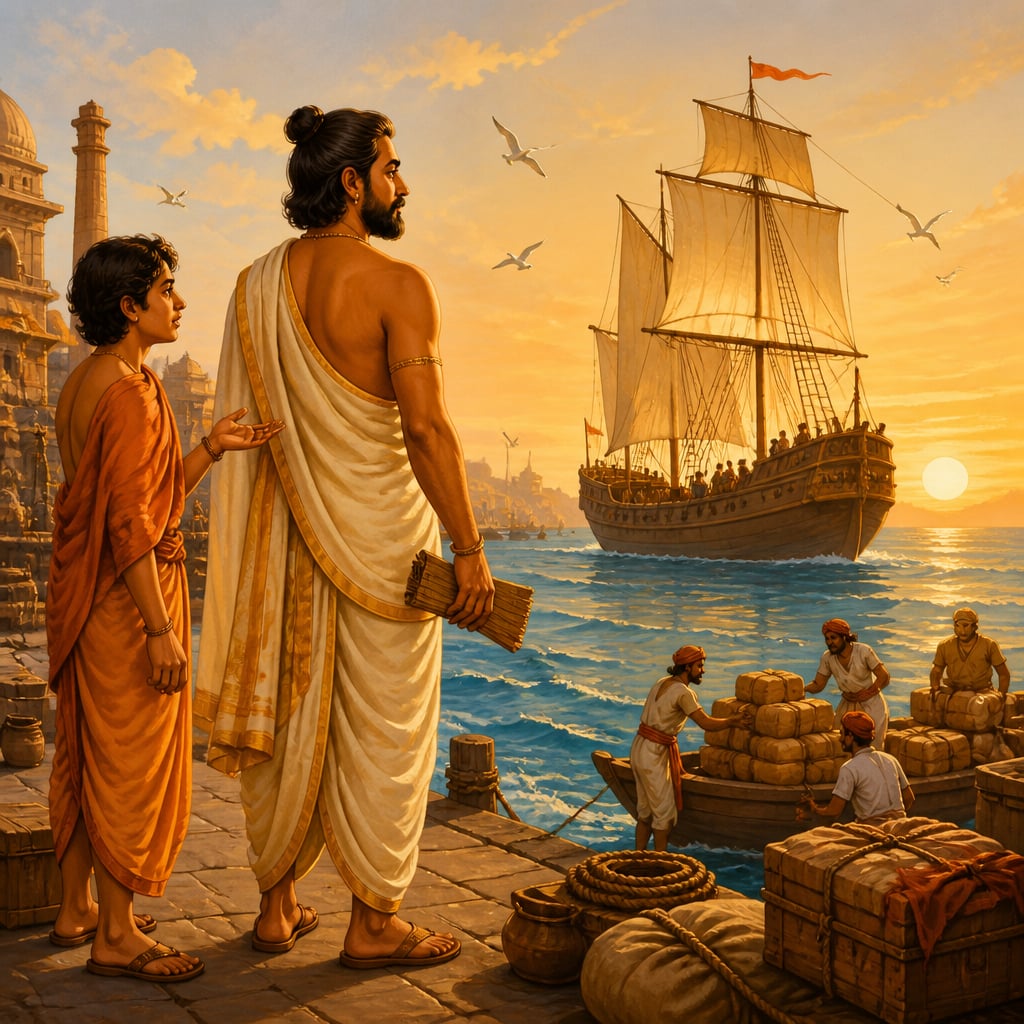
The merchant Sanghadasa stood on the dock at Bharuch, watching the nava (ship) grow smaller against the Arabian Sea's horizon. It was the month of Kartika, 150 CE, and the southwest monsoon had finally subsided enough for the voyage to begin. On board: 400 amphorae of pepper, 200 bales of fine cotton, sandalwood worth a merchant's lifetime earnings, and, most terrifyingly, everything Sanghadasa owned in the world.
For six months, he would hear nothing. The ship would cross to the Red Sea, navigate to Egyptian Alexandria, and exchange its cargo for Roman gold, glassware, and wine. Or it would sink in a storm, be taken by pirates, or simply vanish into the vast unknown.
"How do you sleep?" asked a younger merchant beside him, newly entered into the maritime trade.
Sanghadasa smiled. "I don't own that ship alone. Twenty merchants share the cargo. The Nagarashreni (city guild) guarantees half my investment. And I have taken a samudra-yātrā ṛṇa, a sea voyage loan, where the lender bears the loss if the ship sinks."
The younger merchant looked confused. "The lender bears the loss?"
"The lender charges higher interest precisely because he carries the risk. If the ship returns, he profits greatly. If it doesn't, he loses. My loss is limited to what I put in, not my house, not my family's future."
This was the genius of ancient Indian maritime risk management: not eliminating risk, but distributing it among those most able to bear it.
The Terror of the Sea Trade
To understand ancient risk management, we must first understand the terror it addressed.
Maritime trade in the ancient world was catastrophically risky. Modern estimates suggest that 10-20% of Mediterranean voyages ended in total loss, storms, pirates, navigational errors, or ships simply disappearing without trace. The Indian Ocean, with its monsoon patterns, offered a slightly safer but still perilous passage.
The Dharmashastra texts recognized this explicitly. Yajnavalkya Smriti (c. 200-500 CE) classified sea trade as mahā-sāhasa (great peril) and prescribed different legal rules for it:
"Samudra-yātrikasya arthaṃ yadi naṣṭaṃ bhaved bhavet | sa tad-ṛṇaṃ na dāpyaḥ syāt yadi potaḥ vipannakaḥ ||" "If the goods of a sea-voyager are lost, he should not be made to pay the debt if the ship has perished."
This single verse revolutionized maritime commerce. It created what we now call limited liability, the principle that loss in certain high-risk ventures doesn't follow the debtor to destruction.
The Architecture of Ancient Maritime Insurance
Ancient Indian merchants developed three primary mechanisms for managing maritime risk:
1. Samudra-Yātrā Ṛṇa (Sea Voyage Loans / Bottomry)
The most sophisticated instrument was the sea voyage loan, known in Western terminology as "bottomry" (from the ship's bottom, which served as collateral). The structure was elegant:
- A merchant borrows capital for a voyage
- The lender charges significantly higher interest (sometimes 20-30% per voyage)
- If the ship returns safely, the merchant repays principal plus interest
- If the ship sinks, the debt is extinguished
The Manu Smriti (c. 200 BCE - 200 CE) explicitly authorized this structure:
"Sāmudraṃ tu samāhitya yo dadyāt tatra vṛddhaye | yathāsaṅkhyena tenaiva tad dravyaṃ pratigṛhyatām ||" "He who lends money for sea trade at interest shall receive back the principal and profit according to agreement, if the voyage succeeds."
The higher interest rate wasn't usury, it was risk premium. Lenders who bore catastrophic risk deserved compensation. This is identical to how modern insurance premiums work: the insurer charges for accepting risk transfer.
2. Shreni Guarantee (Guild Insurance)
Merchant guilds (shreni) provided collective risk-sharing. A member could pay into a common fund that would compensate losses from shipwreck or piracy. The guild's reputation and assets backed individual members' ventures.
Inscriptions from the Gupta period document guilds offering what we would now call Protection & Indemnity coverage:
- Compensation for cargo loss at sea
- Support for merchants whose ships were captured
- Funds for ransom if crew were taken by pirates
The Nasik cave inscriptions (c. 120 CE) record a weavers' guild depositing funds with temples, the interest from which would perpetually support guild members facing misfortune, an endowed insurance fund operating two millennia ago.
3. Cargo Syndication (Risk Pooling)
Rather than one merchant risking everything on one ship, ancient practice encouraged spreading cargo across multiple vessels and multiple voyages. The Arthashastra recommends:
"Bahubhiḥ saha saṃyukto navāṃ āropayed budhaḥ" "The wise merchant loads his cargo with many others combined."
If twenty merchants each put 5% of their goods on twenty different ships, individual catastrophe becomes impossible even if several ships sink. This is portfolio diversification, the same principle that modern finance textbooks attribute to Harry Markowitz's 1952 paper.
Global Perspectives on Maritime Risk

Edward Lloyd (c. 1648-1713) operated a coffee house in London that became the gathering place for ship captains, merchants, and those willing to underwrite marine risks. By the 1680s, "Lloyd's Coffee House" was the center of English maritime insurance. Underwriters would literally write their names under the risk description, accepting a portion of liability, hence "underwriting."
Lloyd's innovation was creating a marketplace for risk, connecting those who had risk with those willing to bear it for a price. This is precisely what ancient Indian shreni guilds provided: a marketplace where individual merchant risk could be distributed across a community of traders.
The Code of Hammurabi (c. 1754 BCE), predating Indian texts, contained early bottomry provisions. Babylonian merchants could take loans where the ship itself was collateral, and sinking extinguished the debt. The Dharmashastra provisions likely developed independently but show remarkable parallel evolution, evidence that maritime commerce naturally produces similar risk-sharing solutions.
Ibn Battuta (1304-1369), the great Moroccan traveler, documented Indian Ocean trade practices during his 14th-century voyages. He noted that Indian merchants routinely spread cargo across multiple ships, maintained guild-backed guarantees, and used sophisticated credit instruments that transferred risk from traders to financiers. His accounts confirm that medieval Indian maritime insurance was at least as sophisticated as contemporary Mediterranean practice.
| Thinker/System | Period | Key Innovation | Indian Parallel |
|---|---|---|---|
| Code of Hammurabi | 1754 BCE | Bottomry loans | Samudra-yātrā ṛṇa |
| Edward Lloyd | 1680s CE | Insurance marketplace | Shreni guild networks |
| Ibn Battuta (observer) | 1340s CE | Documented Indian practices | Confirmed sophistication |
| Harry Markowitz | 1952 CE | Portfolio theory | Multi-ship cargo distribution |
When the Ship Never Returns
Now imagine the other moment, the one Sanghadasa feared.
Three months after departure, a fishing boat brings news to Bharuch. A storm off the Yemeni coast. Ships scattered. Some returned to Aden; others... did not. Sanghadasa's ship was last seen taking on water.
In a world without risk management, this news would destroy him. His investment gone. His creditors demanding repayment. His family's home seized.
But Sanghadasa had structured carefully:
- His samudra-yātrā ṛṇa (sea voyage loan) was extinguished, the lender, not he, absorbed that loss
- His 5% share in the guild pool entitled him to compensation from the common fund
- His own investment was diversified across three other ships, all of which returned safely
- The Nagarashreni's guarantee covered half his direct exposure
Sanghadasa would not prosper this season. But he would not be ruined. He could trade again, rebuild, try once more. The ancient risk management systems had done their work: converting catastrophic, life-ending loss into manageable setback.
Modern Resonance: When Global Trade Stops

On March 23, 2021, the container ship Ever Given ran aground in the Suez Canal, blocking one of the world's most critical trade arteries for six days. The 400-meter vessel, carrying cargo worth approximately $775 million, trapped an estimated $9.6 billion worth of goods daily as 400+ ships waited at either end.
The incident demonstrated that maritime risk hasn't been eliminated, only transformed. The Ever Given's owners faced claims exceeding $900 million. The cargo owners, the charterers, the canal authority, all had competing claims that would take years to resolve.
But here's where ancient wisdom proved resilient: the losses, while massive, didn't destroy any single party. Why? Because modern maritime trade uses sophisticated P&I Clubs (Protection & Indemnity Clubs), mutual insurance associations where shipowners pool risk exactly as ancient shreni members did.
The Ever Given was insured through the UK P&I Club, part of the International Group of P&I Clubs that collectively insures 90% of world shipping. When the vessel's primary insurance (around $100 million) proved insufficient, the P&I Club pooled resources across all member shipowners globally. A loss that would bankrupt any individual owner became manageable when distributed across thousands.
This is precisely the mechanism Sanghadasa relied on in Bharuch: collective guarantee, risk pooling, and the conversion of individual catastrophe into shared, survivable burden.
The P&I Club model has operated since the 1850s, but its essential structure, mutual association of merchants sharing maritime risk, appears in Indian guild inscriptions from 2,000 years earlier. Lloyd's of London formalized underwriting; the shreni formalized mutual guarantee. Different institutional forms, identical economic logic.
Your Turn: Risk as Dharma
The ancient texts frame risk management not as clever financial engineering but as dharmic obligation. A merchant who risks his family's welfare on a single voyage commits adharma, recklessness that harms dependents. A merchant who spreads risk, takes appropriate insurance, and preserves capital for recovery acts dharmically, with prudent care for those who rely on him.
Consider your own risk exposure:
- Is your income concentrated in one employer, one client, one industry? (Single-ship loading)
- Do you have insurance appropriate to your life stage, health, disability, term life? (Sea voyage loan protection)
- Are you part of communities, professional, social, familial, that could support you in catastrophe? (Shreni guarantee)
The merchants of Bharuch knew that the sea was indifferent to their ambitions. Ships would sink. Storms would strike. Pirates would raid. The question was never "Can I eliminate risk?" but "Can I survive when risk becomes reality?"
Two thousand years later, we face the same question. The dharmic answer remains the same: distribute risk, build community guarantees, and never stake everything on a single ship.
In our next lesson, we explore Pratibhuti, the principles of collateral and security that allowed ancient merchants to access capital while protecting both borrower and lender.
Harry Markowitz's Modern Portfolio Theory (1952, Nobel Prize 1990) mathematically demonstrated that diversification reduces risk without necessarily reducing expected return. His insight that 'diversification is the only free lunch in finance' became foundational to investment management.
Ancient Indian merchants practiced portfolio theory two millennia before Markowitz formalized it. More significantly, they framed diversification as dharmic duty, not just smart strategy. A merchant who concentrates risk commits adharma by endangering dependents. This moral framing may create stronger compliance than purely financial reasoning.
Studies of venture capital portfolios show that funds investing in 15+ companies significantly outperform concentrated portfolios, empirical validation of the ancient 'many ships' principle. The optimal diversification level (15-20 positions) is remarkably close to what guild-based cargo syndication naturally produced.
Kenneth Arrow's work on insurance economics (Nobel Prize 1972) established that risk transfer creates economic value, willing parties can be made better off when those more able to bear risk accept it from those less able. Insurance premiums represent the price of this risk transfer.
The Dharmashastra framework anticipated Arrow by two millennia. More importantly, it embedded risk transfer in a legal system that enforced contracts across religious and ethnic lines. Ancient Indian merchants could trade with Romans, Persians, and Southeast Asians because the legal framework for risk-sharing was robust and recognized.
The global insurance industry manages approximately $7 trillion in premiums annually, with marine insurance representing roughly $30 billion. This entire industry operates on principles, risk pooling, premium pricing, limited liability, codified in Dharmashastra texts.
Key terms
- Samudra-Yātrā Ṛṇa
- A sea voyage loan; a loan specifically for maritime trade where the lender bears the risk of shipwreck, if the vessel perishes, the debt is extinguished
- Śreṇi-Pratibhūti
- Guild guarantee; a commitment by a merchant guild to back member merchants' ventures, providing compensation if losses occur beyond the member's capacity
- Mahā-Sāhasa
- Great peril or extreme risk; a legal classification for ventures (especially maritime) that warranted different legal treatment due to their exceptional danger
- Pota-Nāśa
- Ship destruction or shipwreck; the legal event that triggered debt cancellation under sea voyage loan agreements
Verses
समुद्रयात्रिकस्यार्थं यदि नष्टं भवेद्भवेत् | स तद्ऋणं न दाप्यः स्याद्यदि पोतः विपन्नकः ||
samudra-yātrikasyārthaṃ yadi naṣṭaṃ bhaved bhavet | sa tad-ṛṇaṃ na dāpyaḥ syād yadi potaḥ vipannakaḥ ||
When the sea claims both ship and cargo, let no debt pursue the merchant to shore.
This principle enabled maritime trade to flourish. Without limited liability, risk-averse merchants would never venture capital at sea. By allowing debt forgiveness when ships sank, the law incentivized the high-risk, high-reward trade that made India wealthy. Modern limited liability corporations operate on the same principle.
Yajnavalkya Smriti, Vyavahara Adhyaya 2.38 (Based on Ganganath Jha translation)
सामुद्रं तु समाहित्य यो दद्यात्तत्र वृद्धये | यथासंख्येन तेनैव तद्द्रव्यं प्रतिगृह्यताम् ||
sāmudraṃ tu samāhitya yo dadyāt tatra vṛddhaye | yathā-saṅkhyena tenaiva tad dravyaṃ pratigṛhyatām ||
He who lends for the ocean's venture shall receive as agreed, if fortune favors the voyage.
By explicitly permitting maritime interest premiums, Manu created a legal framework for what we now call insurance pricing. The 'extra' interest compensates the lender for bearing catastrophic risk. This is economically identical to insurance premiums, paying someone to accept your downside.
Manu Smriti, 8.157 (Based on Patrick Olivelle translation)
बहुभिः सह संयुक्तो नावं आरोपयेद् बुधः
bahubhiḥ saha saṃyukto nāvāṃ āropayet budhaḥ
The wise merchant loads his fortune with many companions, never alone does he face the sea.
This is the earliest clear statement of portfolio diversification in commercial literature. By spreading cargo across multiple ships and multiple merchants, individual catastrophe becomes mathematically improbable even when individual ships sink regularly. Modern portfolio theory, formalized in the 1950s, operates on this identical principle.
Arthashastra, 2.16.20 (Based on R. Shamasastry translation)
Key figures
Yajnavalkya / Manu
c. 200 BCE - 500 CE (composition period of respective Smritis)
Jamsetji Nusserwanji Tata
1839-1904
Edward Lloyd
c. 1648-1713
Case studies
Six Days That Shook Global Trade: The Ever Given Suez Blockage
On March 23, 2021, the container ship Ever Given ran aground in the Suez Canal during a sandstorm, blocking one of the world's most critical trade chokepoints for six days. The 400-meter vessel (longer than the Empire State Building is tall) wedged diagonally across the canal, trapping approximately 400 ships carrying an estimated $9.6 billion worth of cargo daily. The Ever Given itself carried cargo worth approximately $775 million, 18,000 containers holding everything from furniture to electronics to Ikea products. The ship's owner (Japanese firm Shoei Kisen), operator (Taiwanese company Evergreen Marine), insurer, and the Suez Canal Authority all faced massive claims. The Egyptian government initially demanded $916 million in compensation before settling for approximately $550 million. The incident disrupted global supply chains already stressed by COVID-19, delayed European manufacturing dependent on Asian components, and demonstrated how concentrated maritime chokepoints create systemic risk.
From a Dharmashastra perspective, the Ever Given incident demonstrated both the success and limitations of modern maritime risk management. **What worked:** The Ever Given's risks were distributed across multiple parties, owner, operator, charterers, cargo owners, each with their own insurance. The vessel was covered by the UK P&I Club, part of the International Group of P&I Clubs that collectively insures 90% of world shipping. When primary insurance limits were exceeded, the mutual structure distributed costs across thousands of member shipowners globally. This is precisely *śreṇi-pratibhūti* (guild guarantee) operating at global scale. No single shipowner could absorb a $900 million loss. But 13 P&I Clubs together, representing the world's maritime community, could manage it, exactly as ancient guild pooling intended. **What failed:** The systemic risk, 400 ships blocked, global supply chains disrupted, wasn't insurable. No insurance compensated the German automaker whose production stopped for lack of components, or the farmer whose perishable goods rotted while waiting. The ancient system of diversification (*bahubhiḥ saha*, with many others combined) was violated: too much global trade concentrated through a single chokepoint.
The Ever Given was refloated on March 29, 2021. Insurance claims reportedly exceeded $1 billion across hull damage, cargo, and liability categories. The Suez Canal Authority settled with the ship's owners for approximately $550 million after holding the vessel for over 100 days. The P&I Club structure absorbed losses that would have bankrupted individual owners. Cargo insurers paid out for delayed and damaged goods. Business interruption claims from affected third parties remained largely uncompensated, highlighting gaps in modern risk transfer. The incident accelerated discussion of Arctic shipping routes (avoiding Suez entirely) and 'nearshoring' manufacturing (reducing dependence on long supply chains). Both responses echo the ancient wisdom of diversification: don't route all ships through one passage.
Ancient maritime merchants understood something modern logistics often forgets: concentration creates fragility. The Suez Canal handles 12% of global trade, a concentration risk the ancients would have considered reckless. The Ever Given proved that even with sophisticated insurance, some risks can only be managed through structural diversification. Build multiple routes, multiple sources, multiple options.
The Red Sea shipping crisis of 2024, where Houthi attacks forced vessels to reroute around Africa, validated every lesson from the Ever Given blockage. Companies that had diversified supply routes after 2021 were less affected. Yet most global supply chains remain concentrated through a handful of chokepoints. The ancient merchant principle of route diversification is now standard advice from every logistics consultant, but execution still lags.
The Ever Given blockage cost global trade approximately $10 billion daily. By comparison, the entire Suez Canal generates approximately $6 billion annually in transit fees, one day of blockage cost more than 18 months of normal operation.
P&I Clubs: Ancient Guild Logic in Modern Maritime Insurance
Protection & Indemnity (P&I) Clubs are mutual insurance associations owned by their member shipowners. Originating in 19th-century Britain when commercial insurers refused to cover certain maritime liabilities, P&I Clubs operate on a fundamentally different model than conventional insurance: members pool risks, share losses, and collectively govern the association. Thirteen major P&I Clubs form the International Group, collectively insuring approximately 90% of world ocean-going tonnage, over 1 billion gross tons. When a member's claim exceeds their individual club's capacity, the International Group pooling agreement distributes the excess across all 13 clubs and their members globally. The structure seems exotic by modern insurance standards: no shareholders, no profit motive, mutual ownership, calls for additional premium if losses exceed expectations. But this structure has proven remarkably resilient, surviving world wars, economic crises, and catastrophic losses that would have bankrupted conventional insurers.
P&I Clubs are the institutional descendants of ancient *śreṇi* (guild) structures, operating on principles Brihaspati would recognize: **Mutual ownership:** Just as guild members collectively owned guild assets, P&I Club members own their clubs. No external shareholders extract profit; all surplus returns to members or builds reserves. **Risk pooling:** The International Group pooling agreement operates exactly like ancient guild guarantees, individual catastrophic losses become shared, manageable burdens. A $500 million claim that would destroy any single shipowner becomes less than $0.50 per ton across global shipping. **Community governance:** P&I Clubs are governed by boards of member shipowners, not external investors. This creates accountability and skin-in-the-game that conventional insurance lacks. Members who create excessive risk face higher premiums and potential expulsion, the ancient guild's power to exclude bad actors. **Long-term orientation:** Without shareholders demanding quarterly profits, P&I Clubs can maintain reserves for multi-year cycles and invest in loss prevention. Ancient guilds similarly maintained permanent funds for member support across generations.
The P&I Club model has successfully managed maritime risk for over 150 years. Major incidents, Costa Concordia (2012, $2 billion+ in claims), Ever Given (2021), various oil spills and collisions, were absorbed without club failure. The mutual structure's resilience has led to consideration of P&I-style arrangements for other catastrophic risk categories. The 13 International Group clubs collectively maintain approximately $8 billion in reserves and reinsurance capacity, enabling coverage of claims up to $3.1 billion per incident, far beyond what conventional markets would provide. Critically, P&I Clubs maintain maritime safety standards through inspection programs, loss prevention advice, and premium incentives for safety investment. They don't just pay claims, they actively reduce risk, following the ancient guild function of maintaining trade standards.
The P&I Club model proves that ancient guild principles, mutual ownership, risk pooling, community governance, remain viable and often superior for managing catastrophic risks. When conventional insurance fails or becomes unaffordable, returning to mutual structures (cooperatives, mutuals, P&I-style arrangements) may be the dharmic and practical answer.
Mutual insurance models are experiencing a revival in cyber-risk coverage, where commercial insurers struggle to price rapidly evolving threats. Industry-specific cyber mutual pools mirror P&I Clubs exactly: members share risk, pool data, and enforce standards collectively. The ancient guild logic of 'shared risk among peers who understand each other's operations' solves problems that conventional insurance markets cannot.
P&I Club premiums average approximately $300 per GT (gross tonnage) annually, roughly equivalent to 3-5% of a vessel's annual operating cost. Ancient maritime merchants paid roughly similar proportions (5-10%) for guild guarantees and voyage loan premiums, suggesting a stable equilibrium for maritime risk pricing across millennia.
Historical context
Classical Maritime Trade Period (200 BCE - 1200 CE)
India during this period was the nexus of global maritime trade, connecting Rome in the west with China in the east. The southwest monsoon created predictable but dangerous sailing seasons: ships departed India in winter, returned in summer, with six-month communication blackouts between. This extreme risk environment produced sophisticated financial innovation out of necessity.
Roman maritime law (Lex Rhodia) provided some bottomry provisions, but less systematically than Indian sources. Islamic maritime law developed later (8th century onwards), likely influenced by Indian Ocean practices. Medieval European maritime insurance (commenda, societas maris) emerged in Mediterranean trade cities by the 12th-13th centuries, showing structural similarities to earlier Indian models encountered through crusade-era contact.
Archaeological evidence from the Roman trading post at Arikamedu (near Pondicherry) includes Mediterranean amphorae, Roman coins, and evidence of permanent merchant residence, indicating long-term commercial relationships that required sophisticated contract and risk-sharing arrangements.
Understanding ancient Indian maritime risk management corrects the misconception that insurance is a Western invention. Lloyd's of London (1680s) formalized practices that Indian Ocean merchants had used for over a millennium. When Indian shipping companies use P&I Clubs today, they're participating in a risk-pooling tradition their ancestors invented.
Living traditions
The Marine Insurance Act, 1963 governs Indian marine insurance, incorporating principles from both British marine insurance law and indigenous Indian commercial practice. The concept of 'insurable interest,' 'utmost good faith,' and 'indemnity' reflect ancient requirements that those claiming loss must have genuine stake and honest dealing. The Insurance Regulatory and Development Authority (IRDA) continues to develop marine insurance products for India's growing shipping industry, now the world's 16th largest by tonnage.
- Marine Insurance through New India/LIC: New India Assurance (founded 1919 by Tata interests) remains India's largest marine insurer, covering cargo, hull, and liability risks using principles, risk classification, premium pricing, limited coverage, traceable to Dharmashastra concepts.
- Fishing Community Risk Pools: Traditional fishing communities along India's coasts maintain informal insurance arrangements, collective funds supporting families when boats are lost, rotating savings and credit associations (chit funds) that buffer income volatility.
- P&I Club Membership: Indian shipping companies (Shipping Corporation of India, Great Eastern Shipping) maintain P&I Club membership for international operations, participating in the global mutual insurance network that echoes ancient guild structures.
- Lothal, Gujarat: The world's oldest known dock (c. 2400 BCE), evidence of ancient Indian maritime capability and the commercial infrastructure that required risk management
- Bharuch (ancient Barygaza), Gujarat: One of India's oldest ports, documented in the Periplus, where Indo-Roman trade flourished and maritime risk arrangements developed
- Dwarkadhish Temple: Ancient maritime temple at one of India's oldest port cities, where merchants traditionally sought blessings before sea voyages. The temple's coastal location reflects the deep connection between dharma and maritime commerce.
- Kanyakumari Bhagavathy Amman Temple: Located at the southernmost tip of India where three seas meet, this temple has been venerated by fishing and maritime communities for centuries as protector of those who venture onto the ocean.
Reflection
- The Dharmashastra classified maritime trade as 'mahā-sāhasa' (great peril), warranting special legal treatment including debt cancellation if ships sank. In modern times, should certain high-risk activities (AI development, genetic engineering, space exploration) receive similar special treatment, different liability rules recognizing that standard commercial law doesn't apply? What would 'mahā-sāhasa' for the 21st century look like?
- Assess your personal 'maritime risk', the catastrophic events that could financially destroy you. For each major risk (health crisis, job loss, liability, disability), do you have risk transfer (insurance) or risk pooling (community support) in place? If your 'ship' sank tomorrow, would you be ruined or merely set back?